Guide:Kumari
.png)
| |
| Kumari | |
|---|---|
| Class Overview | |
| Category | Battle Cruiser |
| Operational | 2142 - 2182 |
| Constructed | 58 total |
| Dimensions | |
| Length | 360.2 m |
| Beam | 102.0 m |
| Height | 33.0 m |
| Mass | 215,200 mt |
| Performance | |
| Cruise Speed | w 3 |
| Max Speed | w 7.4 |
| Endurance |
|
| Complement | |
| Officers | 16 |
| Enlisted | Standard
High Endurance Operations
|
| Troops | Low Endurance Operations
|
| Tactical Systems | |
| Beam Weapons |
|
| Shields |
|
| Transporters |
|
| Auxiliary Craft |
|
| Historical | |
| Ships of Note |
|
| Canonicity | |
| Design | ENT |
| Name | Bennett: Uncertain Logic |
| History | Bennett: Uncertain Logic; The Official Starships Collection magazine
|
Background: The Hobbyist's Guide
The propulsive revolution that swept through the Andorian Imperial Guard (AIG) in the 2140s was worrisome to all the neighbors of Andoria. While Vulcans would view replacement schedules and observed performance figures for each ship type with equal concern, there was one cause for disquiet over others for any less analytical culture. Heretofore constrained in their conquest ambitions by the short range of their vessels, Andorians were now making bold moves into deep space with a singularly impressive piece of technology—the Kumari class battle cruiser.
About half as large again as her predecessor, the Zheusal battle cruiser, the Kumari was an intimidating sight indeed, and heavily armed with multiple phase guns estimated by the Vulcans to be in the fifty-gigawatt range. Far more significantly, from her first appearance in 2142 on, she demonstrated true deep space operations capacity with multiple solo sorties to worlds well within the Vulcan sphere of influence. The most unnerving of all was the appearance of eight sister ships within the first five years of operations, bringing Andoria on par with Vulcania in terms of production capacity, if not yet parity in numbers.
There were observed weaknesses to the forcefield shielding of the new type, leading Vulcan analysts to settle on a designation later translated into "battle cruiser" for the benefit of their Human allies. What went unobserved was the equipping of the vessel with transporter technology in the late 2140s—and not just any primitive variant thereof, but the specific Vulcan model that the V’Shar was using for operative insertion and extraction tasks. Supposedly the best kept of the many secrets of the Vulcan intelligence organization, the technology had been let loose by the Human allies who had inadvertently unlocked the bio-safe modes through their reckless experimentation with the device. It still remains unclear whether Andor came to possession of Human transporters through espionage, privateering, or clandestine bilateral agreement. Crucially, the battle cruisers attached to the Imperial Guard were among the possessors and made good use of their seven-pad units in many an intelligence coup against the V’Shar during the late 2140s.
By the 2150s, the AIG was operating at least fifty of the vessels and severely upsetting the local balance of power. The Guard sent its top-of-the-line ships to audacious mission after audacious mission, striking directly at Vulcan targets that supposedly were under the protection of Vulcan High Command warships but, in practice, were only covered by the deterrence effect of the severely overstretched fleet. Had circumstances allowed for the game of brinkmanship to go on, an interstellar war would have been inevitable within the decade. Yet the Humans tripping first on the Xindi and then on the Romulans altered the circumstances, making Andor enter an unexpected and uneasy alliance with Vulcan and turning the potent yet still in many ways crude and primitive Kumaris into an asset complementing the Human and Vulcan top-line vessels in joint action.
.png)
Most of the engineering solutions on the ships were traditional and telling: the stacked warp nacelles at centerline stern, the angular crew section conservatively separated from the drive section by cargo holds and other buffer spaces, and the well-distanced wingtip mounts for the powerful yet tricky heavy phase guns. Two large pods were docked on the dorsal surfaces of the wings, detaching to deliver troops and vehicles to planetary surfaces in the projected but never practiced assault mission. They were, in many ways, subscale repeats of the primary habitat hull.
The center deck of the nine-deck primary hull featured a trench for sensors and medium phase guns, with the main bridge at the very heart of the deck. A further trench set apart the aft segment of the crew hull, with a series of lifepods on Decks 4 and 6, and massive impulse engines for emergency hull separation maneuvers. While the flanks of the hull featured many portholes for the psychological needs of the crew, the top and bottom surfaces were armored with a moderate layer of duranium, with openings only for dorsal and ventral defensive cannon, tractor beams, and auxiliary deflectors.
Main deflectors were at the bow ends of the warp nacelles. Forcefield technology in antimatter stream focusing allowed the engines to produce twenty-cochrane fields for a top speed of warp 7.4. Yet there were major risks associated with this technology, leading to at least one documented total loss (IGS Yasakai on November 12th, 2144) and possibly accounting for the disappearances of several units on deep space missions. Other reasons for loss may be found, though, as the vessels operated unescorted in hostile space. The Thofsin cruisers soon built to accompany the Kumaris incorporated many lessons learned, including a less high-strung version of the compression nozzle technology, some gravitic hull armor, and missile launch racks. They ended up taking the lead when Andoria rejoined the Romulan War for the final offensive stage, and most Kumaris were left behind to keep company to the preceding Zheusal battle cruisers in defensive tasks in case the Human offensive backfired.
That the Andorian quest for parity with Vulcan did not lead to mutual annihilation but instead the bolstering of a joint fleet at a crucial hour was but half the story of the Kumaris. Their more significant contribution came in the 2160s, when the Guard battle cruisers, cruisers and frigates became the de facto defense force of the UFP Star Fleet. Vulcan never rebuilt its power projection fleet and Earth was heavily engaged in the intelligence gathering and covert influencing effort commonly known as exploration, tailoring its shipbuilding programs to match until the block obsolescence of the 2170s. Beyond this point, Terran engineering solutions dominated over Andorian ones in UFP warship construction. Yet the heritage of the Kumari and the 2140s revolution in Andorian warp design lived on in dedicated Andorian Guard types such as the Andor, Thufir, and Lenthal, all with closely-spaced nacelle pairs and an inimitably Andorian doctrine of head-on attack.
Gallery
-
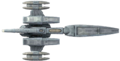 Kumari (dorsal view)
 -
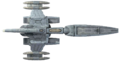 Kumari (ventral)
 -
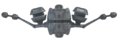 Kumari (bow)
 -
 Kumari (stern)
 -
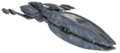 Kumari (starboard bow)
 -
 Kumari providing orbital security for Andor.
 -
 Two Kumaris on defense patrol
 -
 An Andorian task force, led by a Kumari
 -
 A post-war pass-in-review
.png)
.png)
.png)
.png)
.png)


Star Fleet Registry
- USS (NCC-05)
- USS (NCC-12)
- USS Atlirith (NCC-18)
- USS (NCC-49)
- USS (NCC-53)
- USS (NCC-54)
- USS (NCC-59)
- USS (NCC-67)
- USS (NCC-69)
- USS (NCC-99)
- USS (NCC-118)
- USS (NCC-119)
- USS (NCC-131)
- USS (NCC-134)
- USS (NCC-144)
- USS (NCC-152)
- USS (NCC-163)
- USS (NCC-170)
- USS (NCC-183)
- USS (NCC-190)
- USS (NCC-191)
- USS (NCC-218)
- USS (NCC-220)
- USS (NCC-224)
- USS (NCC-239)
- USS (NCC-243)
- USS (NCC-255)
- USS Docana (NCC-265)
- USS (NCC-268)
- USS (NCC-280)
- USS (NCC-286)
- USS (NCC-287)
- USS Thelasa-vei (NCC-291)
- USS (NCC-296)
- USS (NCC-298)
- USS Vol'Rala (NCC-316)
- USS (NCC-333)
- USS (NCC-341)
- USS (NCC-348)
- USS Vinakthen (NCC-349)
- USS (NCC-365)
Alt Sources
External Sources
Notes
- All ASDF comments were changed to "Andorian Imperial Guard".
- The prefix "USS" has been changed to "IGW" for warships of the Andorian Imperial Guard.
- The final paragraph's mention of the Kumaris performing the new UFP Star Fleet's strike role has been changed to "defense".
- This class served an early important role in defense of the Federation. One plus "several units" were lost outside of the war and I'm working from the assumption that "several" more were lost in combat with the Romulans, leading me to have 46 survive to the founding of the UFP. Of these, I'm presuming five remained for the AIG, allowing 41 to join the UFP Star Fleet, operating as battle cruisers and registered in the standard NCC range.
- The infobox must still be updated with Timo's named ships (only). (Remove this entire line when complete.)