Guide:Belknap/Impervious/Excel: Difference between revisions
No edit summary |
No edit summary |
||
| (16 intermediate revisions by the same user not shown) | |||
| Line 4: | Line 4: | ||
|category= strike cruiser | |category= strike cruiser | ||
|years= [[2270]]-[[2355]]<br> | |years= [[2270]]-[[2355]]<br> | ||
* ''USS Decatur'': [[2270]] - [[ | * ''USS Decatur'': [[2270]] - [[2330]] | ||
* ''Belknap'': [[2273]] - [[ | * ''Belknap'': [[2273]] - [[2335]] | ||
* ''Impervious'': [[2283]] - [[ | * ''Impervious'': [[2283]] - [[2356]] | ||
* ''Excel'': [[2293]] - [[ | * ''Raan'': [[2288]] - [[2335]] | ||
* ''Excel'': [[2293]] - [[2338]] | |||
|constructed= 38<br> | |constructed= 38<br> | ||
* ''USS Decatur'': (built [[2268]] - [[2270]]) | * ''USS Decatur'': (built [[2268]] - [[2270]]) | ||
* ''Belknap'': 27 (built [[2270]] - [[2280]]) | * ''Belknap'': 27 (built [[2270]] - [[2280]]) | ||
* ''Impervious'': 7 (built [[2281]] - [[2285]]) | * ''Impervious'': 7 (built [[2281]] - [[2285]]) | ||
* ''Raan'': 2 (converted ''Belknaps'' [[2287]] - [[2288]] | |||
* ''Excel'': 4 (built [[2291]] - [[2294]]) | * ''Excel'': 4 (built [[2291]] - [[2294]]) | ||
|length= 290.0 m | |length= 290.0 m | ||
|beam= <br> | |beam= <br> | ||
* ''USS Decatur'': 137.8 m | * ''USS Decatur'': 137.8 m | ||
* ''Belknap / Impervious / Excel'': 141.7 m | * ''Belknap / Impervious / Raan / Excel'': 141.7 m | ||
|height= <br> | |height= <br> | ||
* ''USS Decatur'', ''Belknap'': 67.5 m | * ''USS Decatur'', ''Belknap'', ''Raan'': 67.5 m | ||
* ''Impervious, Excel'': 66.2 m | * ''Impervious, Excel'': 66.2 m | ||
|mass= <br> | |mass= <br> | ||
| Line 24: | Line 26: | ||
* ''Belknap'': 787,000 mt | * ''Belknap'': 787,000 mt | ||
* ''Impervious'': 785,800 mt | * ''Impervious'': 785,800 mt | ||
* ''Raan'': 793,000 mt | |||
* ''Excel'': 788,100 mt | * ''Excel'': 788,100 mt | ||
|cruisespeed= w 8.0 | |cruisespeed= w 8.0 | ||
|towspeed= | |towspeed= | ||
|maxspeed= w 12.0 | |maxspeed= <br> | ||
|endurance= 5 years | * ''Belknap / Impervious / Excel'': w 12.0 | ||
* ''Raan'': w 13.0 | |||
|endurance= <br> | |||
* ''Belknap / Impervious / Excel'': 5 years | |||
* ''Raan'': 4 years | |||
|officers= <br> | |officers= <br> | ||
* ''USS Decatur'': 49 | |||
* ''Belknap'': 55 | * ''Belknap'': 55 | ||
* ''Impervious, Excel'': 53 | * ''Impervious, Excel'': 53 | ||
* ''Raan'': 57 | |||
|enlisted= <br> | |enlisted= <br> | ||
* ''USS Decatur'': 277 | |||
* ''Belknap'': 340 | * ''Belknap'': 340 | ||
* ''Impervious, Excel'': 328 | * ''Impervious, Excel'': 328 | ||
* ''Raan'': 353 | |||
|troops= | |troops= | ||
|passengers= | |passengers= | ||
| Line 45: | Line 56: | ||
* 1x phaser '''VI''' emitter (atop connecting neck) | * 1x phaser '''VI''' emitter (atop connecting neck) | ||
* 2x phaser VII emitters (twin bank) (ventral secondary hull) | * 2x phaser VII emitters (twin bank) (ventral secondary hull) | ||
<u> | <u>''Raan''</u> | ||
* 12x phaser VII emitters (twin banks) (primary hull) | * 12x phaser VII emitters (twin banks) (primary hull) | ||
* 2x phaser VII emitters (twin bank) (atop connecting neck) | * 2x phaser VII emitters (twin bank) (atop connecting neck) | ||
| Line 52: | Line 63: | ||
<u>''Excel''</u> | <u>''Excel''</u> | ||
* 12x phaser VII emitters (twin banks) (primary hull) | * 12x phaser VII emitters (twin banks) (primary hull) | ||
* 4x phaser '''VI''' | * 4x phaser '''VI''' emitters (deflector module, atop connecting neck) | ||
* 2x phaser VII emitters (twin bank) (ventral secondary hull) | * 2x phaser VII emitters (twin bank) (ventral secondary hull) | ||
|missileweapons= <br> | |missileweapons= <br> | ||
| Line 107: | Line 118: | ||
The two Andorian [[Skar-Rat]] Mk 7 torpedo launchers in the new assembly rivaled the firepower of the six-tube batteries carried by the previous generation of major combatants. With the latest speed‑loader technology and a radically improved warhead design that produced far greater destructive yield from less reactant mass, they were regarded as an adequate answer to the previously unsettling [[Klingon]] superiority in torpedo weaponry. Each torpedo was still individually weaker than its massive Klingon counterpart, but rate of fire adequately compensated for that. Star Fleet had its sights set on even more powerful systems and officially classified the new cruiser torpedo systems as "medium" weapons. | The two Andorian [[Skar-Rat]] Mk 7 torpedo launchers in the new assembly rivaled the firepower of the six-tube batteries carried by the previous generation of major combatants. With the latest speed‑loader technology and a radically improved warhead design that produced far greater destructive yield from less reactant mass, they were regarded as an adequate answer to the previously unsettling [[Klingon]] superiority in torpedo weaponry. Each torpedo was still individually weaker than its massive Klingon counterpart, but rate of fire adequately compensated for that. Star Fleet had its sights set on even more powerful systems and officially classified the new cruiser torpedo systems as "medium" weapons. | ||
The ''Decatur'' proved a technical and operational success, but plans were already in motion for a growth version. ''USS Belknap'' was finished with a far more extensive redesign of the standard saucer, adding almost four meters to the saucer radius in form of a new layer of circumferential structures. Also, an improved navigational deflector was chosen, and phaser armament slightly reconfigured. During the test runs, the report on the maiden voyage of the [[Guide: Constitution refit|refitted ''Constitution'']] cruiser ''Enterprise'' (NCC-1701) prompted Star Fleet to install secondary power options to the phasers of all cruisers and strike cruisers, even though warp power tapping was still retained as the principal powering mode. The ''Belknap'' and her later sisters were fitted with secondary power circuits and additional EPS nodes to support these systems. As a result of these alterations, the ships’ gross weight increased to 787,000 tons. Many of the design details were shared with the ''Constitution'' upgrade and the ''[[Guide:Avenger|Avenger]]'' heavy frigate programs, creating a high degree of commonality. | The ''Decatur'' proved a technical and operational success, but plans were already in motion for a growth version. ''USS Belknap'' was finished with a far more extensive redesign of the standard saucer, adding almost four meters to the saucer radius in form of a new layer of circumferential structures. Also, an improved navigational deflector was chosen, and phaser armament slightly reconfigured. During the test runs, the report on the maiden voyage of the [[Guide: Constitution (refit)|refitted ''Constitution'']] cruiser ''Enterprise'' (NCC-1701) prompted Star Fleet to install secondary power options to the phasers of all cruisers and strike cruisers, even though warp power tapping was still retained as the principal powering mode. The ''Belknap'' and her later sisters were fitted with secondary power circuits and additional EPS nodes to support these systems. As a result of these alterations, the ships’ gross weight increased to 787,000 tons. Many of the design details were shared with the ''Constitution'' upgrade and the ''[[Guide:Avenger|Avenger]]'' heavy frigate programs, creating a high degree of commonality. | ||
Between [[2270]] and [[2284]], as many as 27 ships of the ''Belknap'' class, in three main production batches, were completed for deep space combat duties; only one of the planned 28 units was left unfinished in favor of Space Control Ship procurement. Four of the ships were later reassigned from general combat to the [[TacFleet]] special force, receiving an improved sensor countermeasures suite and, in the case of the ''Raan'' (NCC-2519) and the ''Sur Cha'' (NCC-2541), also the high dash speed [[LN-68]] engines. Their dual role as perimeter fleet anchors and special interdiction units often carried them deep into enemy territory, warranting the reinforcement of their defenses with an aft dorsal phaser VII double bank. | Between [[2270]] and [[2284]], as many as 27 ships of the ''Belknap'' class, in three main production batches, were completed for deep space combat duties; only one of the planned 28 units was left unfinished in favor of Space Control Ship procurement. Four of the ships were later reassigned from general combat to the [[TacFleet]] special force, receiving an improved sensor countermeasures suite and, in the case of the ''Raan'' (NCC-2519) and the ''Sur Cha'' (NCC-2541), also the high dash speed [[LN-68]] engines. Their dual role as perimeter fleet anchors and special interdiction units often carried them deep into enemy territory, warranting the reinforcement of their defenses with an aft dorsal phaser VII double bank. | ||
| Line 132: | Line 143: | ||
<gallery> | <gallery> | ||
File:Belknap (stbd).png | File:Decatur (stbd).png | ''USS Decatur'' (prototype) | ||
File:Decatur (bow).png | |||
File:Decatur (dorsal).png | |||
File:Decatur (stern).png | |||
File:Belknap (stbd).png| ''Belknap'' | |||
File:Belknap (bow).png | File:Belknap (bow).png | ||
File:Belknap (dorsal).png | File:Belknap (dorsal).png | ||
File:Belknap (stern).png | File:Belknap (stern).png | ||
File:Belknap (ventral).png | |||
File:Impervious (bow).png| ''Impervious'' subclass | |||
File:Impervious (dorsal).jpg | |||
File:Impervious (stern).png | |||
File:Impervious (ventral).jpg | |||
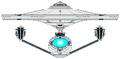
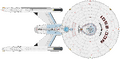
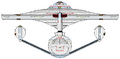
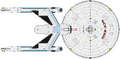
File:Raan (stbd).png| ''Raan'' subclass | |||
File:Raan (bow).png | |||
File:Raan (dorsal).png | |||
File:Raan (stern).png | |||
File:Raan (ventral).png | |||
File:Excel (bow).png| ''Excel'' subclass | |||
File:Excel (dorsal).jpg | |||
File:Excel (stern).png | |||
File:Excel (ventral).jpg | |||
File:Belknap (2-view).png|2-view | File:Belknap (2-view).png|2-view | ||
| Line 143: | Line 176: | ||
==Notes== | ==Notes== | ||
* Timo mentions there are "24 remaining ship" following the decommissioning of twelve ''Belknaps'' (and the inactivation of 14 ''Belknaps'' and 8 ''Imperviouses''). These 24 ships are "returned to service". As there are 38 ships in the overall class produced, for there to be 24 remaining, then the decommissioned ships must have come from the 20 that were inactivated. With the self-destruction of ''USS Aveley'' and the trainee status of ''USS Decatur'', that would account for the 24 hulls. | * Timo mentions there are "24 remaining ship" following the decommissioning of twelve ''Belknaps'' (and the inactivation of 14 ''Belknaps'' and 8 ''Imperviouses''). These 24 ships are "returned to service". As there are 38 ships in the overall class produced, for there to be 24 remaining, then the decommissioned ships must have come from the 20 that were inactivated. With the self-destruction of ''USS Aveley'' and the trainee status of ''USS Decatur'', that would account for the 24 hulls. | ||
* The exact decommissioning years for each of the subclasses is randomly assigned in the [[2330s]]. The final ''Impervious'' was decommissioned in [[2336]], with the exception of the two that remained active as training vessels until [[2356]]. | |||
* By my methodology, the changes (internal and external) to ''USS Raan'' (NCC-2519) and ''USS Sur Cha'' (NCC-2541) warrant a separate subclass, which I'm arbitrarily naming after the ''Raan''. The generated specs were mine. | |||
==External Sources== | ==External Sources== | ||
| Line 149: | Line 186: | ||
* [https://fasaststcs.com/index.php/thefleets/united-federation-of-planets/star-fleet/belknap-class-x-strike-cruiser/ fasaststcs] | * [https://fasaststcs.com/index.php/thefleets/united-federation-of-planets/star-fleet/belknap-class-x-strike-cruiser/ fasaststcs] | ||
* [https://memory-beta.fandom.com/wiki/Decatur_class Memory Beta: "Decatur Class"] | * [https://memory-beta.fandom.com/wiki/Decatur_class Memory Beta: "Decatur Class"] | ||
* [[:File:Ships of the Star Fleet 2290-91 - Volume 1 - Cruisers & Frigates.pdf|''Ships of the Star Fleet 2290-91 - Volume 1 - Cruisers & Frigates'']] | |||
* [[:File:Starfleet Prototype 2291 to 2292 2e.pdf|Starfleet Protoype 2291-2292]], p 74 | * [[:File:Starfleet Prototype 2291 to 2292 2e.pdf|Starfleet Protoype 2291-2292]], p 74 | ||
* [http://www.ussalbion.co.uk/belknap.html USSAlbion] | * [http://www.ussalbion.co.uk/belknap.html USSAlbion] | ||
Latest revision as of 13:32, 2 October 2025
.png)
| |
| Belknap / Impervious / Excel | |
|---|---|
| Class Overview | |
| Category | strike cruiser |
| Operational | 2270-2355 |
| Constructed | 38 |
| Dimensions | |
| Length | 290.0 m |
| Beam |
|
| Height |
|
| Mass |
|
| Performance | |
| Cruise Speed | w 8.0 |
| Max Speed |
|
| Endurance |
|
| Complement | |
| Officers |
|
| Enlisted |
|
| Tactical Systems | |
| Beam Weapons | Belknap, Impervious
Raan
Excel
|
| Missile Weapons |
|
| Shields |
|
| Laboratories |
|
| Transporters |
|
| Auxiliary Craft |
|
| Historical | |
| Ships of Note |
|
| Canonicity | |
| Design | SotSF |
| Name | SotSF |
| History | SotSF
|
Background: Hobbyist's Guide

The invention of the linear warp coil technology was swiftly and inevitably followed by the decision to create a brand new ship class, optimized to utilize the propulsive breakthrough. Since extensive refit programs for heavy frigates and heavy cruisers had been formulated already, the new class was given a specific mission outside the mission parameters of these refit designs. Despite the relative peace, Star Fleet pressed for the fielding of so-called strike cruisers to provide a dedicated fast attack type for the fleet. The ship type, formerly also called attack cruiser, would enjoy the defensive and offensive capabilities of heavy cruisers, but sacrifice endurance and exploration capacity for higher cruise speed. Indeed, the linear LN-64 engines would be taken to their extreme limits to provide a cruise speed of warp 8, sustainable until fuel exhaustion. Maximum speed would still be limited to brief bursts of warp 12, the same as with the refitted heavy cruisers.
The program was launched with the construction of USS Decatur, a 771,000 ton strike cruiser with heavy phaser and torpedo armament. While many systems were revolutionary to say the least, the basic spaceframe borrowed from existing designs, utilizing a modified Type-1D primary hull confiscated from the Pompey destroyer modernization program, and the secondary hull structural frame of a Constitution structural integrity testbed. The gray thermocoat finish that until then had been applied on all Star Fleet designs was omitted; instead, the hull was plated with ceramic material functioning as thermocoat by itself, and the deflector grid, the field stabilization crystal, and other hull surface detail were left exposed.*
The bridge and sensor bulge were more advanced—if less streamlined—designs than their earlier counterparts. Internally, the saucer was extensively reworked and the number of available phaser system berths increased from three to six, much as with the recent heavy frigate up-gunning program. Twelve phaser VII emitters in twin-bank mounts were installed there, and plasma conduits were drawn directly from the main powerplant, which consisted of a series of magnetic bottles inside the dorsal connector and the secondary hull. This setup replaced the multilinear bottles traditional for this size of vessels and familiar from the Constitution or Federation designs. Power was provided for the new FIE-4 impulse deck with RSL series engines and for the CWD LN-64 advanced warp nacelles, mounted on triangular pylons extending from the bottom of the secondary hull.
To prepare for emergencies, the novel and untested power system was fitted with redundant failsafes. The whole pylon/nacelle assembly could be jettisoned, the vertical m/am core as well as the antimatter pods ejected, and finally the saucer separated from the engineering hull.
The ship was fitted with modern, never previously fielded fire control and navigation suites and forcefield generators. Major pieces of new hardware also included an oval, enclosed-design navigational sensor/deflector array and a torpedo deck located at the stem of the connecting neck instead of the primary hull. Also included were multiple docking ports and airlocks, reducing strain on the shuttlebay, which now incorporated an atmosphere-holding forcefield in addition to mechanical pressure doors.
The two Andorian Skar-Rat Mk 7 torpedo launchers in the new assembly rivaled the firepower of the six-tube batteries carried by the previous generation of major combatants. With the latest speed‑loader technology and a radically improved warhead design that produced far greater destructive yield from less reactant mass, they were regarded as an adequate answer to the previously unsettling Klingon superiority in torpedo weaponry. Each torpedo was still individually weaker than its massive Klingon counterpart, but rate of fire adequately compensated for that. Star Fleet had its sights set on even more powerful systems and officially classified the new cruiser torpedo systems as "medium" weapons.
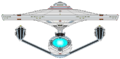
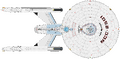
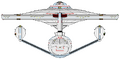
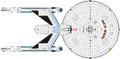
The Decatur proved a technical and operational success, but plans were already in motion for a growth version. USS Belknap was finished with a far more extensive redesign of the standard saucer, adding almost four meters to the saucer radius in form of a new layer of circumferential structures. Also, an improved navigational deflector was chosen, and phaser armament slightly reconfigured. During the test runs, the report on the maiden voyage of the refitted Constitution cruiser Enterprise (NCC-1701) prompted Star Fleet to install secondary power options to the phasers of all cruisers and strike cruisers, even though warp power tapping was still retained as the principal powering mode. The Belknap and her later sisters were fitted with secondary power circuits and additional EPS nodes to support these systems. As a result of these alterations, the ships’ gross weight increased to 787,000 tons. Many of the design details were shared with the Constitution upgrade and the Avenger heavy frigate programs, creating a high degree of commonality.
Between 2270 and 2284, as many as 27 ships of the Belknap class, in three main production batches, were completed for deep space combat duties; only one of the planned 28 units was left unfinished in favor of Space Control Ship procurement. Four of the ships were later reassigned from general combat to the TacFleet special force, receiving an improved sensor countermeasures suite and, in the case of the Raan (NCC-2519) and the Sur Cha (NCC-2541), also the high dash speed LN-68 engines. Their dual role as perimeter fleet anchors and special interdiction units often carried them deep into enemy territory, warranting the reinforcement of their defenses with an aft dorsal phaser VII double bank.
USS Decatur was also included in the class despite design differences, and mainly utilized as a training vessel, a situation parallel to the fate of for example USS Republic of Constitution class. The rest of the Belknaps, along with the small but growing selection of modern destroyer-type ships, formed the military-offensive strongback of Star Fleet, and freed multi-purpose cruisers for exploration and frigates for defense and law enforcement duties. In the oft-practiced but seldom performed planetary assault role, the strike cruisers were in turn accompanied by through-deck cruisers, carriers, and strike frigates.
But even this degree of escalation was not enough for the new leadership of Star Fleet. Post-V’Ger doctrines of border control required heavy defensive firepower. The abortive Federation class dreadnought upgrade program failed to provide it; the program was thus superseded with a project utilizing Belknap components, resulting in the Ascension class of dreadnoughts. Ten ships were built beginning in 2278, and featured a third warp nacelle mounted atop the secondary hull for increased endurance in high-warp operations. This class is described later in a separate entry.
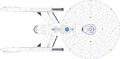
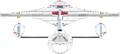
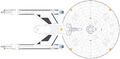
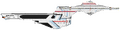
Later changes in Star Fleet doctrine adapted the dreadnoughts for offensive warfare to boost the 1600-starship initiative of Commissioner Valdemar in the 2280s. Further classes of strike cruisers were also planned for offensive action; the Impervious subclass of slightly improved Belknap design increased the number of strike cruisers by ten. The jettison-able pylon assembly of the Belknaps was replaced by a simpler and more affordable fixed horizontal pylon system, and the secondary hull structure simplified in other ways as well. Crew requirements were slightly diminished, yet mission equipment remained largely common with the earlier type. The Imperviouses were followed by four ships of the practically identical Excel subclass before production was aborted due to Khitomer treaty cutbacks.
The peace did not come easily for the strike cruisers. Only minutes after the attempt at UFP President Ra-ghoratreii’s life at Khitomer, strike cruiser Aveley (NCC-2543) and her two destroyer escorts, USS Iron Sentry and USS Masterton, moved into Klingon space according to their covert orders. Their aim was to level a Klingon garrison world near the border and then regroup with other strike teams for a deep plunge into the Empire. Fifty minutes into the mission, the Aveley was intercepted by the cruisers Canopus (NCC-1814) and Hornet (NCC-1714), loyal to the President. In the ensuing battle, the cruisers managed to collapse the shields of the Aveley and damage her drive systems. An onboard explosion, later judged to be the result of deliberate self-destruct, then ripped the strike cruiser in half and killed 287 of her crew, including Capt. Elijah Heinrichs and his senior officers. A hundred people were saved by the efforts of the Canopus and the border patrol cruiser IKV M’Kogh. The two destroyers capitulated, returning to Federation space.
Two similar strike attempts were cut short when the first officers of the leading cruisers took command from their captains. The dreadnought Minsk was prevented from proceeding with the attack through sabotage conducted by her engineering crew, later decorated for their actions.
After the Khitomer conference, Star Fleet immediately deactivated 14 of the Belknaps and 8 of the Imperviouses, along with most of the surviving destroyers and dreadnoughts and other offensive-mission starships. Twelve Belknaps and all ten Ascensions were decommissioned and scrapped soon thereafter; Star Fleet was obligated to dismantle a certain number of its largest starships, and the strike cruisers and dreadnoughts were a suitable sacrifice, as the overtly combat-oriented sensory and analysis systems aboard the vessels were found to be quite unsuitable for supporting exploratory missions. The 24 remaining ships returned to service in defense duties until the 2330s, when the large numbers of Excelsior-class ships, with superior range and firepower, took over. Two Belknaps, USS Ki Rin (NCC-2539) and USS Cicala (NCC-2540), continued in a general training role until the late 2350s, while the other vessels were mothballed.
The surviving strike cruisers are still theoretically kept in reserve, but the serviceability of their extremely complex powerplants is suspect, and none were reactivated even at the height of the Dominion War. Twelve Belknaps have also been partially cannibalized for spare parts to Miranda class vessels.
* In contrast, the heretofore so distinctive subspace antennas were covered by the duonetically transparent ceramic coating. In his 2314 memoirs, the prominent Klingon Imperial Intelligence strongman K’tagh s.o. Kraton relates to an early confusion in predicting the completion dates of Belknaps, refitted Constitutions and other modern starships – operatives kept on reporting that the ships were in early stages of fitting the mission equipment, since even the subspace communicators were still missing!
Gallery
-
 USS Decatur (prototype)
 -
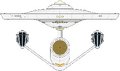
-
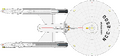
-
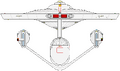
-
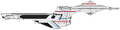 Belknap
 -
-
-
-
-
 Impervious subclass
 -
-
-
-
 Raan subclass
 -
-
-
-
-
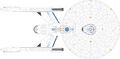
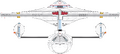
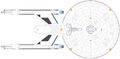
 Excel subclass
 -
-
-
-
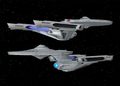 2-view
.png)
.png)
.png)
.png)
.png)
.png)
.png)
.png)
.png)
.jpg)
.png)
.jpg)
.png)
.png)
.png)
.png)
.png)
.png)
.jpg)
.png)
.jpg)
.png)
Notes
- Timo mentions there are "24 remaining ship" following the decommissioning of twelve Belknaps (and the inactivation of 14 Belknaps and 8 Imperviouses). These 24 ships are "returned to service". As there are 38 ships in the overall class produced, for there to be 24 remaining, then the decommissioned ships must have come from the 20 that were inactivated. With the self-destruction of USS Aveley and the trainee status of USS Decatur, that would account for the 24 hulls.
- The exact decommissioning years for each of the subclasses is randomly assigned in the 2330s. The final Impervious was decommissioned in 2336, with the exception of the two that remained active as training vessels until 2356.
- By my methodology, the changes (internal and external) to USS Raan (NCC-2519) and USS Sur Cha (NCC-2541) warrant a separate subclass, which I'm arbitrarily naming after the Raan. The generated specs were mine.
External Sources
- Cygnus-X1: "U.S.S. Belknap NCC-2501"
- Expanded Universe: "Belknap class"
- fasaststcs
- Memory Beta: "Decatur Class"
- Ships of the Star Fleet 2290-91 - Volume 1 - Cruisers & Frigates
- Starfleet Protoype 2291-2292, p 74
- USSAlbion