Guide:Athens: Difference between revisions
No edit summary |
|||
| (7 intermediate revisions by the same user not shown) | |||
| Line 1: | Line 1: | ||
{{Sidebar Guide ship | {{Sidebar Guide ship | ||
|image=[[File: | |image=[[File:Sarajevo (line).png|250px|Athens class courier/scout]] | ||
|classname= Athens | |classname= Athens | ||
|category= courier/scout | |category= courier/scout | ||
|years= [[ | |years= [[2138]] - [[2179]] | ||
|constructed= 22 | |constructed= 22 | ||
|length= 68.0 m | |length= 68.0 m | ||
|beam= 62.8 m | |beam= 62.8 m | ||
|height= 19.4 m | |height= 19.4 m | ||
|mass= 13,500 | |mass= 13,500 mt (original) <br> | ||
13,250 | 13,250 mt (refit) | ||
|cruisespeed= | |cruisespeed= | ||
|maxspeed= w 2.0 | |maxspeed= w 2.0 | ||
| Line 29: | Line 29: | ||
|missileweapons= | |missileweapons= | ||
|otherweapons= | |otherweapons= | ||
|shields= | |shields= polarizable armor | ||
|labs= | |labs= | ||
|transporters= | |transporters= none (original)<br> | ||
1x GP (1-pad); Mk I (refit [[2153]]) | |||
|auxcraft= | |auxcraft= | ||
|historicalships= <br> | |historicalships= <br> | ||
* '' | * ''UESS Athens'' | ||
* ''UESS Sapporo'' (NO-21) | * ''UESS Sapporo'' (NO-21) | ||
* ''UESS Sarajevo'' | * ''UESS Sarajevo'' | ||
|design= ENT / John Eaves | |design= ENT / John Eaves | ||
|name= | |name= Timo | ||
|history= | |history= Timo | ||
}} | }} | ||
With the advent of [[Earth]]’s independent interstellar defensive capability, the [[UESF]] found itself needing | ==Background: ''Hobbyist's Guide''== | ||
a whole range of support vessels it had not thought of before. Most of the defenses were tied in | With the advent of [[Earth]]’s independent interstellar defensive capability, the [[UESF]] found itself needing a whole range of support vessels it had not thought of before. Most of the defenses were tied in place, consisting of virtually immobile systems such as planetary interceptor bases, orbital battlestations or, later on, space tanks. Such forces could be deployed at Earth’s off-system holdings only via the introduction of new kinds of military transport. Even within the [[Sol]] system, they needed more mobile support assets for replenishment, scouting, and liaison. | ||
place, consisting of virtually immobile systems such as planetary interceptor bases, orbital | |||
battlestations or, later on, space tanks. Such forces could be deployed at Earth’s off-system holdings | |||
only via the introduction of new kinds of military transport. Even within the [[Sol]] system, they | |||
needed more mobile support assets for replenishment, scouting and liaison. | |||
Issues of prestige and cost prevented Starfleet from completely relying on conversions of foreign | Issues of prestige and cost prevented [[Starfleet]] from completely relying on conversions of foreign designs. On the other hand, as the UESF expertise on combat systems and tactics remained modest, it was not completely clear what sort of support vessel program should receive Earth’s limited funds and resources. Playing it safe, the first indigenous construction programs concentrated on generic missions, such as the all-important in-system/near-system liaison. Among the very first support vessels to accompany the ''[[Guide: Djartanna|Djartanna]]'', ''[[Guide: Ganges|Ganges]]'', and ''[[Guide: Triton|Triton]]'' forces were fast couriers and scouts of '''''Athens''''' class, first introduced in [[2138]]. | ||
designs. On the other hand, as UESF expertise on combat systems and tactics remained modest, it | |||
was not completely clear what sort of support vessel program should receive Earth’s limited funds | |||
and resources. Playing it safe, the first indigenous construction programs concentrated on generic | |||
missions, such as the all-important in-system/near-system liaison. Among the very first support | |||
vessels to accompany the ''[[Guide: Djartanna|Djartanna]]'', ''[[Guide: Ganges|Ganges]]'' and ''[[Guide: Triton|Triton]]'' forces were fast couriers and scouts of | |||
'''''Athens''''' class, first introduced in [[ | |||
The two-deck, aerodynamic hull of the ''Athens'' (NO-12) was a typical Earth engineering solution, | The two-deck, aerodynamic hull of the ''Athens'' (NO-12) was a typical Earth engineering solution, courtesy of [[Empress SD&B]] of [[Luna]]. Less traditional were choices of propulsive system positioning. Making use of the novel gravitically-polarizable armor, the ''Athens'' sought maximum protection of onboard systems via complete physical encasement. Thus, the warp engines were shielded by armored lateral cowlings, and only had smallish, aft-facing field windows. Similarly covered were the three plasma cannon, hiding behind armored gunports until deployed for firing. Such engineering solutions naturally limited the performance of the systems thus encased. Yet with a powerful compression fusion powerplant combined with careful internal shielding, the ''Athens'' could reach warp 2.0, and thus was cleared for the all-important mission of crossing interstellar distances. | ||
courtesy of [[Empress SD&B]] of [[Luna]]. Less traditional were choices of propulsive system | |||
positioning. Making use of the novel gravitically polarizable armor, the ''Athens'' sought maximum | |||
protection of onboard systems via complete physical encasement. Thus, the warp engines were | |||
shielded by armored lateral cowlings, and only had smallish, aft-facing field windows. Similarly | |||
covered were the three plasma cannon, hiding behind armored gunports until deployed for firing. | |||
Such engineering solutions naturally limited the performance of the systems thus encased. Yet with | |||
a powerful compression fusion powerplant combined with careful internal shielding, the ''Athens'' | |||
could reach warp 2.0, and thus was cleared for the all-important mission of crossing interstellar | |||
distances. | |||
Out-system errands in support of cruiser missions demanded more than mere speed, of course. | Out-system errands in support of cruiser missions demanded more than mere speed, of course. Range was provided by sizable fuel tanks within the engine sponsons, leaving only select areas of the midhull for habitation. Main habitat functions were in the three-deck dorsal "sail" structure, whose two upper levels featured large panoramic viewports. The uppermost served a navigational function, forming the forward and side walls of the control bridge. The lower windows provided passenger comfort, surrounding a lounge/mess area ahead of main passenger cabins. In times of crisis, the area would be transformed into a command center from which other forces could be directed via powerful communications systems installed on the deck below. Some further passenger cabins could also be found on this level, these in turn convertible to cargo holds for priority shipments or to auxiliary analysis facilities for sig-int missions. Berthing for the 12 crew was within the main body of the vessel and tiny round portholes on the ceilings or floors had to suffice for | ||
Range was provided by sizable fuel tanks within the engine sponsons, leaving only select areas of | exterior view. More meaningful situational awareness was obtained with a ventrally-mounted sensor dome, a versatile installation measuring up to ''Ganges'' standards. | ||
the midhull for habitation. Main habitat functions were in the three-deck dorsal | |||
whose two upper levels featured large panoramic viewports. The uppermost served a navigational | |||
function, forming the forward and side walls of the control bridge. The lower windows provided passenger comfort, surrounding a lounge/mess area ahead of main passenger cabins. In times of | |||
crisis, the area would be transformed into a command center from which other forces could be | |||
directed via powerful communications systems installed on the deck below. Some further passenger | |||
cabins could also be found on this level, these in turn convertible to cargo holds for priority | |||
shipments | |||
the main body of the vessel | |||
exterior view. More meaningful situational awareness was obtained with a ventrally mounted sensor | |||
dome, a versatile installation measuring up to ''Ganges'' standards. | |||
[[File:Sarajevo & Enterprise.png|left|300px|thumb| | [[File:Sarajevo & Enterprise.png|left|300px|thumb|''UESS Sarajevo'' (NO-27) rendezvouses with ''UESS Enterprise'' (NX-01) on yet another mission crucial to [[Earth]] security—possibly a transfer of fresh fruit and other perishables, on short supply in deep space. Significantly faster than the majority of the [[UESF]] support fleet, the ''Athens'' couriers were often tasked with capital ship replenishment and personnel rotation in the early [[2150s]]. In scouting duty, they tried to pry the secrets of alien fleets through primitive sig-int measures, with limited success. The late [[2150s]] principally saw the ships serving as command and coordination vessels in the [[Romulan War]].]] | ||
of [[UESF]] support fleet, the ''Athens'' couriers were often tasked with capital ship replenishment and personnel rotation in the | |||
early [[2150s]]. In scouting duty, they tried to pry the secrets of alien fleets through primitive sig-int measures, with limited | |||
success. The late 2150s principally saw the ships serving as command and coordination vessels in the Romulan War.]] | |||
Taking an ''Athens'' down to a planetary surface was rather tricky, due to the considerable mass of the | Taking an ''Athens'' down to a planetary surface was rather tricky, due to the considerable mass of the interstellar-grade warp engines. The awkwardly positioned impulse engines, high up on the aft end of the lower sail deck, did not help any, and the RCS systems on the lower hull perimeter were hard-pressed to stabilize the vessel in side wind conditions. Still, trans-atmospheric operations were an essential part of UESF requirements. Although practical passenger capacity was limited to 10-20 people, depending on mission duration, the courier could be pressed to perform rapid personnel rotation in systems ill-equipped with lesser surface-to-orbit transports. Eight ships of the production run of 22 had their home ports on such colony systems, while the rest wore [[Sol]] colors but spent most of their time in deep space, up to a dozen lightyears away from Earth. | ||
interstellar-grade warp engines. The awkwardly positioned impulse engines, high up on the aft end | |||
of the lower sail deck, did not help any, and the RCS systems on lower hull perimeter were hard | |||
pressed to stabilize the vessel in side wind conditions. Still, trans-atmospheric operations were an | |||
essential part of UESF requirements. Although practical passenger capacity was limited to 10-20 | |||
people, depending on mission duration, the courier could be pressed to perform rapid personnel | |||
rotation in systems ill-equipped with lesser surface-to-orbit transports. Eight ships of the production | |||
run of 22 had their home ports on such colony systems, while the rest wore Sol colors but spent | |||
most of their time in deep space, up to a dozen lightyears away from Earth. | |||
The mid-2150s saw a partial refitting of the class with transporter systems and a phased particle | The mid-[[2150s]] saw a partial refitting of the class with transporter systems and a phased particle cannon. The former significantly lessened the strain of courier operations, as it negated the need for | ||
cannon. The former significantly lessened the strain of courier operations, as it negated the need for | trans-atmospheric flight. The latter hardly meant reassignment as first line combatants—but half a dozen ''Athens'' vessels still saw battle during the [[Romulan War]], typically in system defense situations. Four were lost in that conflict, although only three of them to a space duel; ''UESS Sapporo'' was blown to pieces in [[2159]] while powered down and docked to [[Spaceport Vega]]. A gradual withdrawing from service began during the war already, but colonial forces only gave up the last of their units in [[2179]]. | ||
trans-atmospheric flight. The latter hardly meant reassignment as first line | |||
dozen ''Athens'' vessels still saw battle during the Romulan War, typically in system defense | |||
situations. Four were lost in that conflict, although only three of them to a space duel; | |||
was blown to pieces in [[2159]] while powered down and docked to [[Spaceport Vega]]. A gradual withdrawing from service began during the war already, but colonial forces only gave up the last of | |||
their units in [[2179]] | |||
==Gallery== | ==Gallery== | ||
<gallery> | <gallery> | ||
File:Athens (beam).png|''Athens'' (beam) | |||
File:Athens (bow).png| ''Athens'' (bow) | File:Athens (bow).png| ''Athens'' (bow) | ||
File:Athens (dorsal).png| ''Athens'' (dorsal) | File:Athens (dorsal).png| ''Athens'' (dorsal) | ||
File:Athens (forward dorsal aspect).png| ''Athens'' (forward dorsal aspect) | File:Athens (forward dorsal aspect).png| ''Athens'' (forward dorsal aspect) | ||
File:Athens at warp.png| ''Athens'' at warp | File:Athens at warp.png| ''Athens'' at warp | ||
</gallery> | </gallery> | ||
==Notes== | |||
* The Jan 2017 update to ''Timo's Guide'' introduced the ''Athens'' class ten years earlier, though the narrative date was unchanged. The change was made here. | |||
* The [[Ship Prefixes|prefix]] "USS" has been changed to "UESS" for ships of the [[United Earth Starfleet]]. | |||
* The ''Athens'' class did not serve in the [[UFP Star Fleet]]. | |||
<br><br> | |||
---- | ---- | ||
* [[ | * [[Timo's Guide to Star Fleet|Back to the Table of Contents]] | ||
* [[Guide: Corvettes, Couriers, Escorts, Perimeter Ships & Light Scouts|Corvettes, Couriers, Escorts, Perimeter Ships & Light Scouts]] | * [[Guide: Corvettes, Couriers, Escorts, Perimeter Ships & Light Scouts|Corvettes, Couriers, Escorts, Perimeter Ships & Light Scouts]] | ||
* [[Guide: Of Ship Statistics|Appendix A: Of Ship Statistics]] | * [[Guide: Of Ship Statistics|Appendix A: Of Ship Statistics]] | ||
* [[Guide: Glossary|Appendix B: Glossary]] | * [[Guide: Glossary|Appendix B: Glossary]] | ||
* [[Guide: | * [[Guide: Star Fleet Organization - General Outline|Appendix C: Star Fleet Organization - General Outline]] | ||
* [[Guide: Abbreviations From Outside|Appendix D: Abbreviations From Outside]] | * [[Guide: Abbreviations From Outside|Appendix D: Abbreviations From Outside]] | ||
[[Category:Guide|{{PAGENAME}}]] | [[Category:Guide|{{PAGENAME}}]] | ||
Latest revision as of 15:08, 16 July 2023
.png)
| |
| Athens | |
|---|---|
| Class Overview | |
| Category | courier/scout |
| Operational | 2138 - 2179 |
| Constructed | 22 |
| Dimensions | |
| Length | 68.0 m |
| Beam | 62.8 m |
| Height | 19.4 m |
| Mass | 13,500 mt (original) 13,250 mt (refit) |
| Performance | |
| Max Speed | w 2.0 |
| Endurance | 3 months |
| Complement | |
| Officers | 2 (courier mission) 6 (scout mission) |
| Enlisted | 12 (courier mission) 16 (scout mission)
|
| Passengers | 10-20
|
| Tactical Systems | |
| Beam Weapons | Original
Refit (2153)
|
| Shields | polarizable armor |
| Transporters | none (original) 1x GP (1-pad); Mk I (refit 2153) |
| Historical | |
| Ships of Note |
|
| Canonicity | |
| Design | ENT / John Eaves |
| Name | Timo |
| History | Timo
|
Background: Hobbyist's Guide
With the advent of Earth’s independent interstellar defensive capability, the UESF found itself needing a whole range of support vessels it had not thought of before. Most of the defenses were tied in place, consisting of virtually immobile systems such as planetary interceptor bases, orbital battlestations or, later on, space tanks. Such forces could be deployed at Earth’s off-system holdings only via the introduction of new kinds of military transport. Even within the Sol system, they needed more mobile support assets for replenishment, scouting, and liaison.
Issues of prestige and cost prevented Starfleet from completely relying on conversions of foreign designs. On the other hand, as the UESF expertise on combat systems and tactics remained modest, it was not completely clear what sort of support vessel program should receive Earth’s limited funds and resources. Playing it safe, the first indigenous construction programs concentrated on generic missions, such as the all-important in-system/near-system liaison. Among the very first support vessels to accompany the Djartanna, Ganges, and Triton forces were fast couriers and scouts of Athens class, first introduced in 2138.
The two-deck, aerodynamic hull of the Athens (NO-12) was a typical Earth engineering solution, courtesy of Empress SD&B of Luna. Less traditional were choices of propulsive system positioning. Making use of the novel gravitically-polarizable armor, the Athens sought maximum protection of onboard systems via complete physical encasement. Thus, the warp engines were shielded by armored lateral cowlings, and only had smallish, aft-facing field windows. Similarly covered were the three plasma cannon, hiding behind armored gunports until deployed for firing. Such engineering solutions naturally limited the performance of the systems thus encased. Yet with a powerful compression fusion powerplant combined with careful internal shielding, the Athens could reach warp 2.0, and thus was cleared for the all-important mission of crossing interstellar distances.
Out-system errands in support of cruiser missions demanded more than mere speed, of course. Range was provided by sizable fuel tanks within the engine sponsons, leaving only select areas of the midhull for habitation. Main habitat functions were in the three-deck dorsal "sail" structure, whose two upper levels featured large panoramic viewports. The uppermost served a navigational function, forming the forward and side walls of the control bridge. The lower windows provided passenger comfort, surrounding a lounge/mess area ahead of main passenger cabins. In times of crisis, the area would be transformed into a command center from which other forces could be directed via powerful communications systems installed on the deck below. Some further passenger cabins could also be found on this level, these in turn convertible to cargo holds for priority shipments or to auxiliary analysis facilities for sig-int missions. Berthing for the 12 crew was within the main body of the vessel and tiny round portholes on the ceilings or floors had to suffice for exterior view. More meaningful situational awareness was obtained with a ventrally-mounted sensor dome, a versatile installation measuring up to Ganges standards.

Taking an Athens down to a planetary surface was rather tricky, due to the considerable mass of the interstellar-grade warp engines. The awkwardly positioned impulse engines, high up on the aft end of the lower sail deck, did not help any, and the RCS systems on the lower hull perimeter were hard-pressed to stabilize the vessel in side wind conditions. Still, trans-atmospheric operations were an essential part of UESF requirements. Although practical passenger capacity was limited to 10-20 people, depending on mission duration, the courier could be pressed to perform rapid personnel rotation in systems ill-equipped with lesser surface-to-orbit transports. Eight ships of the production run of 22 had their home ports on such colony systems, while the rest wore Sol colors but spent most of their time in deep space, up to a dozen lightyears away from Earth.
The mid-2150s saw a partial refitting of the class with transporter systems and a phased particle cannon. The former significantly lessened the strain of courier operations, as it negated the need for trans-atmospheric flight. The latter hardly meant reassignment as first line combatants—but half a dozen Athens vessels still saw battle during the Romulan War, typically in system defense situations. Four were lost in that conflict, although only three of them to a space duel; UESS Sapporo was blown to pieces in 2159 while powered down and docked to Spaceport Vega. A gradual withdrawing from service began during the war already, but colonial forces only gave up the last of their units in 2179.
Gallery
-
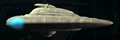 Athens (beam)
 -
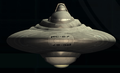 Athens (bow)
 -
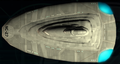 Athens (dorsal)
 -
 Athens (forward dorsal aspect)
 -
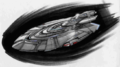 Athens at warp
.png)
.png)
.png)
.png)

Notes
- The Jan 2017 update to Timo's Guide introduced the Athens class ten years earlier, though the narrative date was unchanged. The change was made here.
- The prefix "USS" has been changed to "UESS" for ships of the United Earth Starfleet.
- The Athens class did not serve in the UFP Star Fleet.