Guide:Whirlwind
.png)
| |
| Whirlwind | |
|---|---|
| Class Overview | |
| Category | assault ship |
| Operational | 2250-2274 |
| Constructed | 40 (2248-2255) |
| Dimensions | |
| Length | 286.0 m |
| Beam | 54.2 m |
| Height | 22.9 m |
| Mass | 400,000 mt |
| Performance | |
| Cruise Speed | w 5 |
| Max Speed |
|
| Endurance | 2 years |
| Complement | |
| Officers | 24 |
| Enlisted | 276 |
| Troops | 1,000
|
| Cargo |
|
| Tactical Systems | |
| Beam Weapons | Original
2259 refit
|
| Missile Weapons | 2259 refit
|
| Shields |
|
| Laboratories | 1x medical/biology |
| Transporters |
|
| Auxiliary Craft |
|
| Historical | |
| Ships of Note |
|
| Canonicity | |
| Design | Daniel Biringer |
| Name | Daniel Biringer |
| History | own
|

Star Fleet’s efforts at upgrading its planetary assault capabilities continued in the 2250s. Even with the Aakenn heavy transport production at full swing, it was obvious that the mobility of Federation ground combat forces would remain limited by the lack of suitable transports. Two bottleneck criteria existed: sufficient speed of travel, and sufficient speed of unloading. Conventional thinking dictated that only a large transport could house the powerful warp engines and numerous assault barges required. However, there were many unconventional thinkers in the Fleet. In 2250, a sleek assault transport propelled by two relatively lightweight engines and carrying 28 modern and compact barges defied the expectations and gave a welcome boost to Star Fleet troop logistics.
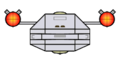
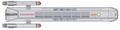
The Whirlwind (NCC-6000) relied on PB-45 for warp 5 cruise and warp 8 dash performance. Instead of the complex—if flexible—hull arrangements of the heavy Aakenns, she went for a simple baguette of hexagonal cross section, with the assault barge bays laid out along the upper flanks. A heavy defensive armament of five single 600 MW lasers, later Type IV phasers, was concentrated on bow and stern. So were the ship’s utilities: the forward end housed the bridge and command offices at Deck 1, an analysis center on Deck 2, assault planning offices on Deck 3, sensors, deflectors and port and starboard tractor beams on Deck 4, and a small gymnasium on Deck 5, while the aft end featured workshops on Deck 1, warp engineering on Deck 2, upper mess hall and recreation facilities on Deck 3, impulse engineering and auxiliary control on Deck 4, and lower mess hall on Deck 5.
The upper two decks of the long midsection housed the assault barge berths plus two general utility hangars for personnel and cargo shuttles. Internal cargo stowage was available next to the utility hangars, and was provided with two cargo transporters. Deck 3 forward end featured both a well-equipped hospital and a security complex that could hold 30 detainees, while the aft end offered an extensive training space or staging area, all of these ideally placed for direct access to the assault barge deck. Amidships there were fabrication facilities for the needs of the full two battalions that could be shipped. Deck 4 housed one of these battalions, along with the operating crew that included the barge pilots. Deck 5 housed another, in troop cabins of four triple bunks and officer/NCO cabins of one or two bunks. Ship’s stores on Deck 6 were served by two additional cargo transporters, and surrounded by a variety of support systems. There were no troop transporters, as the technology was not deemed suitable for first wave assault, the main task of this heavily armed and protected assault ship.
Crew fatigue in the cramped accommodations limited mission duration. Every attempt was made to alleviate the effects, and there were all sorts of amenities such as contemplation rooms with visicom systems, garden areas and variable-gee pools – all with alternate military training applications, of course. Similar measures aboard the much larger Aakenns had better odds of success, though, thanks to the sheer difference in legroom. The Whirlwinds were true to their name in having been designed to storm crisis spots at fastest possible reaction time. They could also cause some devastation of their own by mounting a ventral torpedo launcher for bombardment purposes. Yet they carried very little in terms of ground combat hardware, beyond what the troops themselves packed or what their TBL-4 light assault barges represented. No hoppers or rollers were typically shipped; some light flitters for command and liaison purposes could be beamed or shuttled down, but they provided no troop mobility. The barges could move the troops on the battlefield, but they were unavailable for general logistics roles then, and in any case unsuited for them. A Whirlwind battalion could not carry the battle alone, but absolutely required the material support of a more conventional cargo hauler.
A spearhead force of 40 Whirlwinds was nevertheless considered vital, and produced in full by 2255. Miranda, Surya and especially Coventry frigates were ideal escorts for Whirlwind formations, offering their own logistics shuttlecraft and heavy bombardment weaponry to the mix. By the 2260s, the transports had been upgraded with phasers, and all of them had received the ventral torpedo launcher as well; independent operations against hot spots now became a distinct possibility. On the other hand, conventional assault capabilities were boosted by the addition of grappler plates on the dorsal and ventral surfaces: some 90,000 tons of external load could be attached, resulting in reduced speed and endurance but allowing for meaningful battlefield logistics. Instead of the TBL-4 barges, the ships might now load up on Benares or Coronet hoppers in the berths and carry larger barges on the grapples, providing a new balance of equipment and tactics.
This forced versatility translated to extreme fatigue. By the 2270s, the fleet was rapidly approaching the limits of spaceworthiness, and mainly persisted because the follow-on Makin program of fast troop transports had met with delays. No re-engining was attempted, as a switch from PB-45 to the structurally compatible LN-61 or LN-23 would have meant a performance reduction. Nor was there much point in upgrading the weapons, as the ‘happy time’ when a Whirlwind had been a competent individual combatant was long over. Between 2270 and 2274, the ships were only given solo assignments to ‘lukewarm spots’, but did excel in such duty. On the other hand, several losses were suffered in the feline Xindi campaign; the remaining force was retired as soon as the Makin was perfected and fielded.
Gallery
-
 Whirlwind class
 -
-
.png)
.png)
Notes
- This craft relies on two vessels not detailed by Timo: the TBL-4 light assault barge and the Coronet hopper.
- Changed the text's external load from 60,000 mt to 90,000, to match the sidebar.