Guide:Sawyer
.png)
| |
| Sawyer | |
|---|---|
| Class Overview | |
| Category | light scout |
| Operational | 2238-2255 |
| Constructed | 30 |
| Dimensions | |
| Length | 79.0 m |
| Beam | 34.8 m |
| Height | 27.3 m |
| Mass |
|
| Performance | |
| Max Speed | w 6.0 |
| Endurance | 2 years |
| Complement | |
| Officers | 6 |
| Enlisted | 24
|
| Tactical Systems | |
| Beam Weapons | Production vessels:
|
| Shields |
|
| Laboratories | 1x GP |
| Transporters |
|
| Historical | |
| Ships of Note |
|
| Canonicity | |
| Design | SFC |
| Name | SFC |
| History | SFC, own
|
After the experimentation on dilithium foci aboard the Bonaventure was finished, Star Fleet finally
unleashed its designing and engineering teams on the production of a new wave of spaceships – or,
as the new name went, starships. The first series-produced m/am reactors with natural dilithium
reaction control were harnessed to power warp drives in 2238, aboard light scoutships of Sawyer
class.

USS Sawyer, NCC-I810, looked perhaps not so much like a starship as a stardrive let loose without a proper hull to accompany it. The two nearly 80 m long, 80,000 ton PB-36XD dilithium-compatible nacelles together far outbulked the rest of the ship, a narrow central body placed between the engines and joined to them with twin short pylons aft. The low-mounted forward pylons featured plasma feed lines from the revolutionary matter-antimatter reactor to the warp coils. The jettisonable reactor itself sat a couple of meters abaft of the pylons; sternmost, large dorsal loading hatches for fuel pods were flanked by the complex aft supports, which accommodated the impulse propulsion system. Major RCS functions were housed in the aft ends of the nacelles, along with a multiply redundant plasma purge system.
Forward of the reactor rode the payload of the vessel: a flight deck and habitat section for the 30 crew, and a bow compartment dedicated to advanced sensor gear. Some weaponry was later added to the design, in the form of 20 MW lasers above and below the central hull. At this early stage, there was no attempt to harness the power of the m/am reaction to energize the weapon systems, and high power lasers would have been too heavy a burden to the secondary power systems. Shielding of the ship was equally modest. Powerful shields would also have interfered with the sensor suite of the ship, which was not intended to be flown into battle anyway, and was eminently qualified to fly out of one if needed.
Initial propulsion tests were performed unmanned, and the prototype ship reached a staggering speed of warp 6.4 before the emergency limiters cut in. After a very brief manned test period, the ship was pressed into service and fourteen more ordered for the immediate scouting needs of the Federation. A year later, a further order for fifteen was made; while this did not yet fill the fast scout gap for good, at least it vastly improved the situation as regarded military data gathering. Even more importantly, adaptations of the high performance power system were fielded aboard other vessels, first on the Baton Rouges and later on other modern cruiser, frigate, destroyer and science vessel types. There was little hope of maintaining secrecy around the innovation, and in 2243 it was revealed that Klingons, too, possessed the new power source. Star Fleet still believed it had a slight technological lead, especially in translating the raw power of antimatter-excited plasma into useful weapons output – a technology that never saw applications aboard the Sawyer class.
The high performance scouts proved very useful in both reconnaissance and courier duties, taking over from the high-strung and high-fatigued Ariadnes. However, the inherent inflexibility of the specialized design meant that very narrow mission profiles were available. In 2241, during the Secession crisis, USS Gulliver (NCC-I824) was sent to assess the political situation in the Axanar system and became the first ship to succumb to the Klingon forces there. In 2250, USS Sindbad (NCC-I823) got the distinct honor of carrying President Varis to Axanar for the signing of the Rehabilitation Treaty, while in 2254, USS Ulysses (NCC-I814) proved that the Klingon threat had not receded by stumbling to an extensive attempt to influence Prime Directive-protected planets inside Federation territory.
By that time, however, the Sawyers were already so outdated that Star Fleet did not even see it fit to equip them with communication gear compatible with modern subspace transceivers. Duotronics were out of the question, as were phasers – in fact, nothing could be refitted into the cramped vessels without ripping out their entire infrastructure. Instead of attempting extensive modifications, Star Fleet promptly decommissioned and scrapped all the remaining scouts within fiscal year 2255. Instead of procuring a direct successor, it relegated the duties of the Sawyers to the new and capable category of larger vessels, of the Procyon/Centaurus type.
Gallery
-
 Sawyer (bow)
 -
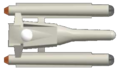 Dorsal
 -
 Stern
Stern -
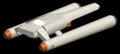 Starboard stern perspective
 -
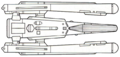 Schematic
.png)
.png)
.png)
.png)

External Sources
- Vintage Starships: "2242 – Sawyer": includes 3D views
Notes
- The Ariadne class is substituted for the referenced Frobisher class, due to the latter coming well after the Sawyer class. If a better ship class is identified, it may be changed.
- The loss of USS Gulliver has been changed from 2246 to the year 2241, per previous entries regarding the incident.
- Timo shows—but does not explain—that the Sawyers started off with "pure" hull numbers, before receiving their prefix-I. Not only does that not jibe with the chronological use of prefixes, but such a scheme would have it sharing hull numbers with the contemporaneous Sentinel & Armstrong cruisers. I've removed any mention of the numbers prefix-less.
References