Guide:Andor

| |
| Andor | |
|---|---|
| Class Overview | |
| Category | cruiser |
| Operational | 2270-2319 |
| Constructed | 14 (built 2267 - 2274) |
| Dimensions | |
| Length | 278.7 m |
| Beam | 139.4 m |
| Height | 56.9 m |
| Mass | 721,600 mt |
| Performance | |
| Cruise Speed | w 7.0 |
| Max Speed | w 9.0 |
| Endurance | 3 years |
| Complement | |
| Officers | 44 |
| Enlisted | 196 |
| Troops | 40
|
| Tactical Systems | |
| Beam Weapons |
|
| Missile Weapons |
|
| Shields |
|
| Laboratories | 1x GP |
| Transporters |
|
| Auxiliary Craft |
|
| Historical | |
| Ships of Note |
|
| Canonicity | |
| Design | FASA, Timo |
| Name | FASA |
| History | FASA
|
Background: Hobbyist's Guide
- Note: Though this did class not serve in Star Fleet, the Andorian-crewed vessels often drilled alongside and they were important cogs within the "eastern" defense doctrine.
As soon as Star Fleet had nominated the CWD LN-64 linear excitation engine for its newest large cruisers, a number of construction and upgrade programs featuring alternate engine types came under scrutiny. Plans on destroyer, heavy destroyer, and light cruiser modernization were put on ice; in absence of immediate military threats, it was felt reasonable to allow the linear engine technology to first prove itself aboard vessels that would be built in low numbers and with maximum commitment of R&D funds and effort.
However, although all was quiet on the Klingon front, developments in and around Romulan space alarmed the local UFP member worlds. After over a century of seeming hibernation, the old enemy was clearly stirring again. Actual military activities were limited to probing strikes at the moment—but wild rumors circulated of the development of polaric weapons, of manipulation of ion storms to nefarious purposes, of conspiracies, infiltrations, and fifth column activities. Star Fleet could hardly counter this sort of psychological warfare with deployment of conventional forces. Yet as Andoria at the time carried primary responsibility for defenses in this direction, the Blue Fleet insisted on maintaining maximum readiness.
This was not the true state of Andorian Guard at the beginning of the seventies. Organizational reshuffling following the Organian peace had scattered the various Star Fleet cruisers familiar in the Andorian region to exploratory errands. The AIG's Loknar frigate force was worn down from decades of service against the Klingons. The light Lenthal escorts were maxed out patrolling the space lanes important to Andoria, and the new & heftier Thufirs were just arriving in less-than-significant numbers. Ground forces had never before stood down to such a low level of readiness and the Chandley strike fleet was all but idled. Yet the AIG had a firm opinion on its preferred kind of battle and on the hardware needed to wage it. Since it enjoyed autonomy from the general Star Fleet budgetary framework, it was a relatively simple matter to initiate the domestic design and construction of a new cruiser, one optimized to cover the temporary weaknesses in the "Blue Shield".

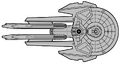
In classic Andorian style, the warp engines of the cruiser would be tucked in at ship centerline, aft of the primary hull, erecting a narrow yet robust propulsive field. Main powerplant, navigational deflector, and primary shield generator would be carried in a ventrally-mounted engineering hull. Lateral shield generator assemblies would further protect the drive system in a typically brazen head-on attack. To make this attack count, the cruiser would sport no fewer than four forward-firing Mk 7 torpedo tubes, two per a laterally-carried weapons pod. In addition, the pods featured single aft tubes plus an articulated launcher that would cover athwartship angles. Each fixed launcher would feature a large 30-shot magazine, each articulated one a ten-shot feeder. In rather sharp contrast, only one twin FH-13 Type VII phaser bank would be carried in the primary hull, a 114 meter saucer riding atop the framework of the lateral torpedo pods, the central engineering section and the trailing booms. Exhaust from the saucer trailing edge impulse engines would be licking the top surfaces of the warp nacelles; the Andorian obsession with head-on protection did not cater for thrust vectoring or high maneuverability.
Accommodation within the primary hull followed Andorian norms as well. Some 240 crew would be needed to operate the vessel, and a reinforced platoon of boarding troops was to be carried at all times. Six GP transporters would facilitate boarding action; a minimal shuttlebay at the secondary hull stern would not, since just two light shuttles could be carried. Plans were at one point made of mounting a larger secondary hull, from the standard stock of Constitution refits. As soon as it became evident that standardization was not to be a central feature of that refit project, such plans were shelved.
Despite the structural and conceptual uniqueness of the design, there was little difficulty in completing the inaugural duo of cruisers by early 2270. While propulsive trials kept IGW Andor fully employed till 2272, IGW Shran was already engaged in tactical exercises intended to establish the type as a core element in AIG squadrons. Production continued at a steady pace at all available Andorian yards, resulting in fourteen vessels completed by 2275. Such an arsenal restored AIG credibility at one stroke: an Andor would provide a standoff or warp-in "sucker punch" of torpedo volleys, followed by ruthless close combat and boarding action by her frigate or destroyer consorts. Romulan and also some Klingon interlopers were engaged, and even the heaviest opponents chose a swift retreat when thus confronted.
The major shortcoming of the Andor formations was their limited sensing and computing power. The antiquated Raakuv Ilus fire control system could handle the actual attack runs well enough, but tying it to the general battle management networks was problematic, and onboard sensors alone could not locate targets at tactically sufficient ranges. Furthermore, despite her central role in the formation, an Andor could hardly be considered a command cruiser: the crew was overworked with running the ship already and had no special command facilities or software in its possession.
Integration of Andors to battlefleets thus was a matter of intensive training and endless exercise and only achievable within the AIG framework. The vessels would have had difficulty finding a role in the far larger Star Fleet anyway, due to their low top speed of warp 9, inherent in the engine configuration. Combined with the almost total lack of exploration and research gear aboard, this confined the innovative combatants to a niche role—in which they served with distinction until the 2320s. Although collision-induced structural damage forced IGW Kathosth to be retired in 2282, no combat casualties were suffered, and an orderly retirement plan spanning fifteen years subsequently allowed the AIG to smoothly replace the Andors with modern cruiser units.
Gallery
-
 Andor missile cruiser
 -

-
-
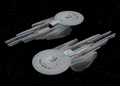 2-view
.png)
.png)
.png)
Notes
- All references to the ASDF have been changed to be the AIG.
- The weapon entries in the sidebars are modified to represent the deliberate loadout described by Timo in the text.
- Timo's specs had the class serving until 2336; however, his text has them serving "until the 2320s". I'm interpreting that as the final one was decommissioned in 2319 and I'm changing the sidebar to support.
- With only 13 ships to the class in the last 15 years of service, it stands to reason that the retirement of the ships occurred at the rate of less than one a year (starting in 2304).