Guide:Karekh
_(stbd).png)
| |
| Karekh | |
|---|---|
| Class Overview | |
| Category | prospector |
| Operational | 2261 - 2339 |
| Constructed | 125 |
| Dimensions | |
| Length | 35.0 m |
| Beam | 26.1 m |
| Height |
|
| Mass |
|
| Performance | |
| Cruise Speed | w 3.0 |
| Max Speed |
|
| Endurance | 1 year |
| Complement | |
| Crew |
|
| Tactical Systems | |
| Beam Weapons |
|
| Shields |
|
| Laboratories |
|
| Transporters | 1x GP (2-pad); Mk III |
| Historical | |
| Ships of Note |
|
| Canonicity | |
| Design | FASA |
| Name | FASA |
| History | FASA
|
Background: Hobbyist's Guide

When Star Fleet in 2259 launched the Prospecting And Reconnaissance Integrated Scoutcraft (PARIS) program, the blatantly spelled-out intent was to procure just a single type of craft for both resource hunting and military scouting. Yet the challenges of improving upon the performance of the Mission scoutcraft were quickly found too great and the conceptual dream of a warp 3/5+ light prospector gave way to mundane warp 3/4 reality. This was still an improvement over the Sulek family of prospecting vessels, and in 2260, Star Fleet agreed to bifurcating PARIS to the high-end Archer scouts and the Karekh series of prospectors.
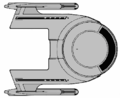
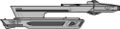
Karekh held on to some Mission concepts, such as low-slung, solid state nacelles trailing behind the center of aerodynamic lift, extremely lightweight hull construction, and a ventral hatch for effortless equipment loading and offloading. Internally, she was a prospector through and through, however: the two decks in the sleek, circular hull 19 meters in diameter were optimized for long term habitation for a multitasked crew of five to nine. Versatile analysis systems were compacted and automated so that the powerful L-14 computer could turn the single humble assay room into a university-standard laboratory.
Spinoff technology from the Archer program further improved on the basic capabilities. A modern Mk III transporter was something of a luxury item aboard the fully landing-capable vessel. A ventral garage just aft of the saucer hull, in the engineering structure that also supported the engine booms, provided additional access by housing a pair of surface vehicles and full survey gear. The prospector was secured for underwater operations and accepted a variety of fuel grades for both the main m/am reactor and the two small fusion backups integral in the impulse systems of the booms.
With the 21 meter, 4,100 ton DB-40 engines at 60% power, warp 4 could be achieved and maintained for some 12 hours. Extra power could be channeled to powerful shields, but no armament was fitted on any of the 125 craft procured. Unlike Archer, the prospector was supposed to steer clear of trouble, even if the missions took the type much farther out than the lesser Sulek and Velikovski vessels. The vast majority of the vessels were delivered to civilian prospecting enterprises, with Star Fleet initially only taking possession of 12 hulls for SF Intelligence needs.
As prospecting operations wound down in the 2280s, surprisingly many of the Karekhs were still spaceworthy. In an attempt to re-enact the success of Project Locust, Star Fleet purchased 85 of the survivors and engaged in a refitting project that would give the vessels linear-excitation engines and a modest phaser armament. In functional terms, the project was a disaster, resulting in a grossly overweight design of poorly defined operational concept. Space within the range of the improved vessels was already thoroughly charted in mineralogical terms and Exploration Command attempted in vain to find a meaningful deep space role for the type. The eventual niche for the upgraded Karekh class, dutifully filled until the late 2330s, was as pathfinders for colonization missions in low-risk regions.
_(portrait).png)
Gallery
Other images
-

-

-
-
 Apocryphal style
(see notes) -

-

_(bow).png)
_(dorsal).png)
.jpg)
.jpg)
.jpg)
Notes
- The Karekh is manufactured by M'Yengh Yards.[1]
- It appears that there are two styles of images for this craft. Timo says all three canonicity properties (design, name, history) are from FASA; one style references the TMP saucer style, while the other is certainly less traditionally Star Fleet (what I refer to as "Vulcan version"). The Vulcan version may be a re-design by Neale Davidson, but I suspect he simply cleaned up the original image for the source from which Timo borrowed it. The Star Fleet version seems more "FASA" and supposedly (per my notes) came from the defunct Star Trek Starship Tactical Combat Simulator On-Line Database & Archive site, but the images themselves didn't survive the Wayback Machine's efforts. However, the text associated with the Karekh entry (on the ststcsolda site) suggests the Vulcan version was the original. I don't know. However, I've decided the rounded Vulcan version is overwhelmingly more fitting for this SFC universe; accordingly, the pre-linear artwork should clearly have warp nacelles more in keeping with the TOS era.
- All years of construction are nearly arbitrary. The mid-decade start for the refit was to allow for the "prospecting operations [to wind] down", prior to Star Fleet purchasing the former prospectors. I've decided the repurchasing began in 2284.
- The 97 hulls refitted refer to the 85 former prospectors purchased and up to the original 12 intel scouts also being refitted. Hypothetically, some or all of the intel scouts were not refitted, but I'm presuming that Star Fleet's interest in leveraging the spaceworthy hulls included the scouts.
- USS Ariel (NCC-I904) is indicated to have been one of the original 12 intel scouts, which gives us the likely registry range of I900 through I911. The 85 former prospectors purchased, refitted, and re-assigned as pathfinders will have registries available in 2285 and later.
- Per Timo, it appears 113 prospectors were subsidized by Star Fleet, for resource surveys. A majority of these were purchased in the 2280s.
- The Karekh class intel scouts' registry range will be interspersed with the second-run Archers. Apparently, the funding (and registry assignment) for the second run occurred at the same time.
References
Alt Sources