Guide:Independence
.png)
| |
| Independence | |
|---|---|
| Class Overview | |
| Category | medium transport |
| Operational | 2229-2290 |
| Constructed | 584
|
| Dimensions | |
| Length | 92.0 m |
| Beam | 58.1 m |
| Height | 64.3 m |
| Mass |
|
| Performance | |
| Cruise Speed |
|
| Max Speed |
|
| Endurance | 1.5 years |
| Complement | |
| Officers | 3 |
| Enlisted | 22 (typical Independence; numbers vary considerably) |
| Troops | 100 (troop transport configuration) |
| Passengers | 100 (evacuation configuration) |
| Cargo | 24,000 - 32,000 tons |
| Tactical Systems | |
| Beam Weapons |
|
| Shields |
|
| Transporters | Original
Freedom, Equality
Liberty, Justice, Fraternity, Honor; some Freedom refitted in 2249
|
| Auxiliary Craft |
|
| Historical | |
| Ships of Note |
|
| Canonicity | |
| Design | TAS |
| Name | ICP/Geoffrey Mandel, FASA |
| History | FRS, ICP, FASA own
|
The Sherman class of transports was soon joined by an even more ambitious design. This slightly
larger cargo ship, named the Independence class, featured improved warp engines, a shuttlebay
and high performance impulse engines. While bulk cargo capacity was decreased from the Sherman
design, mission versatility was increased, and the ships could perform a wide variety of courier,
passenger transport or replenishment missions at a moment’s notice. Part of the versatility resulted
from the fact that the ships were designed to be operated by living crew instead of simple
automation – despite advances in AI development, Starfleet was very hesitant to give computers
extensive control over missions requiring quick adaptation and passing of judgment.
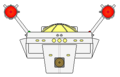
The central hull was a flat, rectangular structure housing crew quarters and passenger space as well as the usual personnel support amenities and computing systems. To cater for a wide range of missions, the transport sprouted appendages dedicated to the various mission aspects; the somewhat inelegant end result nevertheless was highly functional. At the bow, the control dome sat atop the hull, while a keel-like structure extended downwards and housed the main docking adapter for cargo handling, complete with elevator shafts, pumps and valves for every conceivable need. In many variants, two navigational deflector pods were later added for extra protection; they dangled at the ends of narrow ‘whiskers’ angled 40 degrees downward from the central hull. These booms also mounted additional tractor beam emitters for cargo handling, duplicating functions already found in the keel structure itself and increasing loading/offloading speed and flexibility.

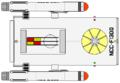
Aft of this bow keel, the central hull ventral surface curved downwards until the hull reached the height of five decks. The forward half of these featured crew amenities and passenger space. The aft part held the complete propulsive package, including main reactors, a wide, four-nozzle Scarbak KKR impulse engine, and fuel tanks for each drive system. The warp coils were mounted on straight pylons angling out laterally from the hull. The engines were PB-23B units – slight modifications of the original Master tug engines, their simplified plasma purge system now complete with a military-standard diffuser endcap that gave them a few meters of extra length.
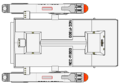
Beneath the central hull were the actual cargo spaces, taking the form of a long keel box whose dimensions varied from model to model. Some variants also incorporated a tower extending down from the main cargo compartment as far as the lower warp field lobe went; this structure was usually dedicated to passenger accommodation.
Above the stern was a shuttle hangar, with dorsal doors atop an access shaft extending to the ventral holds so that shuttle-sized items could be brought directly onboard. Facilities for supporting the visiting craft were rudimentary; workshops had to be installed at the expense of cargo space and thus typically were omitted.
The ships were originally flown by 25 crew. Duotronic upgrades later brought crew requirements down to as few as nine, at least on short, one- or two-shift trips. Also, several successor subclasses with arousing and alliterative naming schemes were fielded after the original 100 Independences had been completed. The Freedom and Equality ships were growth versions of the basic design, with improved engine systems; their central hull sterns bulged out and curved down to house the augmentations. The shuttlebay was remodeled for better onboard accommodation of visiting craft, now that access from the bay to the cargo holds had to be rearranged anyway to clear the expanded engineering spaces. Few of these ships received the extra deflector pods, thanks to greater power available for the main deflector array. The forward ventral tower was also slimmed down considerably, no longer housing refrigerated goods holds or fabricators.
The Liberty ships (not to be confused with the contemporary Liberty ship concept where components of former fighting vessels were combined into contingency transports) were the first to introduce PB-35 solid-state engines, and could theoretically reach warp 9 when lightly loaded. They were intended for rapid deployment of supplies to faraway battlefronts, and mostly spent their time waiting idly at starbases. Special crews had to be trained to operate their quirky powerplants, whose high performance ill-befitted the light spaceframe. Not even the best Tellarite engineers could guarantee safe operations, however, and two vessels were lost to powerplant explosions at high speed in the late 2240s.

The Justice series featured minimal self-defense armament and special secure vaults for precious cargo, and omitted much of the bulk cargo spaces, as well as the extended ventral structure for passenger accommodation; these vessels never mounted the podded deflectors, but received improved sensors in twin housings atop the bridge dome. The Fraternity class again married the Freedom/Equality standard with PB-35 propulsion. It was terminated in mid-production in favor of a final 70 examples of Honor, a repeat of Justice but with the passenger tower and deflector pods restored.
Registration followed the practice of giving manned freighters a NCC number preceded by letter F. The vast majority of these ships were operated by Starfleet Merchant Marine, hauling priority cargo where no civilian organization dared venture. The Independence variants and Shermans now seriously contested civilian freighters in numbers, and the trend seemed to be toward an ever-increasing portion of frontier cargo traffic being handled by Starfleet vessels. Thus, the dedicated freighter registry scheme was a logical choice for the Starfleet of that time, even if a handful of the ships always served as dedicated Fleet transports with standard military crews.
Even though the ships rarely operated near Klingon space, it was impossible to direct all cargo traffic away from the zones of influence of the Romulans, Orions or other threat forces surrounding the Federation space. No Romulan attacks on cargo runs were recorded prior to 2268, however. Still, Landorian and Orion pirates were notorious for harassing UFP light and medium transports. Starfleet could not hope to arrange an escort for every transport, and patrol frigates often arrived too late to apprehend the criminals, much less save the ship from pillaging or (illustrating the brutal modus operandi of the new, secrecy-conscious pirate breed) often also from killing of crew and destruction of vessel. The first time an Orion ship was caught and prosecuted for piracy was in 2269, when USS Enterprise (NCC-1701, Constitution class) hunted down and forced to surrender the murderers of four of the crew of the Honor subclass transport USS Huron (NCC-F1913). After the introduction of the Daran family of frigates in the late 2270s, piracy was drastically curtailed, and the series of treaties with Orion groups in the early 24th century finally ensured safe passage for transports moving inside the Federation space near Beta Rigel.
The Independence class was retired from Starfleet strength with the introduction of Sydney and Laweya class modern transports, which filled all the traditional niches of the Independence design while adding some fields of competence of their own. Accompanying the Shermans, some Independences were turned into commercial cargo drones in the 2260s and 2270s. With remodeled holds, they stepped in for many a hazardously old carrier drone, faithfully moving semi-refined ore from automated or semi-automated mining platforms in deep space asteroid clusters, Oort clouds or uninhabited systems to end refineries in inhabited systems, until their much-abused warp drives finally gave up in the 2320s.
Gallery
-
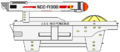 Independence primary class
 -
-
-

-
-
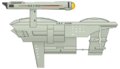 Freedom subclass (stbd)
 -
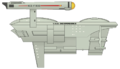 and the similar Equality subclass
 -
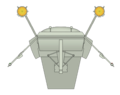 bow
bow -
 dorsal
 -
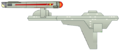 Liberty subclass (stbd)
 -
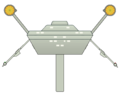 bow
bow -
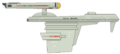 Justice subclass (stbd)
 -
 dorsal
 -
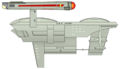 Fraternity subclass (stbd)
 -
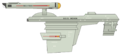 Honor subclass (stbd)
 -
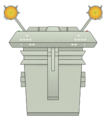 bow
bow
.png)
.png)
.png)
.png)
.png)
.png)
.png)
.png)
.png)
.png)
.png)
.png)


.png)
Other Images
-
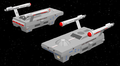 Independence subclass
 -
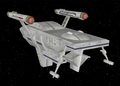 Freedom subclass
.png)
.png)
Notes
- The cargo drone conversions have been identified as for commercial users, to better indicate how they were both retired as a class in the 2280s and yet still in service until the 2320s.
- The additional images for the subclasses (below) don't fit exactly (most specific example being the Liberty), but the images are too good to pass up; I may adjust the text (in the future) to better support these vessels.
- Empty, the Independence is definitely larger than the Sherman, so the "smaller" was changed to "larger".
- All original sub-class Independences must be both retired and scrapped prior to the Honor sub-class being constructed.