Guide:Ganges
.png)
| |
| Ganges | |
|---|---|
| Class Overview | |
| Category | Destroyer |
| Operational | 2146 - 2179 |
| Constructed | 49 |
| Dimensions | |
| Length | 168.3 m |
| Beam | 159.5 m |
| Height | 28.0 m |
| Mass | 198,800 mt |
| Performance | |
| Cruise Speed | w 2.0 |
| Max Speed | w 3.0 |
| Endurance | 1 year |
| Complement | |
| Officers | 9 |
| Enlisted | 55
|
| Tactical Systems | |
| Beam Weapons | Original
2152 refit
|
| Other Weapons | Original
|
| Shields | Original
2157 refit
|
| Transporters | |
| Auxiliary Craft |
|
| Historical | |
| Ships of Note |
|
| Canonicity | |
| Design | ENT |
| Name | Christopher Bennett |
| History | Timo
|
Background: The Hobbyist's Guide
In the 2140s, the enemy stalking Earth’s transports and lone patrol vessels remained as faceless as ever, yet was beyond any doubt a formidable one. A military confrontation was a distinct possibility, yet few measures were taken to prepare for a full-scale war this early on—for a good practical reason. From the viewpoint of the 24th century, it is easy to forget that a 22nd century ship built for offensive military action would be unsuited for hunting pirates or protecting colonies, let alone performing missions of exploration or diplomacy. Harsh choices thus had to be made concerning Earth’s limited resources; certain mission categories had to be ignored to allow others to receive equipment. Instead of a generic warfleet, the UESF desired at least a dozen high profile cruisers to bluff its way to interstellar respect. What little remained had to be allocated to defensive rather than offensive forces—and the defenders would have to be able to cover both the star system and deep space battlefields.
The first type of combat theater was familiar enough to the UESF. The aerodynamically shaped Emmette destroyers provided a sturdy template for a system defender. Adding of recent innovations in armaments and defenses would result in a capable in-system combatant with minimal expenses. Out-system duties would be a wholly different challenge, though. The Emmettes could be considered ‘warp-augmented’ at best; the new destroyer would have to mount practical deep space engines of full warp three performance. This would be a major investment in R&D, construction, and systems integration alike.
There was one final "border condition" defining the new destroyer. Military tradition suggested organizing the harassed transports into convoys protected by escorting spacecraft—yet as space was vast and the number of transport runs needed to support interstellar colonies quite staggering, hundreds of escort vessels would be needed to effectively secure Earth’s commerce. The UESF thus was forced to specify an austere design that could be fitted with various sensor and weapon combinations as the situation warranted. This decision was truly serendipitous, considering that any fixed equipment standard initially considered for the escort mission would have been quite useless in the actual wars that followed.

Experimental modifications on available Emmette spaceframes began almost immediately after the 2141 issuing of the relevant Fleet Requirement. Based on these, Empress and Vickers yards at Earth and Mars began construction of actual flight articles, somewhat larger in overall size and generally streamlined and simplified to facilitate modern armoring. The after half of the hull was expected to see the greatest changes, as outdated power and propulsion systems would be supplanted by completely differently-dimensioned modern counterparts. The two competing entries were presented by the end of the year, with Empress offering a narrow-hulled design with a swappable combat bow and Vickers going for a more conventional flying delta.
Certain key features were dictated to appear on both entrants. Two twin reaction engine nozzle assemblies were to be mounted astern on extended, swiveling structures that allowed their use in lifting as well as forward propulsion tasks. Between them was the main reactor, ejectable in extreme emergencies but mainly mounted this far abaft due to center-of-mass considerations. Atop the reactor assembly would sit an IMRF stabilizer serving the two broadly outriggered, 80,000-ton warp nacelles. In combination, the propulsion system would provide full access to and from terrestrial planets, linear accelerations up to 800 gravities, warp two sustained and warp three flank speeds, and sufficient maneuverability in all three operational realms.
The Vickers design was selected in February 2142, its conservatism the obvious winning point. Internally, the ship was divided into ten decks, most of which were taken up by massive fuel tanks and power generation subsystems. The bridge dome at the bow, mere six meters across, was equipped with armor-shuttered windows opening directly into space for situational awareness in the close-quarters fights expected in convoy service. The level below housed a quartet of navigational deflectors and a sensor array forward, and main command and control facilities beneath the navigation bridge. Crew quarters and various support systems were clustered within the lifting body hull in a manner that paid little heed to ergonomy or safety. Major systems breaching the polarizable hull armor included aft ventral semi-recessed berthing for one twenty-person atmospheric shuttle, six ventrally mounted twin lifting engines, and four landing gear bays, a centralized computer system, and a ventral domed array of medium range sensors.
Primary armament in two ventral banks just below the bridge structures was clustered with the associated targeting sensors, resulting in two rectangular points of weakness. All-new 600 MW main lasers were developed by Lockheed; these were intended to be carried only on select missions due to their complexity and power requirements. Normally, the stations were to be fitted with 45 MW laser emitters and/or plasma guns. Secondary ventral weapons stations were crammed in next to the aftmost lift engine pairs, each capable of holding one plasma cannon or light laser turret. A single dorsal station was available aft of the bridge. In addition, two sets of three mine tubes astern could spew up to 150 thermonuclear mines for system defense or for discouraging pursuit in convoy escort duty.

The first six Ganges units were launched in 2146 and equipped with four 450 MW lasers and two 2 GW plasma cannon turrets. After barely two months of validation trials, operational testing was initiated: UESS Erie and UESS Keflov were sent to escort a group of medium freighters carrying weapons components, including orbital fortress and space tank modules and much-needed excitator coils for system defense vessel laser emitters, to Earth Colony Six. The results were nothing short of tragic. Somehow, Romulans had found out about the delivery and mounted a raiding party that penetrated into nominally Earth-patrolled space and engaged the convoy. The lasers of the destroyers worked as planned, cutting to pieces one alien missile boat per minute—but in less than three minutes, the ships had been overrun and their relatively light armor peeled open by superior numbers of attackers. There were no survivors aboard the destroyers and only one of the freighters managed to escape into high warp. Until 2164, the raid was labeled the work of Nausicaans, until sensor data from the surviving SS Tupac Amaru was properly reanalyzed to reveal classic Romulan duplicity.
Even the initial post-mission analysis called for a stepping up of response, though. Not only had the rate of fire of the destroyers been found insufficient, but the range of engagement with the secondary lasers was too close for the safety of the convoy. The heavy 600 MW laser was clearly needed even against adversaries as puny-looking as pirate missile boats.
Subsequent deployments of Ganges escorts eventually resulted in all ships carrying the maximum weapons load, with a 50/50 balance of lasers and plasma turrets on the secondary mounts. Still, the first truly efficient combat fit had to wait until 2152 and the introduction of phased particle beam weaponry [to the Ganges class]. A pair of Type A phase cannon at the bow was the initial fit, followed by a Type B cannon on the dorsal mount; mines and most plasma cannon were omitted. The shuttlecraft was disembarked, as in its exposed position it presented an explosion hazard for little practical return. A Mk I transporter was soon added in compensation, its emitter array positioned in the shuttle berth.
A total of 49 Ganges were built during the period when random Romulan raids changed into systematic interception of transports in preparation for a major attack. Several of the destroyers saw initial service in anti-Xindi and anti-Klingon operations in the Sol system, based off Mars where the ships could operate from surface bases. Moving of operations out to deep space began after the delivery of the tenth unit, gradually, haltingly: the 2149 Nausicaan scare and again the 2151 Klingon incidents made Starfleet hesitate, but shipping protection ultimately received the majority of the Ganges force.
Homogeneous spreading of the destroyers to interstellar space would have been folly. On the most endangered shipping lanes, convoying was in 2156 changed from constant escort to relay tactics. A group of destroyers followed a convoy for two to three lightyears, then handed it over to the next destroyer group; random links of the relay chain were watched over by a cruiser, but most were left completely unprotected. The tactical aim was to keep the Romulans guessing and to be able to confront them with decisive force when they guessed wrong. This enormously demanding system taxed the Ganges fleet to the extreme, but at least kept the forward colonies and outposts from becoming totally isolated. A downside was the complete unavailability of escort vessels for any of the secondary trade routes.
As the Romulans began their main attack, the front lines nevertheless faced a siege of overwhelming force. The low warp speeds of the Ganges no longer mattered, as they were pressed to system defense service and began to fight their battles under impulse power. While the cruiser and modern destroyer fleets fought in deep space hunting Romulan carriers, Ganges teams were used to ambush raiding parties and to wear down assault forces before they entered planetary bombardment range. Starfleet’s efforts to boost planetary defenses were still hampered by Romulans constantly intercepting shipments of material intended for this purpose and there no longer were destroyers to spare for convoy escort; Ganges production was terminated in favor of the more affordable Daedalus corvettes.
Desperate tactics of providing lone freighters or small convoys with single-pilot escort fighters had no practical effect. Popularly called "cochranes", the dartlike fighters usually consisted of nothing more than a cockpit and a handful of laser or plasma cannon scabbed onto a bulky warp sustainer feeding from the warp field of the freighter. Some four hundred were produced between 2147 and 2159, but a stupefying 289 lost during the first year of operation. While a 1940s CAM pilot might have felt close kinship to a "cochrane jockey", the majority of UESF personnel considered this suicidal method of fighting fit only for saints or fools. It well reflects the desperation of the times that the line of people waiting for their chance to climb into a cochrane cockpit only grew longer with each incoming casualty report.
Despite such bravery, by 2158 it began to seem that almost a hundred of the forward colonies and outposts would have to be abandoned and new defense lines formed closer to Earth. Clearly, a purely defensive strategy would finally lead to complete destruction.
When Earth’s long-awaited move to the offensive came, it was not merely system- or theater-wide, but simultaneously affected every single UESF unit involved in the fighting. As is typical of fledging interstellar powers, both combatants still thought in terms of lines of battle and the Romulans thus could not conceive of the kind of free-roaming operations that would retain the initiative on the defending force. Instead, they mirrored Earth’s desperation from the preceding years and withdrew from their challenged forward positions to what they considered a defensible line. By classic Earth doctrines, this called for the uprooting of all UESF defenses and their utilization for ceaseless assaults that would prevent the Romulans from "digging in". Thus, the Ganges destroyers were mainly used as perimeter guards for battle fleets in the final phase of the war.
Still, even in retreat, the Romulans were a threat to colonies and mining outposts: a Romulan unit cut away from a main force was likely to perform a suicide run at an enemy planet rather than try and fight its way back to Romulan-controlled space. Local defense missions could thus still be of essence and—for example—the mining colony of Lalande 8 can thank UESS Tanganyika (NDD-1047) for its continued existence. The Tanganyika was used as a decoy, luring a suicidal Romulan auxiliary carrier into ramming an abandoned mining station instead of an inhabited one, as well as for rendering harmless twelve fightercraft launched by the carrier. UESS San Esteban (NDD-1021) was the only UESF ship lost with all hands in the final Romulan plunge at Alpha Omega B in 2161, taking with her two Romulan stormwings but unable to prevent the massacre of more than 20,000 people on the planetary settlement.
In the shadow of the cruisers that dictated the outcome of the war, the story of the Ganges was one of forgotten glory. Dull patrol duty along the newly-established Neutral Zone awaited UFP Star Fleet combat forces after the signing of the peace. The compact destroyers were less than ideal for standing the long vigil far away from planetary surfaces or other fixed assets. A handful were pressed to intra-Federation traffic protection duties, another few kept for system protection—but as with many ship types of the Romulan War, no specimen were preserved for posterity. Instead, the last Ganges serving under the Federation Star Fleet flag were in 2179 grounded at colonial starports, never to be reactivated. As the main threat changed from Romulans back to Klingons in the 2220s, even the best preserved Ganges were only fit for swift recycling into construction material.
Gallery
-
 Bow aspect
 -
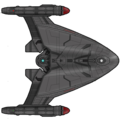 Dorsal aspect
 -
 Stern aspect
 -
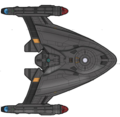 Ventral aspect
 -
 Dorsal view
 -
 Forward dorsal view
 -
 Patrolling an asteroid field
 -

.png)
.png)
.png)
.png)
.png)
.png)


Star Fleet Registry
- USS (NC-07)
- USS (NCC-55)
- USS Baikal (NCC-56)
- USS (NCC-60)
- USS (NCC-71)
- USS (NCC-85)
- USS (NCC-108)
- USS (NCC-129)
- USS (NCC-136)
- USS (NCC-168)
- USS (NCC-185)
- USS (NCC-196)
- USS (NCC-225)
- USS (NCC-231)
- USS (NCC-242)
- USS (NCC-249)
- USS (NCC-256)
- USS (NCC-262)
- USS (NCC-273)
- USS (NCC-278)
- USS (NCC-281)
- USS (NCC-300)
- USS (NCC-305)
- USS (NCC-317)
- USS (NCC-318)
- USS (NCC-352)
- USS (NCC-356)
- USS Maryland (NCC-361)
- USS (NCC-364)
Alt Sources
- Starship Handbook (Combined) (as Iceland class)
Notes
- This is referred to as the Neptune class in some fan-canon. In Enterprise, there is an unseen Neptune type survey ship in the UESF, but the images used here match the Warp Delta (so called because of production notes) seen in three Enterprise episodes. Timo originally named the class Iceland; however he updated his Guide to re-name the class Ganges.
- The class definitely served in the UFP Star Fleet. Presuming 17% losses, that allows for 38 to survive the war. I'm having four vessels decommissioned for not meeting minimum requirements for spaceworthiness repairs and another five reserved for Earth Fleet, indicating 29 vessels served the Federation with standard NCCs.
- The prefix "USS" has been changed to "UESS" for ships of the United Earth Starfleet.