Guide:Roanoke
.png)
| |
| Roanoke (or J Class) | |
|---|---|
| Class Overview | |
| Category | Transport |
| Operational | 2101 - 2279 |
| Constructed | 74 total: |
| Dimensions | |
| Length |
|
| Beam | 58.8 m |
| Height | 32.1 m |
| Mass |
|
| Performance | |
| Cruise Speed |
|
| Max Speed |
|
| Endurance | 6 years |
| Complement | |
| Officers | 2 |
| Enlisted | 17
|
| Cargo |
|
| Tactical Systems | |
| Beam Weapons | FJ-100, FJ-200 (original):
FJ-200 (refit):
FJ-500, FJ-750:
|
| Shields | All:
FJ-500 training vessels
FJ-500 training vessels
|
| Auxiliary Craft |
|
| Historical | |
| Ships of Note |
|
| Canonicity | |
| Design | ENT |
| Name | Timo |
| History | ENT
|
Background: Hobbyist's Guide
The first successes in Earth’s colonization program created an increased demand for transport vessels—not only for spacelanes between the hearthworld and the colonies, but for the trade routes branching off the colonies towards previously unreachable commerce partners. Many Boomer captains chose to sail out in hunt of profits, depleting the inner routes. Tellarite merchants were quick to take advantage. The Arcturus route was soon all but lost to foreign operators. Ships of higher capacity would have to be made available for the primary ore routes or else the combined loss of profits and key resources could shut Earth off deep space for good.
The featherweight Dinyan-Yoyodyne colonizers hauling cargo for fledgling mining colonies at the time were not competitive in the long run. The more capacious but agonizingly slow Assist, Fortune, and Protector series warp tugs were a dead end as well, quickly approaching both financial non-viability and technological obsolescence. In search of alternatives, even the massive refineries crawling back and forth in the Sol asteroid belt were harnessed to bulk transport use, several being launched on interstellar resource hunts. On a more practical vein, Class G and Y container transports, initially intended for high credit to kilogram ratio goods, now found it commercially advantageous to take on bulk cargo.
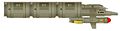
None of this met the definite and increasingly pressing demand for a dedicated modular ore transport. In 2099, Type III cargo modules were introduced for use in the mining industry and construction of several fast tug types initiated. Of these, the flexible and surprisingly nimble class J soon proved the most competitive design.
The uppermost level of the class J tug consisted of a flight control center, a communications and general utility assembly, and a reaction control system that, put together and fitted between transverse docking/airlock sections, comprised a detachable orbit-to-surface craft. While this section could in a cinch provide life support for the total crew of nineteen, the next two levels down were the main habitat section. In addition, they held main deflector machinery and sensors at the bow, an accessway to the containers at Deck 2 stern, and the main computing and environmental systems on Deck 3. Space was at a premium compared with class Y or G vessels, especially because there was no habitable space in the spinal structure of the ship. For journeys taking longer than six months, a typical Boomer crew of twenty to thirty would have to convert part of the forwardmost ore container for habitation. For shorter hauls, the need to maximize cargo volume meant cramped conditions indeed.
Pylons angled down from Deck 2, along the sides of the tug, to the two GSC-1400 nacelles, which fed from a primary fusion powerplant on Deck 4. Despite their compact dimensions, the nacelles also housed main reaction engines, feeding directly from primary-loop plasma. While these fired safely beneath the train of cargo containers, they were still carefully shielded by field guide petals. Further field guides jutted down from nacelle centerpoint and also contained plasma purge vents and heat exchangers. The variable geometry extensions could bias the warp field over one to five containers, although three was the maximum load of the original J-100 and J-200 models. Secondary reaction drive modules would be installed on the aftmost container. Additional fuel was carried in a spine element that could span the full length of three modules for maximum range, but was usually only one third of that. Ramscoops at nacelle forward ends were an efficient range multiplier, if the captain was willing to chase after dense clouds of interstellar hydrogen.
.png)
Almost as soon as the first J class ships glided off the construction docks, the United Earth Stellar Navy purchased five and placed an order for twenty-nine more. Dubbed the Roanoke class in UESN service, the transports began hauling material to Earth’s outer holdings and helping fortify them against raiders of all kinds. The transports themselves were highly vulnerable to attacks, though, and the improved Gemini subclass based on J-200 was in 2112 fitted with multidirectional plasma cannon on both nacelles. ECS vessels began mounting similar weapons soon enough, despite the illegality of the act.
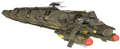
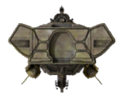
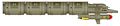
By 2120, work on advanced warp drives was producing dividends for transports and starliners, as well as for high-profile military and exploration starships. The J class grew with two high capacity models, both of which suited the Stellar Navy's needs. The J-500 and J-750 became the Homa Bay and Indian River subclasses, respectively. Both were armed to the hilt and equipped with the latest in subspace radio technology—which wasn’t saying much, in galactic terms, but did give the UESN some confidence in the survivability of the vessels. At least some of the raiders could be kept at an arm’s length, and direct contact across some three lightyears maintained without booster relays. Both classes could also haul four full containers, or 38,000 tons’ worth of cargo; the FJ-750 could take on an extra 7,000 tons and one more container. Both types could maintain warp 2 for extended periods of time.
The grand total of 74 J class vessels transferred into UESF service survived the fighting of the 2150s remarkably well, being mostly deployed in deep space and remaining in transit throughout the conflicts. By the founding of the UFP Star Fleet, 51 of the transports still remained. The last were withdrawn from active Star Fleet freight service in the 2190s, yet ten FJ-500s were maintained as navigation training vessels well into the 2260s. They received modern shields and comm systems, but otherwise maintained their original configuration and meticulous finish. When the last FJ-500, USS Frost Ridge (still registered NCC-F23) was retired in 2279 and her reactors driven down, dismantling crews were happy to confirm a piece of folklore. Equipped with 23rd century radiation protection gear, they cut off, decontaminated, and polished for display a section of the inner reactor casing personally signed by Zephram Cochrane himself.
Gallery
-
 FJ-100/200 starboard
 -
 FJ-500 starboard
 -
 FJ-750 starboard
 -
 FJ-750 bow
 -
 FJ-750 dorsal
 -
 FJ-750 starboard bow
 -
 FJ-750 stern
 -
 FJ-750 ventral


.png)
.png)
.png)
.png)
.png)
.png)
Alternate Images
-
 FJ-200
 -
 FJ-500
 -
 FJ-750
 -
Gemini
-
Homa Bay
-
Indian River
.jpg)
.jpg)
.jpg)
Star Fleet Registry
Roanoke subclass
- NCC-F02
- NCC-F04
- NCC-F06
- NCC-F09
- NCC-F28
- NCC-F30
- NCC-F38
- NCC-F41
- NCC-F46
- NCC-F48
- NCC-F50
- USS Roanoke (NCC-F63)
- NCC-F66
- NCC-F68
- NCC-F78
- NCC-F81
- NCC-F89
- NCC-F92
- NCC-F96
- NCC-F102
- NCC-F105
- NCC-F108
- NCC-F109
- NCC-F111
Gemini subclass
- NCC-F07
- USS Gemini (NCC-F18)
- NCC-F27
- NCC-F45
- NCC-F77
- NCC-F88
- NCC-F101
- NCC-F103
Homa Bay subclass
- NCC-F11
- NCC-F17
- USS Frost Ridge (NCC-F23)
- NCC-F34
- NCC-F40
- NCC-F42
- NCC-F49
- NCC-F52
- USS Homa Bay (NCC-F61)
- NCC-F64
- NCC-F74
- NCC-F76
- NCC-F82
- NCC-F87
- NCC-F93
- NCC-F115
Indian River subclass
- USS Indian River (NCC-F12)
- NCC-F14
- NCC-F36
Alt Sources
Notes
- In order to make the Type III containers a bit better than the concurrent Type II, they are designated as rated for 7,500 metric tons. Ship variants' cargo capacity have been altered to accommodate.
- Except for ten of the best, the Homa Bay subclass was decommissioned in 2195 (with the ten staying on as navigation training vessels, with final decommissioning starting in 2269, and completing with USS Frost Ridge in 2279.
- Fifty-one of the class, including ten FY-500 Homa Bays are transferred to the UFP Star Fleet. They are designated in the NCC-F range.