Guide:Derf: Difference between revisions
No edit summary |
|||
| Line 114: | Line 114: | ||
Almost as an afterthought, the engineers also changed the main propulsive system. Instead of the | Almost as an afterthought, the engineers also changed the main propulsive system. Instead of the | ||
single PB-31C nacelle, the ''Derfs'' featured two PB-31D mod 2 (in the two prototypes, mod 1) | single PB-31C nacelle, the ''Derfs'' featured two PB-31D mod 2 (in the two prototypes, mod 1) | ||
engines lifted from the ''[[Guide: | engines lifted from the ''[[Guide:Loknar|Loknars]]'', and a single RMB-228 powerplant of commercial ancestry and | ||
good serviceability. Performance was basically identical to that of the destroyers, while the closely | good serviceability. Performance was basically identical to that of the destroyers, while the closely | ||
spaced twin nacelle configuration gave a degree of redundancy for solo deep space operations. | spaced twin nacelle configuration gave a degree of redundancy for solo deep space operations. | ||
Revision as of 08:20, 7 May 2020
(side).png)
| |
| Derf | |
|---|---|
| Class Overview | |
| Category | buoy tender / mine warfare ship |
| Operational | 2260-2294 |
| Constructed | 104 total: |
| Dimensions | |
| Length | 217.2 m |
| Beam | 128.0 m |
| Height | 70.3 m |
| Mass | 626,000 mt |
| Performance | |
| Cruise Speed | w 6 |
| Max Speed | w 8 |
| Endurance | 2 years |
| Complement | |
| Officers | 11 |
| Enlisted |
|
| Tactical Systems | |
| Beam Weapons | standard
Mk III
|
| Other Weapons | minelayer role
|
| Shields |
|
| Transporters | original
upgrade (2276)
|
| Auxiliary Craft | Mk I, II
Mk III
|
| Historical | |
| Ships of Note |
|
| Canonicity | |
| Design | FASA |
| Name | FASA |
| History | FASA
|

Among the oddest of Star Fleet projects in the period of Klingon scare was the Derf class of buoy tenders. By designation a Class 5 support vessel, by design a Class 1 frontline combatant, this Larson derivative was an attempt to give a destroyer-category vessel a practical and plausible peacetime mission. Squeezing multi-mission capability into any spaceframe smaller than a light cruiser was folly – but dual-mission capability was quite within the realm of possible. It would be a simple matter to install a hull extension to a Larson, a Saladin, or even an older Kovaris vessel. Any of a number of secondary missions could be facilitated, although at the cost of added mass and reduced impulse performance: planetary exploration or small craft auxiliary tender duty via a proper shuttle hangar, a supply role via a cargo hold or towing clamps, a survey mission via extra sensors and computers. Operationally, however, few of these missions would match the classic destroyer attributes of high deployment speed but low on-theater endurance.
By early 2259, two practical dash-in-dash-out mission profiles had been identified. One was that of a rapid reaction signals intelligence vessel, not a civilian job per se, even though the nonmilitary misnomers ‘survey cruiser’ and ‘exploratory cruiser’ were also toyed with. For the time being, Star Fleet abandoned this profile, as the sigint needs were being met by existing designs. Later, destroyer derivatives would indeed be pressed to this duty, although with modest results.
The second mission profile was that of buoy tender. A task that back on Earth’s oceans had called for rugged, low speed vessels of limited seakeeping was in deep space a very different challenge. Buoys would be deployed not only in ‘coastal waters’ but also in interstellar space, along trade routes and borders. Constant maintenance, repair and replacement missions would have to be flown to the millions of buoys even when the lifetime of an individual buoy was measured in centuries. There would be no sense in returning the buoys to port for analysis and repair; onboard processing was the only reasonable solution. Obviously, a vessel of destroyer size and speed would offer significant advantages over the usual adapted civilian small freighter designs.
Throughout 2259, modifications were performed on a surplus Larson spaceframe. Decks 8-11 received an extension all the way to the stern of the ship. Special craft (operated as unmanned drones in most situations) equipped with tractor beams were housed in a ventral berth. After the mothership had arrived at a malfunctioning buoy, the drones would bring it aboard, eliminating the need for precision approach gear aboard the ship. Automated processing lines within Decks 8-11 could handle the repairing and re-energizing of up to eight deep space relay buoys at a time. Up to 80 standard communications or surveillance buoys could also be carried aboard for deployment via the recovery drones or twin ejector tubes astern. Transporter capacity was boosted by the addition of a second six-person platform and the replacing of the Larson evacuation unit by a dedicated cargo platform.
To accommodate the machinery, most lower hull functions were eliminated. Fire control computers and long range sensors had to go, and life support machinery was reduced in size and capability. The latter change was made possible by the low crew requirements of the ship (72 standard crew, plus ten intelligence specialists on the Mk IV special surveillance network maintenance variant). The former two in turn forced the abandoning of torpedo armament. The energy and cooling system reserves, space and computing power liberated by the elimination of the launcher were eagerly embraced by the engineers, who could now use it to retain full directed-energy weapons capability on the pared-down vessel. A battery of four phaser IVs provided punch similar to that of Mk II Larsons; the berths could take four more emitters if necessary, or even be upgraded to phaser VII standard in a time of crisis.
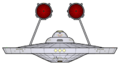
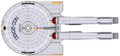
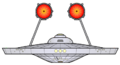
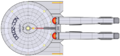
Almost as an afterthought, the engineers also changed the main propulsive system. Instead of the single PB-31C nacelle, the Derfs featured two PB-31D mod 2 (in the two prototypes, mod 1) engines lifted from the Loknars, and a single RMB-228 powerplant of commercial ancestry and good serviceability. Performance was basically identical to that of the destroyers, while the closely spaced twin nacelle configuration gave a degree of redundancy for solo deep space operations. Spherical plasma diffusors were not carried as standard, although a number of ships going to Star Fleet Intelligence were slated to receive these.
Production of the Derfs began in 2260 at the distant yet central Merak II. A hub of trade routes from the mining colonies on Kalandran, Dorvan, Capellan and Vardone sectors to the UFP core, Merak was also known as a thriving industrial center for the production of colonization and mining equipment. Destroyer starships were a novelty to the local industries. Yet by the end of the year, two Derfs (mainly built of surplus Loknar prototyping and Larson components delivered from Proxima) had been launched, and local production of key components for further units was underway.
The early 2260s policy of lend-leasing or selling relatively advanced weaponry to allies in the fight against Klingons also influenced Derf production. The somewhat downgraded destroyers were an ideal phaser-armed lead ship for a smallish navy, easily adaptable to mine-laying as well. Ambitious plans were made of producing up to 400 export vessels, to be operated by foreign navies in support of UFP buoy network maintenance operations. In the end, the same limitations that curtailed Star Fleet’s destroyer ambitions also cut down the Derf numbers to 51 Star Fleet and 34 export versions (excluding the two prototypes), plus 17 special variants for SF Intelligence work. This still represented a considerable fighting force, a potent tool for buoy network maintenance – and a huge dent in the support unit procurement budget.
At no time was there a real chance of the Derfs taking over the majority of buoy tending work. They were tasked with the most remote and highest-risk areas only, and sometimes had to pay the price. USS Acropolis was lost to the Klingons in an intelligence gathering raid; USS Walther Price was the first to disappear without trace, an all too typical fate in the extreme reaches of the UFP communications infrastructure. Training Command retained the two prototypes as well as two production vessels, while the bulk of the fleet was in 2267 transferred from Logistics Command to UFP Transit Authority to circumvent some Organian treaty limitations.
There was no major effort at refitting the Derfs with modern technology other than up-to-date maintenance tooling. Nor was there major demand for such an operation. When budgetary limitations began to be lifted in the 2280s, it took some convincing to get either Logistics Command or the UTA interested in an upgraded variant. In the end, the needs of SF Intelligence were the driving force behind the procurement of the Niffen class that would carry on the exotic tender-destroyer role to the 24th century – and, thankfully, the destroyer half of it would never see practical realization.
Gallery
-
 Derf class (2245)
 -
-
-
 2265
2265 -
-
(bow).png)
(dorsal).png)
_(side).png)
_(bow).png)
_(dorsal).png)
Notes
- Made so sidebar changes to clarify the shield capability.
- Added a cargo transporter to the sidebar, per the text.
- The use of "Mark" will be replaced by subclass names.