Guide:Federation: Difference between revisions
No edit summary |
No edit summary |
||
| Line 140: | Line 140: | ||
absolutely required phaser capacity at warp. | absolutely required phaser capacity at warp. | ||
Twelve hulls out of the initially projected twenty were ordered, funded on one-by-one basis. Each | Twelve hulls out of the initially projected twenty-one were ordered, funded on one-by-one basis. Each | ||
individual hull was fiercely haggled over, so that ''USS Entente'' (NCC-2120) was constructed but for | individual hull was fiercely haggled over, so that ''USS Entente'' (NCC-2120) was constructed but for | ||
example the lower-registry ''USS Organization'' (NCC-2111) was not. The ships entered heightened | example the lower-registry ''USS Organization'' (NCC-2111) was not. The ships entered heightened | ||
| Line 232: | Line 232: | ||
* Based on the overhaul of a majority of the class, it would appear the three non-overhauled vessels started being placed in reserve in [[2274]]. | * Based on the overhaul of a majority of the class, it would appear the three non-overhauled vessels started being placed in reserve in [[2274]]. | ||
* Raised the "initially projected" from 20 to 21, so that there is no gap before ''Entente''. | |||
<br> | <br> | ||
Revision as of 19:35, 6 February 2020
.png)
| |
| Federation | |
|---|---|
| Class Overview | |
| Category | dreadnought |
| Operational | 2255-2295
|
| Constructed | 13 total: |
| Dimensions | |
| Length | 319.8 m |
| Beam | 140.0 m |
| Height | 87.1 m |
| Mass |
|
| Performance | |
| Cruise Speed | w 8 |
| Max Speed | w 10 |
| Endurance | 6 years |
| Complement | |
| Officers | 55 |
| Enlisted | 445
|
| Tactical Systems | |
| Beam Weapons | Federation
NCC-2109, 2112
Star Empire
|
| Missile Weapons | Federation
NCC-2109, 2112
Star Empire
|
| Shields |
|
| Laboratories | 2x general purpose |
| Transporters |
|
| Auxiliary Craft |
|
| Historical | |
| Ships of Note |
|
| Canonicity | |
| Design | Franz Joseph; Star Empire: Dreadnought! (Diane Carey) |
| Name | Franz Joseph |
| History | Franz Joseph; Ships of the Star Fleet; Star Empire: Dreadnought! (Diane Carey)
|

Ever since the 2220s, when Chiokis won its first minor starship construction contracts from Geering, there had been plans to build large multi-nacelled starships heavily armed with warp-phased lasers or particle beams, and also carrying antimatter torpedoes. Called dreadnoughts, these ships would patrol the outer fringes of the Federation for years at a time and be capable of single-handedly defeating any Klingon starship known to Star Fleet. In lieu of the resources and the technology, the dreadnought project remained a dream for some thirty years. ‘Silver bullet’ acquisition politics went only so far: the Federation Council was not willing to divert any resources to a project so unlikely to succeed (the failure of the Tritium experiments still fresh in the minds). The ebb and flow of the Klingon conflict resulted in many warship programs being delayed or cancelled, others being promoted and hastened. At First Axanar, it appeared that the modern cruiser and destroyer fleet would be the final solution to the Klingon problem; by the time of Second Axanar, it was far from certain whether even Project Starship would suffice.
In 2250, it was felt the technology to build the ultimate warships finally existed. The newest Class One warp engines, the so-called PB-47 design, were yet to be introduced to cruisers but were already performing admirably on the frigate fleet. They were the first of the solid-state type to have field configurations malleable enough for multi-nacelle experimentation. With three sets of coils, they could create a six-lobe warp field of 2.5 kc; theoretically, such a field could move the projected massive vessel through warp maneuvers as if she were a light cruiser. All that was needed was an efficient powerplant, and a capable weapons system to go with it. And in late 2253, both were ready for delivery to the first Federation class dreadnoughts to be completed.
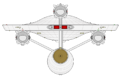
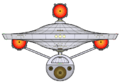
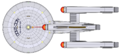
The mammoth primary hulls were built in the quiet wayside dockyards of Arcturus and Vega. Each bulged out into a 140 m saucer twice as voluminous as the standard cruiser or destroyer hull. The saucers housed three twin banks of heavy phaser VIII emitters, plus a Selenia ‘Shark’ torpedo system with two Mk 2 tubes and an octuple loader, and a total rate of fire almost doubly that of a standard six-tube cruiser battery. Inside, twelve decks featured spartan crew accommodation, advanced fire control facilities, heavy armoring and bracing, and shielded power conduits for the main weapons. Many sensor systems familiar from cruisers or destroyers were present, but little in the way of exploration gear was installed.
In the aft sector of the saucer, a m/am storage facility and primary engine room delivered power to the warp engines through two connecting pylons, one extending straight up from the saucer, one joining the saucer to the curved-cylinder secondary hull and allowing plasma conduits through to two further nacelles that were mounted on the secondary hull with short, sturdy horizontal pylons. A secondary m/am system was housed inside the aft secondary hull. Propellant and fusion fuel was carried in armored tanks distributed throughout the secondary hull, feeding six fusion reactors down there plus four more reactors in the saucer, as well as the powerful impulse unit at the aft rim of the saucer. The duplication and triplication of power subsystems made the ships fantastically resilient to battle damage. Even one of the nacelles could be lost and the ships would still retain a degree of warp capacity.
Two twin banks of phasers were mounted on the secondary hull, one aft of the saucer/engineering hull pylon and one below the forward end of the secondary hull. A spacious shuttlebay at the secondary hull bow could accommodate as many as 14 shuttles, and a second hangar was installed astern in two of the ships. Others housed a navigational array there, in addition to a bow unit – both of cruiser standard. The ability to project a subspace field astern was quite useful in solo deep space patrols where all-around FTL sensing was vital for survival. As a bonus, the unit enabled the ships to utilize full reverse warp for extended periods of time.
Some two years per keel were needed to complete the behemoths, but the first one, USS Federation (NCC-2100), sailed out of construction dock fully on schedule, in early 2255. Extensive trials included repeated one-engine-out simulations, some performed at warp 4, as well as overall propulsion system tests up to the speed of warp 10.2. The only problems encountered before actual operational tests concerned the phaser system, which was not quite capable of handling the power surges of warp drive mode and thus was of reduced use in warp-speed battles. A remedy had to be found, though, since the ships were intended to specialize in long-distance, deep space fights which absolutely required phaser capacity at warp.
Twelve hulls out of the initially projected twenty-one were ordered, funded on one-by-one basis. Each individual hull was fiercely haggled over, so that USS Entente (NCC-2120) was constructed but for example the lower-registry USS Organization (NCC-2111) was not. The ships entered heightened operational readiness in 2266, in anticipation of Klingon hostilities, and practiced offensive as well as defensive maneuvers until mid-2267 and the abortive Klingon invasion. The Affiliation (NCC- 2108) and the Federation were already in striking range of Gohrem and Kassat, the main garrison worlds before the industrialized core area of the Empire, when the call for truce came through from the tiny agrarian world of Organia. The Affiliation and her escort destroyers decided to press on and engage the Klingon defense fleet anyway, only to have their weapons controls become red-hot and their engines shut down in mid-warp. As it became evident that the Klingon fleet was in similar difficulties, Star Fleet recalled all its ships and acceded to the terms of the Organian noncorporeal entities.
The last dreadnought, USS Unificatum (NCC-2102) was finished and commissioned in 2267, entering border patrol service under the command of Commodore William Hastings. No funds were forthcoming for further units after the signing of the Organian peace treaty, and dreadnought construction yards were closed permanently.
Or so it seemed. In actual fact, one further unit was still under construction in Arcturan orbit as of early 2268. This dreadnought was not exactly following the guidelines given by the UFP Committee of Star Fleet, and would have raised a few eyebrows and antennae in the Council had her existence been known. Under the supervision of Commander Paul Burch, the ship was being fitted with a new type of hull armor, a significantly enhanced phaser arsenal, a sensory countermeasures device of Vulcan design, as well as a new form of warp drive that would force the ship deeper into subspace than any ship had gone before. When completed, the vessel, USS Star Empire (NCC-2116), would be an offensive platform of irresistible power.
The Star Empire had had her saucer reworked to a structurally superstrong octagonal shape, heavily armored with quantobirilium alloy, braced and triply shielded. Her secondary hull was built roughly to Federation standards, but with newer models of the navigational deflectors and a selection of hidden surprises in the engineering compartments. And while the PB-49 engines were far superior to even the latest Achernar cruiser engines at normal warp speeds, the goal was set on utilizing them for ‘transwarp’ drive, making possible speeds of perhaps warp 30 or beyond through the immersion of the ship deeper into the subspace domain.
But the apparent theft of the Star Empire by a group of terrorists led by CDR Burch himself, on July 12th, 2269, resulted in the exposure of a major conspiracy in the ranks of Star Fleet. Shockingly, Vice Admiral Rittenhouse and several starship captains had planned to utilize the dreadnoughts for deep strikes against Klingon military installations, crippling the Imperial Klingon Navy in preparation for a major invasion. The incredible power of the new battlewagons was evident from the plans: with only twenty ships, the Star Fleet conspirators hoped to completely destroy more than fifty heavily defended Klingon naval bases within Empire space, including their impenetrably fortified stronghold at Ty’Gokor.
Swift action by starship Enterprise led to the release of the dreadnought Star Empire from her captors, who were freed of charges of terrorism and instead hailed for exposing the plans of the Rittenhouse faction. The ship was placed in mothballs at Venus, her main weaponry deactivated and her reactor core removed. Shocked reactions throughout the Council reflected a major concern: why hadn’t the Organians intervened? However, provoked by the incident, Klingons soon tested Star Fleet resolve with border raids and reportedly ran into Organian interference, reassuring the Council of the continuing power of the treaty. Persistent reports to the contrary, delivered by dozens of starship captains between 2269 and 2284, were quietly filed away by Star Fleet.
The dreadnoughts lay dormant in starbases for most of the early 2270s, as Star Fleet discussed possible ways of upgrading them to the demands of the day. Speed increases were a primary target of the upgrades: the V’Ger intrusion of 2271 had left the border patrol dreadnoughts standing still, as the closest ships, USS Entente (NCC-2120) and USS Dominion (NCC-2115), lay weeks away from Earth, and only a handful of frigates and the barely refitted heavy cruiser Enterprise were available for local defense. The upgrades took the form of installation of linear-coil engines on individual basis, and are described in detail in a later entry. Three vessels were left unrefitted and, one by one, placed in reserves until 2295. The Compactat (NCC-2103) served the longest, assuming a training role from 2281 to 2287. Like the Dominion (moved off active status in early 2286), she was equipped with modernized navigational deflectors similar to the Achernar cruiser units. The Confederation (NCC-2114) received no such attention prior to her 2281 deactivation. Nor was the black sheep Star Empire refitted in any way; although a very real part of the dreadnought deterrent, she remained officially decommissioned for the entire length of her career.
Khitomer treaty cutbacks spelled the end of story for all the dreadnoughts, regardless of activation status, service age or design. Their role as long range patrol combatants was merged with the exploration and power projection role of the emerging high endurance, long range Excelsior class. None of the Federations was retained in the Fleet museum, and the Star Empire snuck out of her holding orbit carefully hidden from the eyes of the press. She was towed to her birthplace in Arcturus and used for target practice for some sixteen years, thanks to her incredibly strong hull.
Gallery
-
 Federation (2255)
 -

-

-
-

-
 Federation (2265)
 -
-
.png)
.png)
.png)
.png)
_(side).png)
_(bow).png)
_(dorsal).png)
Notes
- Two of the vessels will have stern shuttlebays (along with the bow ones).
- Based on the overhaul of a majority of the class, it would appear the three non-overhauled vessels started being placed in reserve in 2274.
- Raised the "initially projected" from 20 to 21, so that there is no gap before Entente.