Guide:Enterprise: Difference between revisions
| Line 293: | Line 293: | ||
File:NX01 patch.gif|''Enterprise'' mission patch | File:NX01 patch.gif|''Enterprise'' mission patch | ||
File:MACO-patch.gif|MACO ''Enterprise'' mission patch | File:MACO-patch.gif|MACO ''Enterprise'' mission patch | ||
File:NX cruiser (bow).png|Bow aspect | File:NX cruiser (bow).png|Bow aspect | ||
File:NX cruiser (dorsal).png|Dorsal aspect | File:NX cruiser (dorsal).png|Dorsal aspect | ||
| Line 299: | Line 299: | ||
File:NX cruiser (stern).png|Stern aspect | File:NX cruiser (stern).png|Stern aspect | ||
File:NX cruiser (ventral).png|Central aspect | File:NX cruiser (ventral).png|Central aspect | ||
File:Nx-01-struts.png|External field stabilizer | File:Nx-01-struts.png|External field stabilizer | ||
File:Nx-01-saucer-edge.png|Starboard saucer edge | File:Nx-01-saucer-edge.png|Starboard saucer edge | ||
File:Nx-01-bridge-aft.png|Saucer, aft of bridge | File:Nx-01-bridge-aft.png|Saucer, aft of bridge | ||
File:Drex-NX-impulse.png|Starboard main impulse nozzle | File:Drex-NX-impulse.png|Starboard main impulse nozzle | ||
File:NX-02 under early construction.png|NX-02 pre-''Columbia'' under early construction | File:NX-02 under early construction.png|NX-02 pre-''Columbia'' under early construction | ||
File:Columbia (NX-02)-Main engineering.jpg|Main Engineering on ''Columbia'' (NX-02) | File:Columbia (NX-02)-Main engineering.jpg|Main Engineering on ''Columbia'' (NX-02) | ||
Revision as of 08:14, 13 March 2018
.png)
| |
| Enterprise | |
|---|---|
| Class Overview | |
| Category | explorer |
| Operational | 2151-2161 |
| Constructed | Total: 16 |
| Dimensions | |
| Length | 225.1 m |
| Beam | 132.6 m |
| Height | 33.1 m |
| Mass | Original
2153 weapons upgrade
NX-02 onwards
|
| Performance | |
| Cruise Speed | w 3 |
| Max Speed | w 5.0 |
| Endurance | 4 years |
| Complement | |
| Officers | 23 |
| Enlisted | Original
NX-02 onwards
Romulan War standard
|
| Tactical Systems | |
| Beam Weapons | Original
2153 weapons upgrade
NX-02 onwards
|
| Missile Weapons | Original
2153 weapons upgrade
NX-02 onwards
|
| Shields |
|
| Laboratories |
|
| Transporters |
|
| Auxiliary Craft |
|
| Historical | |
| Ships of Note |
|
| Canonicity | |
| Design | ENT |
| Name | ENT |
| History | ENT (Christopher Bennett, Michael A. Martin, ‘ST:ENT Romulan War’ series)
|
At the end of the 2140s, Earth’s escalation program was fully geared towards reaching what
engineers and politicians alike called ‘escape velocity’. Scenarios of pirate hunts or interstellar war
were concerns of the distant future, not attainable until a crucial prerequisite had been met: Earth
had to have a presentable force of deep space cruisers. Only a vessel capable of challenging the
Vulcan voidships in terms of speed, range, protection and firepower would allow Earth to pursue an
independent foreign policy. The Tritons inched towards parity in the latter two respects, assisted by
frantic work on hull armor and phased particle beam weaponry. Sheer stubbornness would give them
the required range as well, just as it had allowed the primitive Boomer vessels to take to the stars.
Yet speed remained the master key to interstellar power projection.
The Daedalus ion drive disaster was a major blow to Earthly hopes. Amidst all the specieist sentiments of the era, it was humbling to be reminded that Earth’s bid for interstellar independence now hinged on Vulcan assistance. For three decades now, Henry Archer’s team had been ‘close’ to finding the formula to ‘escape velocity’. The first testbeds had a checkered record, verifying some engineering solutions while proving that others were a danger to life and limb. Full-scale testing was frustratingly delayed, forcing the Tritons to sail out with warp three rather than warp five engines. It was only in 2147 that the final elements were falling in place. With the first successful simulation of the warp five engine design completed, go-ahead was at last given for the construction of an experimental deep space explorer, the Enterprise (NX-01).
The experimental status of the ship was both a harsh fact and a deliberate misnomer. Certainly there was no guarantee that the plasma rechargers intended to boost power output and thus increase field strength would work as planned. The ability of the external field stabilizer to cope with the boosted fields was also in justifiable doubt, as was the rest of the innovative geometry of the propulsive arrangement. Warp propulsion was to be pronouncedly asymmetric, with the 100,000 ton, 98 m PA-1A nacelles riding on support pylons canted up at 30 degrees. Sublight thrust was to be divided in two: main exhaust nozzles tied to the primary power loop fired at the ends of the longitudinal booms that also housed the rechargers and supported the nacelles, but fusion reactors on the primary hull trailing edge next to the booms also had small vectorable exhaust ports of their own, adding to the thrust and maneuverability, and preserving mobility when main drive plasma was de-energized.
As for the novel dilithium regulators inside the raw annihilation reactor, even Captain Jonathan Archer, son of the late designer and an active participant in the program, could but cross his fingers. Fortunately, power generation seemed to work just like simulations predicted. As test flights began in October, 2150, low to medium warp was achieved relatively easily. Impulse thrust resulted in hull buckling and overheating, however, and half a year was spent on getting the dilithium focus to perform at warp 4.0. To facilitate the inevitable modification and upgrade work, the entire power generation assembly was designed to be easily exchangeable: the reaction chamber could be pulled out through the stern and a new one installed in a matter of days. The initial F1.0 flight article gave way to F1.1 before the ship was cleared for operational testing, and F2.0 was already under construction.
Yet there was more to the ship than mere propulsive experimentation. Although initially armed with ten plasma cannon, the ship was from the very beginning hardwired for phased particle beam armament. Her missile arsenal was formidable, with four bow and two stern tubes on the ventral primary hull. Four basic types of missile were available, including two fusion warheads, a KE penetrator and even an experimental antimatter device; a total of 120 shots catered for virtually every contingency. New FTL deflector and sensor systems were under development, even though NX-01 would sail out with a minimally modified Triton package.
In addition to being a competent combatant, the Enterprise was being prepared for the daunting task of deep space exploration. Gear that on the Messiers or Cosmoses had occupied most of the available volume had to be miniaturized so as not to compromise the combat mission – and with shrinking size had to come an increase in capabilities. Earth sensor technology remained as unremarkable as ever, but refinements were made on virtually every other type of exploration gear. Some of these were foolhardy, such as the use of the Erickson one-terminal transporter system for teleporting of live subjects. Others, like the experimental procedures for biohazard containment, were merely bizarre and largely ineffective.
The auxiliary craft docking bay and hangar of NX-01 were the most advanced ever devised. Precision approach aids, rapid recovery booms, air curtains across the ventral doors and between sections of the single-volume hangar plus high capacity air pumps ensured recovery, securing and bay repressurization within 80 seconds of matching of velocities. Single-point refueling and purging systems, in situ debaryonizers, advanced molecular fabricators and an onboard gamma-welding unit kept the craft in top condition despite a limited cache of spares. While standard Varioflight shuttlepods were still the preferred auxiliary type, the bays could accommodate highly nonstandard vehicles, including alien visitors, as long as they conformed to the limiting doorway dimensions of 6.5 x 3.2 x 3.0 meters. Mechanical grappler guns could retrieve velocity-matched objects at a distance of one kilometer; at closer ranges, induction brakes on the multi-monofilament cables allowed the halting of uncooperative targets up to a delta-V of 1 km/s.
Fuel and propulsive stores could be admitted onboard via two stern interfaces compatible with the same standard lighters that served the Triton fleet. Two loading shafts piercing the primary hull provided direct access to main cargo holds, generously sized for whatever items future missions might require. Initially slated to be stocked aboard were field repair items such as hull plates and impulse coils, some surface excursion vehicles and habitats, four spatial pods and a classified selection of ‘special ordnance’.
Loading was still incomplete when, on April 16th, 2151, a Klingon courier crashed on Earth while running from the enemies of the Empire. Against Vulcan warnings, Starfleet chose to promote a contact mission, hoping that returning the crash survivor would break the ice and allow Earth to forge ties with an interstellar force on par with the Vulcans. The only Earth vessel capable of delivering the survivor in a reasonable amount of time was the Enterprise. Launched with just 80 people onboard, the cruiser hit warp 4.4 sixteen hours into the mission – and a complete power failure at the 18 hour mark, when hostile boarding threatened to scuttle the entire mission. A desperate race to relocate and repossess the Klingon survivor was successful, yet yielded very little in terms of cooperation with the Klingon Empire. What it did result in was an exploration mission of far greater scope than intended: sailing out from Qo’noS, the Enterprise eventually loitered some 130 ly away from Earth before returning to Sol two years later.

Meanwhile, the original construction dock was processing NX-02, the Columbia. Again the irony of Earth’s bid for independence was highlighted: for the first time, Earth shipwrights were truly paying heed to lessons taught by alien entities. The Enterprise, Earth’s lone deep space ambassador, kept sending back mission updates and suggestions on improvements, most of them dealing with tactical systems. In the many combat engagements along the mission, the sublight missiles and the heavy Almaz plasma cannon had proven virtually useless, while an innovative overcharge mode had been discovered for the 500 GJ phase cannon, and the transporter platform had been adopted as a landing or boarding party insertion and extraction tool. Also, intelligence had been gathered on foreign shielding devices, stealth technologies and weapons, as well as on alien political systems, physiology and psychology.
Yet the return of the Enterprise in early 2153 was not in triumph of her mission and its significant achievements. Instead, that mission was completely brushed aside for another, more pressing one. Once again, a fact-finding sortie of extreme range was burdened on the vessel. For locating, assessing and hopefully negating the Xindi threat, the Enterprise was stocked with a year’s worth of supplies, equipped with a full battery of phase cannon, and fitted to carry three warp accelerators for antimatter-powered, antimatter-tipped FTL missile weapons dubbed 'photonic torpedoes'. Two of these could be installed within the confines of the hull, with their gunports between the forward sublight launch tubes (which were also made compatible with the new munitions). The third, aft-facing warp launcher had to be squeezed into the field stabilizer pod, and could only be given minimal reloads. Nevertheless, the weapons offered devastating firepower and unprecedented range, and were elemental in realizing the combat potential of the cruisers. A sensor and deflector upgrade had to be delayed to the next overhaul, however – assuming there would be one. Scientists were disembarked in favor of a reinforced platoon of surface combat specialists.
Against all odds, the mission succeeded in thwarting the Xindi designs for Earth. Victory was secured by the very method that the Vulcans had so feared when humans first sailed out: by invoking forces beyond human or Vulcan comprehension. The Xindi hostilities were exposed as minor elements of a grander interstellar, intertemporal and even interdimensional conflict. Leaving that battle to the godlike forces capable of waging it, the Enterprise team satisfied itself with worldlier acts, such as dispersing the vast Delphic Expanse. Removal of the major navigation obstacle rearranged important interstellar borders overnight. Most of the political upheavals that followed were also beyond human comprehension and control – but the more concretely observable local balance of power had also irrevocably been changed, bringing humans to the bright limelights. The primary aim of Project Enterprise had been met.
By the time matters of local politics again began to spin out of control, four additional Enterprises had been completed. Despite their full cruiser capabilities and military assignments, all still bore the NX mission class designation, denoting not so much their research abilities as their exceptionally potent warp drive systems. In the Romulan conflict, they were to be used as a silver bullet force, still among the fastest in Starfleet, and still among the most expensive. Operating with their only true peers, the new cruisers of Achilles and Christopher classes, the Enterprises were expected to score significant victories in daring offensive maneuvers, compensating for their shortcomings in defensive operations. Andorian shield generators would offset the limited impulse maneuverability, Vulcan long range sensors the warp speed disadvantage against highest-performing Romulan vessels. Multi-species crews were to be the norm, for Starfleet concentrated the cream of its volunteer allies on ships of this type.
Few of the Enterprises made it into the second year of the war. Heroism in the war resulted in many a posthumous decoration, considered by some to be mere consolation prizes: the Challenger, Discovery and Atlantis all perished without achieving a single one of their tactical goals, co-opted as they were by vicious Romulan software attacks to serve on the side of the enemy for the last minutes of their existence. The Endeavour had better defenses against intrusive AIs and went on to fight a great number of more physical battles; further units were completed as well, quickly compensating for the early losses. Yet even those vessels that survived combat were often in a severe state of disrepair after having spent years far away from maintenance docks.

When severe battle wounds were in November 2158 added to the woes of the aging and compromise-ridden Enterprise, the veteran vessel was pulled in for an experimental refit. A large podded mounting—in practice amounting to a second hull—had been devised for the F4.0 improved main reactor, with the idea of quickly coupling the fully outfitted power hull to a ship in need of a boost. Three attaching points were used: a sturdy neck with assorted logistics trunks would secure the bow of the power hull to the former landing bay door area, and two pylons would take drive plasma from the reactor up to the aft ends of the booms, bypassing the original leads and rechargers. The IMRF unit would be severed from its pylons and lowered to rest on the stern of the power hull. The proof-of-concept installation was a great success, taking only 180 days. It fell somewhat short of an operational mounting, however, with the Enterprise still retaining her original warp core alongside the new unit and largely reliant on her rechargers for the remainder of the action she would see. Further power hulls were being prepared nevertheless, and would have seen action in early 2160 had not armistice intervened.
With the standing down of the coalition fighting forces, all five Enterprise survivors were decommissioned, their future refurbishment or refitting depending on the shaping of the projected postwar joint fleet. Warp seven–capable Vulcan designs were fully expected to take the lead, and the initiative to provide the reasonably well-preserved Endeavour with an improved secondary hull was considered but a vanity project to keep Earth formally in the deep space exploration business. The Vulcan decision to de-escalate came as a stunning surprise, forcing the (now) Earth Fleet to consider retaining the Union, Florida and even the ailing Democracy in Earth service.
Ultimately, only the Endeavour would keep on serving, in UFP Starfleet colors and with a complete overhaul and refit, including the full installation of the secondary hull. The Enterprise was not just deactivated, but cut up, restored to her original looks internally and externally, and preserved as a museum specimen.
Notes
- Recommended RPG Ships:
- USS Enterprise (NX-01): survives Romulan War
- USS Columbia (NX-02)
- USS Challenger (NX-03)
- USS Discovery (NX-04)
- USS Atlantis (NX-05)
- USS Endeavour (NX-06): survives Romulan War
- USS Lexington (NX-07)
- USS Union (NX-08): survives Romulan War; severely damaged due to shattering of the dilithium foci during the war[1]
- USS Constitution (NX-09): lost due to shattering of the dilithium foci during Romulan War[1]
- USS Florida (NX-10): survives Romulan War
- USS Constellation (NX-11)
- USS Defiant (NX-12)
- USS Avenger (NX-13)
- USS Democracy (NX-14): survives Romulan War
- USS Endurance (NX-15)
- USS Excalibur (NX-16)
- The initial article was updated by Timo, and the Columbia subclass was broken out as its own. Serious attempts were made to update all related information elsewhere in this game canon, but any discrepancies may originate with this attempt to update the material.
Gallery
-
 Enterprise mission patch
 -
 MACO Enterprise mission patch
 -
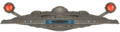 Bow aspect
 -
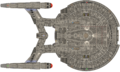 Dorsal aspect
 -
 Starboard aspect
 -
 Stern aspect
 -
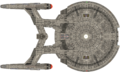 Central aspect
 -
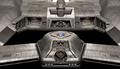 External field stabilizer
 -
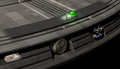 Starboard saucer edge
 -
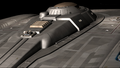 Saucer, aft of bridge
 -
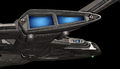 Starboard main impulse nozzle
 -
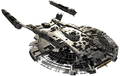 NX-02 pre-Columbia under early construction
 -
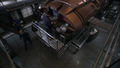 Main Engineering on Columbia (NX-02)
 -
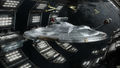 Columbia nearing launch
 -
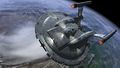 Enterprise class conducting planetary survey
 -
 Close-up passing shot of USS Discovery (NX-04)


.png)
.png)
.png)
.png)


-Main_engineering.jpg)
,_late_2154.jpg)


References