Guide:Aakenn: Difference between revisions
created |
|||
| (30 intermediate revisions by the same user not shown) | |||
| Line 1: | Line 1: | ||
{{Sidebar Guide ship | |||
|image=[[File:Aakenn (admhorten) (stbd).png|250px|''Aakenn'' heavy transport]] | |||
|classname= ''Aakenn'' | |||
|category= heavy transport | |||
|years= [[2247]]-[[2319]] | |||
* ''Aakenn'' Flt I heavy transports: [[2247]]-[[2277]] | |||
* ''Aakenn'' Flt II propulsive prototypes: [[2253]]-[[2277]] | |||
* ''Westminster'' heavy transports: [[2255]]-[[2299]] | |||
* ''Abbott'' heavy repair ships: [[2261]]-[[2319]] | |||
|constructed= 145 total: | |||
* ''Aakenn'': 67 (built [[2246]]-[[2254]]) | |||
* ''Aakenn'': 2 (built [[2253]]) | |||
* ''Westminster'': 76 (built [[2254]]-[[2263]]) | |||
* ''Abbott'': 6 (converted from ''Westminster'' [[2261]]-[[2262]]) | |||
|length= 235.9 m | |||
|beam= 124.3 m | |||
|height= 76.5 m | |||
|mass= <br> | |||
* 320,700 mt (''Aakenn'') | |||
* 321,000 mt (''Westminster'') | |||
* 339,200 mt (''Abbott'') | |||
|cruisespeed= w 6 | |||
|towspeed= | |||
|maxspeed= <br> | |||
* w 7.0 (''Aakenn'', loaded) | |||
* w 9.0 (''Aakenn'', unloaded) | |||
* w 7.2 (''Aakenn'' Flt II, loaded) | |||
* w 9.2 (''Aakenn'' Flt II, unloaded) | |||
* w 6.2 (''Westminster'', loaded) | |||
* w 8.3 (''Westminster'', ''Abbott'', unloaded) | |||
* w 6.0 (''Abbott'', standard load) | |||
* w 5.8 (''Abbott'', slung nacelle) | |||
|endurance= <br> | |||
* 2 years (''Aakenn'') | |||
* 4 years (''Westminster, Abbott'') | |||
|officers= 4 | |||
|enlisted= 50 | |||
|troops= 700 (troopship configuration) | |||
|passengers= 6 (cargo configuration) | |||
|patients= | |||
|crew= | |||
|cargo= <br> | |||
* 109,000 mt (''Aakenn'') | |||
* 139,000 mt (''Westminster'') | |||
* 40,000 mt (''Abbott'') | |||
|beamweapons= <br> | |||
<u>Original</u> | |||
* 1x laser emitter (600 MW) (ventral bow) | |||
* 1x laser emitter (600 MW) (ventral stern) | |||
<u>[[2259]] refit</u> | |||
* 1x phaser IV (ventral bow) | |||
* 1x phaser IV (ventral stern) | |||
|missileweapons= | |||
|otherweapons= | |||
|shields=<br> | |||
* 1-layer conformal forcefield | |||
* Navigational deflector on dorsal midhull | |||
|labs= | |||
|transporters=<br> | |||
<u>Original</u> | |||
* 2x GP (6-pad), Mk II | |||
* 4x small cargo, Mk II | |||
* 4x large cargo, Mk II | |||
<u>[[2249]] refit (most)</u> | |||
* 2x GP (6-pad), Mk III | |||
* 4x small cargo, Mk III | |||
* 4x large cargo, Mk III | |||
<u>[[2270]] refit (some)</u> | |||
* 2x GP (6-pad), Mk IV | |||
* 4x small cargo, Mk IV | |||
* 4x large cargo, Mk IV | |||
|auxcraft= <br> | |||
* 4x medium shuttles | |||
* 4x work pods | |||
* 12x landing barges/lifepods | |||
|historicalships=<br> | |||
* ''USS Aakenn'' | |||
* ''USS Abbott'' | |||
* ''USS Malacca'' (NCC-F2032) | |||
* ''USS Mundy'' (NCC-F2022) | |||
* ''USS Westminster'' | |||
|design= FASA, dimensions corrected | |||
|name= FASA | |||
|history= FASA | |||
}} | |||
In a matter of a few years, Project Starship and its offshoots had resulted in a quantum leap in | |||
[[Star Fleet]] capabilities and strength. So great in fact was this leap that many support assets were being | |||
left behind. This meant in practice a step back, to the sort of circumstances familiar from the early | |||
[[22nd century]]. Communications networks no longer covered the whole theater of operations; early | |||
warning sensors now guarded the rear instead of the front; and starships operating in the frontier had | |||
to barter for supplies, as logistics chains fell well short of starship range. | |||
Fortunately, all the prerequisites for building logistics support vessels apace with frontline starships | |||
were now in place. For once, the enemies were known quantities, so detailed procurement policies | |||
could be created without having to brace against major surprises. The Fleet had a reasonably strong | |||
defensive backbone, and its block obsolescence was not an immediate threat, thanks to the potential | |||
for solid-state engine and phaser upgrades. Thus, [[UFP]] industrial output could be channeled towards | |||
a balanced newbuild program: in addition to cruisers, destroyers, frigates, fleet control ships and | |||
tenders of the most modern sort, the shopping list of the [[2240s]] included half a thousand modern | |||
transports. | |||
The up-engining of the ''[[Guide:Independence|Independence]]'' class with PB-35 was one way to meet the transport | |||
requirement. There existed a specific demand for a heavier vessel, though. In addition to priority | |||
goods, Star Fleet was going to haul more mundane materiel to the frontier to support both the next | |||
exploration wave and the anti-Klingon operations. For this purpose, a fast vessel in the 100,000 ton | |||
cargo capacity range would be ideal. Since none were available in the commercial market, a design | |||
was created by [[Shintoi Heavy Industries]] to combine destroyer-type propulsion with a heavy | |||
spaceframe adapted from the massive ''[[Guide: Cochrane|Cochrane]]'' colonizers. Star Fleet eagerly accepted the proposal, | |||
and promised Shintoi complete PB-31C drive chains off the ''[[Guide:Larson|Larson]]'' production lines for the | |||
transport application. | |||
By [[2246]], Shintoi had fine-tuned its proposal into a mighty military machine quite on par with the | |||
combat starships of the era. Shielded to modern standards, capable of warp nine dash speed when | |||
free of load, and hauling more than a hundred thousand tons of cargo at fleet speed of warp six, the | |||
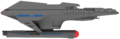
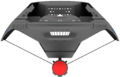
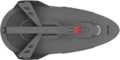
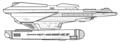
'''''Aakenn''''' was a class apart from the civilian standard of the day. The sleek pseudo-aerodynamic hull, | |||
236 meters long, was elegantly arranged into functional sections. These included a three-deck-high | |||
main level for cargo holds; dorsal structures for the navigational deflector and sensors plus various | |||
support and auxiliary power systems; a ventral bay for accepting cargo shuttles or pallets and | |||
distributing them to the hold area via internal lifts and transporters; and a stern area for the destroyer | |||
powerplant and impulse engines plus fuel tanks. | |||
At the last moment, however, Star Fleet withdrew the PB-31C and substituted the D model instead. | |||
In addition, demands on onboard sensor, SCM and communications system performance were | |||
increased. The most serious change was a requirement for troop transport capacity. All this came in | |||
response to the peaking Klingon threat, and presented Shintoi with an engineering and | |||
manufacturing challenge – but with priority resources as well. Three [[Star Fleet Division]] dockyards | |||
at [[Proxima Centauri]] were now slated for the production, in addition to the [[Tellar]] facilities already reserved. | |||
With such resources, Shintoi was able to deliver the first twenty ''Aakenns'' fully on schedule and equipped with twelve large lateral lifepods/barges for the up to 700 troops and | |||
with a new ventral bow sensor array for tactical scanning, tracking and fire control. Two 600 MW | |||
laser emitters were slaved to the sensors and to the [[Takakura]] Mk 2 main computer, a somewhat | |||
symbolic arsenal that nevertheless had practical applications as well. | |||
[[Image:No Photo Available.jpg|left|200px|thumb|There is a very good reason why this convoy of ''Aakenns'' from [[2249]] features no transports from other contemporary classes: a fleet speed of warp six would have been impossible for an ''[[Guide:Independence|Independence]]'' or even a fully laden ''[[Guide: Ptolemy|Ptolemy]]''. Inhabiting a comfortable niche in cargo capacity between the two classes, the ''Aakenn'' was the ideal means of transporting materiel to frontier and frontline bases from the [[2240s|forties]] to the [[2260s|sixties]]. Competition on [[UFP]] trunk routes was harsher, and the ''Aakenn'' had its shortcomings in the field of point supply and replenishment. Yet [[Star Fleet]] demand for frontier transport buoyed ''Aakenn'' production to the point of ultimate general commercial success.]] | |||
The fact that the Klingon War ultimately dwindled down to border skirmishes did not diminish | |||
Star Fleet’s need for the ''Aakenns'' one iota. On the contrary, the frontier nature of the conflict called | |||
for the special propulsive performance of the heavy transports. Production intensified to encompass | |||
‘deep homefront’ facilities at [[Cait]], and Shintoi was asked to integrate the PB-32 deep space engine | |||
into the latest production batches. The handful of Flight II prototypes were indeed followed with a | |||
PB-32D -propelled '''''Westminster''''' subclass operational variant in late [[2254]], half a year | |||
before the first similarly converted ''[[Guide: Ptolemy|Ptolemy]]'' would sail out. Yet an increase of maximum cargo load | |||
by 30,000 tons and doubling of propulsive endurance was accompanied by a reduction of top speed | |||
by one warp factor. Improved shields and computing systems were a more useful change, and | |||
phaser IV emitters of [[Armscor-Hindustan]] FH-2 model ultimately replaced the lasers. | |||
The ''Westminster'' subclass came several years too late to actually make a difference in the Klingon | |||
conflict. Star Fleet’s craving for the fast and capacious transports would not be satisfied until the | |||
production of 76 units, though, rounding out the total to 145 vessels. This did not include the | |||
civilian spin-offs, many of which had been licensed to feature PB-31 engines albeit not the other | |||
military gear. The availability of such vessels encouraged major UFP cargo operators to return to | |||
the formerly Klingon-menaced and still pirate-ridden space lanes, although not yet in sufficient | |||
strength to significantly boost the laggard economy. [[Star Fleet Merchant Marine]] still had to carry its | |||
cross: virtually all the Star Fleet ''Westminsters'' remained in service till the [[2299|end of the century]], not as | |||
Fleet theater transports but as general cargo vessels for the frontier. Whereas some older ''Aakenns'' | |||
were relegated to training duty [[2261|early on]], many were sold to commercial interests in the [[2277|seventies]]. | |||
Re-engining was seldom warranted, as transport duty was more forgiving for the sturdy single-nacelle | |||
configuration than for the long-pyloned, multi-engined tug designs. | |||
[[Image:No Photo Available.jpg|left|200px|thumb|The spectacular [[2268|demise]] of ''USS Malacca'' (NCC-F2032) in a covert operations strike at [[Starbase 47|SB 47]] was but one of the victories secured by Klingon Imperial Intelligence in the [[2260s]]. The ''Westminster'' transport succumbed to a series of internal explosions and barely avoided containment failure. It is presumed that such a calamity was the true goal of the Klingon bombers, as it would have crippled the starbase and, along with it, Star Fleet operations in the [[Taurus Reach]]. However, the explosives were almost amateurishly placed for such an outcome, giving several seconds for the multiply redundant containment protection and ejection systems to work.]] | |||
Six of the ''Westminster'' vessels were in [[2261]]-[[2262|62]] modified into '''''Abbott''''' heavy repair ships for supporting | |||
cruiser operations in deep space. They featured significant amounts of internal gear ranging from | |||
conventional workshops to advanced fabricators, and had reduced cargo facilities as a consequence. | |||
On the other hand, the ''Abbott'' vessels had a dorsal cargo sling for oversize components, up to and | |||
including a spare PB-32 or PB-47 engine if needed. Hauling of such a burden would reduce speed | |||
below nominal cruise value, yet was an essential service in the years of severe ''Ptolemy'' tug/tender | |||
shortage. | |||
Having set completely new standards for transport vessels all across the [[Federation]], the ''Aakenn'' series | |||
bowed out in the [[2319|2310s]]. A diverse set of commercial imitators, with slight differences in propulsion | |||
configuration, forms the backbone of medium distance cargo traffic even today. On the longest and | |||
shortest cargo routes, different solutions have emerged – yet the most significant watershed in UFP | |||
transport design history steadfastly remains at [[2247]], the year the classic [[Earth]] container transport | |||
and the [[Beta Rigel|Rigelian]] monohull both finally met their better. | |||
==Gallery== | ==Gallery== | ||
<gallery> | <gallery> | ||
File:Aakenn | |||
File:Aakenn (admhorten) (stbd).png|''Aakenn '' class | |||
File:Aakenn (admhorten) (bow).png | |||
File:Aakenn (admhorten) (dorsal).png | |||
File:Aakenn (admhorten) (stern).png | |||
File:Aakenn (admhorten) (ventral).png | |||
</gallery> | </gallery> | ||
[[Category: | ===Other Images=== | ||
<gallery> | |||
File:Aakenn (stbd).png|''Aakenn '' class | |||
File:Aakenn (bow).png | |||
File:Aakenn (dorsal).png | |||
</gallery> | |||
==Notes== | |||
* The reference to the first 20 ''Aakenns'' as Mark IIs has been removed, since I'm avoiding that terminology (in lieu of "flight" and "subclass"), and because it doesn't work that the first production series is the 2nd named. There is no evidence that a prototype was completed with differing specs. Where appropriate, the term "flight" has been used. | |||
* Adrasil: The 12 referenced laterally-placed barges/lifepods are depicted in the present rough image, but don't seem to be equally scaled. | |||
* It appears the specifically-''Aakenn'' subclasses served with [[Star Fleet]], while the ''Westminsters'' served with the [[SMM]]. I've decided that the ships that were retired in [[2319]] were specifically those of the ''Abbott'' subclass repair vessels. | |||
* Since there is now to be a Flight II for the ''Aakenns'', in order to support the process, the original ''USS Aakenn'' must be destroyed or otherwise decommissioned prior to [[2253]], so that a second newbuild ship may be so-named. | |||
* I've decided that the ''Aakenns'' first started to be relegated to training status in [[2261]], with the final one sold off to commercial operators in [[2277]]. | |||
* The reference to "Proxima" has been changed to [[Proxima Centauri]]. | |||
==Alt Sources== | |||
* [https://www.ststcsolda.space/federation/aakenn/aakenn.html STSTCSOLDA] | |||
* [https://vintagestarships.wordpress.com/2017/02/07/2251-aaken/ Vintage Starships: "2251 – Aaken"]: includes 3D viewer | |||
<br><br> | |||
---- | |||
*[[Guide: Timo's Guide to Star Fleet|Back to the Table of Contents]] | |||
*[[Guide: 2240-2270 - The Final Frontier|Back to "The Final Frontier"]] | |||
*[[Guide: Of Ship Statistics|Appendix A: Of Ship Statistics]] | |||
*[[Guide: Glossary|Appendix B: Glossary]] | |||
*[[Guide: Star Fleet Organization - General Outline|Appendix C: Star Fleet Organization - General Outline]] | |||
*[[Guide: Abbreviations From Outside|Appendix D: Abbreviations From Outside]] | |||
[[Category:Guide|{{PAGENAME}}]] | |||
Latest revision as of 15:06, 10 August 2024
_(stbd).png)
| |
| Aakenn | |
|---|---|
| Class Overview | |
| Category | heavy transport |
| Operational | 2247-2319 |
| Constructed | 145 total: |
| Dimensions | |
| Length | 235.9 m |
| Beam | 124.3 m |
| Height | 76.5 m |
| Mass |
|
| Performance | |
| Cruise Speed | w 6 |
| Max Speed |
|
| Endurance |
|
| Complement | |
| Officers | 4 |
| Enlisted | 50 |
| Troops | 700 (troopship configuration) |
| Passengers | 6 (cargo configuration) |
| Cargo |
|
| Tactical Systems | |
| Beam Weapons | Original
2259 refit
|
| Shields |
|
| Transporters | Original
2249 refit (most)
2270 refit (some)
|
| Auxiliary Craft |
|
| Historical | |
| Ships of Note |
|
| Canonicity | |
| Design | FASA, dimensions corrected |
| Name | FASA |
| History | FASA
|
In a matter of a few years, Project Starship and its offshoots had resulted in a quantum leap in
Star Fleet capabilities and strength. So great in fact was this leap that many support assets were being
left behind. This meant in practice a step back, to the sort of circumstances familiar from the early
22nd century. Communications networks no longer covered the whole theater of operations; early
warning sensors now guarded the rear instead of the front; and starships operating in the frontier had
to barter for supplies, as logistics chains fell well short of starship range.
Fortunately, all the prerequisites for building logistics support vessels apace with frontline starships were now in place. For once, the enemies were known quantities, so detailed procurement policies could be created without having to brace against major surprises. The Fleet had a reasonably strong defensive backbone, and its block obsolescence was not an immediate threat, thanks to the potential for solid-state engine and phaser upgrades. Thus, UFP industrial output could be channeled towards a balanced newbuild program: in addition to cruisers, destroyers, frigates, fleet control ships and tenders of the most modern sort, the shopping list of the 2240s included half a thousand modern transports.
The up-engining of the Independence class with PB-35 was one way to meet the transport requirement. There existed a specific demand for a heavier vessel, though. In addition to priority goods, Star Fleet was going to haul more mundane materiel to the frontier to support both the next exploration wave and the anti-Klingon operations. For this purpose, a fast vessel in the 100,000 ton cargo capacity range would be ideal. Since none were available in the commercial market, a design was created by Shintoi Heavy Industries to combine destroyer-type propulsion with a heavy spaceframe adapted from the massive Cochrane colonizers. Star Fleet eagerly accepted the proposal, and promised Shintoi complete PB-31C drive chains off the Larson production lines for the transport application.
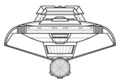
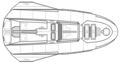
By 2246, Shintoi had fine-tuned its proposal into a mighty military machine quite on par with the combat starships of the era. Shielded to modern standards, capable of warp nine dash speed when free of load, and hauling more than a hundred thousand tons of cargo at fleet speed of warp six, the Aakenn was a class apart from the civilian standard of the day. The sleek pseudo-aerodynamic hull, 236 meters long, was elegantly arranged into functional sections. These included a three-deck-high main level for cargo holds; dorsal structures for the navigational deflector and sensors plus various support and auxiliary power systems; a ventral bay for accepting cargo shuttles or pallets and distributing them to the hold area via internal lifts and transporters; and a stern area for the destroyer powerplant and impulse engines plus fuel tanks.
At the last moment, however, Star Fleet withdrew the PB-31C and substituted the D model instead. In addition, demands on onboard sensor, SCM and communications system performance were increased. The most serious change was a requirement for troop transport capacity. All this came in response to the peaking Klingon threat, and presented Shintoi with an engineering and manufacturing challenge – but with priority resources as well. Three Star Fleet Division dockyards at Proxima Centauri were now slated for the production, in addition to the Tellar facilities already reserved. With such resources, Shintoi was able to deliver the first twenty Aakenns fully on schedule and equipped with twelve large lateral lifepods/barges for the up to 700 troops and with a new ventral bow sensor array for tactical scanning, tracking and fire control. Two 600 MW laser emitters were slaved to the sensors and to the Takakura Mk 2 main computer, a somewhat symbolic arsenal that nevertheless had practical applications as well.

The fact that the Klingon War ultimately dwindled down to border skirmishes did not diminish Star Fleet’s need for the Aakenns one iota. On the contrary, the frontier nature of the conflict called for the special propulsive performance of the heavy transports. Production intensified to encompass ‘deep homefront’ facilities at Cait, and Shintoi was asked to integrate the PB-32 deep space engine into the latest production batches. The handful of Flight II prototypes were indeed followed with a PB-32D -propelled Westminster subclass operational variant in late 2254, half a year before the first similarly converted Ptolemy would sail out. Yet an increase of maximum cargo load by 30,000 tons and doubling of propulsive endurance was accompanied by a reduction of top speed by one warp factor. Improved shields and computing systems were a more useful change, and phaser IV emitters of Armscor-Hindustan FH-2 model ultimately replaced the lasers.
The Westminster subclass came several years too late to actually make a difference in the Klingon conflict. Star Fleet’s craving for the fast and capacious transports would not be satisfied until the production of 76 units, though, rounding out the total to 145 vessels. This did not include the civilian spin-offs, many of which had been licensed to feature PB-31 engines albeit not the other military gear. The availability of such vessels encouraged major UFP cargo operators to return to the formerly Klingon-menaced and still pirate-ridden space lanes, although not yet in sufficient strength to significantly boost the laggard economy. Star Fleet Merchant Marine still had to carry its cross: virtually all the Star Fleet Westminsters remained in service till the end of the century, not as Fleet theater transports but as general cargo vessels for the frontier. Whereas some older Aakenns were relegated to training duty early on, many were sold to commercial interests in the seventies. Re-engining was seldom warranted, as transport duty was more forgiving for the sturdy single-nacelle configuration than for the long-pyloned, multi-engined tug designs.
Six of the Westminster vessels were in 2261-62 modified into Abbott heavy repair ships for supporting cruiser operations in deep space. They featured significant amounts of internal gear ranging from conventional workshops to advanced fabricators, and had reduced cargo facilities as a consequence. On the other hand, the Abbott vessels had a dorsal cargo sling for oversize components, up to and including a spare PB-32 or PB-47 engine if needed. Hauling of such a burden would reduce speed below nominal cruise value, yet was an essential service in the years of severe Ptolemy tug/tender shortage.
Having set completely new standards for transport vessels all across the Federation, the Aakenn series bowed out in the 2310s. A diverse set of commercial imitators, with slight differences in propulsion configuration, forms the backbone of medium distance cargo traffic even today. On the longest and shortest cargo routes, different solutions have emerged – yet the most significant watershed in UFP transport design history steadfastly remains at 2247, the year the classic Earth container transport and the Rigelian monohull both finally met their better.
Gallery
-
 Aakenn class
 -
-

-

-
_(bow).png)
_(dorsal).png)
_(stern).png)
_(ventral).png)
Other Images
-
 Aakenn class
 -
-
.png)
.png)
.png)
Notes
- The reference to the first 20 Aakenns as Mark IIs has been removed, since I'm avoiding that terminology (in lieu of "flight" and "subclass"), and because it doesn't work that the first production series is the 2nd named. There is no evidence that a prototype was completed with differing specs. Where appropriate, the term "flight" has been used.
- Adrasil: The 12 referenced laterally-placed barges/lifepods are depicted in the present rough image, but don't seem to be equally scaled.
- It appears the specifically-Aakenn subclasses served with Star Fleet, while the Westminsters served with the SMM. I've decided that the ships that were retired in 2319 were specifically those of the Abbott subclass repair vessels.
- Since there is now to be a Flight II for the Aakenns, in order to support the process, the original USS Aakenn must be destroyed or otherwise decommissioned prior to 2253, so that a second newbuild ship may be so-named.
- I've decided that the Aakenns first started to be relegated to training status in 2261, with the final one sold off to commercial operators in 2277.
- The reference to "Proxima" has been changed to Proxima Centauri.
Alt Sources
- STSTCSOLDA
- Vintage Starships: "2251 – Aaken": includes 3D viewer