Guide:Ranger (courier): Difference between revisions
No edit summary |
|||
| (32 intermediate revisions by the same user not shown) | |||
| Line 1: | Line 1: | ||
{{Sidebar Guide ship | {{Sidebar Guide ship | ||
|image=[[|250px|Ranger courier]] | |image=[[File:Ranger (courier) (stbd).png|250px|Ranger courier]] | ||
|classname= ''Ranger'' | |classname= ''Ranger'' | ||
|category= courier | |category= training ship/courier/corsair | ||
|years= [[2264]] - [[2324]] | |years= [[2264]] - [[2324]] | ||
* Flight I ([[2264]] - [[ | * Flight I (training ship): [[2264]] - [[2280]] | ||
* Flight II ([[2269]] - [[ | * Flight II (training ship/courier): [[2269]] - [[2324]] | ||
* Flight III ([[2272]] - [[ | * Flight III (corsair): [[2272]] - [[2324]] | ||
|constructed= 264 total:<br> | |constructed= 264 total:<br> | ||
* Flt I: 102 (built [[2264]] - [[2268]]) | * Flt I: 102 (15 [[Star Fleet]]) (built [[2264]] - [[2268]]) | ||
* Flt II: 108 (3 refitted from Flt I and 105 built [[2269]] - [[2271]]) | * Flt II: 108 (3 & 40 Star Fleet) (3 refitted from Flt I and 105 built [[2269]] - [[2271]]) | ||
* Flt III: 54 (built [[2272]] - [[2274]]) | * Flt III: 54 (all Star Fleet) (built [[2272]] - [[2274]]) | ||
|length= 68.0 m | |length= 68.0 m | ||
|beam= 43.5 m | |beam= 43.5 m | ||
| Line 46: | Line 46: | ||
|transporters= <br> | |transporters= <br> | ||
* 2x GP (1-pad); Mk III | * 2x GP (1-pad); Mk III | ||
* 1x emergency evacuation ( | * 1x emergency evacuation (padless); Mk III | ||
|auxcraft= 2x shuttlepods (Flt I only) | |auxcraft= 2x shuttlepods (Flt I only) | ||
|historicalships= <br> | |historicalships= <br> | ||
| Line 57: | Line 57: | ||
==Background: ''Hobbyist's Guide''== | ==Background: ''Hobbyist's Guide''== | ||
[[Image:No Photo Available.jpg|left|250px|thumb|A rare ''Ranger'' to ''Ranger'' meeting in deep space. The craft often operated in groups of three in local defense missions, but courier or scouting tasks were handled solo. These Flight I craft fire their original bow phasers to good effect. Note also the field constrictors and modified ramscoops on the PB-60s, optimized for the rare high endurance role of the engine here.]] | |||
[[VXT]] wasn’t the only company interested in making use of the new PB-60 engine, and the [[Federation Customs Service]] wasn’t the only organization interested in purchasing the resulting vessels. Yet the market niche remained a narrow one in the [[2260s]], as antimatter powerplants remained expensive to operate. People capable of securing a private warp five yacht could well be assumed to have powerful backers of possibly shady repute and to utilize their high speed craft for dubious purposes. Larger vessels with more obvious utility value were the safer bet for the designers and marketers and, in [[2263]], [[Panastris]] took on the challenge. | |||
[[Image:No Photo Available.jpg|left|250px|thumb|A different kind of ''Ranger'' to ''Ranger'' encounter. In theory, ''USS Ibn Rustah'' of ''[[Guide:Pytheas|Pytheas]]'' subclass kept the cruiser class name ''Ranger'' in active [[Star Fleet]] use till the [[2290s]], creating terminological overlap with the small craft. In practice, confusion was unlikely in every respect.]] | |||
was | |||
[[ | The market Panastris aimed at was not the generic warp five transport, since PB-40 was already giving maximum performance for the ''[[Guide:Tavares|Tavares]]'' class, and the newer engine would only generate deadly field gradients if semi-internally mounted onto the compact vessel. A higher-performing vessel would need to mount the engines on long pylons, in such a configuration as to rule out landing capability. So a thoroughbred starcraft was built instead, with a clean 36-meter saucer hull that mounted a powerful deflector and sensor array at centerline bow and twin impulse engines on the trailing edge. The reactor sat in the very middle, atop an IMRF crystal that completed the propulsive ensemble of the craft. Reactor control spaces and the flight control center were combined into a compact facility just ahead of the reactor, atop the bow arrays. | ||
[[File:USS Strider in distress.png|left|250px|thumb|''USS Strider'' in distress. The offensive action taken by the scout against the Klingon Empire in [[2273]] was never given a satisfactory public explanation, nor was the timidity of the Klingon response. The mysteries are typical of the era of clandestine operations and counter-operations that was supposed to culminate in open war.]] | |||
The bow quarters of the hull were left for crew and passengers, with wraparound window slits and shutterable dorsal and ventral portholes. The spaces could be configured for various purposes, including separate cabins, communal areas or various functional facilities. A single transporter pad was provided on each side, and the initial model also featured compact dorsal berths for three-person shuttlepods. The discerning customer could add centerline launchers for light torpedoes and | |||
two phaser III emitters on the lower corners of the bow array. | |||
for | |||
[[ | More than a hundred of these large craft were sold as couriers to various [[Federation]] customers; Panastris was unable to secure rights to offer the PB-60 to foreign markets, and there would have been no point in offering the craft with a lesser engine. Government orders followed after a more heavily armed and provisioned Flight II variant was introduced. The most visible change was replacement of pod berths with twin Type IV phasers, giving the model serious firepower for gunboat missions. A final batch of fifty was added in the [[2270s|early seventies]], before the benefits of linear excitation warp drives began to trickle down to this size range of starcraft. | ||
was | |||
[[Star Fleet Training Command]] made use of fifteen of the craft (NCC-T6000 to -T6014), gradually selling them forward to the civilian market in a stripped-down configuration until just three were left. These soldiered on until [[2324]], providing practical training in high speed astrogation and allowing for extended missions involving large numbers of trainees. Forty more saw brief service in armed light scouting and courier duty, with regular registries in the NCC-7140 to -7179 range. These were attached to border starbases and outposts, and continued the work of the smaller ''[[Guide:Archer|Archer]]'' scouts under their commercial class name ''Ranger'', despite name conflict with the frontier cruisers from the beginning of the century. | |||
[[ | Twenty-seven Flight III craft are also known to have been operated by [[Star Fleet Intelligence]] at various times, presumably also taking part in corsair operations. A corresponding number were dedicated to combat tasks in regional fleets and mercenary organizations, both of which met with federal disapproval in the [[24th century|early 24th century]] and had to downscale their operations. | ||
==Gallery== | ==Gallery== | ||
<gallery> | <gallery> | ||
File:Ranger (courier) (stbd).png | |||
File:Ranger (courier) (bow).png | |||
File:Ranger (courier) (dorsal).png | |||
File:Ranger (courier) (stern).png | |||
File:Ranger (courier) (ventral).png | |||
</gallery> | </gallery> | ||
| Line 137: | Line 102: | ||
==Notes== | ==Notes== | ||
* The | * The Flight III production run will fall under the standard registry. | ||
* The [[2380]] end-year of the Flight I represents the final transference or upgrade to Flight II status, the drawdown beginning in [[2272]]. The [[2324]] end-year for the Flight II is based upon the three remaining Flight Is being upgraded to IIs, with a concrete decommissioning that year. The regular Star Fleet Flight IIs are decommissioned sooner ([[2279]]), due to their " brief service in armed light scouting and courier duty". The 2324 end-year for the Flight IIIs is determined from the "federal disapproval in the early 24th century" statement. | |||
* The "up to thirty Flight II and III craft" has been amended to twenty-seven exactly, all Flights III. | |||
* '''Task''': change the Flight III to a subclass name, since those vessels were the only ones built to that standard (per [[Flights & Versions]]). | |||
* The "constructed" field represents [[Panastris]]' complete production run, rather than the default numbers in Star Fleet duty. The numbers procured for Star Fleet are: | |||
- 15 Flight Is, in use by [[Star Fleet Training Command]]<br> | |||
- 3 Flight IIs refitted to Flight II (for Star Fleet Training Command) and 40 Flight IIs built for regular [[Star Fleet]] use, at starbases and other outposts<br> | |||
- 54 Flight IIIs purposefully built for [[Star Fleet Intelligence]] (and other "mandated" users) | |||
* Despite Adrasil's (pre-DD) depictions with LN nacelles, all flights made use of the PB-60. | |||
==Alt Sources== | |||
* [https://www.ststcsolda.space/federation/ranger/ranger.html STSTCSOLDA] | |||
<br><br> | <br><br> | ||
Latest revision as of 15:03, 10 August 2024
_(stbd).png)
| |
| Ranger | |
|---|---|
| Class Overview | |
| Category | training ship/courier/corsair |
| Operational | 2264 - 2324 |
| Constructed | 264 total: |
| Dimensions | |
| Length | 68.0 m |
| Beam | 43.5 m |
| Height | 16.0 m |
| Mass |
|
| Performance | |
| Cruise Speed | w 5.0 |
| Max Speed | w 7.1 |
| Endurance | 18 months |
| Complement | |
| Officers | 4 |
| Crew |
|
| Passengers | 10 - 50 |
| Cargo | Mk II: |
| Tactical Systems | |
| Beam Weapons | Flight I:
Flights II/III:
|
| Missile Weapons | Optional:
|
| Shields |
|
| Transporters |
|
| Auxiliary Craft | 2x shuttlepods (Flt I only) |
| Historical | |
| Ships of Note |
|
| Canonicity | |
| Design | FASA (Timo) |
| Name | FASA |
| History | FASA
|
Background: Hobbyist's Guide

VXT wasn’t the only company interested in making use of the new PB-60 engine, and the Federation Customs Service wasn’t the only organization interested in purchasing the resulting vessels. Yet the market niche remained a narrow one in the 2260s, as antimatter powerplants remained expensive to operate. People capable of securing a private warp five yacht could well be assumed to have powerful backers of possibly shady repute and to utilize their high speed craft for dubious purposes. Larger vessels with more obvious utility value were the safer bet for the designers and marketers and, in 2263, Panastris took on the challenge.
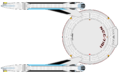
The market Panastris aimed at was not the generic warp five transport, since PB-40 was already giving maximum performance for the Tavares class, and the newer engine would only generate deadly field gradients if semi-internally mounted onto the compact vessel. A higher-performing vessel would need to mount the engines on long pylons, in such a configuration as to rule out landing capability. So a thoroughbred starcraft was built instead, with a clean 36-meter saucer hull that mounted a powerful deflector and sensor array at centerline bow and twin impulse engines on the trailing edge. The reactor sat in the very middle, atop an IMRF crystal that completed the propulsive ensemble of the craft. Reactor control spaces and the flight control center were combined into a compact facility just ahead of the reactor, atop the bow arrays.

The bow quarters of the hull were left for crew and passengers, with wraparound window slits and shutterable dorsal and ventral portholes. The spaces could be configured for various purposes, including separate cabins, communal areas or various functional facilities. A single transporter pad was provided on each side, and the initial model also featured compact dorsal berths for three-person shuttlepods. The discerning customer could add centerline launchers for light torpedoes and two phaser III emitters on the lower corners of the bow array.
More than a hundred of these large craft were sold as couriers to various Federation customers; Panastris was unable to secure rights to offer the PB-60 to foreign markets, and there would have been no point in offering the craft with a lesser engine. Government orders followed after a more heavily armed and provisioned Flight II variant was introduced. The most visible change was replacement of pod berths with twin Type IV phasers, giving the model serious firepower for gunboat missions. A final batch of fifty was added in the early seventies, before the benefits of linear excitation warp drives began to trickle down to this size range of starcraft.
Star Fleet Training Command made use of fifteen of the craft (NCC-T6000 to -T6014), gradually selling them forward to the civilian market in a stripped-down configuration until just three were left. These soldiered on until 2324, providing practical training in high speed astrogation and allowing for extended missions involving large numbers of trainees. Forty more saw brief service in armed light scouting and courier duty, with regular registries in the NCC-7140 to -7179 range. These were attached to border starbases and outposts, and continued the work of the smaller Archer scouts under their commercial class name Ranger, despite name conflict with the frontier cruisers from the beginning of the century.
Twenty-seven Flight III craft are also known to have been operated by Star Fleet Intelligence at various times, presumably also taking part in corsair operations. A corresponding number were dedicated to combat tasks in regional fleets and mercenary organizations, both of which met with federal disapproval in the early 24th century and had to downscale their operations.
Gallery
_(bow).png)
_(dorsal).png)
_(stern).png)
_(ventral).png)
Other Images
-
 Ranger class
 -

-

-

-
-

-

-

-

-
 Darwin on assignment
.png)
.png)
.png)
.png)
.png)
.png)
.png)
.png)
.png)
.png)
Notes
- The Flight III production run will fall under the standard registry.
- The 2380 end-year of the Flight I represents the final transference or upgrade to Flight II status, the drawdown beginning in 2272. The 2324 end-year for the Flight II is based upon the three remaining Flight Is being upgraded to IIs, with a concrete decommissioning that year. The regular Star Fleet Flight IIs are decommissioned sooner (2279), due to their " brief service in armed light scouting and courier duty". The 2324 end-year for the Flight IIIs is determined from the "federal disapproval in the early 24th century" statement.
- The "up to thirty Flight II and III craft" has been amended to twenty-seven exactly, all Flights III.
- Task: change the Flight III to a subclass name, since those vessels were the only ones built to that standard (per Flights & Versions).
- The "constructed" field represents Panastris' complete production run, rather than the default numbers in Star Fleet duty. The numbers procured for Star Fleet are:
- 15 Flight Is, in use by Star Fleet Training Command
- 3 Flight IIs refitted to Flight II (for Star Fleet Training Command) and 40 Flight IIs built for regular Star Fleet use, at starbases and other outposts
- 54 Flight IIIs purposefully built for Star Fleet Intelligence (and other "mandated" users)
- Despite Adrasil's (pre-DD) depictions with LN nacelles, all flights made use of the PB-60.
Alt Sources