Guide:Burke: Difference between revisions
| (38 intermediate revisions by the same user not shown) | |||
| Line 110: | Line 110: | ||
|name= SFB, LUG | |name= SFB, LUG | ||
|history= SFB, ST:Axanar | |history= SFB, ST:Axanar | ||
|delta= [http://starshiptracker.com/deltadynamics/images/8/84/Report_Burke_frigates.pdf ''SRM #291''] | |||
}} | }} | ||
==Background== | ==Background== | ||
=== | ===''Hobbyist's Guide''=== | ||
[[File:Aldrin Flt II (booster) (dorsal).png|left|300px|thumb|The deep space patrol frigate. The arch mount for torpedoes did exist in stock and simply was never applied on this ship type; it is the lack of a dorsal centerline booster package that actually visually separates the nearspace patrollers from their deep space sisters. The original PB-21 engines were installed without aft field visors, as opposed to most other applications of the engine.]] | [[File:Aldrin Flt II (booster) (dorsal).png|left|300px|thumb|The deep space patrol frigate. The arch mount for torpedoes did exist in stock and simply was never applied on this ship type; it is the lack of a dorsal centerline booster package that actually visually separates the nearspace patrollers from their deep space sisters. The original PB-21 engines were installed without aft field visors, as opposed to most other applications of the engine.]] | ||
| Line 245: | Line 246: | ||
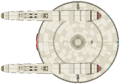
The four variants were never used in any fleet operational actions. While there was certainly the opportunity, in reality operational area commanders only had the modules installed on their assigned ''Burke'' assets for the directed weapons exercises and rarely for scheduled patrols; the reason was that the other versatility of the vessel—diplomacy—was deemed far more important than the overt militarization of a respected response vessel. However, Star Fleet did not abandon the idea of the weapons pod, easily recognizing the need for such a capacity, and settled on a final configuration that was unveiled with the fourth flight of the ''Burkes'', in [[2252]]. | The four variants were never used in any fleet operational actions. While there was certainly the opportunity, in reality operational area commanders only had the modules installed on their assigned ''Burke'' assets for the directed weapons exercises and rarely for scheduled patrols; the reason was that the other versatility of the vessel—diplomacy—was deemed far more important than the overt militarization of a respected response vessel. However, Star Fleet did not abandon the idea of the weapons pod, easily recognizing the need for such a capacity, and settled on a final configuration that was unveiled with the fourth flight of the ''Burkes'', in [[2252]]. | ||
=====Burke Flt II weapons pod===== | =====''Burke'' Flt II weapons pod===== | ||
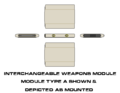
The four torpedo module variants released with the Flight II were: | The four torpedo module variants released with the Flight II were: | ||
| Line 268: | Line 269: | ||
</gallery> | </gallery> | ||
== | ====''Aldrin'' Flight II deep space frigate==== | ||
===''Burke'' Flight III nearspace frigate=== | Between [[2235]] and [[2237]], all 24 vessels of the ''Aldrin'' subclass entered drydocks and spacedocks for their standard refit periods, along with the ''Burkes''. The most important tactical upgrade they each received was having the three laser emitters removed and replaced with six Type L phased particle cannons of 1.2 terrawatt capacity, secured by spacetight hatches. Four were provided on the dorsal saucer, with the remaining two on the ventral side. | ||
A lack of satisfaction with the PB-21B nacelle crafted to the mission profile of the frigates was primarily focused on the range capacity afforded the ship, which was limited to a cruise limit of warp 4, and a maximum speed of warp 6.5. Modelling suggested that a reflux of the warp field, focused on the immediate aft, along with a few other longevity and internal maintenance tweaks, might tip the scales of efficiency a bit in the ships' favor; a subspace field visor coupled on to the extreme end of the nacelles, however, did not support the results of the modelling. They were not removed, as they seemed to have no effect one way or the other, other than somewhat restricting the light emissions from that particular field window. | |||
=====''Aldrin'' Flight II booster pod===== | |||
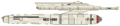
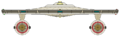
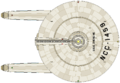
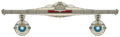
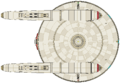
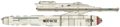
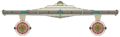
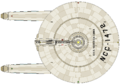
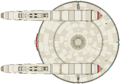
One of the selling points by Geering for the ''Aldrin'' subclass deep space frigate was the adaptability afforded by the spinal extension (with its additional fuel storage), vitally necessary for extending the patrolling range of the original class. The shipbuilder heavily pushed the versatility and capacity of the attachment rail running fore to aft along the extension for all sorts of sensors, mechanical gear, and other equipment, both proposed and as-yet unrealized. If an ''Aldrin'' was to be in the vicinity of a Class G Dichromic nebula, then the area commander could outfit the ship with the appropriate gravimetric sensors to map the distortions. An astrometric suite would be ideal for that T Tauri star just off the charted course. And independently controlled spotlights would be critical to assisting in ship-based recovery efforts, especially in the post-event investigations. | |||
All of these events did occur, and many more, but one thing every ship's commanding officer requested before short- or mid-length deployments was the booster pod. While definitely a fuel burner, the immediate acceleration from both a full stop and during an otherwise-steady delta vee was commendable and potentially a life-saver. ''Aldrins'' were not oblivious of the various pirate forces, Orions included, and the unexpected rate of closure could often startle an otherwise confident hostile boarding party "visiting" a hapless merchant freighter. And when the warp bubble was fully formed, the additional 0.05 c of impulse could stop the show. | |||
Certainly, the booster pod was a popular request with ''Aldrins'', and once they were fully produced, rarely would a deep space frigate be seen without one, unless it was transiting thru the inner Federation or on a long-range patrol, outside of dependable refueling stages. | |||
A similar image to the ''Aldrin'' Flight II with booster pod will be found within the Aldrin Flight IV entry. | |||
<gallery> | |||
File:Aldrin Flt II (stbd).png | |||
File:Aldrin Flt II (bow).png | |||
File:Aldrin Flt II (dorsal).png | |||
File:Aldrin Flt II (stern).png | |||
File:Aldrin Flt II (ventral).png | |||
File:Aldrin Flt II (booster) (stbd).png|''Aldrin'' Flight II w/ booster pod | |||
File:Aldrin Flt II (booster) (bow).png | |||
File:Aldrin Flt II (booster) (dorsal).png | |||
File:Aldrin Flt II (booster) (stern).png | |||
File:Aldrin Flt II (booster) (ventral).png | |||
</gallery> | |||
====''Burke'' Flight III nearspace frigate==== | |||
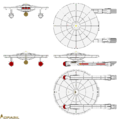
In [[2244]], the Andorian shipbuilder company [[Chiokis]], a sub-contracting design firm for previous ship classes, won the Star Fleet bid to modernize the ''Burke'' class nearspace frigate with the new solid state era nacelles. Chiokis seized this for the opportunity to promote its primary hull design (also a saucer shape), because the new PB-45 warp nacelles required external power generation: a total matter conversion powerplant not built into the nacelle itself, allowing the ship to achieve a cruising speed of warp 5 and a max speed of warp 8. This required a near-complete redesign of the saucer section to accommodate this massive new system. | |||
Select ships of the ''Burke'' and ''Aldrin'' subclass series were designated for this radical refit; along with the new saucer modifications—both internal and external—they also received the latest (in the now more dependable) phaser emitters in twin banks, the new SAD impulse assembly, and, for the nearspace frigates, a destroyer-type sensor dish attached to the ventral saucer via a "bulge" extension that would very soon be considered as characteristic of Chiokis' saucers. These modifications gave the ships a more engineered—less organic—look compared to the majority of the remaining ships of [[Geering]] origination. | |||
All in all, only 8 of the ''Burkes'' would receive this upgrade. Not because the design concept was a failure, by any means, but because of the expense and time for the upgrade was deemed too intrusive. This class would soon be a generation older in comparison to the numerous ship designs expected to be released as the vanguard of a large modernization leap forward for the fleet, and their lifespan would be limited regardless of any major facelifts. Additionally, both the existing nearspace and deep space ships were deemed too critical to operations in the short term to take them out of service for the time needed to refit the entire class. | |||
<gallery> | <gallery> | ||
File:Burke Flt III (stbd).png| | File:Burke Flt III (stbd).png| | ||
| Line 278: | Line 311: | ||
</gallery> | </gallery> | ||
===''Aldrin'' Flight III deep space frigate=== | ====''Aldrin'' Flight III deep space frigate==== | ||
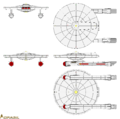
In [[2244]], the Andorian shipbuilder company [[Chiokis]], a sub-contracting design firm for previous ship classes, won the Star Fleet bid to modernize the ''Burke'' class nearspace frigate with the new solid state era nacelles. Chiokis seized this for the opportunity to promote its primary hull design (also a saucer shape), because the new PB-45 warp nacelles required external power generation: a total matter conversion powerplant not built into the nacelle itself, allowing the ship to achieve a cruising speed of warp 5 and a max speed of warp 8. This required a near-complete redesign of the saucer section to accommodate this massive new system. | |||
Select ships of the ''Burke'' and ''Aldrin'' subclass series were designated for this radical refit; along with the new saucer modifications—both internal and external—-they also received the latest (in the now more dependable) phaser emitters in twin banks, the new SAD impulse assembly, and, a ventral "bulge" extension that would very soon be considered as characteristic of Chiokis' saucers. These modifications gave the ships a more engineered—less organic—-look compared to the majority of the remaining ships of Geering origination. | |||
All in all, only four of the ''Aldrins'' would receive this upgrade (though an additional eight would be selected for the ''Magellan'' deep reconnaissance variation). Not because the design concept was a failure, by any means, but because of the expense and time for the upgrade was deemed too intrusive. This class would soon be a generation older in comparison to the numerous ship designs expected to be released as the vanguard of a large modernization leap forward for the fleet, and their lifespan would be limited regardless of any major facelifts. Additionally, both the existing nearspace and deep space ships were deemed too critical to operations in the short term to take them out of service for the time needed to refit the entire class. | |||
<gallery> | <gallery> | ||
File:Aldrin Flt III (stbd).png | File:Aldrin Flt III (stbd).png | ||
| Line 287: | Line 326: | ||
</gallery> | </gallery> | ||
===''Magellan'' subclass scout cruiser=== | ====''Magellan'' subclass scout cruiser==== | ||
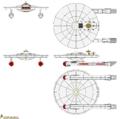
In [[2244]], with the decision to upgrade the ''Burkes'' and ''Aldrins'' to the developing [[Chiokis]] standard, a total of 12 of the latter subclass were re-assigned to regional drydocks to begin the yard period. Eight of these were selected to receive what was tentatively referred to as the ''Aldrin'' Flight III Plus overhaul, wherein they would receive all of the deep space equipment, but also have a multi-mission adaptable sensor suite bolted on all three sides of the re-configured spinal extension. | |||
Oddly enough, one of the selling features of the earlier Flight II ''Aldrins'' was the adaptable attachment rail that ran along the dorsal side of the extension, but was removed for the Flight III series. Nonetheless, the variety of sensors installed (gravimetric, multiphasic, magneton, subspace differential, and virtual positron) were not intended to come off and their breadth met more than most expected contingencies. Additionally, an improved command, control, communications, and intelligence (C3I) suite was internally installed to allow the ship to conduct its main mission: deep space reconnaissance. And in this role they performed exceptionally well, with sterling service in the Four Years War. | |||
<gallery> | <gallery> | ||
File:Magellan (stbd).png | File:Magellan (stbd).png | ||
| Line 296: | Line 339: | ||
</gallery> | </gallery> | ||
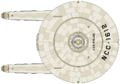
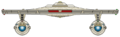
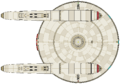
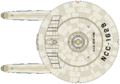
===''Burke'' Flight IV nearspace frigate=== | ====''Burke'' Flight IV nearspace frigate==== | ||
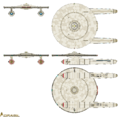
As stated previously, the Flight III series of refits for the ''Burkes'' and ''Aldrins'' were abbreviated to 8 and 4 (respectively), due both in part to the expense of upgrading an entire class of aging vessels and their high OPTEMPO, regardless of their warp 6.5 or 8 nacelles. The ships were the linchpin for regional commanders, both in the major spacelanes and the "mid-space" between the homeworlds and the frontier. While it was regrettable the majority of the overall class would not be able to make use of the newer and faster PB-45 nacelles, they were still needed and valued in their respective roles. | |||
Though long range intentions had the ''Burke'' lines operational into the [[2270s]], the intent also was to keep the ships relevant. Between [[2252]] and [[2254]], all remaining Flight IIs were brought into the yards for overhauls of the weapons systems. Both the plasma and particle cannons were removed, freeing up considerable space for the Type VI phaser emitters, now that the technology had hit its reliable stride. However, these modernizations did not allow the class to remain operational for the planned length; the first decommissionings began with a sizable block at the beginning of the [[2260s]], with the last stricken from the Star Fleet rolls in [[2267]]. | |||
=====''Burke'' Flight IV weapons pod===== | |||
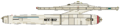
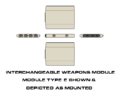
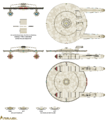
The ''Burkes'' and ''Aldrins'' saw their beam weaponry armament halved with the replacement of the plasma and particle cannons by the three twin-bank phaser emitters during the refit beginning in [[2252]], from Flight II to Flight IV status. Commanding officers were not reticent to undergo this conversion, for phaser technology was well-touted by the skippers of other ships of the line. That faith did not mean there was any discussion of relieving the ''Burkes'' of their missile capabilities by removing the modular weapons sled, though. Quite the opposite: Star Fleet now felt it had enough test data to suggest the Type E torpedo module as the standard launcher for sled-equipped ships. Four forward-facing launchers were supported by a large aft-facing vent, allowing the launch-phase targeting sensors to work unimpeded. While this final configuration did not include the aft-facing launchers, the commonality of equipment and alignment allowed the weapons department on each of these ships a greater rate of fire than had been achieved in similar exercises with the previous four configurations. | |||
By this time, operational area commanders were much less reluctant to outfit their ''Burkes'' with the weapons sled: regional partners and member states were becoming more accustomed to a more militarized Star Fleet, though they were also appreciative of the duality the fleet demonstrated through the more peace-oriented interactions of other vessels, such as cruisers and medical ships. It didn't hurt, either, to see a ''Burke'' warp into the system with a weapons sled now equipped with the new sensor module, in order to timely examine, in detail, some anomaly that had made its presence known or to assist in a black swan catastrophe. | |||
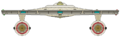
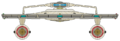
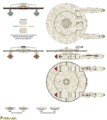
=====''Burke'' Flight IV deflector pod===== | |||
In [[2258]], a concerted effort was made to save the megesti, an energy-hungry spaceborne species endemic to the [[Algol]] system. Studied off and on by visiting exploration and research vessels for a few decades, several conclusions had been reached: the megesti's "natural environment" had been constructed (for them?) 23,000 years ago by parties unknown as a subspace disk orbiting two of the three stars, and the disk was rapidly degrading. The creatures had no more than another 1,550 years before they would fully dissipate. The ''[[Guide: Horizon|Horizon]]'' class ''USS Victoria'''s survey of the system and the swarm had even raised the (hotly debated) question of the species' sentience. | |||
The rescue concept was predicated on the idea of rejuvenating the subspace disk using warp-enabled deflectors to build and possibly retain "energy bridges" from the stars' highly charged center of gravity. Normally, such a feat would be well outside the capacity of the Federation, as most inhabitable zones of a solar system are almost a full astronomical unit (AU) or more from the host star(s), and the sheer amount of energy needed to even attempt such a task would be inconceivable. However, the close orbital nature of Beta Persei Aa1 and Aa2 (0.062 AU) allowed the swarm to endlessly travel about the binary pair at a relative distance of only 0.17 AU. Theoreticians suggested it just might be achievable in this specific situation. | |||
Six Flight IV ''Burkes'' were equipped with their weapons pods and specially manufactured deflector modules. Five of the vessels were staged at equidistant points within the swarm's orbit (the sixth had standby duty) and engaged their modules at a precise point of the stars' shared revolution. While early indications supported the development of the bridge, it was determined the initial attempt was too short. A month later, the task force tried again, holding their positions for 16 days, and the results were encouraging; the subspace disk was definitely strengthened and the megesti reacted with a multitude of colors in the visual spectrum and alternating oscillations in intensity in the ultraviolet bands. However, when the optimal period of star orbits had passed and the beams were disengaged, the bridges withdrew and the same ratio of degradation had returned. At most, the effort only sustained the swarm's environment for the period of external activity. | |||
It was concluded that a series of stationary subspace enhancers might be able to maintain the bridges for about half the orbital time, which meant that the Federation's efforts would only extend the environment by about an additional 800 years. A better answer would have to be discovered. Meanwhile, the deflector pods would go back into storage, not to be brought out again over the remaining 2 years of the ''Burkes''' service. | |||
<gallery> | <gallery> | ||
File:Burke Flt IV (stbd).png | File:Burke Flt IV (stbd).png | ||
| Line 317: | Line 378: | ||
</gallery> | </gallery> | ||
===''Aldrin'' Flight IV deep space frigate=== | ====''Aldrin'' Flight IV deep space frigate==== | ||
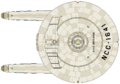
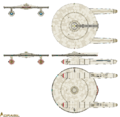
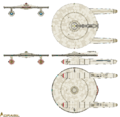
The ''Burkes'' and ''Aldrins'' saw their beam weaponry armament halved with the replacement of the plasma and particle cannons by the three twin-bank phaser emitters during the refit beginning in [[2252]], from Flight II to Flight IV status. Commanding officers were not reticent to undergo this conversion, for phaser technology was well-touted by the skippers of other ships of the line. Other than this undeniable improvement of firepower, the subclass continued on its mission of exploration and diplomacy within the Federation's "mid-space" regions, until the last was de-commissioned in the mid-[[2260s]]. | |||
Note: For more details on the Flight IV booster pod, please refer to the Flight II version of this same load-out. | |||
<gallery> | <gallery> | ||
File:Aldrin Flt IV (stbd).png| | File:Aldrin Flt IV (stbd).png| | ||
| Line 336: | Line 401: | ||
</gallery> | </gallery> | ||
==Ship Registry== | |||
{| class="wikitable sortable" | |||
|- | |||
! Registry !! Ship Name !! Original<br>Configuration || 1st Overhaul || 2nd Overhaul | |||
|- | |||
| 1600 || ''USS Burke'' || ''Burke'' (Flt I) || ''Burke'' (Flt II) || ''Burke'' (Flt III) | |||
|- | |||
| 1601 || ''USS Firefly'' || ''Burke'' (Flt I) || ''Burke'' (Flt II) || ''Burke'' (Flt IV) | |||
|- | |||
| 1602 || ''USS Clayton'' || ''Burke'' (Flt I) || ''Burke'' (Flt II) || ''Burke'' (Flt IV) | |||
|- | |||
| 1603 || ''USS Quileute'' || ''Burke'' (Flt I) || ''Burke'' (Flt II) || ''Burke'' (Flt IV) | |||
|- | |||
| 1604 || ''USS Dragon'' ||''Burke'' (Flt I) || ''Burke'' (Flt II) || ''Burke'' (Flt IV) | |||
|- | |||
| 1605 || ''USS Intercepto'' || ''Burke'' (Flt I) || ''Burke'' (Flt II) || ''Burke'' (Flt IV) | |||
|- | |||
| 1606 || ''USS Bulwark'' || ''Burke'' (Flt I) || ''Burke'' (Flt II) || ''Burke'' (Flt IV) | |||
|- | |||
| 1607 || ''USS Abundance'' || ''Burke'' (Flt I) || ''Burke'' (Flt II) || ''Burke'' (Flt III) | |||
|- | |||
| 1608 || ''USS Emden'' || ''Burke'' (Flt I) || ''Burke'' (Flt II) || ''Burke'' (Flt III) | |||
|- | |||
| 1609 || ''USS Thyhlel'' || ''Burke'' (Flt I) || ''Burke'' (Flt II) || ''Burke'' (Flt IV) | |||
|- | |||
| 1610 || ''USS Billings'' || ''Burke'' (Flt I) || ''Burke'' (Flt II) || ''Burke'' (Flt IV) | |||
|- | |||
| 1611 || ''USS Magpie'' || ''Burke'' (Flt I) || ''Burke'' (Flt II) || ''Burke'' (Flt IV) | |||
|- | |||
| 1612 || ''USS Pailles'' || ''Burke'' (Flt I) || ''Burke'' (Flt II) || ''Burke'' (Flt IV) | |||
|- | |||
| 1613 || ''USS Sabre'' || ''Burke'' (Flt I) || ''Burke'' (Flt II) || ''Burke'' (Flt III) | |||
|- | |||
| 1614 || ''USS Iroquois'' || ''Burke'' (Flt I) || ''Burke'' (Flt II) || ''Burke'' (Flt IV) | |||
|- | |||
| 1615 || ''USS Daring'' || ''Burke'' (Flt I) || ''Burke'' (Flt II) || ''Burke'' (Flt IV) | |||
|- | |||
| 1616 || ''USS Abyssinia'' || ''Burke'' (Flt I) || ''Burke'' (Flt II) || ''Burke'' (Flt IV) | |||
|- | |||
| 1617 || ''USS Ramsey'' || ''Burke'' (Flt I) || ''Burke'' (Flt II) || ''Burke'' (Flt IV) | |||
|- | |||
| 1618 || ''USS Maroon'' || ''Burke'' (Flt I) || ''Burke'' (Flt II) || ''Burke'' (Flt IV) | |||
|- | |||
| 1619 || ''USS Tracker'' || ''Burke'' (Flt I) || ''Burke'' (Flt II) || ''Burke'' (Flt IV) | |||
|- | |||
| 1620 || ''USS Raider'' || ''Burke'' (Flt I) || ''Burke'' (Flt II) || ''Burke'' (Flt III) | |||
|- | |||
| 1621 || ''USS Mayflower'' || ''Burke'' (Flt I) || ''Burke'' (Flt II) || ''Burke'' (Flt IV) | |||
|- | |||
| 1622 || ''USS Vanguard'' || ''Burke'' (Flt I) || ''Burke'' (Flt II) || ''Burke'' (Flt IV) | |||
|- | |||
| 1623 || ''USS Nighthawk'' || ''Burke'' (Flt I) || ''Burke'' (Flt II) || ''Burke'' (Flt IV) | |||
|- | |||
| 1624 || ''USS Firebrand'' || ''Burke'' (Flt I) || ''Burke'' (Flt II) || ''Burke'' (Flt IV) | |||
|- | |||
| 1625 || ''USS Echo'' || ''Burke'' (Flt I) || ''Burke'' (Flt II) || ''Burke'' (Flt IV) | |||
|- | |||
| 1626 || ''USS Scimitar'' || ''Burke'' (Flt I) || ''Burke'' (Flt II) || ''Burke'' (Flt IV) | |||
|- | |||
| 1627 || ''USS Greyhound'' || ''Burke'' (Flt I) || ''Burke'' (Flt II) || ''Burke'' (Flt III) | |||
|- | |||
| 1628 || ''USS Astute'' || ''Burke'' (Flt I) || ''Burke'' (Flt II) || ''Burke'' (Flt IV) | |||
|- | |||
| 1629 || ''USS Aquitaine'' || ''Burke'' (Flt I) || ''Burke'' (Flt II) || ''Burke'' (Flt IV) | |||
|- | |||
| 1630 || ''USS Freya'' || ''Burke'' (Flt I) || ''Burke'' (Flt II) || ''Burke'' (Flt IV) | |||
|- | |||
| 1631 || ''USS Trenchant'' || ''Burke'' (Flt I) || ''Burke'' (Flt II) || ''Burke'' (Flt IV) | |||
|- | |||
| 1632 || ''USS Calder'' || ''Burke'' (Flt I) || ''Burke'' (Flt II) || ''Burke'' (Flt IV) | |||
|- | |||
| 1633 || ''USS Mauritius'' || ''Burke'' (Flt I) || ''Burke'' (Flt II) || ''Burke'' (Flt IV) | |||
|- | |||
| 1634 || ''USS Argyll'' || ''Burke'' (Flt I) || ''Burke'' (Flt II) || ''Burke'' (Flt IV) | |||
|- | |||
| 1635 || ''USS Acacia'' || ''Burke'' (Flt I) || ''Burke'' (Flt II) || ''Burke'' (Flt IV) | |||
|- | |||
| 1636 || ''USS Lancaster'' || ''Burke'' (Flt I) || ''Burke'' (Flt II) || ''Burke'' (Flt IV) | |||
|- | |||
| 1637 || ''USS Albion'' || ''Burke'' (Flt I) || ''Burke'' (Flt II) || ''Burke'' (Flt III) | |||
|- | |||
| 1638 || ''USS Protector'' || ''Burke'' (Flt I) || ''Burke'' (Flt II) || ''Burke'' (Flt IV) | |||
|- | |||
| 1639 || ''USS Mantis'' || ''Burke'' (Flt I) || ''Burke'' (Flt II) || ''Burke'' (Flt IV) | |||
|- | |||
| 1640 || ''USS Agamemnon'' || ''Burke'' (Flt I) || ''Burke'' (Flt II) || ''Burke'' (Flt IV) | |||
|- | |||
| 1641 || ''USS Aotearoa'' || ''Burke'' (Flt I) || ''Burke'' (Flt II) || ''Burke'' (Flt IV) | |||
|- | |||
| 1642 || ''USS Artful'' || ''Burke'' (Flt I) || ''Burke'' (Flt II) || ''Burke'' (Flt III) | |||
|- | |||
| 1650 || ''USS Aldrin'' || ''Aldrin'' (Flt I) || ''Aldrin'' (Flt II) || ''Aldrin'' (Flt III) | |||
|- | |||
| 1651 || ''USS Mogensen'' || ''Aldrin'' (Flt I) || ''Aldrin'' (Flt II) || ''Magellan'' | |||
|- | |||
| 1652 || ''USS Irwin'' || ''Aldrin'' (Flt I) || ''Aldrin'' (Flt II) || ''Aldrin'' (Flt IV) | |||
|- | |||
| 1653 || ''USS Dyomin'' || ''Aldrin'' (Flt I) || ''Aldrin'' (Flt II) || ''Magellan'' | |||
|- | |||
| 1654 || ''USS Mitchell'' || ''Aldrin'' (Flt I) || ''Aldrin'' (Flt II) || ''Magellan'' | |||
|- | |||
| 1655 || ''USS Bean'' || ''Aldrin'' (Flt I) || ''Aldrin'' (Flt II) || ''Aldrin'' (Flt IV) | |||
|- | |||
| 1656 || ''USS Sharman'' || ''Aldrin'' (Flt I) || ''Aldrin'' (Flt II) || ''Magellan'' | |||
|- | |||
| 1657 || ''USS Duke'' || ''Aldrin'' (Flt I) || ''Aldrin'' (Flt II) || ''Aldrin'' (Flt IV) | |||
|- | |||
| 1658 || ''USS Fei'' || ''Aldrin'' (Flt I) || ''Aldrin'' (Flt II) || ''Aldrin'' (Flt IV) | |||
|- | |||
| 1659 || ''USS Zheng He'' || ''Aldrin'' (Flt I) || ''Aldrin'' (Flt II) || ''Aldrin'' (Flt IV) | |||
|- | |||
| 1660 || ''USS Hadfield'' || ''Aldrin'' (Flt I) || ''Aldrin'' (Flt II) || ''Aldrin'' (Flt IV) | |||
|- | |||
| 1661 || ''USS Atkov'' || ''Aldrin'' (Flt I) || ''Aldrin'' (Flt II) || ''Magellan'' | |||
|- | |||
| 1662 || ''USS Magellan'' || ''Aldrin'' (Flt I) || ''Aldrin'' (Flt II) || ''Magellan'' | |||
|- | |||
| 1663 || ''USS Relentless'' || ''Aldrin'' (Flt I) || ''Aldrin'' (Flt II) || ''Aldrin'' (Flt III) | |||
|- | |||
| 1664 || ''USS Zhai'' || ''Aldrin'' (Flt I) || ''Aldrin'' (Flt II) || ''Aldrin'' (Flt III) | |||
|- | |||
| 1665 || ''USS Zhang'' || ''Aldrin'' (Flt I) || ''Aldrin'' (Flt II) || ''Aldrin'' (Flt IV) | |||
|- | |||
| 1666 || ''USS Shackleton'' || ''Aldrin'' (Flt I) || ''Aldrin'' (Flt II) || ''Aldrin'' (Flt IV) | |||
|- | |||
| 1667 || ''USS Chretien'' || ''Aldrin'' (Flt I) || ''Aldrin'' (Flt II) || ''Aldrin'' (Flt IV) | |||
|- | |||
| 1668 || ''USS Schmitt'' || ''Aldrin'' (Flt I) || ''Aldrin'' (Flt II) || ''Magellan'' | |||
|- | |||
| 1669 || ''USS Frimout'' || ''Aldrin'' (Flt I) || ''Aldrin'' (Flt II) || ''Magellan'' | |||
|- | |||
| 1670 || ''USS Jahn'' || ''Aldrin'' (Flt I) || ''Aldrin'' (Flt II) || ''Aldrin'' (Flt IV) | |||
|- | |||
| 1671 || ''USS Vespucci'' || ''Aldrin'' (Flt I) || ''Aldrin'' (Flt II) || ''Aldrin'' (Flt IV) | |||
|- | |||
| 1672 || ''USS Vasco'' De Gama || ''Aldrin'' (Flt I) || ''Aldrin'' (Flt II) || (destroyed) | |||
|- | |||
| 1673 || ''USS Kotov'' || ''Aldrin'' (Flt I) || ''Aldrin'' (Flt II) || ''Aldrin'' (Flt III) | |||
|} | |||
==Gallery== | |||
===Master Sheets=== | ===Master Sheets=== | ||
<gallery> | <gallery> | ||
| Line 346: | Line 552: | ||
File:Burke Flt III (blank).png|''Burke'' Flight III | File:Burke Flt III (blank).png|''Burke'' Flight III | ||
File:Aldrin Flt III (blank).png|''Aldrin'' Flight III | File:Aldrin Flt III (blank).png|''Aldrin'' Flight III | ||
File:Magellan ( | File:09 Magellan (master).png|''Magellan'' | ||
File:10 Burke Flt IV (master).png|''Burke'' Flight IV | File:10 Burke Flt IV (master).png|''Burke'' Flight IV | ||
File:11 Burke Flt IV (wep pod) (master).png|''Burke'' Flight IV (w/ weapons pod) | File:11 Burke Flt IV (wep pod) (master).png|''Burke'' Flight IV (w/ weapons pod) | ||
| Line 368: | Line 574: | ||
==Supporting Documents== | ==Supporting Documents== | ||
* [ | * [https://starshiptracker.com/DDLCARS/index.php/reports/burke-class-frigate/#BlueprintsOrthos Blueprints] | ||
* [ | * [[:File:SRM Report Burke frigates.pdf|''Starship Recognition Manual #291 - Report: Burke Frigate'']] | ||
==Notes== | ==Notes== | ||
| Line 377: | Line 583: | ||
* The image and caption regarding the ''USS Vasco da Gama'' indicates a NCC of 1842. The caption has been changed to 1472, to better represent the range of codes for the ''Aldrin'' sub-class. | * The image and caption regarding the ''USS Vasco da Gama'' indicates a NCC of 1842. The caption has been changed to 1472, to better represent the range of codes for the ''Aldrin'' sub-class. | ||
** Sub-note: While the article & sidebar continue to show the ships in the 1400 range of the registry, the DD registry holds them to be in the 1600 range instead. This will be altered one way or the other (or another other) once the registry has advanced to this era. | |||
* To clarify: | * To clarify: | ||
| Line 391: | Line 598: | ||
* Work pods have been listed to the auxiliaries for ''Aldrins'' and the ''Magellan''. | * Work pods have been listed to the auxiliaries for ''Aldrins'' and the ''Magellan''. | ||
<br><br> | |||
---- | ---- | ||
* [[Guide: Timo's Guide to Star Fleet|Back to the Table of Contents]] | * [[Guide: Timo's Guide to Star Fleet|Back to the Table of Contents]] | ||
Latest revision as of 13:44, 25 March 2024
.png)
| |
| Burke | |
|---|---|
| Class Overview | |
| Category | frigate |
| Operational | 2221-2267
|
| Constructed | 67 total:
|
| Dimensions | |
| Length |
|
| Beam | 122.0 m |
| Height |
|
| Mass |
|
| Performance | |
| Cruise Speed |
|
| Max Speed |
|
| Endurance |
|
| Complement | |
| Officers | 25 |
| Enlisted | 214
|
| Tactical Systems | |
| Beam Weapons | Burke/Aldrin (original)
Burke/Aldrin Flt II
Burke/Aldrin Flts III & IV, Magellan
|
| Missile Weapons | Burke Flt II refit
Burke Flt IV refit
|
| Shields |
|
| Transporters | Original
|
| Auxiliary Craft |
|
| Historical | |
| Ships of Note |
|
| Canonicity | |
| Design | STXI; SFB, ST:Axanar/Tobias Richter |
| Name | SFB, LUG |
| History | SFB, ST:Axanar |
| Delta Dynamics | SRM #291 |
Background
Hobbyist's Guide
_(dorsal).png)
The successes of the Mann generation of capital combatants had not only increased the Federation’s chances of survival in a war against the Klingons – they had provided Chiokis Corporation with an excellent commercial reputation as an independent spacecraft designer. Yet the Manns and Rangers were a dead end for an ambitious company: saucerlike hulls of refined warp dynamics were the future of starflight. In 2219, Chiokis still remained but a junior partner in such projects, and the contract for the Burke class patrol ship went to Geering. While the nascent Andorian enterprise was asked to modernize the Rangers for a slimmer hull structure, the competing Earth company in turn launched its inaugural saucer hull, taking advantage of the fact that the specifications did not dictate a bulky total conversion powerplant.
Despite the seeming modesty of the patrol ship project, this was a major coup for Geering, and a decisive loss for Chiokis. The Burke class frigate (a bold new definition for the time-honored mission class) would have been the best possible way to make an entry to the market as an independent contractor: a spaceship already conceptualized, visualized and all but designed. This was what the Ranger would look like, once a more compact powerplant could be found for her. Yet without a number of the light cruiser’s mission-specific complications, the new design could be a clean slate for future expansion and eventual greatness. The significance was not lost to Geering’s designing team, which began drafting the shape of a ship far larger than her physical dimensions.
The saucer hull in all its simplicity held the crew accommodation, weapons systems, computing gear, sensors, fuel and impulse propulsion systems, all neatly modularized and sectored. The SAA impulse drive took up the aft centerline, its structures extending somewhat above the level of the widest deck of 122 m diameter. To both sides were main fuel tanks, then crew and support system spaces. On two dorsal positions and a single forward ventral one were the single laser cannon that formed the main armament of the class; six dorsal berths held standard defensive plasma cannon underneath their trapdoors. Even in the modern and ambitious definition of ‘frigate’, there was no mention of torpedo armament. Still, Geering was thinking ahead and introduced dorsal structural hardpoints for possible future installation of weapons modules.

Two stubby pylons underneath would house the PB-21 engines, complete with their built-in power systems. Each also held an integrated navigational deflector, although the saucer bow section was already provided with three auxiliary deflector beam emitters. The performance, or lack thereof, of the engines was no concern of Geering, and the company could deliver the first of the planned fifty hulls on schedule, for trials starting in 2221. Registries were allocated in Ranger fashion, starting out a whole new ‘century’; the 1600s would be a local patrol combatant range for the time being.
Satisfied with the results so far, Star Fleet also gave the go-ahead for a Mk II version of improved endurance, designated as the Aldrin sub-class. The main difference was to be found at the aft dorsal hull: a spinal protrusion housed extended fuel tanks, consumables storage, and a workshop and hangarette for repair pods. Adding a year to total patrol time was a largely theoretical exercise, as engine performance was unchanged and did not allow the vessels to deploy particularly far. Minor improvements in sensors, targeting systems and computers nevertheless contributed to Star Fleet assigning registries in line with contemporary deep space cruisers, in the 1400 ‘century’, right after the Baton Rouge heavy cruiser and the (much delayed and eventually re-registered) Ares battle cruiser.

The Burkes proved sturdy and dependable in most respects. Unfortunately, propulsion was not one of them. Through the latter half of the 2220s, Star Fleet struggled to find a suitable replacement for the PB-21, the failure rate of which kept the 43 plus 24 completed Burkes from efficiently contributing to Federation defense. It was only in 2244 that the PB-45 rose as a credible contender, bringing the Burkes to the solid state era and increasing their military potential. At that point, the baton had been passed; it would be Chiokis’ turn to give shape to Star Fleet’s future. Select ships received a modern phased beam arsenal with twin emitters, their impulse engines were brought to SAD standard, and a wholly internal warp core was installed. The nearspace units were also equipped with a destroyer-type underbelly sensor dish plus boosted shields. Chiokis crafted a ventral bulge to mount the former; the latter called for the customary downward extension of the saucer rim and removed the last traces of the original Geering shape.
The high endurance vessels remained truer to the origins externally. Eight of them received improved C3I facilities and had a host of new sensors bolted onto the spine. They were dedicated to deep space reconnaissance tasks and in theory were considered Magellan class scout cruisers, as per the lowest-registry conversion (NCC-1462). In this role, they saw sterling service in the Four Years War.
Timing wasn’t on the side of the dependable little ships, however. The Great Awakening brought up the possibility of much more capable frigates in this size range, and directed the attentions of Chiokis elsewhere. Further extension of the Burke hull to house a multilinear dilithium-focus powerplant was considered futile, especially considering the very recent investments that would keep these frigates a useful force until full transition could be made to Loknar and Miranda types. In practice, even these investments were cut, leaving almost a third of the Burke force unmodernized (save for a 2250s phaser upgrade) and stationed near the core worlds. Retirements began with laying off a dozen vessels immediately, then followed apace with Loknar and Miranda commissionings. Hulls from both the modernized blocks persisted until the mid-2260s, and the last such unit was stricken from records as late as in 2267.
_(stern).png)
Despite falling a tad short of longevity, the Burke class was elemental in ushering in the era of the saucer-hulled combatant. The tentative steps taken with Ranger light cruisers would soon be followed by the decisive on-march of Baton Rouge and Proxima cruisers, Detroyat and Saladin destroyers and Ptolemy armed transports, projects directly benefiting from work done on the Burke program. There would be no turning back now; no further lifting-body ships would be procured, and even the results of major modernization programs on such designs would be sent directly to second-rate assignments. Ever since the introduction of the Burke, the archetypal image of Star Fleet has been the silhouette of the saucer-hulled starship.
Delta Dynamics
Burke class nearspace frigate
In 2219, Geering (of Earth) was granted the contract for a new combatant to patrol the internal spacelanes of the Federation, now almost sixty years old. Along with the ship's mission, it was already conceptualized and visualized...just not yet designed. Geering had no issues jumping to this later development phase.
In 2221, the Burke class nearspace frigate was unveiled: comprised of two underslung nacelles and one thin but large saucer, the vessel was ready not only for immediate production, but also variation. The saucer held the entire crew complement, all of the weapons systems, computers, fuel and impulse propulsion systems, in precise modularized sections. The SAA impulse drive appeared to be an attachment to the aft centerline, extending just a slight amount above the widest deck. Within the saucer, fuel tanks rimmed the two sides, with then crew and support systems successively inboard. Two single 1.0 GW laser emitters were installed dorsally, with one on the ventral centerline, as offensive weaponry. Six dorsal berths, covered by protective portals, housed the defensive 2.0 GW plasma cannons. The contract specifically excluded torpedo weaponry, but Geering was thinking ahead by including two powered attachment points for a future weapons pod.
The dual PB-21 warp nacelles were attached by stubby support pylons to the ventral hull of the saucer. The nacelle had built-in power systems, accounting for the larger-than-expected bulk. Additionally, the nacelle's power systems also supported an integrated navigational deflector ahead of the (obstructed) Bussard collectors. These two dishes served as the primary deflection capability of the ship, supported by three auxiliary deflectors built into the saucer's forward rim.
Despite the complex nature of the nacelles, they were not considered to be super-performers; quite the contrary, they were fuel hogs and were capable only of propelling the ship's up to warp 6.5, with an endurance of 2 years. Geering was adamant they were necessary to properly equipping the saucer with all of the combat and support services that would otherwise be in space competition with an internal warp core.
The ships set sail with 239 crew (25 officers, 214 enlisted). Dimensions for the Burkes were 183 meters of length, 122 along the saucer's beam, and a height of 35.5, and massed 320,000 metric tons. Primary forcefields were of the 2-layer conformal type, with the extendable support of the two primary and three auxiliary deflectors. Two 6-person Mk general purpose and two 22-person emergency transporters were installed, and no auxiliary craft were provided. A total of 43 (original) Burkes were constructed by 2226.
.png)
.png)
.png)
.png)
Aldrin subclass deep space frigate
With the first ships of the Burke class slipping the rails, Star Fleet gave the go-ahead to Geering to produce a Mark II version, one intended to have a longer endurance and patrol the areas of the Federation not normally visited by the charted spacelanes. Adding 5,000 metric tons to the design was an extension aft of the bridge, along the saucer's spine. The interior provided extended fuel tanks, storage for consumables, a workshop, and a small hanger ("hangerette") to house a small number of repair pods. On either side, closer to the pilot house and one deck below, were docking ports. The powered attachment points on the Burke's saucer were left off, for the attachment rail along the top of the spinal extension would allow optional equipment to be quickly installed to these Aldrins, equipment that would preclude the type of weapon pods being planned for the Burkes.
The extension did increase the operational range of the class by 50%, which wasn't saying much, since the increase was only an additional year (from two). The PB-21B warp nacelles were not the workhorses necessary to take advantage of the extra fuel, so the frigates did not so much push the boundaries of the Federation than allow the cruisers and other explorers the freedom to not linger in the nether areas of semi-explored space. However, the subclass did benefit from minor improvements in sensors, targeting and computing power.
A total of 24 Aldrins were constructed by 2225.
.png)
.png)
.png)
.png)
.png)
Burke Flight II nearspace frigate
A versatile ship is a valuable ship. This concept was not unknown in Star Fleet in the 2210s, but practicality must outweigh lofty ideas; frigates were easy to pigeon-hole into the function of patrollers. Before Geering was selected to design and assemble the Burkes (in 2219), the idea of a torpedo-capable frigate was discarded as far from as important as getting responsive and capable patrollers into the spacelanes. Numbers were proving critical to assuring the mercantile fleets that they could and would be protected when they raised the alarm. Complicating a design with torpedo bays and launchers would not only lengthen the amount of time to produce each individual frigate, but would come at the expense of something else that was deemed critical. Crew? Range? Neither of these were worth torpedo capability. The simple answer was to get a capable energy-armed ship out there and out there now.
Geering had the foresight to suggest that there could be a time that a torpedo-capable ship might be required in great numbers and that time might not be on the Federation's side to design and produce such a combatant in the numbers required to handle the threat. The company was able to convince Star Fleet's Office of Support Operations that by adding only two powered attachment points to the dorsal hull now, there would be plenty of time to develop an optional sled with a weapons mount. The Burkes could hit the spacelanes in the short term but be quickly upgraded with torpedo capability, when called to do so. The attachment points required so little maintenance, claimed Geering, that it would a wise investment. The office agreed and directed Star Fleet Engineering to assist in preliminary planning for such a system.
The weapons sled and 4 torpedo module variants were ready well before the class' 2235 refit yard period was to begin. However, it was decided to go into full production of the pods only in preparation for the ships' tech upgrade. The four variants were produced in limited numbers each, so as to try each of the combinations equally. Torpedo launch venting was a serious concern in the cramped compartments of the modules, but venting was known to interfere with both heat build-up of the launching equipment and launch-phase targeting sensors co-located on the pods. For this reason, weapons exercises—and eventually operational combat use—were to be considered and recorded rather closely, to find which configuration was the most efficient and dependable. Of course, the ship's commanding and weapons officers would provide feedback and opinions critical to the decision makers.
The four variants were never used in any fleet operational actions. While there was certainly the opportunity, in reality operational area commanders only had the modules installed on their assigned Burke assets for the directed weapons exercises and rarely for scheduled patrols; the reason was that the other versatility of the vessel—diplomacy—was deemed far more important than the overt militarization of a respected response vessel. However, Star Fleet did not abandon the idea of the weapons pod, easily recognizing the need for such a capacity, and settled on a final configuration that was unveiled with the fourth flight of the Burkes, in 2252.
Burke Flt II weapons pod
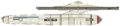
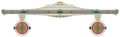
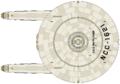
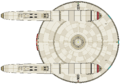
The four torpedo module variants released with the Flight II were:
- Module A: 2 forward launchers, large aft venting
- Module B: 2 forward launchers, 1 aft launcher, forward and aft venting
- Module C: 2 forward launchers, 2 aft launchers, forward and minimalized aft venting
- Module D: 3 forward launchers, 1 aft launcher, restricted forward and standard aft venting
-
-
-
-

-
-
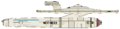 Burke Flight II w/ weapons pod (Module Type A)
 -
-
-

-
-
 Module Type A (all aspects)
 -
 Modules Type B, C, & D
.png)
.png)
.png)
.png)
.png)
_(stbd).png)
_(bow).png)
_(dorsal).png)
_(stern).png)
_(ventral).png)


Aldrin Flight II deep space frigate
Between 2235 and 2237, all 24 vessels of the Aldrin subclass entered drydocks and spacedocks for their standard refit periods, along with the Burkes. The most important tactical upgrade they each received was having the three laser emitters removed and replaced with six Type L phased particle cannons of 1.2 terrawatt capacity, secured by spacetight hatches. Four were provided on the dorsal saucer, with the remaining two on the ventral side.
A lack of satisfaction with the PB-21B nacelle crafted to the mission profile of the frigates was primarily focused on the range capacity afforded the ship, which was limited to a cruise limit of warp 4, and a maximum speed of warp 6.5. Modelling suggested that a reflux of the warp field, focused on the immediate aft, along with a few other longevity and internal maintenance tweaks, might tip the scales of efficiency a bit in the ships' favor; a subspace field visor coupled on to the extreme end of the nacelles, however, did not support the results of the modelling. They were not removed, as they seemed to have no effect one way or the other, other than somewhat restricting the light emissions from that particular field window.
Aldrin Flight II booster pod
One of the selling points by Geering for the Aldrin subclass deep space frigate was the adaptability afforded by the spinal extension (with its additional fuel storage), vitally necessary for extending the patrolling range of the original class. The shipbuilder heavily pushed the versatility and capacity of the attachment rail running fore to aft along the extension for all sorts of sensors, mechanical gear, and other equipment, both proposed and as-yet unrealized. If an Aldrin was to be in the vicinity of a Class G Dichromic nebula, then the area commander could outfit the ship with the appropriate gravimetric sensors to map the distortions. An astrometric suite would be ideal for that T Tauri star just off the charted course. And independently controlled spotlights would be critical to assisting in ship-based recovery efforts, especially in the post-event investigations.
All of these events did occur, and many more, but one thing every ship's commanding officer requested before short- or mid-length deployments was the booster pod. While definitely a fuel burner, the immediate acceleration from both a full stop and during an otherwise-steady delta vee was commendable and potentially a life-saver. Aldrins were not oblivious of the various pirate forces, Orions included, and the unexpected rate of closure could often startle an otherwise confident hostile boarding party "visiting" a hapless merchant freighter. And when the warp bubble was fully formed, the additional 0.05 c of impulse could stop the show.
Certainly, the booster pod was a popular request with Aldrins, and once they were fully produced, rarely would a deep space frigate be seen without one, unless it was transiting thru the inner Federation or on a long-range patrol, outside of dependable refueling stages.
A similar image to the Aldrin Flight II with booster pod will be found within the Aldrin Flight IV entry.
-
-
-
-
-
-
 Aldrin Flight II w/ booster pod
 -
-
-

-
.png)
.png)
.png)
.png)
.png)
_(stbd).png)
_(bow).png)
_(ventral).png)
Burke Flight III nearspace frigate
In 2244, the Andorian shipbuilder company Chiokis, a sub-contracting design firm for previous ship classes, won the Star Fleet bid to modernize the Burke class nearspace frigate with the new solid state era nacelles. Chiokis seized this for the opportunity to promote its primary hull design (also a saucer shape), because the new PB-45 warp nacelles required external power generation: a total matter conversion powerplant not built into the nacelle itself, allowing the ship to achieve a cruising speed of warp 5 and a max speed of warp 8. This required a near-complete redesign of the saucer section to accommodate this massive new system.
Select ships of the Burke and Aldrin subclass series were designated for this radical refit; along with the new saucer modifications—both internal and external—they also received the latest (in the now more dependable) phaser emitters in twin banks, the new SAD impulse assembly, and, for the nearspace frigates, a destroyer-type sensor dish attached to the ventral saucer via a "bulge" extension that would very soon be considered as characteristic of Chiokis' saucers. These modifications gave the ships a more engineered—less organic—look compared to the majority of the remaining ships of Geering origination.
All in all, only 8 of the Burkes would receive this upgrade. Not because the design concept was a failure, by any means, but because of the expense and time for the upgrade was deemed too intrusive. This class would soon be a generation older in comparison to the numerous ship designs expected to be released as the vanguard of a large modernization leap forward for the fleet, and their lifespan would be limited regardless of any major facelifts. Additionally, both the existing nearspace and deep space ships were deemed too critical to operations in the short term to take them out of service for the time needed to refit the entire class.
.png)
.png)
.png)
.png)
.png)
Aldrin Flight III deep space frigate
In 2244, the Andorian shipbuilder company Chiokis, a sub-contracting design firm for previous ship classes, won the Star Fleet bid to modernize the Burke class nearspace frigate with the new solid state era nacelles. Chiokis seized this for the opportunity to promote its primary hull design (also a saucer shape), because the new PB-45 warp nacelles required external power generation: a total matter conversion powerplant not built into the nacelle itself, allowing the ship to achieve a cruising speed of warp 5 and a max speed of warp 8. This required a near-complete redesign of the saucer section to accommodate this massive new system.
Select ships of the Burke and Aldrin subclass series were designated for this radical refit; along with the new saucer modifications—both internal and external—-they also received the latest (in the now more dependable) phaser emitters in twin banks, the new SAD impulse assembly, and, a ventral "bulge" extension that would very soon be considered as characteristic of Chiokis' saucers. These modifications gave the ships a more engineered—less organic—-look compared to the majority of the remaining ships of Geering origination.
All in all, only four of the Aldrins would receive this upgrade (though an additional eight would be selected for the Magellan deep reconnaissance variation). Not because the design concept was a failure, by any means, but because of the expense and time for the upgrade was deemed too intrusive. This class would soon be a generation older in comparison to the numerous ship designs expected to be released as the vanguard of a large modernization leap forward for the fleet, and their lifespan would be limited regardless of any major facelifts. Additionally, both the existing nearspace and deep space ships were deemed too critical to operations in the short term to take them out of service for the time needed to refit the entire class.
.png)
.png)
.png)
.png)
.png)
Magellan subclass scout cruiser
In 2244, with the decision to upgrade the Burkes and Aldrins to the developing Chiokis standard, a total of 12 of the latter subclass were re-assigned to regional drydocks to begin the yard period. Eight of these were selected to receive what was tentatively referred to as the Aldrin Flight III Plus overhaul, wherein they would receive all of the deep space equipment, but also have a multi-mission adaptable sensor suite bolted on all three sides of the re-configured spinal extension.
Oddly enough, one of the selling features of the earlier Flight II Aldrins was the adaptable attachment rail that ran along the dorsal side of the extension, but was removed for the Flight III series. Nonetheless, the variety of sensors installed (gravimetric, multiphasic, magneton, subspace differential, and virtual positron) were not intended to come off and their breadth met more than most expected contingencies. Additionally, an improved command, control, communications, and intelligence (C3I) suite was internally installed to allow the ship to conduct its main mission: deep space reconnaissance. And in this role they performed exceptionally well, with sterling service in the Four Years War.
.png)
.png)
.png)
.png)
.png)
Burke Flight IV nearspace frigate
As stated previously, the Flight III series of refits for the Burkes and Aldrins were abbreviated to 8 and 4 (respectively), due both in part to the expense of upgrading an entire class of aging vessels and their high OPTEMPO, regardless of their warp 6.5 or 8 nacelles. The ships were the linchpin for regional commanders, both in the major spacelanes and the "mid-space" between the homeworlds and the frontier. While it was regrettable the majority of the overall class would not be able to make use of the newer and faster PB-45 nacelles, they were still needed and valued in their respective roles.
Though long range intentions had the Burke lines operational into the 2270s, the intent also was to keep the ships relevant. Between 2252 and 2254, all remaining Flight IIs were brought into the yards for overhauls of the weapons systems. Both the plasma and particle cannons were removed, freeing up considerable space for the Type VI phaser emitters, now that the technology had hit its reliable stride. However, these modernizations did not allow the class to remain operational for the planned length; the first decommissionings began with a sizable block at the beginning of the 2260s, with the last stricken from the Star Fleet rolls in 2267.
Burke Flight IV weapons pod
The Burkes and Aldrins saw their beam weaponry armament halved with the replacement of the plasma and particle cannons by the three twin-bank phaser emitters during the refit beginning in 2252, from Flight II to Flight IV status. Commanding officers were not reticent to undergo this conversion, for phaser technology was well-touted by the skippers of other ships of the line. That faith did not mean there was any discussion of relieving the Burkes of their missile capabilities by removing the modular weapons sled, though. Quite the opposite: Star Fleet now felt it had enough test data to suggest the Type E torpedo module as the standard launcher for sled-equipped ships. Four forward-facing launchers were supported by a large aft-facing vent, allowing the launch-phase targeting sensors to work unimpeded. While this final configuration did not include the aft-facing launchers, the commonality of equipment and alignment allowed the weapons department on each of these ships a greater rate of fire than had been achieved in similar exercises with the previous four configurations.
By this time, operational area commanders were much less reluctant to outfit their Burkes with the weapons sled: regional partners and member states were becoming more accustomed to a more militarized Star Fleet, though they were also appreciative of the duality the fleet demonstrated through the more peace-oriented interactions of other vessels, such as cruisers and medical ships. It didn't hurt, either, to see a Burke warp into the system with a weapons sled now equipped with the new sensor module, in order to timely examine, in detail, some anomaly that had made its presence known or to assist in a black swan catastrophe.
Burke Flight IV deflector pod
In 2258, a concerted effort was made to save the megesti, an energy-hungry spaceborne species endemic to the Algol system. Studied off and on by visiting exploration and research vessels for a few decades, several conclusions had been reached: the megesti's "natural environment" had been constructed (for them?) 23,000 years ago by parties unknown as a subspace disk orbiting two of the three stars, and the disk was rapidly degrading. The creatures had no more than another 1,550 years before they would fully dissipate. The Horizon class USS Victoria's survey of the system and the swarm had even raised the (hotly debated) question of the species' sentience.
The rescue concept was predicated on the idea of rejuvenating the subspace disk using warp-enabled deflectors to build and possibly retain "energy bridges" from the stars' highly charged center of gravity. Normally, such a feat would be well outside the capacity of the Federation, as most inhabitable zones of a solar system are almost a full astronomical unit (AU) or more from the host star(s), and the sheer amount of energy needed to even attempt such a task would be inconceivable. However, the close orbital nature of Beta Persei Aa1 and Aa2 (0.062 AU) allowed the swarm to endlessly travel about the binary pair at a relative distance of only 0.17 AU. Theoreticians suggested it just might be achievable in this specific situation.
Six Flight IV Burkes were equipped with their weapons pods and specially manufactured deflector modules. Five of the vessels were staged at equidistant points within the swarm's orbit (the sixth had standby duty) and engaged their modules at a precise point of the stars' shared revolution. While early indications supported the development of the bridge, it was determined the initial attempt was too short. A month later, the task force tried again, holding their positions for 16 days, and the results were encouraging; the subspace disk was definitely strengthened and the megesti reacted with a multitude of colors in the visual spectrum and alternating oscillations in intensity in the ultraviolet bands. However, when the optimal period of star orbits had passed and the beams were disengaged, the bridges withdrew and the same ratio of degradation had returned. At most, the effort only sustained the swarm's environment for the period of external activity.
It was concluded that a series of stationary subspace enhancers might be able to maintain the bridges for about half the orbital time, which meant that the Federation's efforts would only extend the environment by about an additional 800 years. A better answer would have to be discovered. Meanwhile, the deflector pods would go back into storage, not to be brought out again over the remaining 2 years of the Burkes' service.
-
-
-
-
-
-
 Burke Flight IV w/ weapons pod (Module Type E)
 -

-
-

-
-
 Module Type E (all aspects)
 -
 Burke Flight IV w/ deflector pod
 -
-
-
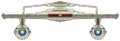
-
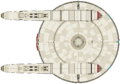
-
 Sensor module and a module-less pod
.png)
.png)
.png)
.png)
.png)
_(stbd).png)
_(bow).png)
_(dorsal).png)
_(stern).png)
_(ventral).png)

_(stbd).png)
_(bow).png)
_(dorsal).png)
_(stern).png)
_(ventral).png)

Aldrin Flight IV deep space frigate
The Burkes and Aldrins saw their beam weaponry armament halved with the replacement of the plasma and particle cannons by the three twin-bank phaser emitters during the refit beginning in 2252, from Flight II to Flight IV status. Commanding officers were not reticent to undergo this conversion, for phaser technology was well-touted by the skippers of other ships of the line. Other than this undeniable improvement of firepower, the subclass continued on its mission of exploration and diplomacy within the Federation's "mid-space" regions, until the last was de-commissioned in the mid-2260s.
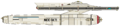
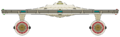
Note: For more details on the Flight IV booster pod, please refer to the Flight II version of this same load-out.
-
-
-
-
-
-
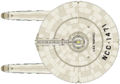
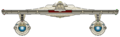
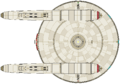
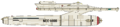 Aldrin Flight IV w/ booster pod
 -
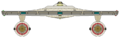
-

-
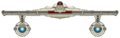
-
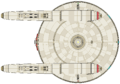
.png)
.png)
.png)
.png)
.png)
_(stbd).png)
_(bow).png)
_(dorsal).png)
_(stern).png)
_(ventral).png)
-
 Aldrin sub-class starboard stern view
 -
 "Voyage of the Mayflower"


Ship Registry
| Registry | Ship Name | Original Configuration |
1st Overhaul | 2nd Overhaul |
|---|---|---|---|---|
| 1600 | USS Burke | Burke (Flt I) | Burke (Flt II) | Burke (Flt III) |
| 1601 | USS Firefly | Burke (Flt I) | Burke (Flt II) | Burke (Flt IV) |
| 1602 | USS Clayton | Burke (Flt I) | Burke (Flt II) | Burke (Flt IV) |
| 1603 | USS Quileute | Burke (Flt I) | Burke (Flt II) | Burke (Flt IV) |
| 1604 | USS Dragon | Burke (Flt I) | Burke (Flt II) | Burke (Flt IV) |
| 1605 | USS Intercepto | Burke (Flt I) | Burke (Flt II) | Burke (Flt IV) |
| 1606 | USS Bulwark | Burke (Flt I) | Burke (Flt II) | Burke (Flt IV) |
| 1607 | USS Abundance | Burke (Flt I) | Burke (Flt II) | Burke (Flt III) |
| 1608 | USS Emden | Burke (Flt I) | Burke (Flt II) | Burke (Flt III) |
| 1609 | USS Thyhlel | Burke (Flt I) | Burke (Flt II) | Burke (Flt IV) |
| 1610 | USS Billings | Burke (Flt I) | Burke (Flt II) | Burke (Flt IV) |
| 1611 | USS Magpie | Burke (Flt I) | Burke (Flt II) | Burke (Flt IV) |
| 1612 | USS Pailles | Burke (Flt I) | Burke (Flt II) | Burke (Flt IV) |
| 1613 | USS Sabre | Burke (Flt I) | Burke (Flt II) | Burke (Flt III) |
| 1614 | USS Iroquois | Burke (Flt I) | Burke (Flt II) | Burke (Flt IV) |
| 1615 | USS Daring | Burke (Flt I) | Burke (Flt II) | Burke (Flt IV) |
| 1616 | USS Abyssinia | Burke (Flt I) | Burke (Flt II) | Burke (Flt IV) |
| 1617 | USS Ramsey | Burke (Flt I) | Burke (Flt II) | Burke (Flt IV) |
| 1618 | USS Maroon | Burke (Flt I) | Burke (Flt II) | Burke (Flt IV) |
| 1619 | USS Tracker | Burke (Flt I) | Burke (Flt II) | Burke (Flt IV) |
| 1620 | USS Raider | Burke (Flt I) | Burke (Flt II) | Burke (Flt III) |
| 1621 | USS Mayflower | Burke (Flt I) | Burke (Flt II) | Burke (Flt IV) |
| 1622 | USS Vanguard | Burke (Flt I) | Burke (Flt II) | Burke (Flt IV) |
| 1623 | USS Nighthawk | Burke (Flt I) | Burke (Flt II) | Burke (Flt IV) |
| 1624 | USS Firebrand | Burke (Flt I) | Burke (Flt II) | Burke (Flt IV) |
| 1625 | USS Echo | Burke (Flt I) | Burke (Flt II) | Burke (Flt IV) |
| 1626 | USS Scimitar | Burke (Flt I) | Burke (Flt II) | Burke (Flt IV) |
| 1627 | USS Greyhound | Burke (Flt I) | Burke (Flt II) | Burke (Flt III) |
| 1628 | USS Astute | Burke (Flt I) | Burke (Flt II) | Burke (Flt IV) |
| 1629 | USS Aquitaine | Burke (Flt I) | Burke (Flt II) | Burke (Flt IV) |
| 1630 | USS Freya | Burke (Flt I) | Burke (Flt II) | Burke (Flt IV) |
| 1631 | USS Trenchant | Burke (Flt I) | Burke (Flt II) | Burke (Flt IV) |
| 1632 | USS Calder | Burke (Flt I) | Burke (Flt II) | Burke (Flt IV) |
| 1633 | USS Mauritius | Burke (Flt I) | Burke (Flt II) | Burke (Flt IV) |
| 1634 | USS Argyll | Burke (Flt I) | Burke (Flt II) | Burke (Flt IV) |
| 1635 | USS Acacia | Burke (Flt I) | Burke (Flt II) | Burke (Flt IV) |
| 1636 | USS Lancaster | Burke (Flt I) | Burke (Flt II) | Burke (Flt IV) |
| 1637 | USS Albion | Burke (Flt I) | Burke (Flt II) | Burke (Flt III) |
| 1638 | USS Protector | Burke (Flt I) | Burke (Flt II) | Burke (Flt IV) |
| 1639 | USS Mantis | Burke (Flt I) | Burke (Flt II) | Burke (Flt IV) |
| 1640 | USS Agamemnon | Burke (Flt I) | Burke (Flt II) | Burke (Flt IV) |
| 1641 | USS Aotearoa | Burke (Flt I) | Burke (Flt II) | Burke (Flt IV) |
| 1642 | USS Artful | Burke (Flt I) | Burke (Flt II) | Burke (Flt III) |
| 1650 | USS Aldrin | Aldrin (Flt I) | Aldrin (Flt II) | Aldrin (Flt III) |
| 1651 | USS Mogensen | Aldrin (Flt I) | Aldrin (Flt II) | Magellan |
| 1652 | USS Irwin | Aldrin (Flt I) | Aldrin (Flt II) | Aldrin (Flt IV) |
| 1653 | USS Dyomin | Aldrin (Flt I) | Aldrin (Flt II) | Magellan |
| 1654 | USS Mitchell | Aldrin (Flt I) | Aldrin (Flt II) | Magellan |
| 1655 | USS Bean | Aldrin (Flt I) | Aldrin (Flt II) | Aldrin (Flt IV) |
| 1656 | USS Sharman | Aldrin (Flt I) | Aldrin (Flt II) | Magellan |
| 1657 | USS Duke | Aldrin (Flt I) | Aldrin (Flt II) | Aldrin (Flt IV) |
| 1658 | USS Fei | Aldrin (Flt I) | Aldrin (Flt II) | Aldrin (Flt IV) |
| 1659 | USS Zheng He | Aldrin (Flt I) | Aldrin (Flt II) | Aldrin (Flt IV) |
| 1660 | USS Hadfield | Aldrin (Flt I) | Aldrin (Flt II) | Aldrin (Flt IV) |
| 1661 | USS Atkov | Aldrin (Flt I) | Aldrin (Flt II) | Magellan |
| 1662 | USS Magellan | Aldrin (Flt I) | Aldrin (Flt II) | Magellan |
| 1663 | USS Relentless | Aldrin (Flt I) | Aldrin (Flt II) | Aldrin (Flt III) |
| 1664 | USS Zhai | Aldrin (Flt I) | Aldrin (Flt II) | Aldrin (Flt III) |
| 1665 | USS Zhang | Aldrin (Flt I) | Aldrin (Flt II) | Aldrin (Flt IV) |
| 1666 | USS Shackleton | Aldrin (Flt I) | Aldrin (Flt II) | Aldrin (Flt IV) |
| 1667 | USS Chretien | Aldrin (Flt I) | Aldrin (Flt II) | Aldrin (Flt IV) |
| 1668 | USS Schmitt | Aldrin (Flt I) | Aldrin (Flt II) | Magellan |
| 1669 | USS Frimout | Aldrin (Flt I) | Aldrin (Flt II) | Magellan |
| 1670 | USS Jahn | Aldrin (Flt I) | Aldrin (Flt II) | Aldrin (Flt IV) |
| 1671 | USS Vespucci | Aldrin (Flt I) | Aldrin (Flt II) | Aldrin (Flt IV) |
| 1672 | USS Vasco De Gama | Aldrin (Flt I) | Aldrin (Flt II) | (destroyed) |
| 1673 | USS Kotov | Aldrin (Flt I) | Aldrin (Flt II) | Aldrin (Flt III) |
Gallery
Master Sheets
-
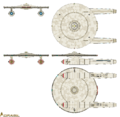 Burke Flight I
 -
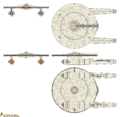 Aldrin Flight I
 -
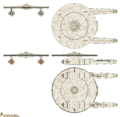 Burke Flight II
 -
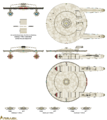 Burke Flight II (w/ weapons pod)
 -
 Aldrin Flt II
 -
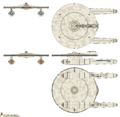 Aldrin Flt II (w/ booster pod)
 -
 Burke Flight III
 -
 Aldrin Flight III
 -
 Magellan
 -
 Burke Flight IV
 -
 Burke Flight IV (w/ weapons pod)
 -
 Burke Flight IV (w/ deflector pod)
 -
 Aldrin Flight IV
 -
 Aldrin Flight IV (w/ booster pod)
.png)
.png)
.png)
_(master).png)
.png)
_(master).png)
.png)
.png)
.png)
.png)
_(master).png)
_(master).png)
.png)
_(master).png)
Other Images

_dorsal_view3.png)
_port_stern_view.png)

_port_fwd_view.png)
_stbd_view.png)
_bow_view.png)
_dorsal_view2.png)
Supporting Documents
Notes
- The number of Burke sub-class ships was increased by one in the text, to match the sidebar.
- The initial inline image has been changed from Timo's Guide as a nearspace Burke to that of a deep space Aldrin, because Adrasil made an actual image that best shows the dorsal booster described in the caption.
- The image and caption regarding the USS Vasco da Gama indicates a NCC of 1842. The caption has been changed to 1472, to better represent the range of codes for the Aldrin sub-class.
- Sub-note: While the article & sidebar continue to show the ships in the 1400 range of the registry, the DD registry holds them to be in the 1600 range instead. This will be altered one way or the other (or another other) once the registry has advanced to this era.
- To clarify:
- The Burke sub-class was built as a 'nearspace' frigate first, followed during the same production run by the Aldrin 'deep space' frigate, with a dorsal spine.
- Starting in 2235, the both sub-classes received a significant upgrade, but the Burkes also received dorsal torpedo modules, with 2, 3 or 4 launchers; the Aldrins did not receive the package; instead they received booster pods.
- In 2244, both classes were refit to (then) modern standards, with the Burkes generally retaining the weapons pod (also with an upgraded torpedo module). Eight from Aldrins were modified to become Magellan sub-class scout cruisers. Also note: the modernized Aldrins did not receive the ventral-mounted sensor dish. Note also, the original Geering-built saucers did not have the ventral bulge. These were added to some by Chiokis.
- Starting in 2252, the ships were upgraded to the latest weaponry.
- In the 2260s, all of the vessels started being decommissioned, ending in 2267.
- The text says even the non-modernized Burke sub-class ships received the 2252 weapons upgrade, but it is likely they were all decommissioned by that time. I've decided that all Flight IV Burkes and Aldrins will be de-commissioned no later than 2260.
- Mass figures have been added for the Aldrin Flt I, based on guesstimate.
- Work pods have been listed to the auxiliaries for Aldrins and the Magellan.