Guide:Hercules: Difference between revisions
No edit summary |
|||
| (38 intermediate revisions by the same user not shown) | |||
| Line 1: | Line 1: | ||
{{Sidebar Guide ship | {{Sidebar Guide ship | ||
|image=[[Image:Y-class. | |image=[[Image:Y-class.png|250px|Y class transport (Hercules for Starfleet) schematic]] | ||
|classname=''Hercules'' | |classname=''Hercules'' (or ''Y Class'') | ||
|category=Transport | |category=Transport | ||
|years=[[2091]] - [[2177]] | |years= <br> | ||
* ''G'': [[2090]] - [[2141]] | |||
* ''Y'': [[2091]] - [[2177]] | |||
|constructed=<br> | |constructed=<br> | ||
29 total: | 29 total: | ||
:*4 ''Hercules'' (FY-100) | :* 4 ''Hercules'' (FY-100) | ||
:*22 ''Ottawa'' (FY-200) | :* 22 ''Ottawa'' (FY-200) | ||
:*3 ''Karakorum'' (FY-500) | :* 3 ''Karakorum'' (FY-500) | ||
|length=<br> | |length=<br> | ||
*240.3 m (FY-100, 200) | * 240.3 m (FY-100, 200) | ||
*322.1 m (FY-500) | * 322.1 m (FY-500) | ||
|beam=43.5 m | |beam=43.5 m | ||
|height=36.2 m | |height=36.2 m | ||
|mass=<br> | |mass=<br> | ||
*21,300 | * 21,300 mt (FY-100) | ||
*22,100 | * 22,100 mt (FY-200) | ||
*25,700 | * 25,700 mt (FY-500) | ||
|cruisespeed=w 1.1 | |cruisespeed=w 1.1 | ||
|maxspeed=<br> | |maxspeed=<br> | ||
*w 1.8 (FY-100, 200) | * w 1.8 (FY-100, 200) | ||
*w 3.0 (FY-200 refit [[2162]]-[[2163|63]]) | * w 3.0 (FY-200 refit [[2162]]-[[2163|63]]) | ||
*w 1.6 (FY-500) | * w 1.6 (FY-500) | ||
|endurance=6 years | |endurance=6 years | ||
|officers=2 | |officers=2 | ||
|enlisted=<br> | |enlisted=<br> | ||
*17 (FY-100, 200) | * 17 (FY-100, 200) | ||
*21 (FY-500) | * 21 (FY-500) | ||
|troops= | |troops= | ||
|passengers= | |passengers= | ||
| Line 33: | Line 35: | ||
|crew= | |crew= | ||
|cargo=<br> | |cargo=<br> | ||
* | * 20,500 mt (''G class'') | ||
*43,000 | ** 1x-4x Type II 5k mt containers | ||
*64,000 | ** 500 mt internal storage | ||
* 41,250 mt (FY-100) | |||
** 1x-8x Type II 5k mt containers | |||
** 1,250 mt internal storage | |||
* 43,000 mt (FY-200) | |||
** 1x-8x Type II 5k mt containers | |||
** 3,000 mt internal storage | |||
* 64,000 mt (FY-500) | |||
** 1x-12x Type II 5k mt containers | |||
** 4,000 mt internal storage | |||
|beamweapons=<br> | |beamweapons=<br> | ||
* | * 1x plasma cannon (varying types), ventral hull | ||
* | * 4x plasma cannons (varying types), container mounts (select ships) | ||
|missileweapons= | |missileweapons= | ||
|otherweapons= | |otherweapons= | ||
|shields=<br> | |shields=<br> | ||
* | * navigational deflector on bow | ||
* | * electromagnetic shields (max. 8 T) | ||
|labs= | |labs= | ||
|auxcraft=<br> | |auxcraft=<br> | ||
* | * 2-10x work pods | ||
|historicalships= | |historicalships= | ||
|design=ENT | |design= ENT | ||
|name= | |name= Timo | ||
|history=ENT | |history= ENT | ||
}} | }} | ||
Outwardly, it appears a huge step that the defense and exploration assets of [[Earth]]’s various spaceflight organizations were in [[ | ==Background: ''Hobbyist's Guide''== | ||
Outwardly, it appears a huge step that the defense and exploration assets of [[Earth]]’s various spaceflight organizations were in [[2089]] solidified into an international [[United Earth Stellar Navy|star fleet]]. However, those assets themselves remained largely unaffected by the transformation. The crew of a survey cruiser orbiting a distant star for the fifth successive year would pay little heed to such bureaucracy. Defensive fleets in the [[Sol]] system would already be under international control due to the Sparon-DeSoto clauses. [[UESPA]] would still retain control of the waves of probes launched into deep space and would coordinate the data flows and survey budgets from within the fleet. The existing hardware largely met the needs of the UESN during its formative years—it just happened to be temporarily unavailable, separated from the homeworld by dozens of lightyears and by several years of travel time. | |||
Partial recalling and redeployment of the ''Messier'' fleet was expected to cater for | Partial recalling and redeployment of the ''[[Guide: Messier|Messier]]'' fleet was expected to cater for the fleet’s modest exploration and even humbler power projection programs. Increased trust and understanding between [[Human]]s and [[Vulcans]] allowed [[Sol]] defenses to be rearranged so that the antiquated sublight combatants could be retired and replaced by cheaper transatmospheric low-warp interceptors and fixed installations. However, there was one field of operations where the fleet neither controlled the resources it needed nor could hope to downscale its operations to fit what resources it did possess. Logistics for an interstellar research, defense, and training organization could not be handled by the | ||
motley fleet of STL and FTL colonizers or short-range tugs and transports loitering in the vicinity of Sol. And the high capacity warp transports that [[Earth]] already possessed were only nominally under [[ECS]] authority. In practice, no power on Earth could recall them from their profit-hunting cruises in deep space. | |||
It was thus in the interests of | It was thus in the interests of the [[UEDP]] to sponsor the development and construction of new warp freighters, suited for its needs as well as for commercial use. Two primary designs emerged within a year. Rather than add warp engines to an originally STL cargo hull, both introduced a warp-optimized spaceframe onto which cargo modules were bolted. The ''G'' (''see gallery below'') and ''Y'' series vessels were virtual scale models of each other. Both had a central spine element for general goods and lateral grapples for containers. Both featured an amidship section for the main fusion reactor and a bow section that held impulse engines in low-mounted cowlings and housed a crew of some 20-30 people in tolerable conditions in a four-deck habitat suspended above the centerline; an antenna farm for sensors and deflectors occupied the centerline bow. The ''G'' series had a single centerline bay for shuttlecraft, typically with one permanently embarked alongside work pods; the ''Y'' series had two bays, at the forward ends of the impulse pods, and carried up to ten cargo handling craft. | ||
The Class ''G'' (or ''Anchorage'') vessels with four 5,000-ton Type II containers were rather modest in performance, though, and UESN concentrated on the acquisition of ''Y'' series transports. In military service, these ships were dubbed the '''''Hercules''''' class. | |||
[[File:Hercules (starboard bow).png|left|300px|thumb|A ''Hercules'' at speed. From this angle, the GSC-800 engines are just barely visible at ventral stern, with the impulse coils flanking the bow. Standard [[United Earth Stellar Navy|Stellar Navy]] paint scheme from the [[2120s]] leaves most of the hull titanium-brown but adds blue cheat lines to the containers and forward hull and large black pennants on the sides of the command tower. The classic [[UESPA]] arrowhead is not yet part of military livery.]] | |||
The grandiose name was fitting enough. At nearly 250 meters, the ships were half again as long as competing [[Guide: DY warp series|DY series]] heavy variants. Compared with the lumbering ''Messiers'', the transports had far superior impulse acceleration. Warp speed using the lightweight GSC-800 coils (sitting below the central spine, with plasma conduits running on the underside of the center hull) was naturally lower than that of the massive cruisers, with theoretical optimum cruise speed at warp 1.1 and maximum speed at warp 1.8. In practice, the transports always cruised at maximum speed, as this fuel-inefficient mode still was the most economic one overall. Both ECS and UESN benefited more from the timely delivery of goods than from conserving of slush hydrogen. In any case, the vast deuterium tanks lined up beneath the midsection provided a safe reserve for a 20-ly cruise to nowhere and back, making the vessel especially attractive as a tramp for adventurous Boomers. | |||
For both Boomer and explorer crews, the ''Y series'' meant significantly improved accommodation standards. The spine of the ship was quite available for habitation, and direct underway access to the eight Type II containers was also possible. For the fleet, this meant suitability to troop transport duties. Actual planetary assault was not in the plans yet, nor would it be for half a century, but personnel transfer to off-Earth garrisons was of interest, either with cryosleep or without. Other duties going beyond pure cargo hauling were also intended. UESPA survey packages provided Earth with scientific data and some SIGINT victories and the installation of plasma cannon modules was hoped to give space pirates a nasty surprise or two. The "Q-ships" carrying four container-mounted 2-GW cannon, in addition to one permanent hull-mounted unit, did score a few early kills, but only on already relatively secure short haul routes. | |||
Boosted by the warp breakthroughs of the [[2150s]], Earth continued to operate ''Y-200'' vessels well past the Romulan | Once the initial ''Y-100'' model had been fielded in [[2091]], UESN decided it actually needed an even more capable design. The improved commercial model ''Y-200'' was bought in some quantity, with up to 22 ''FY-200'' (or ''Ottawa'' subclass) vessels joining the fleet between [[2096]] and [[2099]]. The enlarged ''FY-500'' (''Karakorum'' subclass) ultimately proved a disappointment, though, and only three were purchased. Commercial use of the clumsy twelve-container behemoth was discontinued in [[2125]], by which time all three UESN ships had been sold to civilian operators. | ||
Boosted by the warp breakthroughs of the [[2150s]], Earth continued to operate ''Y-200'' vessels well past the [[Romulan War]]. The last military examples, now in [[UFP Star Fleet]] registry, were retired in [[2177]]. Civilian users persisted into the [[23rd century]], as the uprated engines were capable of practical deep space speeds, yet the ships still sported the internal volume of "community vessels". Postwar designs were optimized for high speeds and subsequently short trips and were ill-suited for the tramp/salesman mode of operations outside normal spacelanes. Even pre-war development had steered towards lower habitability standards, driven by the needs of near-Earth mining operations and UE Starfleet’s increasing military commitments. The Boomer subculture and lifestyle was on its way to obscurity at the advent of class ''[[Guide:Roanoke|J]]'' and ''W'' transports already and largely vanished from nearspace by the time of the Romulan War. Its last vestiges could be found in long-ranging class ''Y'' vessels, the final few of which disappeared from [[Federation]] records in the early [[2220s]]. | |||
==Gallery== | |||
<gallery> | |||
File:G class.png|G class ''Anchorage'' (starboard) | |||
File:Hercules (starboard).png|FY-100/FY-200 starboard | |||
File:Hercules (bow).png|FY-100/FY-200 bow | |||
File:Hercules (dorsal).png|FY-100/FY-200 dorsal | |||
File:Hercules (starboard bow2).png|FY-100/FY-200 starboard bow | |||
File:Hercules (stern).png|FY-100/FY-200 stern | |||
File:Y-class (FY-500).jpg|FY-500 starboard | |||
</gallery> | |||
==Star Fleet Registry== | |||
<div style="-moz-column-count:3; column-count:3;"> | |||
* ''USS Ottawa'' (NCC-F19)<sup>(''see note'')</sup> | |||
* NCC-F20 | |||
* NCC-F21 | |||
* NCC-F22 | |||
* NCC-F29 | |||
* NCC-F47 | |||
* NCC-F51 | |||
* NCC-F53 | |||
* NCC-F62 | |||
* NCC-F65 | |||
* NCC-F73 | |||
* NCC-F79 | |||
* NCC-F85 | |||
</div> | |||
==Alt Sources== | |||
* [[Starship Handbook (Combined)]] | |||
==Notes== | |||
* The operational years of the ''G class'' comes from both ''G'' and ''Y'' being introduced within a year of each other (favor granted to the ''G'') and a guesstimate that it did not last as long in service due to its more "modest" performance. | |||
* Some cargo capacity was changed to reflect the game-canon figures for the Type II containers; ''G class'' has also been included in the sidebar. | |||
* All references pre-[[2133]] to the [[UESF]] have been changed to [[UESN]]. | |||
* It appears the NCCs the freighters received had the numerals preceded by "F" (for "freighter"). | |||
* I've arbitrarily decided that 13 ''Ottawa'' subclass vessels were transferred to [[UFP Star Fleet]] service, in the registry range of NCC-F. (It is not yet decided if the ''Ottawa'' herself was in service.) | |||
* There is no mistake: ''UESS Ottawa'' did get transferred to the [[UFP Star Fleet]] and it happened to be the first one surveyed for the registry. | |||
==References== | ==References== | ||
<references /> | <references /> | ||
<br><br> | |||
---- | ---- | ||
*[[Timo's Guide to | * [[Timo's Guide to Star Fleet|Back to the Table of Contents]] | ||
*[[2063-2130 - The Incredible Expansion | * [[Guide: 2063-2130 - The Incredible Expansion|Back to "The Incredible Expansion"]] | ||
*[[Of Ship Statistics | * [[Guide: Of Ship Statistics|Appendix A: Of Ship Statistics]] | ||
*[[Glossary | * [[Guide: Glossary|Appendix B: Glossary]] | ||
*[[ | * [[Guide: Star Fleet Organization - General Outline|Appendix C: Star Fleet Organization - General Outline]] | ||
*[[Abbreviations From Outside | * [[Guide: Abbreviations From Outside|Appendix D: Abbreviations From Outside]] | ||
[[Category:Guide|{{PAGENAME}}]] | [[Category:Guide|{{PAGENAME}}]] | ||
Latest revision as of 09:33, 24 July 2023

| |
| Hercules (or Y Class) | |
|---|---|
| Class Overview | |
| Category | Transport |
| Operational | |
| Constructed | 29 total:
|
| Dimensions | |
| Length |
|
| Beam | 43.5 m |
| Height | 36.2 m |
| Mass |
|
| Performance | |
| Cruise Speed | w 1.1 |
| Max Speed | |
| Endurance | 6 years |
| Complement | |
| Officers | 2 |
| Enlisted |
|
| Cargo |
|
| Tactical Systems | |
| Beam Weapons |
|
| Shields |
|
| Auxiliary Craft |
|
| Canonicity | |
| Design | ENT |
| Name | Timo |
| History | ENT
|
Background: Hobbyist's Guide
Outwardly, it appears a huge step that the defense and exploration assets of Earth’s various spaceflight organizations were in 2089 solidified into an international star fleet. However, those assets themselves remained largely unaffected by the transformation. The crew of a survey cruiser orbiting a distant star for the fifth successive year would pay little heed to such bureaucracy. Defensive fleets in the Sol system would already be under international control due to the Sparon-DeSoto clauses. UESPA would still retain control of the waves of probes launched into deep space and would coordinate the data flows and survey budgets from within the fleet. The existing hardware largely met the needs of the UESN during its formative years—it just happened to be temporarily unavailable, separated from the homeworld by dozens of lightyears and by several years of travel time.
Partial recalling and redeployment of the Messier fleet was expected to cater for the fleet’s modest exploration and even humbler power projection programs. Increased trust and understanding between Humans and Vulcans allowed Sol defenses to be rearranged so that the antiquated sublight combatants could be retired and replaced by cheaper transatmospheric low-warp interceptors and fixed installations. However, there was one field of operations where the fleet neither controlled the resources it needed nor could hope to downscale its operations to fit what resources it did possess. Logistics for an interstellar research, defense, and training organization could not be handled by the motley fleet of STL and FTL colonizers or short-range tugs and transports loitering in the vicinity of Sol. And the high capacity warp transports that Earth already possessed were only nominally under ECS authority. In practice, no power on Earth could recall them from their profit-hunting cruises in deep space.
It was thus in the interests of the UEDP to sponsor the development and construction of new warp freighters, suited for its needs as well as for commercial use. Two primary designs emerged within a year. Rather than add warp engines to an originally STL cargo hull, both introduced a warp-optimized spaceframe onto which cargo modules were bolted. The G (see gallery below) and Y series vessels were virtual scale models of each other. Both had a central spine element for general goods and lateral grapples for containers. Both featured an amidship section for the main fusion reactor and a bow section that held impulse engines in low-mounted cowlings and housed a crew of some 20-30 people in tolerable conditions in a four-deck habitat suspended above the centerline; an antenna farm for sensors and deflectors occupied the centerline bow. The G series had a single centerline bay for shuttlecraft, typically with one permanently embarked alongside work pods; the Y series had two bays, at the forward ends of the impulse pods, and carried up to ten cargo handling craft.
The Class G (or Anchorage) vessels with four 5,000-ton Type II containers were rather modest in performance, though, and UESN concentrated on the acquisition of Y series transports. In military service, these ships were dubbed the Hercules class.
.png)
The grandiose name was fitting enough. At nearly 250 meters, the ships were half again as long as competing DY series heavy variants. Compared with the lumbering Messiers, the transports had far superior impulse acceleration. Warp speed using the lightweight GSC-800 coils (sitting below the central spine, with plasma conduits running on the underside of the center hull) was naturally lower than that of the massive cruisers, with theoretical optimum cruise speed at warp 1.1 and maximum speed at warp 1.8. In practice, the transports always cruised at maximum speed, as this fuel-inefficient mode still was the most economic one overall. Both ECS and UESN benefited more from the timely delivery of goods than from conserving of slush hydrogen. In any case, the vast deuterium tanks lined up beneath the midsection provided a safe reserve for a 20-ly cruise to nowhere and back, making the vessel especially attractive as a tramp for adventurous Boomers.
For both Boomer and explorer crews, the Y series meant significantly improved accommodation standards. The spine of the ship was quite available for habitation, and direct underway access to the eight Type II containers was also possible. For the fleet, this meant suitability to troop transport duties. Actual planetary assault was not in the plans yet, nor would it be for half a century, but personnel transfer to off-Earth garrisons was of interest, either with cryosleep or without. Other duties going beyond pure cargo hauling were also intended. UESPA survey packages provided Earth with scientific data and some SIGINT victories and the installation of plasma cannon modules was hoped to give space pirates a nasty surprise or two. The "Q-ships" carrying four container-mounted 2-GW cannon, in addition to one permanent hull-mounted unit, did score a few early kills, but only on already relatively secure short haul routes.
Once the initial Y-100 model had been fielded in 2091, UESN decided it actually needed an even more capable design. The improved commercial model Y-200 was bought in some quantity, with up to 22 FY-200 (or Ottawa subclass) vessels joining the fleet between 2096 and 2099. The enlarged FY-500 (Karakorum subclass) ultimately proved a disappointment, though, and only three were purchased. Commercial use of the clumsy twelve-container behemoth was discontinued in 2125, by which time all three UESN ships had been sold to civilian operators.
Boosted by the warp breakthroughs of the 2150s, Earth continued to operate Y-200 vessels well past the Romulan War. The last military examples, now in UFP Star Fleet registry, were retired in 2177. Civilian users persisted into the 23rd century, as the uprated engines were capable of practical deep space speeds, yet the ships still sported the internal volume of "community vessels". Postwar designs were optimized for high speeds and subsequently short trips and were ill-suited for the tramp/salesman mode of operations outside normal spacelanes. Even pre-war development had steered towards lower habitability standards, driven by the needs of near-Earth mining operations and UE Starfleet’s increasing military commitments. The Boomer subculture and lifestyle was on its way to obscurity at the advent of class J and W transports already and largely vanished from nearspace by the time of the Romulan War. Its last vestiges could be found in long-ranging class Y vessels, the final few of which disappeared from Federation records in the early 2220s.
Gallery
-
 G class Anchorage (starboard)
 -
 FY-100/FY-200 starboard
 -
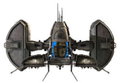 FY-100/FY-200 bow
 -
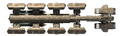 FY-100/FY-200 dorsal
 -
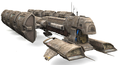 FY-100/FY-200 starboard bow
 -
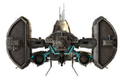 FY-100/FY-200 stern
 -
 FY-500 starboard

.png)
.png)
.png)
.png)
.png)
.jpg)
Star Fleet Registry
- USS Ottawa (NCC-F19)(see note)
- NCC-F20
- NCC-F21
- NCC-F22
- NCC-F29
- NCC-F47
- NCC-F51
- NCC-F53
- NCC-F62
- NCC-F65
- NCC-F73
- NCC-F79
- NCC-F85
Alt Sources
Notes
- The operational years of the G class comes from both G and Y being introduced within a year of each other (favor granted to the G) and a guesstimate that it did not last as long in service due to its more "modest" performance.
- Some cargo capacity was changed to reflect the game-canon figures for the Type II containers; G class has also been included in the sidebar.
- It appears the NCCs the freighters received had the numerals preceded by "F" (for "freighter").
- I've arbitrarily decided that 13 Ottawa subclass vessels were transferred to UFP Star Fleet service, in the registry range of NCC-F. (It is not yet decided if the Ottawa herself was in service.)
- There is no mistake: UESS Ottawa did get transferred to the UFP Star Fleet and it happened to be the first one surveyed for the registry.
References