Guide:Montcalm/Meridio: Difference between revisions
No edit summary |
No edit summary |
||
| (One intermediate revision by the same user not shown) | |||
| Line 37: | Line 37: | ||
|history= Todd Guenther/Mike Morrissette, own | |history= Todd Guenther/Mike Morrissette, own | ||
}} | }} | ||
[[File:Montcalm in space.png|left|250px|thumb|Much like the legendary ''Voroth'' class vessels from a century prior, the ''Gadshen'' dedicated two sectors of the hull to main | [[File:Montcalm in space.png|left|250px|thumb|Much like the legendary ''Voroth'' class vessels from a century prior, the ''Gadshen'' dedicated two sectors of the hull to main propulsive power generation and one to secondary power and mission systems. The almost perfect symmetry of the exterior view betrays little of this.]] | ||
propulsive power generation and one to secondary power and mission systems. The almost perfect symmetry of the exterior view betrays little of this.]] | |||
In the wake of the ''[[Guide: Powers|Powers]]'' project, several enterprises sprung up to hybridize Vulcan and | In the wake of the ''[[Guide: Powers|Powers]]'' project, several enterprises sprung up to hybridize [[Vulcan (species)|Vulcan]] and [[Human]] technologies for the rapidly expanding Human market. A typical combination would see a Vulcan | ||
technologies for the rapidly expanding | medium-endurance vessel transformed to a low-endurance Human counterpart, the joint result of a less economical drive system and a more claustrophobic clientele. Among classic examples were the ''Gadshen'' and ''Sharan'' classes, adopted for production as liaison craft and warp yachts in the late [[2160s]]. The former is of special interest here, not only as a pioneering [[UFP Star Fleet]] starcraft, but also as one of the foremost private warp cruisers for the following hundred years. | ||
medium-endurance vessel transformed to a low-endurance | |||
less economical drive system and a more claustrophobic clientele. Among classic examples were | |||
the ''Gadshen'' and ''Sharan'' classes, adopted for production as liaison craft and warp yachts in the late | |||
[[2160s]]. The former is of special interest here not only as a pioneering [[UFP | |||
also as one of the foremost private warp cruisers for the following hundred years. | |||
Most liaison craft followed the longstanding Vulcan tradition of threefold symmetry and general | Most liaison craft followed the longstanding Vulcan tradition of threefold symmetry and general teardrop shape. However, the three propulsive pods of the original [[2163]] interplanetary ''Gadshen'' ("aurora") design were in [[2169]] replaced by two much more potent, nacelle-mounted [[CWD]] Model 9442 warp engines, and an interstellar success story began. | ||
teardrop shape. However, the three propulsive pods of the original [[2163]] interplanetary ''Gadshen'' | |||
( | |||
9442 warp engines, and an interstellar success story began. | |||
The improved ''Gadshen'' was immediately adopted for production by [[Star Fleet Division]], to meet a | The improved ''Gadshen'' was immediately adopted for production by [[Star Fleet Division]], to meet a Star Fleet liaison need. This spawned multiple commercial orders, and [[Duotechnica]] of [[Luna]] also bought the license. The former yards launched a total of 107 craft under the class name '''''Montcalm'''''. The product of the latter was slightly different, and marketed as the '''''Meridio''''' class, to the somewhat more modest total of 53 hulls. [[Panastris]] also continued production of the original type at [[Vulcanis Space Facilities]]. | ||
bought the license. The former yards launched a total of 107 craft under the class name '''''Montcalm'''''. | |||
The product of the latter was slightly different, and marketed as the '''''Meridio''''' class, to the somewhat more modest | |||
total of 53 hulls. [[Panastris]] also continued production of the original type at [[Vulcanis Space Facilities]]. | |||
Principal differences were to be found in accommodation standards. The basic ''Meridio'' was | Principal differences were to be found in accommodation standards. The basic ''Meridio'' was registered for six persons, with egalitarian bunking and a dining area on the lower deck and a compact flight deck and map room on the upper one. A more luxurious interior, selling well in corporate circles, reduced capacity to four; in either case, two would be qualified pilots. Access was through a bow docking port; the adjoining extensible ladder was seldom needed, as surface operations were a rarity for the type. Interplanetary and interstellar journeys from orbital station to orbital station were far more common, the craft having little to do in systems where such facilities were lacking. ''Montcalm'' served Star Fleet needs at shorter ranges by carrying up to a dozen personnel on the lower deck, with the flight crew of three operating a less automated set of instrumentation, a bit austere in some respects, sophisticated in others. Communications gear was particularly | ||
registered for six persons, with egalitarian bunking and a dining area on the lower deck and a | advanced in this variant, although for example, no weaponry was ever integrated to the design. | ||
compact flight deck and map room on the upper one. A more luxurious interior, selling well in | |||
corporate circles, reduced capacity to four; in either case, two would be qualified pilots. Access was | |||
through a bow docking port; the adjoining extensible ladder was seldom needed, as surface | |||
operations were a rarity for the type. Interplanetary and interstellar journeys from orbital station to | |||
orbital station were far more common, the craft having little to do in systems where such facilities | |||
were lacking. ''Montcalm'' served | |||
on the lower deck, with the flight crew of three operating a less automated set of instrumentation, a | |||
bit austere in some respects, sophisticated in others. Communications gear was particularly | |||
advanced in this variant, although for example no weaponry was ever integrated to the design. | |||
[[Image:No Photo Available.jpg|left|250px|thumb|A somewhat artificial shot from [[Starbase 32]] shows a range of private and ex- | [[Image:No Photo Available.jpg|left|250px|thumb|A somewhat artificial shot from [[Starbase 32]] shows a range of private and ex-Star Fleet ''Gadshen'' craft at neighboring piers. A luxurious [[Catullan]] yacht on the forefront is differentiated from a [[Farland]] courier mainly by a gaudier paint job, although enlarged heat exchangers on the yacht’s nacelles hint at an uprated warp propulsion system, one of the many popular targets for tinkering.]] | ||
Star Fleet would come to operate a combined total of 160 vessels, divided not only among the two subclasses but into no less than 34 minor variants (the slight differences ranging from landing gear type to deflector grid patterns, as the manufacturers experimented on the newest available refinements). Starbase liaison and light utility transport assignments kept the craft busy from [[2174]] to [[2180]]. This prompted numerous manufacturers to start designing cutters and runabouts of similar size and improved performance for government use. Even minor improvements in propulsion and internal volume were welcome, and the original type was retired from Fleet service entirely by [[2181]]. Private and corporate operators readily purchased the retiring vessels, adding to the pre-existing numbers of pleasure craft and status symbols. Despite some serviceability problems, many were still encountered on [[UFP]] fringe areas in the late [[23rd century]] (reportedly the last was taken out of operation in [[2273]]). | |||
subclasses but into no less than 34 minor variants (the slight differences ranging from landing gear | |||
type to deflector grid patterns, as the manufacturers experimented on the newest available refinements). | |||
Starbase liaison and light utility transport assignments kept the craft busy from [[2174]] to [[2180]]. This | |||
prompted numerous manufacturers to start designing cutters and runabouts of similar size and | |||
improved performance for government use. Even minor improvements in propulsion and internal | |||
volume were welcome, and the original type was retired from Fleet service entirely by [[2181]]. Private | |||
and corporate operators readily purchased the retiring vessels, adding to the pre-existing numbers of | |||
pleasure craft and status symbols. Despite some serviceability problems, many were still | |||
encountered on [[UFP]] fringe areas in the late [[23rd century]] (reportedly the last was taken out of operation in [[2273]]). | |||
==Gallery== | ==Gallery== | ||
| Line 92: | Line 61: | ||
---- | ---- | ||
*[[Guide: Timo's Guide to Starfleet|Back to the Table of Contents]] | * [[Guide: Timo's Guide to Starfleet|Back to the Table of Contents]] | ||
*[[Guide: Small Craft|Small Craft]] | * [[Guide: Small Craft|Small Craft]] | ||
*[[Guide: Of Ship Statistics|Appendix A: Of Ship Statistics]] | * [[Guide: Of Ship Statistics|Appendix A: Of Ship Statistics]] | ||
*[[Guide: Glossary|Appendix B: Glossary]] | * [[Guide: Glossary|Appendix B: Glossary]] | ||
*[[Guide: Starfleet Organization - General Outline|Appendix C: Starfleet Organization - General Outline]] | * [[Guide: Starfleet Organization - General Outline|Appendix C: Starfleet Organization - General Outline]] | ||
*[[Guide: Abbreviations From Outside|Appendix D: Abbreviations From Outside]] | * [[Guide: Abbreviations From Outside|Appendix D: Abbreviations From Outside]] | ||
[[Category:Guide|{{PAGENAME}}]] | [[Category:Guide|{{PAGENAME}}]] | ||
Latest revision as of 13:20, 20 June 2023

| |
| Montcalm/Meridio | |
|---|---|
| Class Overview | |
| Category | liaison craft |
| Operational | 2169 - 2181 |
| Constructed | 160 total: 107 Montcalm |
| Dimensions | |
| Length | 21.1 m |
| Beam | 19.8 m |
| Height | 10.6 m |
| Mass | 323.1 tons (Montcalm) 318.8 tons (Meridio) |
| Performance | |
| Max Speed | w 1.6 |
| Endurance | 10 months |
| Complement | |
| Crew | 3 (Montcalm) 2 (Meridio) |
| Passengers | 12 (Montcalm) 4 (Meridio)
|
| Tactical Systems | |
| Shields |
|
| Canonicity | |
| Design | TOS |
| Name | Todd Guenther/Mike Morrissette, own |
| History | Todd Guenther/Mike Morrissette, own
|

In the wake of the Powers project, several enterprises sprung up to hybridize Vulcan and Human technologies for the rapidly expanding Human market. A typical combination would see a Vulcan medium-endurance vessel transformed to a low-endurance Human counterpart, the joint result of a less economical drive system and a more claustrophobic clientele. Among classic examples were the Gadshen and Sharan classes, adopted for production as liaison craft and warp yachts in the late 2160s. The former is of special interest here, not only as a pioneering UFP Star Fleet starcraft, but also as one of the foremost private warp cruisers for the following hundred years.
Most liaison craft followed the longstanding Vulcan tradition of threefold symmetry and general teardrop shape. However, the three propulsive pods of the original 2163 interplanetary Gadshen ("aurora") design were in 2169 replaced by two much more potent, nacelle-mounted CWD Model 9442 warp engines, and an interstellar success story began.
The improved Gadshen was immediately adopted for production by Star Fleet Division, to meet a Star Fleet liaison need. This spawned multiple commercial orders, and Duotechnica of Luna also bought the license. The former yards launched a total of 107 craft under the class name Montcalm. The product of the latter was slightly different, and marketed as the Meridio class, to the somewhat more modest total of 53 hulls. Panastris also continued production of the original type at Vulcanis Space Facilities.
Principal differences were to be found in accommodation standards. The basic Meridio was registered for six persons, with egalitarian bunking and a dining area on the lower deck and a compact flight deck and map room on the upper one. A more luxurious interior, selling well in corporate circles, reduced capacity to four; in either case, two would be qualified pilots. Access was through a bow docking port; the adjoining extensible ladder was seldom needed, as surface operations were a rarity for the type. Interplanetary and interstellar journeys from orbital station to orbital station were far more common, the craft having little to do in systems where such facilities were lacking. Montcalm served Star Fleet needs at shorter ranges by carrying up to a dozen personnel on the lower deck, with the flight crew of three operating a less automated set of instrumentation, a bit austere in some respects, sophisticated in others. Communications gear was particularly advanced in this variant, although for example, no weaponry was ever integrated to the design.

Star Fleet would come to operate a combined total of 160 vessels, divided not only among the two subclasses but into no less than 34 minor variants (the slight differences ranging from landing gear type to deflector grid patterns, as the manufacturers experimented on the newest available refinements). Starbase liaison and light utility transport assignments kept the craft busy from 2174 to 2180. This prompted numerous manufacturers to start designing cutters and runabouts of similar size and improved performance for government use. Even minor improvements in propulsion and internal volume were welcome, and the original type was retired from Fleet service entirely by 2181. Private and corporate operators readily purchased the retiring vessels, adding to the pre-existing numbers of pleasure craft and status symbols. Despite some serviceability problems, many were still encountered on UFP fringe areas in the late 23rd century (reportedly the last was taken out of operation in 2273).
Gallery
-
 Bow view
 -
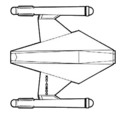 Dorsal view
 -
 Stern view


