Guide:Master: Difference between revisions
No edit summary |
No edit summary |
||
| (3 intermediate revisions by the same user not shown) | |||
| Line 1: | Line 1: | ||
{{Sidebar Guide ship | {{Sidebar Guide ship | ||
|image=[[File:|250px|Master medium fleet tug / tender]] | |image=[[File:Master (stbd).png|250px|Master medium fleet tug / tender]] | ||
|classname= ''Master'' | |classname= ''Master'' | ||
|category= medium fleet tug / tender | |category= medium fleet tug / tender | ||
| Line 35: | Line 35: | ||
* 2-6x work pods | * 2-6x work pods | ||
|historicalships= <br> | |historicalships= <br> | ||
* ''USS Chaplain'' (NCC-3714) | |||
* ''USS Coxswain'' (NCC-3711) | * ''USS Coxswain'' (NCC-3711) | ||
* ''USS Ordnanceman'' (NCC-3722) | |||
* ''USS Wiper'' (NCC-3717) | * ''USS Wiper'' (NCC-3717) | ||
|design= SFC | |design= SFC | ||
| Line 41: | Line 43: | ||
|history= SFC | |history= SFC | ||
}} | }} | ||
While the Sherman and Ptolemy classes represented a technological breakthrough in cargo | While the ''[[Guide: Sherman|Sherman]]'' and ''[[Guide: Ptolemy|Ptolemy]]'' classes represented a technological breakthrough in cargo | ||
operations, the deep space logistics chain of Starfleet was still severely lacking in the early decades | operations, the deep space logistics chain of [[Starfleet]] was still severely lacking in the early decades | ||
of the 23rd century. Operations against Klingon forces put a great strain on theater logistics, and also | of the [[23rd century]]. Operations against Klingon forces put a great strain on theater logistics, and also | ||
created the need for recovery and repair that mere quality of the big Ptolemy tenders could not | created the need for recovery and repair that mere quality of the big ''Ptolemy'' tenders could not | ||
satisfy. For quantity, Starfleet needed dozens of medium tugs with frontline repair capabilities. | satisfy. For quantity, Starfleet needed dozens of medium tugs with frontline repair capabilities. | ||
| Line 50: | Line 52: | ||
loads the size of combat starships, and several could be equipped with an onboard repair facility as a | loads the size of combat starships, and several could be equipped with an onboard repair facility as a | ||
manufacturer option or through minimal modifications, none had the propulsive performance for | manufacturer option or through minimal modifications, none had the propulsive performance for | ||
reaching the deep frontier. In 2225, following the retirement of the last Watt crewed and Boyden | reaching the deep frontier. In [[2225]], following the retirement of the last ''[[Guide:Watt|Watt]]'' crewed and ''[[Guide:Boyden|Boyden]]'' | ||
automated interstellar tugs, Logistics Command decided to procure a dedicated fleet tug, equipped with specifically designed Pleshun PB-23 series engines for warp four cruising and for warp three | automated interstellar tugs, [[Logistics Command]] decided to procure a dedicated fleet tug, equipped with specifically designed [[Pleshun]] PB-23 series engines for warp four cruising and for warp three under load. The major investment in propulsive systems meant low initial production numbers. Yet | ||
under load. The major investment in propulsive systems meant low initial production numbers. Yet | |||
the results were so satisfactory that when additional funds were released, there was no need to | the results were so satisfactory that when additional funds were released, there was no need to | ||
purchase a further batch to complement the initial order for thirty Master class medium fleet tugs. | purchase a further batch to complement the initial order for thirty '''''Master''''' class medium fleet tugs. | ||
The Master was Starfleet’s first true Class 2 supercruiser, a direct predecessor to the high speed | The ''Master'' was Starfleet’s first true Class 2 supercruiser, a direct predecessor to the high speed | ||
transports of Independence class. Granted that Master achieved speed through excess power rather | transports of ''[[Guide: Independence|Independence]]'' class. Granted that ''Master'' achieved speed through excess power rather | ||
than warp-dynamic finesse, the tugship was still potently equipped for high speed, long range | than warp-dynamic finesse, the tugship was still potently equipped for high speed, long range | ||
navigation in every respect. While the basic model had an integrated bow deflector, it was quite | navigation in every respect. While the basic model had an integrated bow deflector, it was quite | ||
typical for the vessels to haul additional podded, outriggered deflectors, of the type that would also | typical for the vessels to haul additional podded, outriggered deflectors, of the type that would also | ||
see use with the Independences. Especially useful with outsize tow loads, the pods would often be | see use with the ''Independences''. Especially useful with outsize tow loads, the pods would often be | ||
stowed in the holds ‘just in case’, to be installed as needed. | stowed in the holds ‘just in case’, to be installed as needed. | ||
The holds, accessible through a giant, 30 m high rolling door at lower stern, were capable of | The holds, accessible through a giant, 30 m high rolling door at lower stern, were capable of | ||
accommodating a wide range of other components as well. Most Masters were equipped for | accommodating a wide range of other components as well. Most ''Masters'' were equipped for | ||
carrying, servicing and swapping standard starship impulse reactors. They could also haul ordnance | carrying, servicing and swapping standard starship impulse reactors. They could also haul ordnance | ||
including antimatter pods, a capacity that would be of great | including antimatter pods, a capacity that would be of great significance later in their careers. | ||
Antimatter-powered starships were by and large too bulky to be efficiently towed by the medium | Antimatter-powered starships were by and large too bulky to be efficiently towed by the medium | ||
tugs, but benefited from timely resupply of fuel (even if in small quantities) and outsize spares | tugs, but benefited from timely resupply of fuel (even if in small quantities) and outsize spares | ||
| Line 79: | Line 80: | ||
during the half a century that the tugs ended up serving. | during the half a century that the tugs ended up serving. | ||
No Master tugs were ever pressed to general cargo hauling duty, nor did Starfleet see the need to | No ''Master'' tugs were ever pressed to general cargo hauling duty, nor did Starfleet see the need to | ||
make them compatible with standard containers. While frontline and battlefront operations were the | make them compatible with standard containers. While frontline and battlefront operations were the | ||
norm, nothing in the way of weaponry or combat sensors was installed. The ability to project strong | norm, nothing in the way of weaponry or combat sensors was installed. The ability to project strong | ||
navigational shields over the objects under tow of course nicely translated to additional self-defense | navigational shields over the objects under tow of course nicely translated to additional self-defense | ||
potential. Nevertheless, two Masters succumbed to Klingon fire in the fifties, USS Coxswain (NCC- | potential. Nevertheless, two ''Masters'' succumbed to Klingon fire in the fifties, ''USS Coxswain'' (NCC- | ||
3711) in transit to a fleet staging area near Makus, USS Wiper (NCC-3717) while recovering the | 3711) in transit to a fleet staging area near [[Makus]], ''USS Wiper'' (NCC-3717) while recovering the | ||
crippled battle cruiser Zawiya (NCC-1170). Mass retirements began after Organia, reflecting less | crippled battle cruiser ''Zawiya'' (NCC-1170). Mass retirements began after [[Organia]], reflecting less | ||
the change in strategic situation or the introduction of the increased capacity Cle Dan type, and | the change in strategic situation or the introduction of the increased capacity ''[[Guide: Cle Dan|Cle Dan]]'' type, and | ||
more the thorough state of fatigue that was making the Masters a hazard to operate. | more the thorough state of fatigue that was making the ''Masters'' a hazard to operate. | ||
The last Master, USS Ordnanceman (NCC-3722), ceased operations in February, 2282 and was | The last ''Master'', ''USS Ordnanceman'' (NCC-3722), ceased operations in February, [[2282]] and was | ||
decommissioned two months later. Like most of her sisters, she donated her onboard equipment to | decommissioned two months later. Like most of her sisters, she donated her onboard equipment to | ||
further use on starbases and other installations before being towed to a scrapping berth – by another | further use on starbases and other installations before being towed to a scrapping berth – by another | ||
Master, the now commercially owned former USS Chaplain (ex-NCC-3714). | ''Master'', the now commercially-owned former ''USS Chaplain'' (ex-NCC-3714). | ||
==Notes== | ==Notes== | ||
| Line 99: | Line 100: | ||
==Gallery== | ==Gallery== | ||
<gallery> | <gallery> | ||
File:Master (stbd deployed).png|Auxiliary deflector pods deployed | |||
</gallery> | </gallery> | ||
Latest revision as of 13:56, 28 February 2019
.png)
| |
| Master | |
|---|---|
| Class Overview | |
| Category | medium fleet tug / tender |
| Operational | 2226-2282 |
| Constructed | 30 |
| Dimensions | |
| Length |
|
| Beam | 98.9 m |
| Height | 67.7 m |
| Mass | 182,000 tons |
| Performance | |
| Cruise Speed | w 4 |
| Tow Speed | w 3 |
| Max Speed | w 5 |
| Endurance | 1 year |
| Complement | |
| Officers | 4 |
| Enlisted | 16
|
| Tactical Systems | |
| Shields |
|
| Transporters |
|
| Auxiliary Craft |
|
| Historical | |
| Ships of Note |
|
| Canonicity | |
| Design | SFC |
| Name | SFC |
| History | SFC
|
While the Sherman and Ptolemy classes represented a technological breakthrough in cargo
operations, the deep space logistics chain of Starfleet was still severely lacking in the early decades
of the 23rd century. Operations against Klingon forces put a great strain on theater logistics, and also
created the need for recovery and repair that mere quality of the big Ptolemy tenders could not
satisfy. For quantity, Starfleet needed dozens of medium tugs with frontline repair capabilities.
Shopping off the commercial shelf was problematic. While many a design was capable of towing loads the size of combat starships, and several could be equipped with an onboard repair facility as a manufacturer option or through minimal modifications, none had the propulsive performance for reaching the deep frontier. In 2225, following the retirement of the last Watt crewed and Boyden automated interstellar tugs, Logistics Command decided to procure a dedicated fleet tug, equipped with specifically designed Pleshun PB-23 series engines for warp four cruising and for warp three under load. The major investment in propulsive systems meant low initial production numbers. Yet the results were so satisfactory that when additional funds were released, there was no need to purchase a further batch to complement the initial order for thirty Master class medium fleet tugs. The Master was Starfleet’s first true Class 2 supercruiser, a direct predecessor to the high speed transports of Independence class. Granted that Master achieved speed through excess power rather than warp-dynamic finesse, the tugship was still potently equipped for high speed, long range navigation in every respect. While the basic model had an integrated bow deflector, it was quite typical for the vessels to haul additional podded, outriggered deflectors, of the type that would also see use with the Independences. Especially useful with outsize tow loads, the pods would often be stowed in the holds ‘just in case’, to be installed as needed.
The holds, accessible through a giant, 30 m high rolling door at lower stern, were capable of accommodating a wide range of other components as well. Most Masters were equipped for carrying, servicing and swapping standard starship impulse reactors. They could also haul ordnance including antimatter pods, a capacity that would be of great significance later in their careers. Antimatter-powered starships were by and large too bulky to be efficiently towed by the medium tugs, but benefited from timely resupply of fuel (even if in small quantities) and outsize spares delivered by the vessels.
Compared with the cargo and repair facilities, crew spaces were spartan and rather cramped. It was customary, even if contrary to regulations, to accommodate part of the 30 crew amidst the machinery. The nooks and crannies in these public spaces typically offered greater privacy and comfort than the dedicated accommodations: what amenities did not exist, the crew could quickly construct out of the available spares. Only the bridge on Deck 1 and the adjoining navigation facilities on Deck 2 were safe from such modifications, and indeed saw little in the way of upgrades during the half a century that the tugs ended up serving.
No Master tugs were ever pressed to general cargo hauling duty, nor did Starfleet see the need to make them compatible with standard containers. While frontline and battlefront operations were the norm, nothing in the way of weaponry or combat sensors was installed. The ability to project strong navigational shields over the objects under tow of course nicely translated to additional self-defense potential. Nevertheless, two Masters succumbed to Klingon fire in the fifties, USS Coxswain (NCC- 3711) in transit to a fleet staging area near Makus, USS Wiper (NCC-3717) while recovering the crippled battle cruiser Zawiya (NCC-1170). Mass retirements began after Organia, reflecting less the change in strategic situation or the introduction of the increased capacity Cle Dan type, and more the thorough state of fatigue that was making the Masters a hazard to operate.
The last Master, USS Ordnanceman (NCC-3722), ceased operations in February, 2282 and was decommissioned two months later. Like most of her sisters, she donated her onboard equipment to further use on starbases and other installations before being towed to a scrapping berth – by another Master, the now commercially-owned former USS Chaplain (ex-NCC-3714).
Notes
Gallery
-
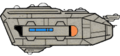 Auxiliary deflector pods deployed
.png)