Guide:Chasseur
.png)
| |
| Chasseur | |
|---|---|
| Class Overview | |
| Category | clipper |
| Operational | 2245-2267 |
| Constructed | 7 |
| Dimensions | |
| Length | 110.0 m |
| Beam | 110.0 m |
| Height | 29.8 m |
| Mass | 190,700 mt |
| Performance | |
| Max Speed | w 6.5 |
| Endurance | 2 months |
| Complement | |
| Officers | 6 |
| Enlisted | 18
|
| Tactical Systems | |
| Beam Weapons | 2x phaser V emitters (pylon roots)
|
| Shields | 1-layer globular forcefield |
| Transporters | 1 GP (2-pad); Mk II |
| Historical | |
| Ships of Note |
|
| Canonicity | |
| Design | aridas sofia |
| Name | aridas sofia |
| History | aridas sofia, Timo
|
The multirole Ariadne class remained an excellent tool in filling the gaps in UFP perimeter defenses even in the 23rd century. Yet the very gapfiller nature of the design read as a challenge for ship designers, especially those believing in the Cochranean sequential-coil drive type. In the early years of the 2240s, various compact solid state warp engines were developed and fielded for use with natural dilithium powerplants, including the PB-34 which was compatible with smallish patrol vessels. When this engine was slotted for system patrol corvettes and optimized accordingly, veteran third generation warp technology provider Yatanesi saw a market opening and instead worked its comparable PA-450 to deep space specifications.
The portly engine came to feature capacious ramscoops, a bypass plasma venting system for rapid recovery from high warp sorties, and plasma diffuser spikes for adequate stealth en route. Star Fleet adopted the design readily enough on first proposal, dubbing it the PB-38. Nylstroom Astris was contracted to produce a fairly generic scoutship hull, an ovoid with an undercut and with a stern section where any suitable antimatter powerplant could effortlessly be fitted. At 25 meters maximum width and 55 meters length, the hull barely out-bulked the twin nacelles, which were rigged on very long, 30 meter pylons both for providing a wide, maneuverability-optimal warp field and for protecting the crew from the field output.
Additional protection came from a Hobbs navigational deflector and long-range sensor booster dangling on a ventral pylon, and from an internal combat shield generator of TaT make. This left minimal room for accommodation, as the forward end of the hull was dominated by a multilevel command facility. The lowermost deck had a panoramic window arching around a half-circle of control stations, with the commanding officer’s station and a situation table at the middle. Ship’s ladder gave access to two upper levels where fire control and communication personnel worked their gear beneath vast duonetically-transparent panels. Closet-sized quarters for 24 crew were arranged along the outer walls of the midhull, with some communal spaces and supply holds in the center, but with support systems for the antimatter reactor taking up most of the centerline space.
As the name chosen for the pathfinding vessel suggested, the Chasseur would defend the perimeter by virtue of being an advance skirmishing force—but unlike the later, larger perimeter ships, it didn’t have the ability to loiter in wait yet. Mad dashes at warp six or better would bring the ship’s two M-43 phaser emitters to bear on an intruder. The technique was rigorously tested for several months in various dry runs and wargames, and found completely unrealistic: the craft lacked the persistence, firepower, and range necessary for frontier operations, as well as the growth potential to rectify the shortcomings.
What the seven Chasseurs built for the testing did excel in was reliability. Within the decade, Star Fleet would be forced to create a border defense fleet, its back against an impassable wall. Vessels built with better powerplants for the PB-38 would be the way to proceed, resulting in defenders of superior endurance and weapons output but nevertheless affordable dimensions. These perimeter ships would also pay heed to certain well-working ideas about the internal layout, and would arrange their large combat control centers in a similar horseshoe manner.
The seven pathfinders were not forgotten. Short on all other qualities, they capitalized on their dash speed in scouting rather than skirmishing tasks. Minor but crucial sensor upgrades turned them into useful perimeter assets for starbase commanders, in a fitting scale model of the defenses provided by their larger siblings much farther away from home. The Chasseurs benefited from the engine support infrastructure of the strategic perimeter action fleet, and only stopped scouting when their hulls and secondary systems wore down in the late 2260s. The even more compact Archer scoutships took over their role smoothly enough.
Gallery
-
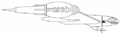 Profile
 -
 Bow
Bow -
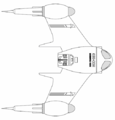 Dorsal
.png)
.png)
Notes
- The seven Chasseurs receive minor but crucial sensor upgrades and are assigned to starbases (at some point).
References
Alt Sources