Guide:Murmansk
.png)
| |
| Murmansk | |
|---|---|
| Class Overview | |
| Category | heavy transport/command ship/cultural exchange ship |
| Operational | |
| Constructed | 13 total:
|
| Dimensions | |
| Length |
|
| Beam | 51.5 m |
| Height |
|
| Mass | 101,000 tons (w/o modules) |
| Performance | |
| Cruise Speed | w 3 |
| Max Speed | |
| Endurance | 4 years |
| Complement | |
| Officers |
|
| Enlisted |
|
| Passengers |
|
| Cargo | 45,000 tons |
| Tactical Systems | |
| Shields | 3-layer graviton/subspace globular forcefield |
| Transporters |
|
| Auxiliary Craft |
|
| Historical | |
| Ships of Note | USS Hurok |
| Canonicity | |
| Design | HCFP, Spaceflight Chronology |
| Name | HCFP, Spaceflight Chronology |
| History | HCFP, Spaceflight Chronology
|
Major changes swept through Earth’s mercantile fleet in the postwar years. As wartime alliances
solidified into federal unity, the bilateral trade agreements between member cultures were replaced
by a broader network of economics. Under the Vanderbilt administration, virtually all corporation-level
trade pacts were dissolved, and cargo routes were opened for free competition. Many of
Earth’s Boomer businesses were marginalized in the process. On the other hand, Earth’s military
logistics fleet was in a unique position to secure commercial contracts, as its organizational
structure and hardware drastically differed from those of its mercantile and military competitors,
combining out of necessity the best of both worlds.
Few foreign military supply ships could haul semi-refined ores the way Earth’s lifeline designs did. Fewer still were built with the operational flexibility and multi-year endurance. Earth was quick to capitalize on the advantages by fielding the Merchant class of heavy transport ships. The standard structure of a bow module with propulsive and habitat functions, a spine for general goods cargo, fuel and ballast systems, and a modular hold arrangement was scaled up once more, to some 250 meters of total length. A few changes were made to the trusty old format, however. Warp propulsion now consisted of a stern-mounted pair of CWD-A7 nacelles, the 45,000 ton civilian counterpart of PB-6. Power was generated by two compression fusion reactors derived from military systems as well. No fewer than nine decks were provided for habitation at the forward compartment. Impulse engines and warp repeaters were mounted laterally, and a navigational deflector installed on bow.
The cargo modules to be carried under the spine were larger than ever, optimized for bulk transport. The Type V module (essentially a double-length Type IV, with flatter endcaps) protruded just a few meters below the bow section of the ship, while the thrice as large Type VI required a separate deflector emitter to protect it from superluminal impacts. Combinations of older Type III and IV modules could also be carried. Flexibility in cargo transfer operations required a shuttle hangar astern, above the main reactor compartment. This facility was modular and carried only when required, however. Typically, loading and offloading would still depend on orbital ports that possessed independent surface-to-orbit systems. Transporter-based bulk loading systems were slowly being introduced, but mechanical conveyors remained the primary means of cargo transfer well into the 23rd century.
Star Fleet’s interest in transports of this type was waning, however. There no longer existed a strategic need for the Earth military to haul ore. Beyond retaining a few class J vessels for moving fissionables, Star Fleet wanted to sell its ore transport fleet to commercial operators. Yet a crucial commercial advantage would be lost by disbanding the logistics net that made the fleet greater than the sum of its ships. On February 2167, the Subcommittee for Logistics and Trade submitted to the UFP Council its proposal for an organization dedicated to mercantile operations under the general Star Fleet command structure. An exceptionally swift process dissolved many doubts about the bureaucratic inertia of the new federal government, and by March 16th, resulted in the founding of Star Fleet Merchant Marine.
By the end of the month, some 60% of Star Fleet’s transport vessels had been assigned to the new organization. Several acquisitions had also been made, among them eight Merchant class transports, under the Star Fleet name Murmansk. The vessels were sent to inaugurate cargo services between UFP core space and the Regulus direction, and to assure purely commercial operators that the spacelanes in this region were now safe for transit. The Murmansks were of an austere standard, lacking the modular shuttlebay or any armament. Shielding was slightly improved over the original civilian level, however.
In 2169, when Merchant production was reaching its peak, Star Fleet purchased five more units. Three of these were configured as Capitol deep space command ships for SF Command needs, and also carried starship repair and replenishment gear in significant quantity and quality in the customized Type VIC command pods. The shuttlebay module and a series of large sensor arrays were permanently carried. A year later, two other ships put the same modular add-ons to very different use, and formed the Broadway subclass of cultural exchange vessels. The Broadway and the Hurok were a combination of spaceborne research facilities, negotiation rooms, exhibition halls and education centers, and carried a permanent specialist crew of 158 civilian experts in addition to the SMM operating crew. At each port of call, the number of people onboard would triple, as local researchers, diplomats, student groups and assorted audiences would make full use of the facilities.
The Merchant Marine sold the eight transports by 2189, but SFC kept operating the Capitol command vessels till the early 23rd century. It also added several auxiliary cruiser types to the combined tender and command ship family, patching the holes in actual cruiser coverage the best it could. Three engine overhauls were effected, and steadily improved the performance of the Capitols. The Broadways underwent the same refits, and the Hurok remained in operation until 2246, retired more due to the changes in political atmosphere than to technological obsolescence. Many civilian Merchant vessels reached the ripe age of 120-130 before being retired in the 2280s.
Gallery
-
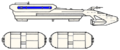 A Murmansk with its two cargo modules unloaded

Notes
- The decision to make Vickers the shipbuilder for the commercial Merchant class is game-canon, but the class definitely originated with Earth.
- The container types have been modified to fit the chronology being developed for game-canon.
- The Mk VII became the Mk V.
- The Mk VIII became the Mk VI and the Type VIIIC became the Type VIC.
- USS Hurok's registry of NCC-78 was dropped, as the number was too low for a ship that had not operated prior to the founding of the UFP.