Guide:Griffon
.jpg)
| |
| Griffon | |
|---|---|
| Class Overview | |
| Category | escort |
| Operational | 2267 - 2312 |
| Constructed | 236 total |
| Dimensions | |
| Length |
|
| Beam |
|
| Height |
|
| Mass |
|
| Performance | |
| Cruise Speed | w 5.0 |
| Max Speed |
|
| Endurance | 4 months |
| Complement | |
| Officers | 9 |
| Enlisted |
|
| Tactical Systems | |
| Beam Weapons | 4x phaser IV emitters (twin banks) (fwd secondary hull) |
| Missile Weapons |
|
| Shields |
|
| Transporters |
|
| Auxiliary Craft | Terrier: 2x work pods |
| Historical | |
| Ships of Note |
|
| Canonicity | |
| Design | FASA/Timo |
| Name | FASA |
| History | FASA
|
Background: Hobbyist's Guide
Star Fleet escort needs peaked in the mid-2260s, after the Remora and Hellespont classes had been fielded and their initial production runs completed. Yet from the contemporary viewpoint, the peak looked like the foothills of a towering mountain range. With no way of knowing that in just a few years, the Klingons would be signing documents of truce and the core space pirates would be driven into hiding on the outer rim or behind Orion backs, Star Fleet had no choice but to continue procurement of dedicated commerce protection vessels. Since vessels with single and triple nacelles had proved suboptimal, the next step was obvious.
The Griffon deep space escort was conceived with mass production in mind. Specifications relating to performance included but two items: warp five sustainable for operations spanning one year (to be attained with twin PB-35E engines), and torpedo armament (consisting of one launcher of any suitable type). Apart from these, solutions enabling a production run in the hundreds should be favored in all respects. Salazaar’s Lenthal was simply too large and costly even before the addition of the required torpedo system. ECF’s saucer hulls proved prohibitively expensive as well, and the company also acknowledged its failure to reduce mass enough to make the twin-engine configuration perform as required. Empress offered a radically simpler and lighter design, compatible with a production rate of 24 keels per year at its Morena yards. In the August of 2266, Star Fleet signed on to purchasing five annual yields and providing the engines thereto.
The Empress proposal was essentially a Corona series lifting body converted for warp drive by welding a propulsive appendage astern. The engineering section doubled the length of the vessel, and the laterally-rigged warp nacelles quintupled the mass, depriving the combination of atmospheric maneuvering or landing capabilities. A forward hull jettison mechanism restored these options in emergencies, though. The lifting body was a practical primary hull structure in other respects as well, already featuring military-standard shield generators, life support scaled for some troop carrying in addition to the needs of the flight crew of 12, and twin cargo holds readily reconfigurable for various deep space purposes. The original impulse engines of the lifting body were replaced by larger ones of military FIE-1 standard, and operated independently of main power.
Also added in this section was a Graynet-style Mk 14 light torpedo launcher with 35 rounds, replacing the original ventral cargo ramp/elevator. The necessary interstellar sensor and deflector gear was in turn installed on the dorsal forward end of the engineering section, along with a beam armament of two twin Type IV banks.
The piecemeal construction was a quick and inexpensive way to proceed, and very little integration was performed on the resulting hodgepodge of systems. When the first Griffon (NCC-E940) was delivered in March 2267, Star Fleet was immediately forced to increase the onboard crew from planned 62 to 85. Personnel expenses were insignificant in the escort equation, however, and 51 of the affordable vessels were fielded by the end of the following year.

Operational experiences were “satisfactory” in official reports. Crews were less than enamored with the compact design, but valued the firepower of the torpedo launcher. A stern tube would help with the poor turning rate and additional aft sensors were also requested. More speed would also be welcome and, in fact, Star Fleet was quite ready to provide it: if either LN-23, LN-41 or LN-61 panned out, the Griffon class would be a prime recipient.
However, Organia and the anti-piracy crusade put new Griffon production on hold for 2268. Like most yards, Empress was reeling from multiple other starship program cancellations or downrampings, and wanted to hang on to the escort program the best it could. Reinventing the mission profile would be more important than reworking the technical details; keeping costs down would be absolutely paramount for project survival. The linear engine refit was postponed, the extra torpedo tubes left ashore for the time being, and the next two batches of sixty finished with more austere sensor systems pared down to nearspace, policing-oriented specs. The Griffons spent more time as system protection cutters than in accompanying transports and merchantmen between systems—a valuable role as such, even if a waste of PB-35 capabilities.
Yet Empress never gave up: plans to install a linear drive were constantly reworked to best match the stage of completion and state of equip of the latest vessels off the dockyards. Sure enough, in 2272 the permission came to finish the final 28 vessels to the LN-61 propulsive standard. Production then moved to the higher endurance Genser type; beyond that, Starfleet had no need for so-called “medium escorts” any more.
The vessels of the second batch had a rather different silhouette out of technological necessity: the linear-excitation engines were rigged below the vessel to give a line of sight between the field windows. All the requested improvements were introduced, and since it was already known that production numbers would be limited, funds were also directed at modern interiors, encompassing both creature comforts and user interfaces. While some chided this as wasted effort, operating crews certainly held the opposite view.
Out of the 208 vessels of the first batch, some 145 saw service to the early 2300s, and 82 of these were refitted with improved interiors although not with the modern propulsion system. The second batch was not slated to outlive the first. At the end of active operations, there were 21 confirmed Griffon losses, mostly in system protection duties at the restless frontier, and three vessels declared missing. A final training unit (USS Feist, NCC-E1164) was retired in 2312; she was the last example of classic Empress lifting body design in Starfleet service.
Gallery
-
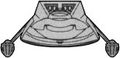 bow
bow -
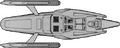 dorsal
 -
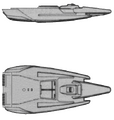 separated fwd hull
.jpg)
.png)
.png)
Note
- The Griffon production run all are assigned the "escort" registry, as they are completed prior to 2271; the Terrier production run are all assigned standard registry numbers.
- The re-assignment to standard registry (for the Griffon run) should be considered about the time the article for this class, and the Remora refit class, is being completed.
- I added the word "new" to Timo's 2268 hold on further production, as ships that had already been started were completed that year, per a previous paragraph. Errand of Mercy would have occurred (by one standard) in mid-March of that year, so production orders would only have been reduced/halted following that episode.
References