Guide:Pirithous/Hippolyta
.png)
| |
| Pirithous / Hippolyta | |
|---|---|
| Class Overview | |
| Category | corvette (later clipper) |
| Operational | |
| Constructed | 101 (total):
|
| Dimensions | |
| Length |
|
| Beam |
|
| Height |
|
| Mass |
|
| Performance | |
| Cruise Speed | w 2.0 |
| Max Speed | w 2.8 |
| Endurance | <nr>
|
| Complement | |
| Officers |
|
| Enlisted |
|
| Tactical Systems | |
| Beam Weapons | Pirithous
Hippolyta (original)
|
| Missile Weapons | Pirithous
|
| Shields | 1-layer globular shield |
| Historical | |
| Ships of Note |
|
| Canonicity | |
| Design | aridas sofia |
| Name | aridas sofia |
| History | aridas sofia, own
|
Background: Hobbyist's Guide
When Earth entered into its first defensive alliance with Vulcan, some in the UEDP held hopes of obtaining Vulcan military technology to bolster Earth’s primitive systems defense arrangements. Such hopes were quickly dashed. Vulcan was no stranger to alliances like this, having burned its fingers with some early experiments and thereafter having successfully nurtured long and slowly (if at all) progressing relationships with various client worlds. Earth’s ambition may have been high, but it was by no means exceptional. Vulcan promised to keep between one and five cruiser-sized voidships close enough to Earth for early interception of military threats and, in practice, had a vessel stationed within the Sol system at most times—but no Vulcan weaponry was distributed to the defenders of the worlds of Sol and no Vulcan served onboard the ships or installations except in abstract liaison duties.
With the formation of the UE Starfleet, the articles of the defense pact were rewritten—now with much more experienced signatories on the Earth side. A warming of relations, if the expression can ever be credibly attributed to Vulcan diplomacy, finally allowed for some limited technology exchange. While deep space military programs met with political resistance at the highest levels, the UESF set out to acquire local defense technologies at the earliest opportunity. This turned out to be in 2130, when Vulcan agreed to releasing a single smallish military ring drive vessel for testing and acclimatization purposes.

The lithe UES Pirithous was an almost off-the-shelf example of Vulcan courier construction, with an ah’Hrak Soyn warp ring of 55.5-meter diameter and a microfusion powerplant that provided a downright embarrassing warp 2 cruise speed—embarrassing for the double reasons of outperforming Earth’s best capital ships and being an almost complete mystery to UESF propulsion engineers. Evaluation of the small armed courier had to concentrate on assessing its export-cleared armament of fairly traditional laser cannon and missile tubes, its downgraded sensor systems. and the suitability of its egg-shaped hull for Human accommodation and operations. The pennants painted on the warp ring did little to establish UESF ownership of the vessel, which officially remained on lease until her 2158 retirement.
Yet Sol desperately needed interceptors capable of high in-system warp, and the courier met and exceeded the propulsive requirements. Fifteen further ring drives were purchased at a king’s ransom of mining and intellectual rights and somewhat enlarged hulls were built for Human operating crews and bulky Earth sensor and communications gear. The Hippolyta class vessels were dubbed corvettes and given pennant numbers 30-44 in the distressingly short series of warp interceptor units available for the defense of Sol. With mounting experience on interstellar adversaries, missile tubes were omitted as ineffective and the laser cannon at the ends of the 260-degree warp ring were upgraded to 750 MW performance.

Although quite capable of interstellar deployment, the Hippolytas were initially concentrated to defend Earth in the Romulan conflict. As the threat of an outright invasion was deflected by the costly counterattacks of 2155-56, the UESF was able to deploy the vessels on assignments better fitting their performance specifics. Having been optimized for the dispatch needs of the compact Vulcanian star empire, they were not Earth’s first choice for battlefield couriers across the vast theater of operations and were only sparsely used to augment the Athens and Strider forces in the conflict. Instead, they performed independent patrol runs at the fringes of the battle areas, hoping to secure the perimeter and the smaller outposts against flanking maneuvers—a vain hope in view of their primitive sensor technology. Vulcan improvements to the sensing systems made a world of difference towards the end of the conflict, allowing Hippolyta units to provide early warning against some of the lesser Romulan strikes against frontier colonies. Mainly, the upgrades helped the corvettes in self-defense, however; the entire force survived the war without losses, although there were some close calls.
After the war, the thirty units continued service in the UFP Star Fleet. Fifty more had been added during the conflict, and twenty completed at its conclusion. Their propulsion technology remained unmatched for the size category, even if larger Star Fleet types now inched towards interstellar parity on Cochrane-type warp drives. Yet Star Fleet could no longer settle for the size category of the Hippolytas when patrolling the increasingly imposing volume of space under its mandate. Further vessels were purchased with larger and more powerful warp drives, with larger hulls, and with greater potential for up-gunning. These also came to be equipped with auxiliary Cochrane drives for combat dashes. The combination of superb propulsive attributes resulted in the vessels at first popularly and then officially being dubbed “clippers”—a re-designation embraced by the Hippolyta fleet as well, until its 2208 retirement.
Gallery
-
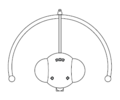 Pirithous (bow)
 -
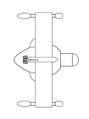 Pirithous (dorsal)
 -
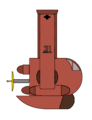 Hippolyta (beam)
 -
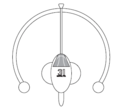 Hippolyta (bow)
 -
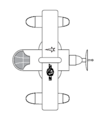 Hippolyta (dorsal)
.png)
.png)
.png)
.png)
.png)
Notes
- Timo apparently left out that a second production of 15 vessels were procured, because he went from a fleet strength of 15 Hippolyta hulls to thirty, by war's end. I've added a statement that addresses the new batch.
- It appears all 100 Hippolytas were in service to the UFP Star Fleet.