Guide:Christopher
| InsertAltTextHere | |
| Armstrong/Helena | |
|---|---|
| Class Overview | |
| Category | Cruiser/Light Cruiser |
| Operational | 2158 - 2203 |
| Constructed | 22 total
|
| Dimensions | |
| Length |
|
| Beam |
|
| Height |
|
| Mass |
|
| Performance | |
| Cruise Speed | w 3 |
| Max Speed |
|
| Endurance |
|
| Complement | |
| Officers |
|
| Enlisted |
|
| Troops |
|
| Tactical Systems | |
| Beam Weapons | Armstrong original
Armstrong (2159-60 refit)
Helena original
Helena (2159-60 refit)
|
| Missile Weapons | Armstrong original
Armstrong (2159-60 refit)
Helena original
Helena (2159-60 refit)
|
| Shields |
|
| Laboratories |
|
| Transporters |
|
| Auxiliary Craft |
|
| Historical | |
| Ships of Note | * USS Glenn (NCA-242/NCC-08)
|
| Canonicity | |
| Design | FASA Romulan War Sourcebook |
| Name | LUG, SFC |
| History | FASA, LUG, SFC
|
It was only a year into the fighting in the Romulan War that Earth truly understood the futility of ‘qualitative high ground’ against the endless ranks of agile and bold Rihannsu attack craft. Certainly the best of UESF vessels held their own against the enemy, but at a price Earth could not afford to pay. Resources dedicated to completing the heavy cruiser construction programs meant a lower total of hulls completed, a lower number of planets protected. In 2157, heated and anguished debate at UESF Command eventually resulted in a compromise known as the “seventy per cent deal”. That much funds would be released per each subsequent cruiser keel, in relation to the high-performing Enterprise class.
Eight months of concurrent design, development and construction produced the first UESF war cruiser. The Armstrong class merged attributes from both the tightly tuned Enterprises and the incredibly robust Marshall heavy destroyers. Warp five propulsion was still a design criterion, and the advanced dilithium regulator technology of the Enterprise class was adopted without hesitation. Improvements introduced with the PA-1C engines concentrated on survivability and maintainability. Six - rather than four - spoked guards on the ramscoops and plasma diffusers gave the armored nacelles a menacing look. Rather than be mounted on separate horizontal booms, the pylons attached to a single broad structure that still carried in duplicate all the PA-1 elements. Plasma rechargers now vented port and starboard rather than up, and the IMRF crystal was ventrally rather than dorsally exposed, but internal differences between the angular Armstrong hull and the rounded Enterprise booms were minimal. The ventrally accessed shuttlebay was only slightly less lavishly equipped than its Enterprise counterpart; dorsal gunports mounted the same aft-firing Type A phased particle cannon. Only aft-firing torpedo tubes were omitted from the design.

The forward hull was trimmed down from its full saucer form. As laboratory spaces and cargo holds were discarded, the bows were bifurcated into two heavily armored prongs, with the paired missile and torpedo launchers in the deep gap in between. The main role of the remaining bows was to house the forward-firing phase cannon, two Type A and one Type B per bow section, as well as the twin navigational deflector arrays on the outer flanks. A combat crew of 23 officers and 175 men served the classic cruiser mission, although accommodated in more spartan conditions than their Enterprise equivalents. Many specialists still tended to scientific instrumentation, even if now in pursuit of tactical intelligence rather than abstract knowledge. Ground combat and boarding specialists were also regularly embarked. With considerable risk but noticeable success, the single Mk I transporter platform was employed for boarding action.
Some adjustments were made to the weapons and sensor suite from the fourth vessel onwards, in response to mounting wartime experiences. Aft phase cannon and forward secondary batteries were replaced by high-power lasers, and the missile tubes were sealed off. By 2160, these changes had been effected on the original triplet of cruisers as well, although there never was anything approaching a common standard of equipment in the Armstrong force. Rather, new gear was installed as soon as it became available, and each cruiser for example came to carry a different shield generator. Maintenance in such circumstances called for a great deal of specialization. Then again, as the vessels were tasked with penetration sorties of extreme range, there seldom was any crew rotation that would have diluted the ship-specific expertise of the engineering teams. The crews spoke of themselves as being “married to their ships”, a situation quite unfamiliar to the armed forces of the preceding century Earth, although commonplace enough in the mercantile fleet.
Concurrently with early Armstrong adjustments came a decision to downscale the design one more step. The more affordable Helena light cruisers mounted the same powerplant and warp propulsion system, but dropped two primary cannon, all missile tubes and one of the torpedo tubes to allow for an even more compact hull. Warp nacelles were brought closer to each other, without major effects on speed but an increase in cruise power consumption; combined with reduced fuel tanks, this gave 25% lower overall endurance. Impulse systems were greatly compacted as well, although the result was greater agility and acceleration for the smaller cruiser. While the Armstrong class ship names honored early Earth spacefarers, a classic martial theme of successful historical war vessels of cruiser type was applied on the ten Helenas ultimately completed.
One of the most famed victories for the Armstrong fleet came at Hydra, a distant battlefield where Admiral Larson in late 2159 managed to amass his tattered and dispersed cruisers into a powerful unit that decimated its Rihannsu counterpart and opened a temporary second front against the Romulan Star Empire. Low on munitions, fuel and supplies, the five Armstrongs and two Enterprises still had to fight their way back to human-held space. In a controversial move, Larson decided to leave behind the Titov and the Kerry along with two hundred crew, in order to stock the rest of the fleet with sufficient dilithium for a voyage home; the crucial resource had become a grave strategic liability that dangerously hobbled the deep space maneuvers of the UESF.
The fleet made it safely back to Earth, and a year later, light cruiser Piranha and the transport vessel Roy Malcolm were dispatched to pick up the castaways. Their daring rescue mission was for nought, however: the two cruisers could no longer be located. Only in light of the much later discovery of debilitating radiation in the system could a plausible theory of their fate be formulated. In all likelihood, the vessels had attempted to leave the deathtrap system at sublight, only to succumb to the radiation effects while underway. Even with contemporary sensors, attempts to find the derelicts have proven fruitless, and it is suspected that an initial desperate homeward course has resulted in them currently coasting through Romulan space.
Humans would only return to Hydra a century later – but there would be no Romulan presence there either, the Neutral Zone having been drawn in accordance with the outcome of the historic battle. An equally lasting imprint from the events was Starfleet’s decision to abandon dilithium in future power applications, a move also suggested by the dwindling reserves of the precious substance and the failure modes encountered on dilithium-equipped vessels.
Turning the Armstrongs into peacetime explorers was somewhat counter-intuitively easier going than the conversion of Enterprise units. Mainly this was due to the fact that the Armstrong production run had reached twelve hulls and ample spares. There also was a lesser degree of damage and fatigue on the Armstrong war survivors. Four vessels (or 4.7, if one counted the remaining essentially spaceworthy two-thirds of the McCandless) were available for continued service in UFP Starfleet colors. Only minor “swords to plowshares” adjustments were initially performed, such as installing a general purpose laboratory, extending the medical facilities, and reconfiguring sensors for survey duty. These were quite sufficient for letting the ships score several scientific victories on par with those of the Enterprise. Much of the space within 100 ly of Earth still remained unknown to humans, or their new allies, few of which had the interest or the hardware to perform competing surveys of meaningful scope.
The exploration careers of the Armstrongs were cut short, however: as early as 2169, a refit of wholly different scope was effected on two of the vessels, and the other three retired, when dilithium regulators were declared too risky for use. USS Tereshkova and USS Glenn stand apart as the only Starfleet vessels ever to be modified from dilithium focusing to the lower-performing forcefield antimatter feed constriction. Both soldiered on at a reduced top speed of warp 4.1 until early 2203. Loss of the former to unknown causes in the line of duty resulted in withdrawing of the latter from deep space duty as well. The Glenn still remains in near-operational condition at Cait, preserved as a museum piece after half a century of sublight system patrol at 15 Lyncis.
Of the seven Helena war survivors, the fatigued Emden was immediately scrapped in 2161. As most large cruisers at the time were undergoing overhauls or refitting for peacetime duty, the distinct honor of carrying the Federation flag befell the humble Parakeet. The Lorelei would pick up the heroic Cavalier survivors in early 2162; the Aurora, Mistral and Rio Negro would again go to war the following year, and be lost to the Tarn. Recalled from deep space by the dilithium decree, the Parakeet would finally be stricken in 2174, along with the less well known sister ship Algerie.
Notes
- The sidebar diverges from the text, in that photonic/photon torpedoes had not yet been developed by 2159. Instead all tubes are for spatial torpedoes, with the numbers reduced during the war to accommodate better defensive capabilities.
- Check out the Vance Schematic site [maybe this one?] for a good stand-in for this class. Also the FASA Romulan War Sourcebook, though I suspect any images will not match text.
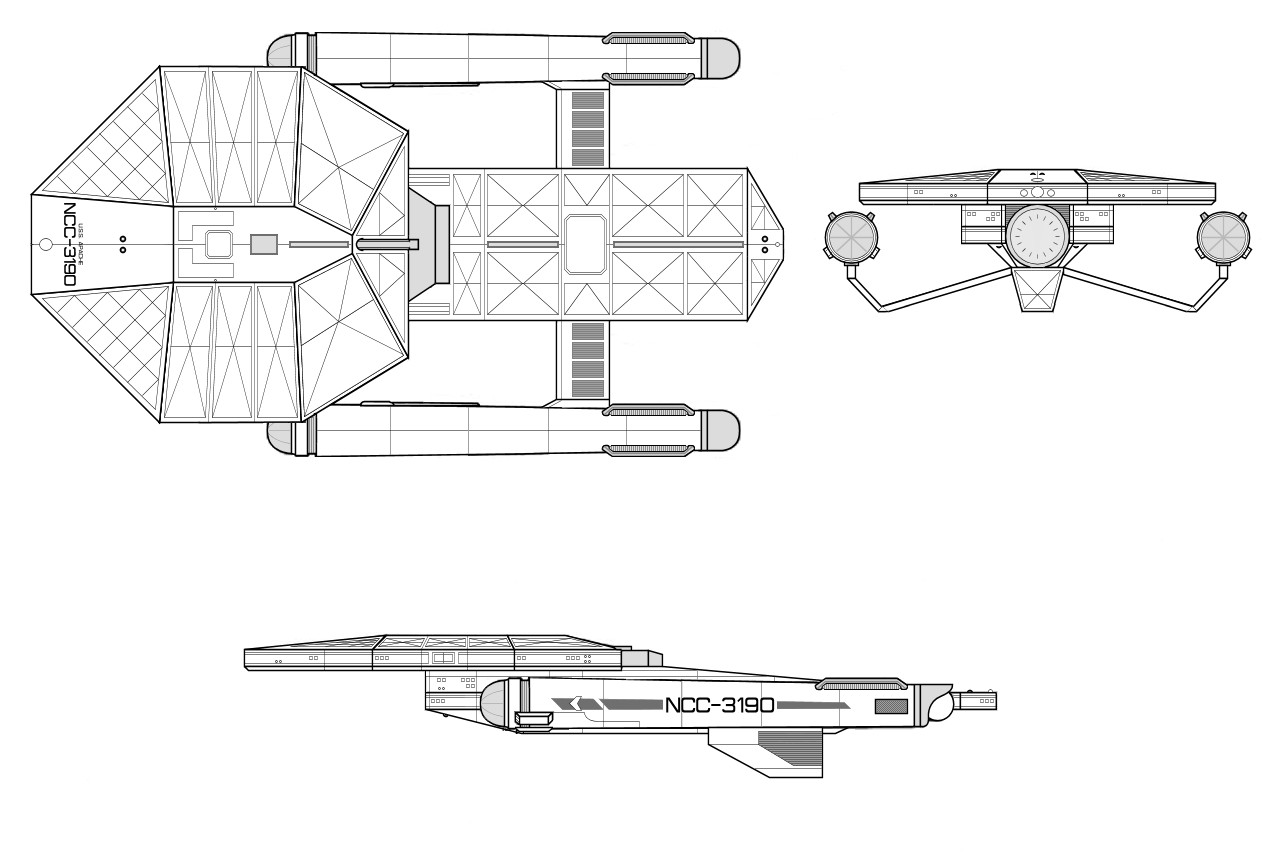
- Some commissioned ship names attributed to the Armstrong/Helena classes are:
- Guide:
- Armstrong-class
- Armstrong (NCA-242/NCC-08)
- Tereshkova (NCA-243/NCC-09)
- Kerry
- McCandless
- Glenn
- Titov
- Helena-class
- Helena
- Emden
- Lorelei (NCA-254/NCC-14)
- Aurora
- Parakeet (NCA-256/NCC-15)
- Mistral
- Rio Negro
- Algerie
- Recommended RPG Ships:
- Armstrong-class
- Armstrong (NCA-242/NCC-08)
- Tereshkova (NCA-243/NCC-09)
- Kerry
- McCandless
- Glenn
- Titov
- Aldrin
- Collins
- Shepherd
- Gagarin
- Lovell
- Leonov
- Helena-class
- Helena
- Emden
- Lorelei (NCA-254/NCC-14)
- Aurora
- Parakeet (NCA-256/NCC-15)
- Mistral
- Rio Negro
- Algerie
- Monitor
- Santisma Trinidad