Guide:Ares (battle cruiser class)
.png)
| |
| Ares | |
|---|---|
| Class Overview | |
| Category | battle cruiser |
| Operational | 2244-2264 |
| Constructed | 1 |
| Dimensions | |
| Length | 228.6 m |
| Beam | 127.0 m |
| Height | 49.0 m |
| Mass | 604,000 mt |
| Performance | |
| Cruise Speed | w 5 |
| Max Speed | w 8.4 |
| Endurance | 3 years |
| Complement | |
| Officers | 38 |
| Enlisted | 231
|
| Tactical Systems | |
| Beam Weapons |
|
| Missile Weapons |
|
| Shields |
|
| Transporters | Original
2256 refit
|
| Auxiliary Craft |
|
| Historical | |
| Ships of Note |
|
| Canonicity | |
| Design | ST: Axanar/Sean Thourangeau |
| Name | ST: Axanar |
| History | ST: Axanar
|

The repeated delays on Project Starship had by the onset of the 2240s become such a serious issue that secrecy on the project was on the verge of breaking down. No shipbuilding project since the days of ‘escape velocity’ had held this sort of strategic and political significance: Fleet procurement plans, wargaming and diplomacy all underwent dramatic twists and turns as the latest news on progress or lack thereof circulated in the corridors of power, in less and less hushed voices. Chiokis was getting an earful, not just for false promises but for the distinct possibility that the current Klingon offensive was in fact a direct response to the intended yet delayed escalation of Star Fleet fighting power.
Baseless as the speculation was, it put extra impetus on the effort through which Chiokis tried to save not just its corporate image but the future of the Federation as well. Officially, the effort consisted of a stream of light cruisers and assorted other gapfillers. Unofficially, Chiokis was prepared to drop Starship altogether and unleash something completely different on the Klingon menace. At first engineered around the trusted PB-45 and the Rochester patrol cruiser spaceframe, Project Quarterback in 2238 was redrawn into a mighty battle cruiser, mating the PB-30 propulsion and power system of Project Starship with a weapons suite the likes of which had never before been seen.
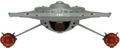
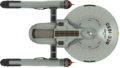
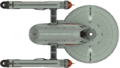
In 2241, the keel for the inaugural Quarterback was laid on one of the less distinctive box docks around Jupiter. By configuration, Quarterback was a typical piece of Hreedenck art, with multiple positioning options for the ramrod-straight pylons on the ventrally trailing secondary hull; the distinctive anhedral of the Kitty Hawk was chosen, providing maximum clearance for both warp fields and the fields of fire of primary armament. Yet the ship was no mere Rochester Mk IV, but an altogether more potent vessel, with a Kearsarge-style saucer 120 meters across brimming with weapons emplacements. There were no fewer than seven dorsal and five ventral double berths for a mixture of beam weapons, and the secondary hull accommodated a deadly quartet of heavy torpedo launchers, two on each side of the navigational deflector dish.
The juncture of the saucer and the engineering section was dorsally bolstered by a superstructure that housed another, aft-firing quartet of launchers, shunting the four-reactor SAQ impulse engines to the sides. A wide stern shuttlebay remained available for support craft, but this was mere afterthought made possible by the size of a hull segment designed to house the vitally important KR13-O m/am reactor system with sextuple dilithium foci. Power feeds to beam weapon emplacements and warp engines were short, straight and heavily armored. Antimatter bunkerage lay right next to the well-shielded power citadel, yet with direct ejection routes through a series of dorsal hatches so that combat survival need not depend on complete impenetrability of primary defenses. The ability to take massive damage was engineered to the power and weapons system from the very start: “catastrophic failure” was not just an eventuality well prepared for, but an acceptable combat mode.

The same was not true of Star Fleet at large. The betrayal at Axanar met every criterion for catastrophic failure save for two: the tactical brilliance of Kelvar Garth and the superior strength of USS Constitution. At the conclusion of First Axanar, only one of these remained. With the first Starship knocked out of action, work on Quarterback was finally given official priority orders. Resources were scavenged from wherever they could be spared, and Federation-wide fundraising campaigns initiated to capitalize on the propaganda value of Axanar. In January 2244, the battle cruiser could at last glide out of her construction dock where she had already been fully outfitted for combat. Rushing to reinforce failing defenses at the outer colonization zone, USS Ares (NCC-1650) was in mid-deployment joined by her first commanding officer, Garth of Izar.
The baptism of fire at Inverness proved the value of the torpedo armament in a series of easy victories over Klingon battle cruisers. The Star Fleet propaganda machine made the best it could of the engagement, releasing stunning visuals of daring maneuvers. What the Offices of Tactical Planning did not wish revealed to the public were the shortcomings found in the shielding of the new fighting machine. A superb tool of offense, the Ares had to be wielded with Klingon-like audacity in order to protect her tender flanks, especially her high-strung warp power system that might suffer disastrous feedback from any piercing hits.
When the painstakingly repaired Constitution received a second crippling blow at Lea, what Star FFleet needed was a defender of great endurance, however. With older battle cruisers falling to pieces left and right of him, Garth saw the hopelessness of a defensive stance, and arranged for a trap worthy of sagas to conclude the war right where it had started. Victory at the Thranstor yards turned the tables on the Klingon Empire that for its turn had to face an acute shortage of capital ships.
It was all the more shocking for Garth, then, to return to the planning offices for the devising of an offensive to take advantage of the situation, and find waiting for him Star Fleet orders to cease all work on the Ares class. With no Klingon forces remaining in UFP space as defined by prewar borders, the decision had been made to utilize the lull in another fashion – by finishing repairs and construction on the Constitution class ships and creating a defense capable of securing the status quo. All 30-series warp coils were to be allocated to the Constitutions, all 130/4.2 heavy lasers installed on Starships.

The strategy paid off. All subsequent Klingon offensives were isolated sorties strictly limited in duration and scope. Thwarting them called for rapid and potent defensive response at the tactical level, rather than strategic strikes against some sort of a grander scheme. The remaining battle cruiser forces were relegated to use as heavy destroyers, either held in retaliatory reserve or deployed in formations protected and led by the heavy cruisers that now reigned supreme in deep space. The sole exception was Ares herself, sometimes utilizing her great speed in solo troubleshooting missions – but more typically cruising around the Federation on assorted promotion tours.
Gallery
-
 Ares class
 -
-
-

-
-
 USS Ares in drydock
 -
 Ares class in orbit
 -
 USS Ares engaging Klingons
.png)
.png)
.png)
.png)


Notes