Guide:Syracuse/Saladin/Siva/Einstein

| |
| Saladin | |
|---|---|
| Class Overview | |
| Category | destroyer |
| Operational | 2224-2297 |
| Constructed | 59 total: |
| Dimensions | |
| Length |
|
| Beam |
|
| Height |
|
| Mass |
|
| Performance | |
| Cruise Speed |
|
| Max Speed |
|
| Endurance |
|
| Complement | |
| Officers |
|
| Enlisted |
|
| Tactical Systems | |
| Beam Weapons | Syracuse
Saladin (original)
Einstein (original)
Einstein (refit)
Siva, Saladin (refit)
Siva II
|
| Missile Weapons | Syracuse
Saladin (original)
Siva, Saladin (refit)
Siva II
|
| Shields |
|
| Transporters | Saladin
All classes
Siva
Siva II
Select ships
|
| Auxiliary Craft | Syracuse
Saladin, Siva, Siva II
Einstein
|
| Historical | |
| Ships of Note |
|
| Canonicity | |
| Design | STII/Franz Joseph, STXI, ST:Axanar |
| Name | STXI, FJ, Goodman Federation: The First 150 Years |
| History | STXI (FJ)
|
As Geering continued to provide Starfleet with its most powerful modern ships in every category,
Chiokis was forging a reputation as the most dependable designer of affordable warships to be
produced in large numbers. This was actually quite contrary to the company’s aims and ambitions,
but helped support the company while it waited for its big break in the Horizon upgrade program
where its true hopes were placed. Starfleet in turn benefited from having two parallel sources for
saucer-hulled ship designs, in addition to always keeping at least two different engine manufacturers
and shipyards sufficiently employed and funded.
When the upper-tier Detroyat destroyers were ordered from Aurora, Geering for once had to settle on the parallel lower-tier contract. There was little cause for disappointment, as the lighter destroyer was intended for an at least fourfold production run. By 2221, the first two vessels for a planned inaugural batch of 26 were undergoing impulse tests and establishing beyond doubt the structural integrity of the new destroyer workhorse. The primary hull was of obvious Burke pedigree, with a flat, single-deck main disk topped by a terraced superstructure and an aft spine featuring a small shuttlebay above the centerline SAB impulse engine.
Yet an angled ventral ‘neck’ now supported a single PB-29 nacelle – the last although, at 148 meters and 170,000 tons, not the largest of the third generation spooled engines to be designed. At the bow of the nacelle, a Hycor deflector system provided a FTL graviton stream that could sweep clear the flightpath of the ship up to a speed of warp eight – a safe margin in terms of true maximum speeds in the 2220s. The beam was effective up to forty-seven light seconds against 5,000 kg objects, and up to two light minutes against smaller obstacles. The nacelle also contained most of the warp machinery of the ship, and distributed power to various other systems, including a booster feed to the impulse system. A lift and ship’s ladder connected the lower engineering levels to the primary control facility in the main hull, and an airlock complex halfway along the neck provided EV access. Also included in the neck area were workshops and some temporary bunking and rest facilities for the engineering crew.
Armament, while still geared for frontal offense at the deliberate expense of all-around defense, was intended to be quite different from that of the Detroyats. A dorsal pod would house four paired torpedo launchers of small caliber but high rate of fire. The saucer was to be provided with four berths for laser cannon, two dorsally and two ventrally, as well as up to three plus three point defense plasma cannon, even though filling of all the berths was never considered the preferred option. Centralized production commenced at Almaz factories on the required weaponry, as various dockyards completed the initial ten hulls. Names honoring ancient cities that had successfully resisted assaults and sieges were chosen; registries for the Syracuse class began at NCC-420, as these lighter vessels were in no way cruiserlike and had no place next to the Detroyats in the registry charts.
After the first combat engagements, it became evident the ship type should not be positioned next to Detroyat formations in more concrete terms, either. Delays in delivery of torpedo systems were not the major problem. Rather, the smaller single-engine configuration resulted in range and maneuverability shortcomings that hindered strategic deployment and made Starfleet re-estimate its needs. Valuable dockyards could not be wasted on inferior products in this time of ever-heightening crisis. Thus, even though Syracuse production continued within the bounds of already allocated resources, an order was placed on an improved model - a vessel that would become the definitive single-engine destroyer for the better part of the century.
Being slow to reach the thick of battle, the Syracuse group could be expected to suffer lighter combat losses than its successors. Yet Starfleet was positively surprised that the 2220s and 2230s went by almost without casualties. A second batch originally intended for attrition replacement was nevertheless funded and likewise managed to avoid both combat and wear and tear for the next decade (there being tongue-in-cheek references to divine protection as the vessels in the batch were named after classic Terran gods and demigods). The class thus was deemed fit for receiving the hypermodern PB-45 engine - just in time for the next major Klingon offensive. Lamentably, little else could be modified under the tight schedule and tighter funding, and casualties now began to mount.
Among the first to fall was the Triton (NCC-I539), blown up by a Klingon privateer in an early test of Starfleet mettle in 2241. Axanar casulaties here. The Troy (NCC-423) and the Hellas (NCC-426) succumbed in 2246 to Klingon forces at Delta Leonis, but helped evict the fleet of Admiral Kkorhetza from Federation space for good, rendering its Axanar expedition null and void; the destroyer names were honorably assigned to brand-new Loknars soon thereafter. Ten years later, USS Alexandria (NCC-422) was destroyed and the Carthage (NCC-428) and Massilia (NCC-432) damaged in an audacious ramming attack by Klingon special forces at SB 19; losses of personnel were light, but material damage too great to warrant repairs of the crippled destroyers. Finally, USS Pompeii (NCC-424) was in 2270 destroyed with all hands by heavy cruiser Enterprise, as part of the ‘dreadnought incident’ that was among the first Starfleet counterreactions to the onset of relative peace.
Back in the 2220s, modification work on the Syracuse design had proceeded with rearranging of the primary hull stern. Former shuttle handling spaces were now taken over by additional power generation machinery and fuel tanks. The light twin torpedo launchers had been found disappointing, yet continuing shortages of the heavy Keindoffer-Klaatsen torpedo launchers prevented their adoption at this stage. The existing dorsal pod was thus fitted with a twin-tube unit of novel design and 700 mm caliber instead. The projectiles were still much humbler than the Detroyat torpedoes, no different in dimensions from the 22nd century ordnance and sustaining warp for just four seconds. Yet it was to be this design and not the Detroyat or Syracuse ones that would be further developed for fleetwide use. Built by Selenia of Rome, Earth, the weapon soon propelled its manufacturer to success and fame, and was grandiosely known as the Mk 1 heavy photon torpedo system.*
Within the saucer hull proper, there still were four twin laser emitters, two firing from above and two from below the hull. This austere arrangement proved very efficient in comparison with the previous multi-port configurations, a development analogous to that of Earth nautical warships in the 1970s. Also in line with the historical precedent was the armchair expert reaction to the innovation: the gigantic saucer hull was declared ‘underarmed’ and ‘excessively sized’ for its task. Yet the rationale for this was also to be found by a retrospective look. At the threshold of major technological and tactical breakthroughs, Starfleet wanted to invest in vessels that could easily be fitted with the newest equipment – even when nothing was known in advance about the nature of this yet to be invented gear. The ‘oversized’, internally easily reconfigurable Class 1A hull was to become a Fleet standard for ships varying from scouts to heavy cruisers.
Test runs established a top speed of warp 5.5 for the inaugural modified destroyer Saladin, allowing her to be commissioned in 2224 for full military service. Her performance still lagged behind that of the Detroyat class, but not so badly that Starfleet wouldn’t have taken advantage of the lower acquisition price of the single-naceller. A final distinction from the original, less than stellar design came with the adoption of a registry number somewhat higher up the range, NCC-500.
Several batches of Saladin class destroyers were completed to boost the Syracuses. Twenty ships, all named after Earth warrior leaders, were built to the original standard with conventional total conversion powerplants, and 26 more were originally planned. Yet construction was halted at this point, pending the introduction of the radically new dilithium-regulated antimatter propulsion system. Sixteen ships of the Saladin standard were converted to this type of power in 2239-42. Instead of the mediumweight PB-45 used in the comparable Syracuse update, sophisticated PB-31 nacelles with either FWD-1 or FWD-1A solid-state coils were introduced in the conversion that turned the sluggish Saladin destroyers into high speed war machines of unprecedented power – worthy stablemates to the emerging heavy cruiser and heavy frigate classes which also utilized this futuristic warp engine type. The more powerful engines were not larger as such, and only increased the overall dimensions of the vessels because their mounting neck was almost tripled in length, for proper coil placement and for housing externally those power systems no longer fitting inside the nacelle. They also increased mass by mere ten percent, despite the greater density of the new coils.
In the end, the original flat saucer proved incapable of accommodating the required internal refits, and Chiokis was called in to perform the necessary modifications. The upper and lower superstructures had to be extended to house an improved, internally carried torpedo system with enlarged magazines, an all-new fire control system, and a sensor array within a prominent dorsal dome. In a further volume-adding move, the saucer was bulged more extensively on the dorsal side, and acquired an additional semi-deck around its ventral rim for the field guides of the Hycor DS-20 shield generator, the combined effect being to give the hull a distinct ventral concavity. This hull form was quite deliberately chosen for its advantageous aerodynamic properties, allowing for increased stability during emergency landings. Within the externally unchanged hull areas, armament was revamped from four pairs of lasers to three pairs of phased particle guns. The plasma cannon were removed, as the improved shields already provided superior defenses against proximity threats.
The navigational deflector was remounted on a ventral support strut. A limited mechanical steering capacity allowed for sweeps of 15 degrees in each direction, compared with the maximum 5 degrees of the earlier fixed installations, or the 28 degrees of the Detroyat sensor/deflector dish assembly. However, the whole assembly could also be made to slowly swivel for special purposes, like closequarters debris sweeping. This modernized system was once again a non-vital item tested for future use. The power output of the destroyer’s total conversion reactor (or even that of the later dilithium powerplant) was not sufficient for the use of the pressor beam as a weapon at warp speeds, but such capacity was planned for the more powerful cruisers that were to follow. The standard forcefield component of the deflector system was a practical defense against kinetic energy weapons.
Since ten new ships were also built to this standard, beginning with USS Siva, the variant is sometimes named the Siva subclass. Three vessels of the original run were left unconverted, though, as they had been given a thorough mission and configuration revamp a decade prior. Addition of a dorsal pod similar to that of the Ranger light cruisers had turned USS Xerxes, USS Eztel and USS Rahman into destroyer leaders, giving them significantly boosted sensing capabilities, a useful load of auxiliary craft, and spacious C3I facilities. The modification had not decreased warp performance, but it carried an impulse maneuverability penalty.
The conversion had been a qualified success at best, and refitting of old Texas light cruisers to destroyer leader tasks was quickly deemed the better way of spanning the gap left by Ranger losses and retirements. This left the converted single-nacellers free for solo assignments. By 2235, they had all been renamed after scientists and engineers, and their registries had been given an O prefix to reflect observation duties in contested space.

In a mirror image of this move, several Hermes scouts would later be converted to destroyers and in turn have their constellation names changed to those of battle sites. The economical nature of singleengined attrition warships thus offered Starfleet unprecedented flexibility and allowed timely responses to changing strategic priorities. Few twin-engined classes were available in sufficient abundance to cater for such radical and quick-paced changes until the very last decades of the Klingon conflict.
A further upgrade standard introduced in 2249 gave the Sivas phaser VII armament, forced-intermix warheads for the torpedoes, a lower-profile bridge structure and a tractor beam mounted on the connecting fin’s trailing edge midway between the saucer and the nacelle. This modification (sometimes referred to as the Siva (II) subclass or the Siva Mk II design, since no new keels were built, and the class ship was the first to be modified), helped the ships stay apace with the latest Klingon threat developments and served until the 2280s as the ultimate standard of Saladin-family ships.
No modification, however, could address the main problem of this at its time extremely innovative and modern design. The narrow cylindrar warp field generated by the single set of coils within the single nacelle did allow the ships to reach speeds up to warp 8, but the maneuverability of the vessel at such speeds was minimal. Early on, this practically forced the ships to drop to sublight and use impulse thrust maneuvering to reach firing positions in close combat situations, making them virtually powerless in one-on-one combat against more maneuverable vessels.
The relatively bloodless solution to the Axanar crisis meant that Starfleet’s ambitious shipbuilding programs became grossly oversized. There was little real military action between Axanar and the 2280s, and very few of the Saladins ever saw combat in that time period. Still, Starfleet trained aggressively for the use of the destroyers both in defense and offense. The earlier slow-paced combat tactics of warp speed deployment runs and impulse maneuvering gave way to high speed engagements where the destroyers only occasionally dropped to sublight speeds. Given the poor warp maneuverability of the early types, extreme skill was required in these operations. Not surprisingly, major casualties were soon suffered in practice maneuvers. In 2259, USS Iblis (NCC- 528) hit the tender USS Newton (NCC-3822) with her navigational deflector, killing 23 aboard the latter ship. In the 2262 exercise Have Gun, USS Azrael (NCC-517) sprang a major leak and lost 12 crew when she loitered too close to the black star TNC 65823, and in disorientation collided with the shields of the dreadnought Dominion (NCC-2115).
Many a profilic Starfleet captain received her or his initial command experience and combat training in the Saladin fleet, which despite the problematic handling qualities was ideal for the role: no other assignments tied down the offensive force in the late fifties or sixties. On the other hand, the absence of glorious battles meant that UFP saw less and less need to build dedicated capital ship killer vessels like the Saladin and later Larson classes. After the final Larson batch of 26 was procured in 2261, destroyer funds were redirected to experiments intended to address the inherent shortcomings of the single-nacelled configuration. The attempted remedies were somewhat uninnovative, though. Adding a second nacelle to USS Pompey (NCC-506) and two sisters in 2262 merely resulted in a disproportionately expensive destroyer or a poorly performing frigate. The Siva (III) dorsal-nacelle experiment performed on NCC-520 would in 2275 give the same results at even greater expenses.
Yet so poor was the reputation of the single-engine configuration at this point that the order for a final 26 Saladin destroyers in the late sixties was turned down by the Council a phenomenal six times in a row. The two-nacelled Akula class based on Siva (III) was funded instead, in one of the worst procurement blunders of the late 23rd century. It would take a completely new engine and a renewed Klingon threat to give Starfleet back its confidence in the abilities of single-engined vessels, as described in the later Cochise entry. The original Saladin lineage would be all but gone by the 2287 détente, and only the most extensively modified variants would see the turn of the century.
At the time of the writing, sixteen Siva (II) ships still reside in surplus depots in near-operational condition. Starfleet has not activated these vessels for the better part of a century mainly because of lack of trained personnel to handle the utterly antiquated power systems – spares could readily be manufactured by replicators, of course. While many political entities have long expressed interest in purchasing the dormant vessels, and while the technology aboard the ships no longer suffers from export limitations, the act of selling the ships themselves is contrary to UFP Council decisions in the aftermath of the Altair VI sales fiasco.
- Even though the Selenia launcher in the 2220s was dubbed a ‘heavy’ weapon, this work systematically follows the practice
introduced in 2271, where weapons of this caliber are know as ‘medium’ systems. Actual ‘heavy’ weapons by current standards would be first introduced in the 2280s, while ‘light’ systems would remain comparable from the 2220s to the 2370s. The introduction of mini- and microtorpedoes has further muddled the waters during the past century. Yet the remarkable degree of standardization in Starfleet torpedo weaponry warrants the continued use of this simplistic-sounding, now five-tiered system.
Notes
- The number of laser emitters indicated for the Einstein (original) are mismatched, so they've been corrected to a total of 6.
- The number of phaser emitters indicated for the Einstein (refit) are mismatched, so they've been corrected to a total of 6.
Gallery
-
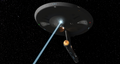 USS Saladin fires her forward phaser bank at a planetary target during her shakedown/systems tests
