Cargo Containers
Type DY
With the introduction of the DY series of transport spacecraft (and related variants) came a standardized cargo module. Sixteen of these modules could be affixed to the spine of the DY-100 and accessed from within the spine itself. The modules were manufactured to handle different cargo types, but even the general type could be adapted to carry liquids and gases when the proper bladders were installed. They were rated to carry up to 100 metric tons.
-
 A close up of a mounted container
 -
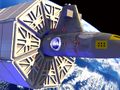 A full ring of cargo wedges
 -
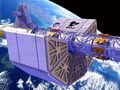 Example of the mounting gear of a DY-100


Type II
Type II containers became the standard with the introduction of the G class freighter in 2090, and were more commonly associated with the three variants of the Y class. Each was rated to hold up to 5,000 metric tons.
-
 Type II side seen from external to the ship
 -
 Forward view
 -
 Dorsal view
 -
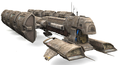 8 Type II containers loaded onto a Y class freighter.
.png)
.png)
.jpg)
.png)
Type III
The Type III container was introduced in 2099 for the purpose of bulk ore hauling. They were rated to carry of to 7,500 metric tons of materials and were quickly modified to handle other non-mineral resources, too, especially on the J class freighters.
-
 Type III side view
 -
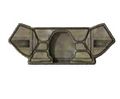 Forward view
 -
 Dorsal view
 -
 Ventral view
 -
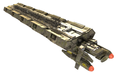 Five Type IIIs suspended under a holding spar and interconnected to the J class tug.
.jpg)
.jpg)
.jpg)
.jpg)
.png)
Types IV and V
Type IV containers were introduced in 2141 for civilian usage, well before the acquisition of the Murmansk transport by the future Federation Starfleet. They were intended for bulk transport, not only of raw and refined ores and liquids, but packaged and large scale products, as well. The Type IV was rated to carry up to 20,000 metric tons. The Type V was introduced three years later and was of a similar stule, but just over twice the size of the Type IV and was rated for 45,000 metric tons.
Type VII
The concept of modular transport containers is far from new. As far back as the DY-100 class, interchangeable components have been used to ease cargo transition as well as allow mission-specific transportation without requiring an entirely new ship.
Through the history of the United Earth Stellar Navy, the United Earth Starfleet, and finally the Federation Starfleet, however, the problem of a ‘standard’ container system, as well as a military-grade interchange system, has kept modular transportation systems just out of reach.
In 2222, a new consideration was added for the developing Ptolemy project: a new design for modular transports. Within a few years, both the first ship and pods were completed and the new system was born.
For transport ships following the modular transport design, the primary hull and drive system is linked to an ‘interlock’ port, a strong locking device which clamps the transport pod to the host ship by way of a joined pylon. In this way, a starship can make use of a variety of cargo containers, fulfilling different needs. For transport duties, the docking system has proven remarkably successful. The ability to switch cargo types, and even ‘ferry’ cargo between ships without loading and unloading has proven to be a valuable asset in the spacelanes.
Of course, it didn’t take long for some to consider combat applications for the transport pod system, and new designs for troop and shuttle transports, as well as ‘battle barge’ systems, were quickly drawn up for testing. The results of the ‘military application’ pods have been mixed. While ‘cheap transport’ may make sense in wartime, particularly when resources are short, their performance in peacetime lags well behind dedicated ships of the same function. Also, since the expected rise in tensions with the Klingon Empire did not come to pass, the designs have largely been shelved, with only a few applications coming to fruition in limited numbers.
Bulk (FDB-001)
The ‘dry bulk’ container pod is basically the ‘stripped down’ transport pod, where little equipment is used for special handling and environmental concerns.
For its design, the ‘dry bulk’ pod is basically a stripped-down and somewhat more economical pod when compared to the general products design. Starfleet does keep a large number of these pods on hand, and are often referred to as ‘snail mail’ pods, since they often deliver stellar mail between ships, starbases, and Federation worlds.
Like the other ‘standard’ container types, the FDB-001 type would find common use in civilian roles and be in common use for decades following their release.
-
 2245 (bow/stern)
 -
 2245 (dorsal)
 -
 2245 (side)
.png)
.png)
.png)
.jpg)
Colony (CLN-001)
The ‘wagon train’ pod is designed to transport a large number of people (as much as two thousand) and all their belongings, as well as basic materials to begin a colonization program. As such, rooms are small and spartan, with design efficiency decidedly given over to ‘making the most of any room that’s available’.
Starfleet maintains very few of these pods on their own, preferring to allow civilians to colonize safe worlds on their own. However, colony transport protection is a very high priority for Starfleet, and these pods sometimes seem to be magnets for raiders.
Liquid (FGL-001)
The ‘liquids’ pod is designed with multiple pressure and temperature-controlled compartments to handle the transportation of liquids of various types, ranging from common water to low-yield hydrogen plasma. The pod’s systems are designed to keep each compartments’ liquids as stable and secure as possible.
Since the FGP pod has similar capacities of its own, the FGL pods are reserved for large-scale transport of liquids, such as initial colony supplies. Because of this, there are significantly fewer ‘liquids’ pods than general products pods in the space-lanes.
Marine Transport (TCV-001)
The ‘troop’ pod is a rarity, being designed for war-time operations and pressed into service for a war with the Klingon Empire that never came. The pod is a ‘budget military transport’, capable of moving a large number of troops quickly, but in very Spartan conditions.
Starfleet ordered a couple of dozen pods of this type during its initial appropriations after the Axanar conflict, but they have seen little use outside of training exercises since that time. Though effective, it’s likely the Marines will simply opt for a new dedicated ship design as the TCV pods are decommissioned.
Mobile Repair (MRS-001)
A lifesaver for more than one starship captain, the ‘missus’ pod acts as a limited-facility drydock, capable of handling emergency repairs and minor system refits in the field. It’s the ‘next best thing’ to a real drydock, and can get all but the most severely damaged starships up and running in short order.
The main and rear ‘clamps’ are shown as retracted, though they can extend out to encompass the primary hull of current class I starships. Though technically possible, it is against regulations for the facility to be in use while actually docked to its host ship.
Products (FGP-001)
The ‘products’ pod is designed for mass transit of ‘finished’ goods and materials. The pod can carry up to 300,000 cubic meters of assorted freight, ideal for resupplying starbases and outposts, as well as maintaining supply lines for Starfleet activities.
The FGP pod is designed to carry an assortment of goods, so it maintains several compartments for refrigeration, liquid transport, and so on. Due to its general purpose use and large capacity, the FGP pod is the most common type of transport container currently in use.
Reefer (FRF-001)
The ‘reefer’, or refrigeration pod, is used to transport materials that are environment-sensitive. ‘Refrigeration’ may be a misnomer, since the pods are capable of transporting and delivering goods while maintaining ‘high heat’ conditions as well.
Since the FPG pod has refrigeration capabilities of its own, the FRF pods are reserved for large-scale transport of environmentally sensitive goods. Consequently, there are significantly fewer ‘reefer’ pods than general products pods in the spacelanes.
Shuttlecarrier (SCV-001)
A design for a war that never came, the SCV ‘shuttlecarrier’ transport was intended as a ‘cheap fighter emplacement’ system. The pod carries a sizable number of heavy shuttlecraft, capable of defending a colony or outpost in potential hazard zones.
Though the design is retained as a ‘war time eventuality’, few of these pods were actually constructed, and the four in service are used primarily for training purposes for Starfleet and Starfleet Marines. It’s likely that this pod type will be phased out entirely in favor of dedicated light carrier ship designs in the future.
Starliner (SLR-001)
The ‘starliner’ pod is normally in use by civilian agencies with auxiliary ships rather than formal use by Starfleet, though there have been a few exceptions - mostly for diplomatic purposes or the large-scale transportation of troops.
An SLR-001 type pod can accommodate between 300 to 500 guests in high luxury, with a wide variety of entertainment services, spacious rooms, and fully stocked galley. To get an understanding of the luxury found within this starliner, the SLR-001 itself (somewhat modified from spec) is the ‘Presidential Liner’, reserved for the Federation President and his staff.