Guide:Victory/Crusade: Difference between revisions
No edit summary |
No edit summary |
||
| Line 53: | Line 53: | ||
history conspired to steal the vessels of their glory, and lack of time and resources meant that the as-such workable drive system could not be tuned to desired performance. | history conspired to steal the vessels of their glory, and lack of time and resources meant that the as-such workable drive system could not be tuned to desired performance. | ||
[[ | [[File:Victory (under construction).png|left|300px|thumb|The would-be ''USS Victory'' taking shape at the [[Chi Eridani]] yards, precariously close to the war theater. Yet to be installed on | ||
the left are the third nacelle, the outboard field guide fins, and the impulse sponsons rounding the sides of the forward hull, | the left are the third nacelle, the outboard field guide fins, and the impulse sponsons rounding the sides of the forward hull, | ||
as well as most of the sensing and scanning systems. The ''Victory'' did get cleared for warp testing before termination of the | as well as most of the sensing and scanning systems. The ''Victory'' did get cleared for warp testing before termination of the | ||
| Line 81: | Line 81: | ||
away. | away. | ||
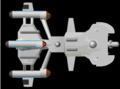
[[ | [[File:Crusade (dorsal aspect).png|left|300px|thumb|The ''Victory'' was given a makeover at the conclusion of the war, involving removal of the fighter bays, most of the plasma | ||
cannon, and the direct external plasma leads to nacelle forward ends. Demonstrating the configuration in simulation form, | cannon, and the direct external plasma leads to nacelle forward ends. Demonstrating the configuration in simulation form, | ||
the unbuilt sister ''Crusade'' is here being marketed as an explorer design. However, the main goal of the design, the warp | the unbuilt sister ''Crusade'' is here being marketed as an explorer design. However, the main goal of the design, the warp | ||
| Line 137: | Line 137: | ||
==Gallery== | ==Gallery== | ||
<gallery> | <gallery> | ||
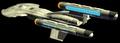
File:Victory (nearing completion).png|''Victory'' nearing completion | |||
File:Crusade (dorsal beam).png|''Crusade'' (dorsal beam) | |||
</gallery> | </gallery> | ||
<br> | <br> | ||
Revision as of 15:37, 20 December 2014
| Victory class battle cruiser | |
| Victory | |
|---|---|
| Class Overview | |
| Category | Battle Cruiser |
| Operational | 2162, 2166 |
| Constructed | 1 |
| Dimensions | |
| Length | 312.0 m |
| Beam | 189.0 m |
| Height | 63.0 m |
| Mass | 445,000 tons (as completed) 423,200 tons (trials configuration) |
| Performance | |
| Cruise Speed | w 3 |
| Max Speed | w 6.4 |
| Endurance | 4 years |
| Complement | |
| Officers | 85 |
| Enlisted | 290 (as completed) 210 (trials configuration)
|
| Tactical Systems | |
| Beam Weapons |
|
| Missile Weapons |
|
| Shields |
|
| Transporters | 2 GP (3-pad); Mk I |
| Auxiliary Craft |
|
| Canonicity | |
| Design | SFC, Michael Lanziger & Paul Lloyd |
| Name | Michael Lanziger & Paul Lloyd |
| History | SFC, own
|
The sad tale of the UESF battle cruisers reached its second, closing chapter in the Victory class of high
speed penetration cruisers, vessels that did not live up to any part of their designation. Intended as
heavily armed offensive platforms surpassing even the Yorktown in firepower, they never saw any
penetration action where the armament could be put to proper test. Their top speed never reached
the hoped-for heights, either – and the career of the only completed vessel involved no cruising, but consisted of brief trial runs only. This was hardly the fault of the designers, however. Twists of
history conspired to steal the vessels of their glory, and lack of time and resources meant that the as-such workable drive system could not be tuned to desired performance.
.png)
For the offensive edge, the saucer hull of the Victory was to carry the same four forward-firing missile tubes as the Yorktown, but these were flanked by a total of four torpedo tubes. Six dorsal and six ventral gunports would protect whatever modular beam armament would be installed. Aft of the saucer, the hull continued as a broad, streamlined block. It featured an hourglass tapering between the forward mission section with two winglike fighter launch stations and the aft reactor space with a trio of dilithium-focus warp reactors. Each wing would support up to ten defensive craft, once it could be agreed what type of craft was to be carried; there was also a pair of more conventional shuttlebays between the wings, with dorsal rolling doors. Each warp reactor in turn would feed one engine nacelle, the type of which was again to be determined. Contingency cross-feeding was provided for, and there were external surge pipes leading directly to the ramscoops for emergency circulation of plasma. Although bold in scope, the design was based on tried and true technologies.
Yet nothing would have been won by rushing the construction of a weapon that would decide the war on one stroke, one way or the other. Only a completely successful battle cruiser design could perform the audacious raid against the Romulan home system. If the element of surprise was lost in a merely halfway successful attempt, Earth could not hope to win the following conventional race of escalation, not on a palatable timescale. The building plans thus underwent continual changes, as new weapons and materials were suggested and discarded, dwindling resources re-estimated, and the desperate cries from the battlefronts for speeding up construction evaluated, classified and filed away.
.png)
Three Victory hulls inched their way towards completion, two at Mars, one apparently initially at Kaleb; this position, precariously proximal to the front lines at Manarram, came close to being abandoned in 2160, and the hull had to be clandestinely evacuated to Andor. The transfer, performed in difficult conditions under the code name Golden Pheasant, further delayed construction. Nevertheless, one of the three ships was almost complete when the word came through that the Romulans had sent an offer for truce through subspace radio. The battle of Cheron, fought two weeks earlier and at first ranked by UESF analysts among the dozens of other costly but indecisive Earthfleet deep strikes, had apparently managed to end the Romulan offensive effort once and for all. Romulan ships everywhere disengaged, withdrew several parsecs and waited for news of peace negotiations. These soon began under the leadership of Council Member Abraham Dannon, and work on the battleships was discontinued.
The cost of stopping these enigmatic people had been high. In face of possible further casualties in a war that neither side could win, the members of the wartime alliance, now officially called the United Federation of Planets, decided to accept the Romulan demands of a neutral zone and of complete non-aggression from the part of Earth or UFP members. In the views of many, a victory in space had been nullified by a defeat at negotiation tables. What angered people more was the complete self-isolation of the Romulans; no information was given on the fates of the missing ships and crews, not even on the identity of the Romulans themselves. The treaty of Algeron (the recently devastated Earth settlement near Alpha Omega B, now a temporary center of UESF operations) was negotiated completely by subspace transmissions without visual feed, up to and including the final ratification by Praetor Karzan and the newly elected human Governor of the Federation Council – and, not so incidentally, wartime Minister of Defense – Cristofur P. Thrope.

The treaty of nonaggression was never broken by the UFP; even in face of further Romulan aggression in the coming years, the Council decided not to retaliate. Initially, however, Romulans remained completely docile, seriously undermining the wartime government’s position on a compromise peace. This weighed heavily on the postwar Federal government as well. The rift between the federalist President Vanderbilt and conservative Council Governor Thorpe on the issue soon threatened the integrity of the government, and a scapegoat from outside the high chambers of the interstellar alliance had to be found. Earth Councillor Dannon was publicly disgraced and blamed for the humiliating treaty, to the point that he was assassinated while making a pacifist speech on Federation grounds in San Francisco in 2162.
The name of another man also pops out from contemporary records of the negotiations, although his role in them has not been publicized. Exactly twenty minutes before the subspace message calling for truce came through, and again exactly twenty minutes before the transmission of the terms of peace, Ambassador Solkar of Vulcan was seen leaving the Communications room of the presidential palace in Paris, to visit the office of the President of Earth and his Joint Chiefs of Staff. The swift recalling of Solkar and his replacing with Ambassador T’Jan in 2161 end the official record on the career of this mysterious figure, and mark a transition to an era of openness in Earth- Vulcan relations – openness that still does not extend to matters preceding this transition point.

Gallery
-
 Victory nearing completion
 -
 Crusade (dorsal beam)
.png)
.png)
