Guide:Brenton: Difference between revisions
No edit summary |
|||
| Line 175: | Line 175: | ||
* Clarity: the Flight Vs are Flight IV command ships that had the command crews and equipment removed, for a complete conversion to "pure" cruiser roles. Because only four made the conversion, I've decided that effort didn't begin until [[2291]], seeing it halted in [[2293]] with the [[Khitomer Accords]]. Presumably, the command crews were removed from the Flight IIIs and the equipment depowered. Here's the relevant timeline: | * Clarity: the Flight Vs are Flight IV command ships that had the command crews and equipment removed, for a complete conversion to "pure" cruiser roles. Because only four made the conversion, I've decided that effort didn't begin until [[2291]], seeing it halted in [[2293]] with the [[Khitomer Accords]]. Presumably, the command crews were removed from the Flight IIIs and the equipment depowered. Here's the relevant timeline: | ||
** [[2279]]: All ''Brenton'' flights cease command ship operations, with the Flight IVs rotated to typical cruiser duties; command crews are removed and mission equipment is depowered. | ** [[2279]]: All ''Brenton'' flights cease command ship operations, with the Flight IVs rotated to typical cruiser duties; command crews on all ships are removed and mission equipment is depowered. | ||
** [[2291]]: ''Brenton'' Flight IVs begin conversion to Flight V cruiser standards; the three newbuilds are slated to go first. | ** [[2291]]: ''Brenton'' Flight IVs begin conversion to Flight V cruiser standards; the three newbuilds are slated to go first. | ||
** [[2293]]: The Flight IV to Flight V conversions for the ''Brenton'' class are halted, with ''USS Gance'' allowed to complete the process; ''USS Ford'' and ''USS Morrow'' are decommissioned immediately following the signing of the [[Khitomer Accords]]. | ** [[2293]]: The Flight IV to Flight V conversions for the ''Brenton'' class are halted, with ''USS Gance'' allowed to complete the process; ''USS Ford'' and ''USS Morrow'' are decommissioned immediately following the signing of the [[Khitomer Accords]]. | ||
Latest revision as of 10:00, 22 September 2025
.png)
| |
| Brenton | |
|---|---|
| Class Overview | |
| Category | cruiser / command ship |
| Operational | 2268 - 2311 |
| Constructed | 12 total: |
| Dimensions | |
| Length |
|
| Beam |
|
| Height |
|
| Mass |
|
| Performance | |
| Cruise Speed | w 6.0 |
| Max Speed |
|
| Endurance | 4 years |
| Complement | |
| Officers |
|
| Enlisted |
|
| Tactical Systems | |
| Beam Weapons |
|
| Missile Weapons |
|
| Shields |
|
| Laboratories |
|
| Transporters |
|
| Auxiliary Craft |
|
| Historical | |
| Ships of Note |
|
| Canonicity | |
| Design | FASA: Flts I, III; Lee Wood: Flts II, IV, V |
| Name | FASA |
| History | FASA, SotSF, Lee Wood
|
- See also DY-120 Brenton rescue cutter class
Background: Hobbyist's Guide

The strategic downscaling of Star Fleet military operations after Organia turned the organization both inward and outward in unprecedented ways. Recalling and idling of warfleets freed funds, ships, and other resources for expanded exploration operations. At the same time, the new administration reined in the deep space programs, maintaining a noninterventionist, nonaggressive public face while channeling funds for advanced military R&D and looking for ways to make the existing fleets count for more. There was no intention to retire the dreadnoughts, which represented an excellent way to concentrate reserve firepower. Indeed, Star Fleet kept asking for more of these "peace ships", even after receiving full funding for the Defender program. The destroyer forces gracefully yielded to idling as well, despite not having been designed for this mode of "operations". But seriously hit were the support forces that no longer had a plausible role in a quayside Star Fleet.
Between 2267 and 2270, Star Fleet made minimal effort to sustain and none at all to upgrade its support fleet, trusting that commercial designs could be purchased or manufactured if and when the need again arose. It wasn’t particularly expensive to keep a tanker idled, either, except perhaps from the commercial viewpoint of lost revenue. Command ships were a completely different matter in both respects: the white elephants of Unity class had no commercially available peers and cost only marginally less to keep on standby than to operate. Star Fleet’s foresight in ordering these ships built with general combat capabilities paid off handsomely now.
Yet sending the Unity ships to exploration and patrol missions was in contradiction to their doctrine and design. The vessels were intended to double as dreadnoughts, not as cruisers: they were built with fast transit and hectic action in mind, and had endurance and affordability shortcomings as a consequence. They also lacked in some key facilities (such as research laboratories) while having others (such as field hospitals and tactical craft repair shops) as extraneous ballast on a typical cruiser sortie.
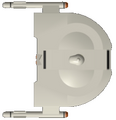
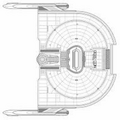
Anticipating this problem as well, Star Fleet had already decided to provide its next generation of dual capacity command ships with a cruiser rather than a dreadnought alter ego. When the Organian situation emerged, the plans were put to action. A cheaper, significantly less armored single-hull was chosen, and research, patrol and colony support duties were emphasized. A generic light cruiser or frigate silhouette was extended in beam to accommodate the main C3 systems side by side with science labs. A three-level superstructure spanning this "centerline plug" housed additional command facilities plus flag accommodation; a shuttlebay neatly inserted underneath was ideally capable of serving the liaison needs of a command ship, but could just as well accommodate four exploration shuttles for cruiser duty.

The broad-beamed design was amply propelled by twin FID impulse engines, giving performance superior to that of the older, SBE-engined Coventry vessels of similar mass and design. Warp propulsion was on par with that design, relying on the same PB-47 that propelled the older frigates, cruisers, and command ships alike. Yet better things were on the horizon; only three of the dual-purpose ships would be finished initially, while three more hulls would wait for the availability of a modern linear excitation warp drive system of either PB-52 or LN-64 type.
This no longer remained the plan in late December of 2268, when the first hull was launched. Instead of exploiting the command ship option of the Organian Peace Treaty, USS Brenton was entered to registry as a regular cruiser (NCC-1766) to meet the requirements of the "use it or lose it" clauses of the treaty. Unwelcome vacancies in the total number of cruisers were emerging now that the oldest Baton Rouge vessels were being withdrawn; their decrepit condition would not have allowed them to be kept in fighting strength even as a contractual ruse. By entering the first three Brentons as cruisers, Star Fleet could tread water and keep slots open for the new generation of linear-engined fighting vessels that was agonizingly just around the corner.
The first hull to gain command ship status and an accordingly chosen registry was USS Ford (NCC-2121). She and her two sisters were considered Brenton Flight II cruisers in official records, however, to further bolster the numbers; contrary to the plan, they, too, were launched with PB-47 engines. All the vessels were equipped with Type VII phasers from onset and enjoyed full operational status. The "true" Flight I cruisers also received torpedo launchers at hull centerline, with two tubes forward, one aft. This ate into the C3, transporter, and shuttlecraft facilities and made retrofitting of full command gear cumbersome, if not impossible, but Star Fleet welcomed the variety in standards of equip. The Flight I performed splendidly as a patrol cruiser, while Flight II excelled in support duties. One simulator hull, informally known as USS Talos (after an at the time topical incident) was also constructed on Earth orbit for training the command crews, lacking propulsion and armament but featuring most of the C3 systems, plus authentic analysis gear for the simulated sensor feed.
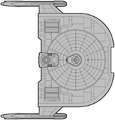
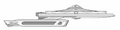
When LN-64 became available in 2271, not only did the original six Brentons get a swap, but six newbuilds were also ordered. Again, a division to torpedo-armed cruisers and phaser-only cruiser/command hybrids was maintained, resulting in the Flight III and Flight IV standards. Star Fleet’s goal of six command ships to supplement and eventually supplant the seven Unities was thus met, with a bonus flotilla of combat cruisers on the side.
The Unities eventually had their command gear transferred and most were quickly paid off at the conclusion of the Brenton program—just in time to miss the Xindi Incursion. In this conflict, forward command outposts were so sorely needed that half-completed cruisers were ushered to the duty. Part of this need arose from a desire for secrecy, however; Star Fleet had no legitimate reason to mobilize the purpose-built command ships in advance, even though it was later revealed that SFI had possessed authentic knowledge and forewarning of feline Xindi intentions. Due to the field shape requirements of the broad-beam design, the LN-64 installation on the Brentons had not given as great a propulsive boost as had been hoped for. Without prior preparation, the Brentons stood no chance of reaching the theater hot spots apace with the erratic slashes of Xindi strikes or the lightning speed of fleet counterstrikes.
In operations that withstood open scrutiny, Star Fleet could manage with the existing resources. There was always room for improvement, though. In the 2273 defense review, the strategic need for command ships was established at ten units, or one per each operational fleet. Maintaining the balance between cruiser/command and dreadnought/command hybrids, Star Fleet ordered the missing four vessels to roughly the same specifications as the older Unities. The types and standards of easily borrowed components had changed in the meantime, so the resulting Balson ships were quite different in details. In basic concept, they still followed the Unity lead, including the option for drastic upgunning to dreadnought—rather than cruiser—standard.
The Brenton and Balson classes continued command ship operations side by side until the 2280s. The primary reason for Brenton retirement at that time was not simple overcapacity, political maneuvering, or technological obsolescence. Rather, the very mission profile of command ships had shifted with the introduction of starship types capable of networked operations without external central management. Command ships were still essential in complex planetary assault or blockading operations, but compact, mission-customized designs such as the Etna class would meet those needs from the early 2290s on. Fleets operating vessels of older stock retained Balsons as their command nodes.
The Brentons freed from their command obligations were in the process of gradually being turned to full cruiser combatants, with the removal of all command spaces, addition of torpedo tubes, and installation of extra bow phasers, when Khitomer peace put an end to the so-called Flight V upgrade program. All Flight IV newbuilds, plus the Gance (of former Flight II standard), had been reworked at that point and continued service along with the Flight III cruisers. The remaining command variants were withdrawn from service right after Khitomer, but the combat cruisers served with distinction until the Tomed incident.
Gallery
-
 Flight I
 -

-
-

-
 Flight III
 -

-
-
 Flight IV
 -
-
.png)
.png)
.png)
.png)
.png)
.png)
.png)
.png)
.png)
Notes
- It appears the Flight Is (and possibly the Flight IIs) could be built in under a year, as Timo's sidebar says their construction started in 2268 and, in the text, that the USS Brenton itself was delivered in late December 2268.
- I've decided the Flight IIs entered service in early 2270. I've had the mockup USS Talos constructed in mid to late 2269.
- I've adapted the officer numbers a bit, to match what I interpret Timo meant but did not reflect in the sidebar. The Enlisted numbers appeared to match his intent.
- Clarity: the Flight Vs are Flight IV command ships that had the command crews and equipment removed, for a complete conversion to "pure" cruiser roles. Because only four made the conversion, I've decided that effort didn't begin until 2291, seeing it halted in 2293 with the Khitomer Accords. Presumably, the command crews were removed from the Flight IIIs and the equipment depowered. Here's the relevant timeline:
- 2279: All Brenton flights cease command ship operations, with the Flight IVs rotated to typical cruiser duties; command crews on all ships are removed and mission equipment is depowered.
- 2291: Brenton Flight IVs begin conversion to Flight V cruiser standards; the three newbuilds are slated to go first.
- 2293: The Flight IV to Flight V conversions for the Brenton class are halted, with USS Gance allowed to complete the process; USS Ford and USS Morrow are decommissioned immediately following the signing of the Khitomer Accords.
Alt Sources
- STSTCSOLDA
- Vintage Starships: "2269 – Brenton": includes 3D views