Guide:Class G3: Difference between revisions
No edit summary |
|||
| Line 53: | Line 53: | ||
==Gallery== | ==Gallery== | ||
<gallery> | <gallery> | ||
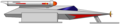
File:G3 (stbd).png | File:G3 (stbd).png | ||
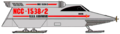
File:G3 (stbd2).png | File:G3 (stbd2).png | ||
File:ClassG3 schematic.png|Schematic showing gear stowage | File:ClassG3 schematic.png|Schematic showing gear stowage | ||
File:Class G3 (2-view).png|2-view | |||
</gallery> | </gallery> | ||
Latest revision as of 14:04, 5 August 2023
.png)
| |
| Class G3 / HSI(U)-3 / Tigris heavy shuttle | |
|---|---|
| Class Overview | |
| Category | heavy shuttle |
| Operational | 2251 - 2277 |
| Constructed | 212 |
| Dimensions | |
| Length | 17.2 m |
| Beam | 5.8 m (6.3m w/ side sponsons) |
| Height | 3.7 m (4.0 m w/ deployed landing gear) |
| Mass | 126.3 mt |
| Performance | |
| Cruise Speed | w 2.0 |
| Max Speed | w 2.9 |
| Endurance | 8 weeks |
| Complement | |
| Crew | 2 |
| Passengers | 6-12
|
| Tactical Systems | |
| Beam Weapons | 2 mounts for lasers/phasers III/IV
|
| Shields |
|
| Canonicity | |
| Design | TAS: “Slaver Weapon”; Mark Wilson; Timo |
| Name | Timo; Ships of the Star Fleet, Volume One: Class 3 and Tigris |
| History | Timo
|
The 2230s had brought sharp contrast between the troop transport barges and the agile warp auxiliaries. Hybridizing the two seemed anathema to both concepts: there appeared to be little doctrinal need for a compact troop barge or a spacious warp liaison boat. Yet the technological breakthroughs of the 2240s made it plausible and tempting to offer a bit more space and endurance, a bit less deck footprint, and a lot of additional power for the high end of starship auxiliaries.
The Arbing & Lidde craft that would be adopted as the Class G3 showed little in the way of advanced equipment or design to the outside. A long coffin shape about two-thirds the width of the Class B8 hull supported two PB-820 or PB-821 warp nacelles on its upper corners, and featured full-width aft access, suggesting an emphasis on bulk cargo handling. To facilitate this, power generation and propulsion hardware was housed within the lower half of the craft, providing a level (if inconveniently high) floor for ease of loading and offloading cargo. The constant cross section cabin could be segmented into up to four functional compartments by extending collapsible bulkheads from the walls. Behind the aftmost of these airtight curtains, the upper part of the stern section was hinged to act as a combined ramp and elevator for personnel and cargo transfer.
The underfloor assembly also featured large fuel tanks, a pair of plasma rechargers, and a proper mass reduction crystal. Through these improvements over previous warp auxiliaries, warp performance was significantly increased, with warp 2.9 available for brief moments, and warp 2 cruising assured in all conditions. Life support was boosted to match, providing up to two months of safe operations for two crew and six passengers—or up to twelve if comfort did not count! Spartan fold-out bunks and seats in the walls, combined with the partitioning bulkheads, did in theory provide sufficient accommodation standards for such extended missions, although more typically the craft would be fitted with dedicated comforts that would hinder generic cargo missions.
Only the principal power and propulsive systems as well as the main elements of the life support system could be stowed underfloor. An extended nose cone was introduced to accommodate the rest. A versatile selection of navigation sensors was provided there on a permanent basis; specialized mapping and surveillance sensors or twin energy weapons could be added to the suite as needed. For detached science operations, the craft could be fitted with laboratory/data-gathering pallets carried inside the cabin, and side sponsons could be mounted for external carriage of instrumentation or weaponry. Routine tasks still centered on cargo hauling and long range deployment of away teams, however, since the shuttle was the most compact craft capable of such missions.
These potent craft were embarked only aboard the largest of starships. Heavy cruisers, mainly the Constitution variants dedicated to exploration, were able to carry one at best; some heavy frigates could accommodate two. Certain Achernar class cruisers experimented with carrying two craft as well, but this meant using the G3 exclusively, as there was no room for handling other auxiliaries when two heavy shuttles were stowed in the landing bay. Stowage on the lower hangar deck was naturally out of the question, due to lift size limitations.

Starbases quickly adopted these craft for liaison duties, however, as hangar space was not a limiting factor there. While the shuttle could hardly be considered an independent interstellar vessel, it was very practical in connecting widely dispersed outposts within a star system, or hauling personnel and cargo across the Kashishowa perimeter in warp-hostile systems. Also, the intelligence community dabbled in the merits of the craft in operative insertion missions.
Despite the wide usership, no colorful nicknames emerged for the type, although sometimes the designation "Tigris class" was applied to the craft when they acted in detached scientific survey roles. The class never ruled sovereign in its primary cargo hauling and long range away team deployment mission, and quickly got replaced by the more refined G4 in the 2260s. On the other hand, its secondary tasks were only partially relegated to this type; the older craft had never made itself invaluable enough to call for immediate filling of the vacuum left behind. Still, the users of this craft remember it as a dependable and—for its time—well-muscled workhorse.
Gallery
-
-
-
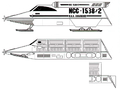 Schematic showing gear stowage
 -
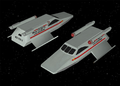 2-view
.png)

.png)
Notes
- Timo's "Arbin&Lidde" was corrected to match Guide: Mission's Arbing & Lidde.