Guide:Strider: Difference between revisions
No edit summary |
No edit summary |
||
| Line 93: | Line 93: | ||
battlefield, the ''Striders'' were doers and movers rather than commanders or analysts. Their role in | battlefield, the ''Striders'' were doers and movers rather than commanders or analysts. Their role in | ||
fleet action was limited to bringing in spares, personnel and key intelligence, and even the latter was | fleet action was limited to bringing in spares, personnel and key intelligence, and even the latter was | ||
typically gathered by other types of vessel, such as the ''[[Guide: Mercury|Mercury]]'' and ''[[Guide: Doppler|Doppler]]'' frontline scoutships of | typically gathered by other types of vessel, such as the ''[[Guide: Mercury|Mercury]]'' and ''[[Guide: Doppler (scout)|Doppler]]'' frontline scoutships of | ||
proper muscle and instrumentation. | proper muscle and instrumentation. | ||
Revision as of 08:23, 1 May 2016
(refit).png)
| |
| Strider | |
|---|---|
| Class Overview | |
| Category | courier/scout |
| Operational | 2159 - 2197 |
| Constructed | 30 |
| Dimensions | |
| Length | 73.0 m |
| Beam | 42.1 m |
| Height | 17.6 m |
| Mass | 12,800 tons |
| Performance | |
| Max Speed | w 3.0 |
| Endurance | 3 months |
| Complement | |
| Officers | 2 (courier mission) 6 (scout mission) |
| Enlisted | 18 (courier mission) 23 (scout mission)
|
| Passengers | 10-20
|
| Tactical Systems | |
| Beam Weapons |
|
| Missile Weapons |
|
| Shields | Polarizable armor Navigational deflector beam on lower fwd hull |
| Transporters | 1 GP (1-pad); Mk I |
| Historical | |
| Ships of Note |
|
| Canonicity | |
| Design | ST:Legacy computer game |
| Name | ST:Legacy computer game |
| History | ST:Legacy computer game, own
|
The developments in advanced warp propulsion in the 2140s and 50s concerned the entire range of
starfaring vessels. By technological necessity, though, smaller vessels could only hope to receive
relatively modest upgrades. The multistage plasma recharging systems that gave cruisers their warp 5 plus performance were bulky pieces of machinery, and the massive protective chambers for
dilithium foci did not easily fit aboard ships smaller than destroyer in size, either. Yet the UESF
need for fast liaison and reconnaissance vessels in the first years of the Romulan War was acute,
even desperate. Propulsive modifications on the Athens couriers were thus given a priority. The
resulting Strider class courier/scout met the requirements, giving the fleet its first warp three
messenger.
The move from cowled to outriggered warp engines was a predictable one, facilitating the greater field strength that was provided by the Kingdom GX total conversion powerplant. This was housed in the boatlike lower hull in a heavily armored amidship compartment. Reactor swaps were facilitated by a ventral stern pullout port, a necessity for a vessel that was supposed to run her engines at maximum power for extended periods of time. Directly atop the reactor was a plasma manifold feeding twin impulse engines and topped by the field manipulation crystal. The plasma leads then branched to the upcanted pylons of the warp nacelles.
A high performance navigational deflector array forward of the reactor made possible on its part the great speeds that the engines would provide. Atop it lay the payload to be moved at warp three: a spade of a hull, not markedly different from that of the Athens in shape, but featuring a number of novel systems. For starters, there were twin torpedo launchers at the bow, each carrying ten casings in revolver loaders that injected antimatter from the main fuel tanks to the warheads just before firing. This was by far the lightest application of the antimatter torpedo technology yet, and promised parity with the Klingon Raptor class torpedo boats from which much of the technology had been copied in the first place.
.png)
There were also two through-hull loading bays to increase the speed and flexibility of bringing the courier packages onboard. Anything from key personnel to crucial spares could be loaded, yet personnel ingress was also possible via a portside gangway; a pair of utility airlocks with an adjoining shuttlecraft target pad aft of the reactor area; or a single transporter platform, which was considered standard gear for the modern courier. Heavy projected energy weaponry was also fitted, in the form of a phase cannon on dorsal main hull, an optional (in practice never fitted) second bank on the corresponding ventral location, and plasma cannon positions flanking the fantail docking target and thus covering aft angles.
In contrast, command and communications facilities were kept to a minimum. There was no dedicated combat control room apart from the navigation bridge, and the modest communications facilities did not form a complex of planning and analysis rooms like in the Athens. Out in the battlefield, the Striders were doers and movers rather than commanders or analysts. Their role in fleet action was limited to bringing in spares, personnel and key intelligence, and even the latter was typically gathered by other types of vessel, such as the Mercury and Doppler frontline scoutships of proper muscle and instrumentation.
During the course of the war, thirty of the couriers were manufactured, and 26 fielded in time to see action. Losses were light, as the odds of intercepting a warp three courier were significantly lower than catching a warp two vessel. The ships were in great postwar demand, though, and several already suffered from fatigued engines in the Tarn conflict of the 2160s. Spare reactors were out of stock by the 2170s, and the final Striders had to be withdrawn from use in 2197. A remarkably different design would take their place as the principal glue that tied together the thinly spread Starfleet.
Gallery
-
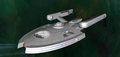 Forward beam aspect
 -
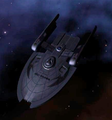 Strider en route
 -
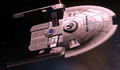 Weapons trials
 -
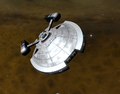 In nebula
 -
 23rd c., stern ventral
.png)


.png)