Guide:Thufir: Difference between revisions
No edit summary |
|||
| Line 1: | Line 1: | ||
{{Sidebar Guide ship | |||
|image=[[File:Thufir (stbd).png|250px|Thufir destroyer]] | |||
|classname= ''Thufir'' | |||
|category= destroyer | |||
|years= | |||
|constructed= | |||
|length= | |||
|beam= | |||
|height= | |||
|mass= | |||
|cruisespeed= | |||
|maxspeed= | |||
|endurance= | |||
|officers= | |||
|enlisted= | |||
|troops= | |||
|passengers= | |||
|patients= | |||
|crew= | |||
|cargo= | |||
|beamweapons= | |||
|missileweapons= | |||
|otherweapons= | |||
|shields= | |||
|labs= | |||
|transporters= | |||
|auxcraft= | |||
|historicalships= | |||
|design= FASA/Timo/SFC | |||
|name= FASA | |||
|history= FASA | |||
}} | |||
==Background: ''Hobbyist's Guide''== | |||
The Thufir class emerged from the Andorian tradition of starship design, embodying the native doctrine of robust forcefields, twin-nacelle close-pair propulsion, and the signature forward-leaning aggression of Blue Fleet doctrine. Designed primarily for deep space patrols in the 2270s and 2280s, the Thufirs built on a century’s experience with gravitonsubspace shielding, combining a powerful 2-layer defensive envelope with a hull geometry optimized for frontal attack. Unlike the more generalized Starfleet models, the Thufir retained the distinctly Andorian emphasis on survivability and head-on weapons delivery, with a heavy torpedo armament housed in wing-mounted pods and advanced Type V phaser banks that drew directly from the primary warp core. Though standardized for Starfleet compatibility, the class’s origins were kept close—almost semi-proprietary—serving as both flagship combatants and symbols of local capability in the Blue Shield fleets. | |||
While Starfleet’s multi-mission platforms increasingly favored flexible interior arrangements and balanced weaponry, Andorian design philosophy, as seen in the Thufir, doubled down on forward firepower and compartmentalized resilience. The warp nacelles, closely spaced and reinforced by lateral field generators, allowed for high coherence defensive geometries and facilitated the Andorian specialty: high-acceleration, direct approaches meant to punch through perimeter skirmishes and bring the ship’s considerable torpedo and phaser banks to bear in decisive action. Together with advanced targeting software and robust, easily-serviced shield modules, these ships could absorb and return devastating salvos, making them ideal for both deep-patrol and home system defense roles, and especially prized along the troubled margins of Andorian-protected space. | |||
Production of the Thufir class was managed almost exclusively by Andorian yards, with Starfleet procurement trailing in the wake of Blue Fleet priorities—just as the Lenthal class reflected in its time. Requests for broader Federation adoption of the Thufir were met with limited enthusiasm; Starfleet cited the high mass, dense internal structure, and cultural focus on head-on fighting as barriers to full integration with more generalist escort squadrons. Nonetheless, several units were acquired and served as powerful escort leaders and rapid response flagships in incidents requiring both muscle and a symbolic Andorian presence. Still, the class never shed its "semi-proprietary" character, always associated with the Blue Shield formation mentality and closely identified with Andorian tactical traditions. | |||
By the early 2290s, the Thufir and its Lenthal-class kin began to give way to newer frigate types, as Starfleet’s emphasis shifted toward modularity and cost-efficient mass deployment. Yet, the legacy of the Thufir lived on, not merely in its technical innovations—many of which were adopted into subsequent destroyer and frigate designs—but also in the doctrine of frontal resilience and shield-centric engineering. The class stands as a testament to the era when Andorian priorities and Starfleet needs briefly aligned, and when Blue Fleet’s semi-proprietary ship programs managed to project distinct tactical philosophies into the heart of Federation starship development. | |||
==Gallery== | ==Gallery== | ||
<gallery> | <gallery> | ||
| Line 11: | Line 52: | ||
</gallery> | </gallery> | ||
==Notes== | |||
* | |||
==See Also== | ==See Also== | ||
| Line 16: | Line 60: | ||
* [[Guide: Kumari]] | * [[Guide: Kumari]] | ||
* [[Guide: Lenthal]] | * [[Guide: Lenthal]] | ||
==References== | |||
<references/> | |||
==Alt Sources== | ==Alt Sources== | ||
* [https://www.ststcsolda.space/federation/thufir/thufir.html STSTCSOLDA] | * [https://www.ststcsolda.space/federation/thufir/thufir.html STSTCSOLDA] | ||
---- | |||
* [[Guide: Timo's Guide to Star Fleet|Back to the Table of Contents]] | |||
* [[Guide: Corvettes, Couriers, Escorts, Perimeter Ships & Light Scouts|Corvettes, Couriers, Escorts, Perimeter Ships & Light Scouts]] | |||
* [[Guide: Of Ship Statistics|Appendix A: Of Ship Statistics]] | |||
* [[Guide: Glossary|Appendix B: Glossary]] | |||
* [[Guide: Star Fleet Organization - General Outline|Appendix C: Star Fleet Organization - General Outline]] | |||
* [[Guide: Abbreviations From Outside|Appendix D: Abbreviations From Outside]] | |||
[[Category:Guide|{{PAGENAME}}]] | [[Category:Guide|{{PAGENAME}}]] | ||
Revision as of 18:17, 29 September 2025
.png)
| |
| Thufir | |
|---|---|
| Class Overview | |
| Category | destroyer
|
| Canonicity | |
| Design | FASA/Timo/SFC |
| Name | FASA |
| History | FASA
|
Background: Hobbyist's Guide
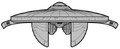
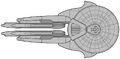
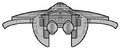
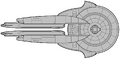
The Thufir class emerged from the Andorian tradition of starship design, embodying the native doctrine of robust forcefields, twin-nacelle close-pair propulsion, and the signature forward-leaning aggression of Blue Fleet doctrine. Designed primarily for deep space patrols in the 2270s and 2280s, the Thufirs built on a century’s experience with gravitonsubspace shielding, combining a powerful 2-layer defensive envelope with a hull geometry optimized for frontal attack. Unlike the more generalized Starfleet models, the Thufir retained the distinctly Andorian emphasis on survivability and head-on weapons delivery, with a heavy torpedo armament housed in wing-mounted pods and advanced Type V phaser banks that drew directly from the primary warp core. Though standardized for Starfleet compatibility, the class’s origins were kept close—almost semi-proprietary—serving as both flagship combatants and symbols of local capability in the Blue Shield fleets.
While Starfleet’s multi-mission platforms increasingly favored flexible interior arrangements and balanced weaponry, Andorian design philosophy, as seen in the Thufir, doubled down on forward firepower and compartmentalized resilience. The warp nacelles, closely spaced and reinforced by lateral field generators, allowed for high coherence defensive geometries and facilitated the Andorian specialty: high-acceleration, direct approaches meant to punch through perimeter skirmishes and bring the ship’s considerable torpedo and phaser banks to bear in decisive action. Together with advanced targeting software and robust, easily-serviced shield modules, these ships could absorb and return devastating salvos, making them ideal for both deep-patrol and home system defense roles, and especially prized along the troubled margins of Andorian-protected space.
Production of the Thufir class was managed almost exclusively by Andorian yards, with Starfleet procurement trailing in the wake of Blue Fleet priorities—just as the Lenthal class reflected in its time. Requests for broader Federation adoption of the Thufir were met with limited enthusiasm; Starfleet cited the high mass, dense internal structure, and cultural focus on head-on fighting as barriers to full integration with more generalist escort squadrons. Nonetheless, several units were acquired and served as powerful escort leaders and rapid response flagships in incidents requiring both muscle and a symbolic Andorian presence. Still, the class never shed its "semi-proprietary" character, always associated with the Blue Shield formation mentality and closely identified with Andorian tactical traditions.
By the early 2290s, the Thufir and its Lenthal-class kin began to give way to newer frigate types, as Starfleet’s emphasis shifted toward modularity and cost-efficient mass deployment. Yet, the legacy of the Thufir lived on, not merely in its technical innovations—many of which were adopted into subsequent destroyer and frigate designs—but also in the doctrine of frontal resilience and shield-centric engineering. The class stands as a testament to the era when Andorian priorities and Starfleet needs briefly aligned, and when Blue Fleet’s semi-proprietary ship programs managed to project distinct tactical philosophies into the heart of Federation starship development.
Gallery
-

-
-
-
-
-
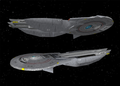 2-view
.png)
.png)
.png)
.png)
.png)
Notes
See Also
References