Guide:Syracuse/Saladin/Siva/Einstein: Difference between revisions
No edit summary |
No edit summary |
||
| Line 116: | Line 116: | ||
<u>Select ships</u> | <u>Select ships</u> | ||
* brought to Mk IV standard after [[2272]] | * brought to Mk IV standard after [[2272]] | ||
|auxcraft= | |auxcraft= <br> | ||
|historicalships= | <u>''Syracuse''</u> | ||
|design= | * 2x light shuttles | ||
|name= | * 2x work pods | ||
|history= | <u>''Saladin, Siva, Siva II''</u> | ||
* 2x shuttlepods | |||
* 1x work pod | |||
<u>''Einstein''</u> | |||
* 18x light shuttles or 6x heavy shuttles | |||
* 2x shuttlepods | |||
* 4x work pods | |||
|historicalships= <br> | |||
* ''USS Alexander'' (NCC-511) | |||
* ''USS Pompey'' (NCC-506) | |||
* ''USS Rahman/USS Kelvin'' (NCC-514/NCC-O514) | |||
|design= STII/Franz Joseph, STXI, ST:Axanar | |||
|name= STXI, FJ, Goodman Federation: The First 150 Years | |||
|history= STXI (FJ) | |||
}} | }} | ||
As Geering continued to provide Starfleet with its most powerful modern ships in every category, | |||
Chiokis was forging a reputation as the most dependable designer of affordable warships to be | |||
produced in large numbers. This was actually quite contrary to the company’s aims and ambitions, | |||
but helped support the company while it waited for its big break in the Horizon upgrade program | |||
where its true hopes were placed. Starfleet in turn benefited from having two parallel sources for | |||
saucer-hulled ship designs, in addition to always keeping at least two different engine manufacturers | |||
and shipyards sufficiently employed and funded. | |||
When the upper-tier Detroyat destroyers were ordered from Aurora, Geering for once had to settle | |||
on the parallel lower-tier contract. There was little cause for disappointment, as the lighter destroyer | |||
was intended for an at least fourfold production run. By 2221, the first two vessels for a planned | |||
inaugural batch of 26 were undergoing impulse tests and establishing beyond doubt the structural | |||
integrity of the new destroyer workhorse. The primary hull was of obvious Burke pedigree, with a | |||
flat, single-deck main disk topped by a terraced superstructure and an aft spine featuring a small | |||
shuttlebay above the centerline SAB impulse engine. | |||
Yet an angled ventral ‘neck’ now supported a single PB-29 nacelle – the last although, at 148 meters | |||
and 170,000 tons, not the largest of the third generation spooled engines to be designed. At the bow of | |||
the nacelle, a Hycor deflector system provided a FTL graviton stream that could sweep clear the | |||
flightpath of the ship up to a speed of warp eight – a safe margin in terms of true maximum speeds | |||
in the 2220s. The beam was effective up to forty-seven light seconds against 5,000 kg objects, and | |||
up to two light minutes against smaller obstacles. The nacelle also contained most of the warp | |||
machinery of the ship, and distributed power to various other systems, including a booster feed to the | |||
impulse system. A lift and ship’s ladder connected the lower engineering levels to the primary control | |||
facility in the main hull, and an airlock complex halfway along the neck provided EV access. Also | |||
included in the neck area were workshops and some temporary bunking and rest facilities for the | |||
engineering crew. | |||
Armament, while still geared for frontal offense at the deliberate expense of all-around defense, was | |||
intended to be quite different from that of the Detroyats. A dorsal pod would house four paired torpedo launchers of small caliber but high rate of fire. The saucer was to be provided with four | |||
berths for laser cannon, two dorsally and two ventrally, as well as up to three plus three point | |||
defense plasma cannon, even though filling of all the berths was never considered the preferred | |||
option. Centralized production commenced at Almaz factories on the required weaponry, as various | |||
dockyards completed the initial ten hulls. Names honoring ancient cities that had successfully | |||
resisted assaults and sieges were chosen; registries for the Syracuse class began at NCC-420, as | |||
these lighter vessels were in no way cruiserlike and had no place next to the Detroyats in the | |||
registry charts. | |||
[[Image:No Photo Available.jpg|left|300px|thumb|A Syracuse of debatable identity sports a Four Years War false registry and a PB-45 nacelle, bringing antiquated weaponry to bear against a distressingly modern enemy. The eight-barrel “peashooter” torpedo mount was despised by the crews, yet installing a more potent system was well beyond the resources of the frontier fleet in the 2240s.]] | |||
After the first combat engagements, it became evident the ship type should not be positioned next to | |||
Detroyat formations in more concrete terms, either. Delays in delivery of torpedo systems were not | |||
the major problem. Rather, the smaller single-engine configuration resulted in range and | |||
maneuverability shortcomings that hindered strategic deployment and made Starfleet re-estimate its | |||
needs. Valuable dockyards could not be wasted on inferior products in this time of ever-heightening | |||
crisis. Thus, even though Syracuse production continued within the bounds of already allocated | |||
resources, an order was placed on an improved model - a vessel that would become the definitive | |||
single-engine destroyer for the better part of the century. | |||
Being slow to reach the thick of battle, the Syracuse group could be expected to suffer lighter | |||
combat losses than its successors. Yet Starfleet was positively surprised that the 2220s and 2230s | |||
went by almost without casualties. A second batch originally intended for attrition replacement was | |||
nevertheless funded and likewise managed to avoid both combat and wear and tear for the next | |||
decade (there being tongue-in-cheek references to divine protection as the vessels in the batch were | |||
named after classic Terran gods and demigods). The class thus was deemed fit for receiving the | |||
hypermodern PB-45 engine - just in time for the next major Klingon offensive. Lamentably, little | |||
else could be modified under the tight schedule and tighter funding, and casualties now began to | |||
mount. | |||
[[Image:No Photo Available.jpg|left|300px|thumb|text]] | [[Image:No Photo Available.jpg|left|300px|thumb|text]] | ||
Revision as of 16:10, 18 April 2016

| |
| Saladin | |
|---|---|
| Class Overview | |
| Category | destroyer |
| Operational | 2224-2297 |
| Constructed | 59 total: |
| Dimensions | |
| Length |
|
| Beam |
|
| Height |
|
| Mass |
|
| Performance | |
| Cruise Speed |
|
| Max Speed |
|
| Endurance |
|
| Complement | |
| Officers |
|
| Enlisted |
|
| Tactical Systems | |
| Beam Weapons | Syracuse
Saladin (original)
Einstein (original)
Einstein (refit)
Siva, Saladin (refit)
Siva II
|
| Missile Weapons | Syracuse
Saladin (original)
Siva, Saladin (refit)
Siva II
|
| Shields |
|
| Transporters | Saladin
All classes
Siva
Siva II
Select ships
|
| Auxiliary Craft | Syracuse
Saladin, Siva, Siva II
Einstein
|
| Historical | |
| Ships of Note |
|
| Canonicity | |
| Design | STII/Franz Joseph, STXI, ST:Axanar |
| Name | STXI, FJ, Goodman Federation: The First 150 Years |
| History | STXI (FJ)
|
As Geering continued to provide Starfleet with its most powerful modern ships in every category,
Chiokis was forging a reputation as the most dependable designer of affordable warships to be
produced in large numbers. This was actually quite contrary to the company’s aims and ambitions,
but helped support the company while it waited for its big break in the Horizon upgrade program
where its true hopes were placed. Starfleet in turn benefited from having two parallel sources for
saucer-hulled ship designs, in addition to always keeping at least two different engine manufacturers
and shipyards sufficiently employed and funded.
When the upper-tier Detroyat destroyers were ordered from Aurora, Geering for once had to settle on the parallel lower-tier contract. There was little cause for disappointment, as the lighter destroyer was intended for an at least fourfold production run. By 2221, the first two vessels for a planned inaugural batch of 26 were undergoing impulse tests and establishing beyond doubt the structural integrity of the new destroyer workhorse. The primary hull was of obvious Burke pedigree, with a flat, single-deck main disk topped by a terraced superstructure and an aft spine featuring a small shuttlebay above the centerline SAB impulse engine.
Yet an angled ventral ‘neck’ now supported a single PB-29 nacelle – the last although, at 148 meters and 170,000 tons, not the largest of the third generation spooled engines to be designed. At the bow of the nacelle, a Hycor deflector system provided a FTL graviton stream that could sweep clear the flightpath of the ship up to a speed of warp eight – a safe margin in terms of true maximum speeds in the 2220s. The beam was effective up to forty-seven light seconds against 5,000 kg objects, and up to two light minutes against smaller obstacles. The nacelle also contained most of the warp machinery of the ship, and distributed power to various other systems, including a booster feed to the impulse system. A lift and ship’s ladder connected the lower engineering levels to the primary control facility in the main hull, and an airlock complex halfway along the neck provided EV access. Also included in the neck area were workshops and some temporary bunking and rest facilities for the engineering crew.
Armament, while still geared for frontal offense at the deliberate expense of all-around defense, was intended to be quite different from that of the Detroyats. A dorsal pod would house four paired torpedo launchers of small caliber but high rate of fire. The saucer was to be provided with four berths for laser cannon, two dorsally and two ventrally, as well as up to three plus three point defense plasma cannon, even though filling of all the berths was never considered the preferred option. Centralized production commenced at Almaz factories on the required weaponry, as various dockyards completed the initial ten hulls. Names honoring ancient cities that had successfully resisted assaults and sieges were chosen; registries for the Syracuse class began at NCC-420, as these lighter vessels were in no way cruiserlike and had no place next to the Detroyats in the registry charts.
After the first combat engagements, it became evident the ship type should not be positioned next to Detroyat formations in more concrete terms, either. Delays in delivery of torpedo systems were not the major problem. Rather, the smaller single-engine configuration resulted in range and maneuverability shortcomings that hindered strategic deployment and made Starfleet re-estimate its needs. Valuable dockyards could not be wasted on inferior products in this time of ever-heightening crisis. Thus, even though Syracuse production continued within the bounds of already allocated resources, an order was placed on an improved model - a vessel that would become the definitive single-engine destroyer for the better part of the century.
Being slow to reach the thick of battle, the Syracuse group could be expected to suffer lighter combat losses than its successors. Yet Starfleet was positively surprised that the 2220s and 2230s went by almost without casualties. A second batch originally intended for attrition replacement was nevertheless funded and likewise managed to avoid both combat and wear and tear for the next decade (there being tongue-in-cheek references to divine protection as the vessels in the batch were named after classic Terran gods and demigods). The class thus was deemed fit for receiving the hypermodern PB-45 engine - just in time for the next major Klingon offensive. Lamentably, little else could be modified under the tight schedule and tighter funding, and casualties now began to mount.
Notes
- The number of laser emitters indicated for the Einstein (original) are mismatched, so they've been corrected to a total of 6.
- The number of phaser emitters indicated for the Einstein (refit) are mismatched, so they've been corrected to a total of 6.
Gallery
-
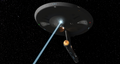 USS Saladin fires her forward phaser bank at a planetary target during her shakedown/systems tests
