Guide:Mercury: Difference between revisions
sidebar |
|||
| (18 intermediate revisions by the same user not shown) | |||
| Line 1: | Line 1: | ||
{{Sidebar Guide ship | {{Sidebar Guide ship | ||
|image=[[ | |image= [[File:Mercury w o scaffolding.png|250px|''Mercury'' class scout]] | ||
|classname=Mercury | |classname= Mercury | ||
|category=scout | |category= scout | ||
|years=[[2154]] - [[2181]] | |years= [[2154]] - [[2181]] | ||
|constructed=72 | |constructed= 72 | ||
|length=162.2 m | |length= 162.2 m | ||
|beam= | |beam= 59.7 m | ||
|height= | |height= 25.9 m<br> | ||
|mass= | 32.8 m (w/ trailing sensor array) | ||
|cruisespeed=w | |mass= 186,800 mt | ||
|maxspeed=w | |cruisespeed= w 3 | ||
|endurance=6 months | |maxspeed= w 4.2 | ||
|officers=14 | |endurance= 6 months | ||
|enlisted=48 | |officers= 14 | ||
|enlisted= 48 | |||
|troops= | |troops= | ||
|passengers= | |passengers= | ||
| Line 20: | Line 21: | ||
|cargo= | |cargo= | ||
|beamweapons=<br> | |beamweapons=<br> | ||
* | * 2x plasma cannon (2.0 GW) (forward hull) | ||
*1x | * 1x plasma cannon (4.5 GW) (aft of bridge) | ||
|missileweapons= | |missileweapons= | ||
|otherweapons= | |otherweapons= | ||
|shields=<br> | |shields=<br> | ||
*polarizable armor | * polarizable armor (main hull) (original) | ||
* 2-layer graviton/subspace globular forcefield (refit [[2164]]-[[2166|66]], select ships) | |||
*2-layer graviton/subspace globular forcefield (refit [[2164]]-[[2166|66]], select ships) | * navigational deflector (ventral bow) | ||
|labs= | |labs= | ||
|transporters= | |transporters= | ||
|auxcraft= | |auxcraft= | ||
|historicalships='' | |historicalships= ''UESS Candace'' (S-5665) | ||
|design= | |design= Timo, using ''Spaceflight Chronology'' ship as forward pod | ||
|name= | |name= ''Spaceflight Chronology'' | ||
|history= | |history= ''Spaceflight Chronology'' | ||
}} | }} | ||
==Background: ''Hobbyist's Guide''== | |||
Despite repeated attempts at establishing diplomatic communications with the reclusive [[Romulans]], military build-up in preparation for the upcoming open war was continued. Development of new long range scoutships was initiated just prior to the first explicit overtures to the [[Romulan War]]. The aim of the '''''Mercury''''' project was to create lower-cost alternatives to the cruiser forces in the mission of scouting enemy positions or performing minimal-resolution evaluations of potential colony or mining worlds. The ''Mercury'' scoutships were not intended to carry the sophisticated gear of slow short range research vessels like the ''[[Guide: Edison|Edison]]'' class, nor were they equipped with any kind of heavy armament. Instead of being miniature cruisers, they essentially consisted of an outsized power and propulsion system and a minimal crew and sensor compartment. | |||
The ''Mercuries'' were based on a twinned power and drive chain of the ''[[Guide:Cavalry|Cavalry]]'' class—a relatively advanced yet already proven warp propulsion system now referred to as a second-generation drive, to tell it apart from both the clumsy contraptions of the [[21st century|preceding century]] and the high-strung superengines of the modern cruisers. A compression fusion reactor sat between the conical forward ends of the slim trailing S70 warp nacelles. The monocylindrar warp field of the closely-spaced 90,000-ton engines was a tricky beast to manage, the impulse engine squeezed in between them an insufficient means of maneuvering; the crews generally compared the handling qualities of their ships to quicksilver, although apparently the origins of the class name were more pompously rooted in Roman mythology and the [[20th century]] US space program. | |||
The pressure hull some eight decks high was of typical [[Earth]] commercial shipbuilding lineage. It featured a bridge dome atop, accompanied by a defensive 4.5 GW plasma cannon; then three decks of sensors and their monitoring facilities, as well as officers’ accommodation and a cluster of four lifeboats; then four broad decks of crew accommodation, utility, and storage spaces, as well as a deflector system and twin forward-facing medium-power plasma guns. On select ships, a ventral scaffolding kept the deployment reel of a trailing sensor array clear of the engines. | |||
Some 72 ships of the class were completed for reconnaissance duty either near Earth or at forward staging area dockyards that were being built to support the deployed fleets. All were deployed in deep space on missions of as long as six months, despite the cramped conditions of the compact hulls. Starfleet soon began to enjoy the profits of their investment as the new vessels brought in data on [[Romulan]] fleet movements. It was not as widely announced that six vessels were lost between June [[2156]] and June [[2157]] alone, with more casualties to follow. The locations of major Romulan planetary bases were not established, either, despite many risky deployments of single or three-ship ''Mercury'' scout units behind enemy "lines". | |||
[[Image:No Photo Available.jpg|left|300px|thumb|Scoutship ''UESS Candace'' (S-5665) being towed to [[Starbase Two]] for repairs after an encounter with [[Romulan]] forces in [[2157]]. The ship was relaunched three months later, only to fall prey to a Romulan fighter wing stranded by the destruction of their carrier. The ''Candace'' was boarded and commandeered by the Romulans seeking a warp-drive ship that could take them | |||
home, but met the ''[[Guide:Cavalry|Cavalry]]'' class light destroyer ''UESS Jackson'' in deep space. The ''Jackson'' decompressed the crew compartments and managed to tow the rest of the vessel back for repairs. The ''Candace'' finally met her fate when the repair dock was suicide-bombed by Romulan missile boats in [[2158]].]] | |||
About 50 scouts did survive the war, and 20 of them were recommissioned as [[UFP Star Fleet]] vessels, enjoying twenty years of service in the patrol forces in the [[Romulan Neutral Zone]]. The ships were unsuited to the science scout role, however, suffering from poor endurance and the inability to carry new instrumentation for survey missions. None were upgraded during their UFP Star Fleet service, save for the installation of modern subspace radios and navigation beacons. | |||
Currently, two ''Mercuries'' survive in the [[Star Fleet Museum|Fleet Museum]], albeit deprived of their warp nacelles. A dozen were converted into civilian couriers after their final decommissioning, featuring more modern commercially-available navigational deflectors and omitting the weaponry and most of the sensors. Automation further reduced the crew numbers, but the challenges of the closely-spaced trailing nacelles required expert spacemanship from the remaining crew. This only served to attract and encourage starship enthusiasts, some of whom still keep ''Mercuries'' in sailing condition for annual regattas in the [[Bolian]] system. | |||
==Gallery== | |||
<gallery> | |||
File:Mercury w scaffolding and sensor trail.png|Ship equipped with trailing sensor and scaffolding | |||
Image:Mercury vintage.jpg|Starboard bow aspect (w/ partial nacelle) | |||
File:Mercury.jpg|Ship with uninstalled nacelles | |||
</gallery> | |||
==Star Fleet Registry== | |||
<div style="-moz-column-count:3; column-count:3;"> | |||
* NCC-L16 | |||
* NCC-L18 | |||
* NCC-L35 | |||
* NCC-L41 | |||
* NCC-L43 | |||
* NCC-L44 | |||
* NCC-L52 | |||
* NCC-L57 | |||
* NCC-L72 | |||
* NCC-L94 | |||
* NCC-L101 | |||
* NCC-L111 | |||
* NCC-L112 | |||
* NCC-L120 | |||
* NCC-L135 | |||
* NCC-L138 | |||
* NCC-L149 | |||
* NCC-L153 | |||
* NCC-L176 | |||
* NCC-L177 | |||
</div> | |||
==Notes== | |||
* The [[Ship Prefixes|prefix]] "USS" has been changed to "UESS" for ships of the [[United Earth Starfleet]]. | |||
* Twenty ''Mercuries'' were assigned to the [[UFP Star Fleet]], registered in the NCC-L domain. | |||
* Check out the history of the ''[[Guide: Doppler|Doppler]]'' scout for clues on construction periods of this class. | |||
<br><br> | |||
---- | ---- | ||
*[[Timo's Guide to | * [[Guide: Timo's Guide to Star Fleet|Back to the Table of Contents]] | ||
*[[2130-2161 - Into The Romulan War | * [[Guide: 2130-2161 - Into The Romulan War|Back to "Into The Romulan War"]] | ||
*[[Of Ship Statistics | * [[Guide: Of Ship Statistics|Appendix A: Of Ship Statistics]] | ||
*[[Glossary | * [[Guide: Glossary|Appendix B: Glossary]] | ||
*[[ | * [[Guide: Star Fleet Organization - General Outline|Appendix C: Star Fleet Organization - General Outline]] | ||
*[[Abbreviations From Outside | * [[Guide: Abbreviations From Outside|Appendix D: Abbreviations From Outside]] | ||
[[Category:Guide|{{PAGENAME}}]] | [[Category:Guide|{{PAGENAME}}]] | ||
Latest revision as of 06:29, 24 July 2023

| |
| Mercury | |
|---|---|
| Class Overview | |
| Category | scout |
| Operational | 2154 - 2181 |
| Constructed | 72 |
| Dimensions | |
| Length | 162.2 m |
| Beam | 59.7 m |
| Height | 25.9 m 32.8 m (w/ trailing sensor array) |
| Mass | 186,800 mt |
| Performance | |
| Cruise Speed | w 3 |
| Max Speed | w 4.2 |
| Endurance | 6 months |
| Complement | |
| Officers | 14 |
| Enlisted | 48
|
| Tactical Systems | |
| Beam Weapons |
|
| Shields | |
| Historical | |
| Ships of Note | UESS Candace (S-5665) |
| Canonicity | |
| Design | Timo, using Spaceflight Chronology ship as forward pod |
| Name | Spaceflight Chronology |
| History | Spaceflight Chronology
|
Background: Hobbyist's Guide
Despite repeated attempts at establishing diplomatic communications with the reclusive Romulans, military build-up in preparation for the upcoming open war was continued. Development of new long range scoutships was initiated just prior to the first explicit overtures to the Romulan War. The aim of the Mercury project was to create lower-cost alternatives to the cruiser forces in the mission of scouting enemy positions or performing minimal-resolution evaluations of potential colony or mining worlds. The Mercury scoutships were not intended to carry the sophisticated gear of slow short range research vessels like the Edison class, nor were they equipped with any kind of heavy armament. Instead of being miniature cruisers, they essentially consisted of an outsized power and propulsion system and a minimal crew and sensor compartment.
The Mercuries were based on a twinned power and drive chain of the Cavalry class—a relatively advanced yet already proven warp propulsion system now referred to as a second-generation drive, to tell it apart from both the clumsy contraptions of the preceding century and the high-strung superengines of the modern cruisers. A compression fusion reactor sat between the conical forward ends of the slim trailing S70 warp nacelles. The monocylindrar warp field of the closely-spaced 90,000-ton engines was a tricky beast to manage, the impulse engine squeezed in between them an insufficient means of maneuvering; the crews generally compared the handling qualities of their ships to quicksilver, although apparently the origins of the class name were more pompously rooted in Roman mythology and the 20th century US space program.
The pressure hull some eight decks high was of typical Earth commercial shipbuilding lineage. It featured a bridge dome atop, accompanied by a defensive 4.5 GW plasma cannon; then three decks of sensors and their monitoring facilities, as well as officers’ accommodation and a cluster of four lifeboats; then four broad decks of crew accommodation, utility, and storage spaces, as well as a deflector system and twin forward-facing medium-power plasma guns. On select ships, a ventral scaffolding kept the deployment reel of a trailing sensor array clear of the engines.
Some 72 ships of the class were completed for reconnaissance duty either near Earth or at forward staging area dockyards that were being built to support the deployed fleets. All were deployed in deep space on missions of as long as six months, despite the cramped conditions of the compact hulls. Starfleet soon began to enjoy the profits of their investment as the new vessels brought in data on Romulan fleet movements. It was not as widely announced that six vessels were lost between June 2156 and June 2157 alone, with more casualties to follow. The locations of major Romulan planetary bases were not established, either, despite many risky deployments of single or three-ship Mercury scout units behind enemy "lines".

About 50 scouts did survive the war, and 20 of them were recommissioned as UFP Star Fleet vessels, enjoying twenty years of service in the patrol forces in the Romulan Neutral Zone. The ships were unsuited to the science scout role, however, suffering from poor endurance and the inability to carry new instrumentation for survey missions. None were upgraded during their UFP Star Fleet service, save for the installation of modern subspace radios and navigation beacons.
Currently, two Mercuries survive in the Fleet Museum, albeit deprived of their warp nacelles. A dozen were converted into civilian couriers after their final decommissioning, featuring more modern commercially-available navigational deflectors and omitting the weaponry and most of the sensors. Automation further reduced the crew numbers, but the challenges of the closely-spaced trailing nacelles required expert spacemanship from the remaining crew. This only served to attract and encourage starship enthusiasts, some of whom still keep Mercuries in sailing condition for annual regattas in the Bolian system.
Gallery
-
 Ship equipped with trailing sensor and scaffolding
 -
 Starboard bow aspect (w/ partial nacelle)
 -
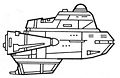 Ship with uninstalled nacelles


Star Fleet Registry
- NCC-L16
- NCC-L18
- NCC-L35
- NCC-L41
- NCC-L43
- NCC-L44
- NCC-L52
- NCC-L57
- NCC-L72
- NCC-L94
- NCC-L101
- NCC-L111
- NCC-L112
- NCC-L120
- NCC-L135
- NCC-L138
- NCC-L149
- NCC-L153
- NCC-L176
- NCC-L177
Notes
- The prefix "USS" has been changed to "UESS" for ships of the United Earth Starfleet.
- Twenty Mercuries were assigned to the UFP Star Fleet, registered in the NCC-L domain.
- Check out the history of the Doppler scout for clues on construction periods of this class.