Guide:Thunderbolt/Battleaxe/Mandalay: Difference between revisions
created |
|||
| (16 intermediate revisions by the same user not shown) | |||
| Line 1: | Line 1: | ||
{{Sidebar Guide ship | {{Sidebar Guide ship | ||
|image=[[File: | |image=[[File:Thunderbolt (stbd).png|Starboard|250px|Thunderbolt class corvette]] | ||
|classname= ''Thunderbolt / Mandalay'' | |classname= ''Thunderbolt / Battleaxe / Mandalay'' | ||
|category= corvette / courier | |category= corvette / courier | ||
|years= [[2234]]-[[2269]] | |years= [[2234]]-[[2269]] | ||
|constructed= 195 total:<br> | |constructed= 195 total:<br> | ||
* ''Thunderbolt'': | * ''Thunderbolt'' (corvette): 52 | ||
* ''Battleaxe'': | * ''Battleaxe'' (corvette): 101 | ||
* ''Mandalay'': | * ''Mandalay'' (courier): 42 | ||
|length= 88.0 m | |length= 88.0 m | ||
|beam= 51.2 m | |beam= 51.2 m | ||
| Line 36: | Line 36: | ||
<u>''Thunderbolt, Battleaxe'' ([[2256]])</u>: | <u>''Thunderbolt, Battleaxe'' ([[2256]])</u>: | ||
* 1x phaser V (phaser IV or twin 4 GW laser in export versions) | * 1x phaser V (phaser IV or twin 4 GW laser in export versions) | ||
* 2x phaser IV emitters (in [[ | * 2x phaser IV emitters (in [[Star Fleet]] and some export versions) | ||
<u>''Mandalay''</u>: unarmed | <u>''Mandalay''</u>: unarmed | ||
|missileweapons= <u>''Thunderbolt, Battleaxe'' (original)</u>: | |missileweapons= <u>''Thunderbolt, Battleaxe'' (original)</u>: | ||
| Line 51: | Line 51: | ||
* ''USS Bronson'' (NCC-L421) | * ''USS Bronson'' (NCC-L421) | ||
* ''USS Callaghan'' (NCC-L357) | * ''USS Callaghan'' (NCC-L357) | ||
* ''USS Lancer'' | |||
* ''USS Mandalay'' (NCC-D300) | * ''USS Mandalay'' (NCC-D300) | ||
* ''USS Thunderbolt'' | * ''USS Thunderbolt'' | ||
| Line 57: | Line 58: | ||
|history= LUG, own | |history= LUG, own | ||
}} | }} | ||
Attach two warp nacelles to an overturned spoon and let go, and you have launched a Thunderbolt | [[Image:No Photo Available.jpg|left|250px|thumb|A rough and ready design sketch for the ''Thunderbolt'' shows the major elements while revealing no compromising detail on weapons placement. The eventual ''Mandalay'' variant ended up looking much like the sketch.]] | ||
[[Image:No Photo Available.jpg|left|250px|thumb|Traffic control on [[Earth]] orbit. ''USS Lancer'' sports a [[Federation Customs Service]] registry, but also doubles as a planetary defense vessel for [[Star Fleet]] Earth. Highly populated and frequently visited worlds like Earth or [[Andor]] usually maintained a dozen corvettes for combined law enforcement and defense duties, while important colonies often supported a defense-dedicated corvette operated by the local Star Fleet liaison team.]] | |||
Attach two warp nacelles to an overturned spoon and let go, and you have launched a '''''Thunderbolt''''' | |||
class patrol vessel – or so it seems. In reality, a corvette is always a tightly packed maze of | class patrol vessel – or so it seems. In reality, a corvette is always a tightly packed maze of | ||
technology, a work of engineering art. In the case of the Thunderbolt class, such extreme | technology, a work of engineering art. In the case of the ''Thunderbolt'' class, such extreme | ||
compactness was reached that the cramped berthing facilities became the primary | compactness was reached that the cramped berthing facilities became the primary endurance-limiting | ||
factor. This mattered little, as | factor. This mattered little, as [[Star Fleet]]’s aim in creating the class was extremely rapid | ||
reaction capability for short range interception and traffic monitoring duties. A top speed of warp | reaction capability for short range interception and traffic monitoring duties. A top speed of warp | ||
four or better, combined with a transatmospheric hull, would redefine the corvette mission class | four or better, combined with a transatmospheric hull, would redefine the corvette mission class | ||
rather completely. | rather completely. | ||
The ''Thunderbolt'' was originally designed in [[2234]] around two 20,000 ton PB-22 warp coils and a | |||
fusion reactor by a civilian design team, but in [[2239]], Star Fleet engineers managed to fit a dilithium-regulated | |||
The Thunderbolt was originally designed in 2234 around two 20,000 ton PB-22 warp coils and a | |||
fusion reactor by a civilian design team, but in 2239, | |||
matter/antimatter reactor to the ship instead. The modernized version, which also later | matter/antimatter reactor to the ship instead. The modernized version, which also later | ||
accommodated phaser weaponry, was named Battleaxe class, and was to be the mainstay of corvette | accommodated phaser weaponry, was named '''''Battleaxe''''' class, and was to be the mainstay of corvette | ||
forces during the forties and fifties. A parallel batch of courier vessels was initiated in the likeness | forces during the forties and fifties. A parallel batch of courier vessels was initiated in the likeness | ||
of an unarmed Thunderbolt but upgraded entirely to unarmed Battleaxe standards within five years | of an unarmed ''Thunderbolt'' but upgraded entirely to unarmed ''Battleaxe'' standards within [[2244|five years]] | ||
of project start. In all the versions, the reactor sat between the nacelles and fed drive plasma through | of project start. In all the versions, the reactor sat between the nacelles and fed drive plasma through | ||
two broad and straight winglike pylons that also housed radiators and landing legs. Behind the | two broad and straight winglike pylons that also housed radiators and landing legs. Behind the | ||
reactor was an impulse engine feeding directly from the main power source; there was no auxiliary | reactor was an impulse engine feeding directly from the main power source; there was no auxiliary | ||
power unit, save for a series of batteries in the space between the reactor and the | power unit, save for a series of batteries in the space between the reactor and the spoon-like forward | ||
hull. Also in this space were two lifting engines for planetary landings (also ingeniously used for | hull. Also in this space were two lifting engines for planetary landings (also ingeniously used for | ||
maneuvering by experienced captains), the tractor beam necessary for capturing uncooperative | maneuvering by experienced captains), the tractor beam necessary for capturing uncooperative | ||
| Line 101: | Line 103: | ||
recently deployed and vulnerable planetary assault troops. In later versions, these cumbersome | recently deployed and vulnerable planetary assault troops. In later versions, these cumbersome | ||
ground-strafing weapons were replaced by two phaser IV emitters, but the rapid response anti-assault | ground-strafing weapons were replaced by two phaser IV emitters, but the rapid response anti-assault | ||
mission of the corvettes was retained. In theory, even the unarmed Mandalay couriers could | mission of the corvettes was retained. In theory, even the unarmed '''''Mandalay''''' couriers could | ||
be fitted with the rocket turrets or their later phaser replacements and perform in this role, after a few days of modification; there was no structural or systemic provision for installing the main laser | be fitted with the rocket turrets or their later phaser replacements and perform in this role, after a few days of modification; there was no structural or systemic provision for installing the main laser or phaser, however. | ||
or phaser, however. | |||
As with most vessels of this size, the navigational deflector was of extremely limited power: to | As with most vessels of this size, the navigational deflector was of extremely limited power: to | ||
avoid micrometeoroid damage, the ship always flew with combat shields up. Originally, this was a | avoid micrometeoroid damage, the ship always flew with combat shields up. Originally, this was a | ||
minor inconvenience, since there were no transporters aboard anyway. Boarding of ships suspected | minor inconvenience, since there were no transporters aboard anyway. Boarding of ships suspected | ||
of illegal activities was still done the way the Pointer and Hunter crews had done it – by actually | of illegal activities was still done the way the ''[[Guide: Pointer|Pointer]]'' and ''[[Guide:Hunter|Hunter]]'' crews had done it – by actually | ||
latching onto the target vessel and demanding access by transfer tube or spacewalk. Weep the | latching onto the target vessel and demanding access by transfer tube or spacewalk. Weep the | ||
opponent who refuses, as the corvette captain turns on his lift engines and burns through the | opponent who refuses, as the corvette captain turns on his lift engines and burns through the | ||
| Line 114: | Line 115: | ||
tools adjacent to the ventral hatch. | tools adjacent to the ventral hatch. | ||
About 150 ''Thunderbolts'' of various standards were produced for patrol and police duties, 40 going | |||
to Federation Customs Service and 50 to Star Fleet local starbase patrols. Several customers later | |||
About 150 Thunderbolts of various standards were produced for patrol and police duties, 40 going | |||
to Federation Customs Service and 50 to | |||
upgraded the ships with modern small craft equipment including transporters and navigation | upgraded the ships with modern small craft equipment including transporters and navigation | ||
systems, plus new software, but engine or weapon upgrades proved too costly for most users. | systems, plus new software, but engine or weapon upgrades proved too costly for most users. | ||
Star Fleet has since given up the use of this class, donating all ships to other [[UFP]] users (the export-cleared, | |||
slightly downgraded version with a phaser IV or twin 4 GW laser turret was generally | slightly downgraded version with a phaser IV or twin 4 GW laser turret was generally | ||
known as the Vazzar class, although many customers insisted on locally applied names). Some | known as the ''Vazzar'' class, although many customers insisted on locally applied names). Some | ||
Battleaxes served in Customs duty until the 2310s essentially in their original configuration, as the | ''Battleaxes'' served in Customs duty until the [[2310s]] essentially in their original configuration, as the | ||
onset of replicator technology made the supply of even antiquated spare parts virtually limitless and | onset of replicator technology made the supply of even antiquated spare parts virtually limitless and | ||
free of expenses. | free of expenses. | ||
The Thunderbolts and Battleaxes were not ideally suited for local defense missions, despite their | The ''Thunderbolts'' and ''Battleaxes'' were not ideally suited for local defense missions, despite their | ||
heavy laser/phaser armament and rapid reaction capability. Shields were of low power and combat | heavy laser/phaser armament and rapid reaction capability. Shields were of low power and combat | ||
endurance poor due to nonexistent repair facilities and system redundancies. Nor was the rapid | endurance poor due to nonexistent repair facilities and system redundancies. Nor was the rapid | ||
reaction configuration compatible with patrol missions of practical length, as the limits of crew | reaction configuration compatible with patrol missions of practical length, as the limits of crew | ||
endurance, both physiological and psychological, would be reached in a matter of weeks. | endurance, both physiological and psychological, would be reached in a matter of weeks. Star Fleet | ||
therefore decided to move toward even heavier corvette designs, which soon began to approach | therefore decided to move toward even heavier corvette designs, which soon began to approach | ||
frigate size and complexity. The heavy corvette classes were often short-lived and production runs | frigate size and complexity. The heavy corvette classes were often short-lived and production runs | ||
| Line 140: | Line 136: | ||
vessels are in general too small to be able to receive significant upgrades. | vessels are in general too small to be able to receive significant upgrades. | ||
The stories of Thunderbolt exploits are too many to be recalled or even believed. Two examples | The stories of ''Thunderbolt'' exploits are too many to be recalled or even believed. Two examples | ||
might be included: USS | might be included: ''USS Callaghan''’s exposure, boarding and impounding of an Orion slave cruiser near [[Cygnet XII]] and ''USS Bronson''’s valiant three-month pursuit of a sensor ghost created by escape artist and con man Harcourt F. Mudd. | ||
artist and con man Harcourt F. Mudd. | |||
==Gallery== | ==Gallery== | ||
<gallery> | <gallery> | ||
File:Thunderbolt (bow).png|''Thunderbolt'' (bow view) | |||
File:Thunderbolt (dorsal).png|Dorsal | |||
File:Thunderbolt (ventral).png|Ventral | |||
File:Thunderbolt (stern).png|Stern | |||
</gallery> | </gallery> | ||
==Notes== | ==Notes== | ||
* | * The rough graphic provide in ''Timo's Guide'' was not detailed enough, nor were any related images found associated with (the cited) ''Star Fleet Battles''. Instead, handofmanos' ''Granger'' re-creation was heavily modified to produce the provided imagery. | ||
* Per its service with the FCS, the ''USS Lancer'' must be a ''Battleaxe'' sub-class vessel. | |||
* Timo subtly indicates ''Mandalay'' entered service in [[2244]]. | |||
---- | ---- | ||
* [[Guide: Timo's Guide to | * [[Guide: Timo's Guide to Star Fleet|Back to the Table of Contents]] | ||
* [[Guide: Corvettes, Couriers, Escorts, Perimeter Ships & Light Scouts|Corvettes, Couriers, Escorts, Perimeter Ships & Light Scouts]] | * [[Guide: Corvettes, Couriers, Escorts, Perimeter Ships & Light Scouts|Corvettes, Couriers, Escorts, Perimeter Ships & Light Scouts]] | ||
* [[Guide: Of Ship Statistics|Appendix A: Of Ship Statistics]] | * [[Guide: Of Ship Statistics|Appendix A: Of Ship Statistics]] | ||
* [[Guide: Glossary|Appendix B: Glossary]] | * [[Guide: Glossary|Appendix B: Glossary]] | ||
* [[Guide: | * [[Guide: Star Fleet Organization - General Outline|Appendix C: Star Fleet Organization - General Outline]] | ||
* [[Guide: Abbreviations From Outside|Appendix D: Abbreviations From Outside]] | * [[Guide: Abbreviations From Outside|Appendix D: Abbreviations From Outside]] | ||
[[Category:Guide|{{PAGENAME}}]] | [[Category:Guide|{{PAGENAME}}]] | ||
Latest revision as of 07:51, 6 November 2025
.png)
| |
| Thunderbolt / Battleaxe / Mandalay | |
|---|---|
| Class Overview | |
| Category | corvette / courier |
| Operational | 2234-2269 |
| Constructed | 195 total:
|
| Dimensions | |
| Length | 88.0 m |
| Beam | 51.2 m |
| Height | 18.0 m |
| Mass |
|
| Performance | |
| Max Speed |
|
| Endurance |
|
| Complement | |
| Officers | 4 |
| Enlisted |
|
| Tactical Systems | |
| Beam Weapons | Thunderbolt, Battleaxe (original):
Thunderbolt, Battleaxe (2256):
Mandalay: unarmed |
| Missile Weapons | Thunderbolt, Battleaxe (original):
|
| Shields |
|
| Transporters | n/a |
| Historical | |
| Ships of Note |
|
| Canonicity | |
| Design | Starfleet Battles |
| Name | Starfleet Battles, LUG |
| History | LUG, own
|

Attach two warp nacelles to an overturned spoon and let go, and you have launched a Thunderbolt class patrol vessel – or so it seems. In reality, a corvette is always a tightly packed maze of technology, a work of engineering art. In the case of the Thunderbolt class, such extreme compactness was reached that the cramped berthing facilities became the primary endurance-limiting factor. This mattered little, as Star Fleet’s aim in creating the class was extremely rapid reaction capability for short range interception and traffic monitoring duties. A top speed of warp four or better, combined with a transatmospheric hull, would redefine the corvette mission class rather completely.
The Thunderbolt was originally designed in 2234 around two 20,000 ton PB-22 warp coils and a fusion reactor by a civilian design team, but in 2239, Star Fleet engineers managed to fit a dilithium-regulated matter/antimatter reactor to the ship instead. The modernized version, which also later accommodated phaser weaponry, was named Battleaxe class, and was to be the mainstay of corvette forces during the forties and fifties. A parallel batch of courier vessels was initiated in the likeness of an unarmed Thunderbolt but upgraded entirely to unarmed Battleaxe standards within five years of project start. In all the versions, the reactor sat between the nacelles and fed drive plasma through two broad and straight winglike pylons that also housed radiators and landing legs. Behind the reactor was an impulse engine feeding directly from the main power source; there was no auxiliary power unit, save for a series of batteries in the space between the reactor and the spoon-like forward hull. Also in this space were two lifting engines for planetary landings (also ingeniously used for maneuvering by experienced captains), the tractor beam necessary for capturing uncooperative vessels, and the shield and artificial gravity generators, plus four propellant/fuel cells.
Atop the ‘spoon hull’ sat a 3.8 GW accelerated laser (later phaser V) turret, actually grossly oversized for the vessel. Ahead of this, the bridge of the ship had a set of windows opening directly forward into space. Below this compact five-person bridge lay a broad second deck with accommodation for the 42 crew, consisting of four cabins of five plus an officers’ cabin and a general mess (although the latter designation was often rightfully applied on the entire interior by the disgruntled crews). A small sensor and deflector array took up space at the bow, and a service corridor and a monitoring room aft provided limited access to the reactor and propulsion systems. The outer rims of the deck did not attain full height due to the hull shape, and held tanks for liquid consumables, as well as proximity sensors and communications gear.
The third deck was narrower than the middle one; a central corridor was flanked by holding cells, storage holds and a cramped staging and briefing room. These competed for space with the main airlock that had a ventral docking adapter and smaller surface ingress/egress hatches opening aft port and aft starboard. Outside the pressurized area lay the bay for the forward landing leg, some space- and surface-scanning sensors, and two rocket-launching swiveling turrets. The turrets were of little use against shielded ships and intended mainly against ‘soft’ surface targets, such as recently deployed and vulnerable planetary assault troops. In later versions, these cumbersome ground-strafing weapons were replaced by two phaser IV emitters, but the rapid response anti-assault mission of the corvettes was retained. In theory, even the unarmed Mandalay couriers could be fitted with the rocket turrets or their later phaser replacements and perform in this role, after a few days of modification; there was no structural or systemic provision for installing the main laser or phaser, however.
As with most vessels of this size, the navigational deflector was of extremely limited power: to avoid micrometeoroid damage, the ship always flew with combat shields up. Originally, this was a minor inconvenience, since there were no transporters aboard anyway. Boarding of ships suspected of illegal activities was still done the way the Pointer and Hunter crews had done it – by actually latching onto the target vessel and demanding access by transfer tube or spacewalk. Weep the opponent who refuses, as the corvette captain turns on his lift engines and burns through the offender’s hull... For less destructive hull breaching, the crew could use a wide variety of power tools adjacent to the ventral hatch.
About 150 Thunderbolts of various standards were produced for patrol and police duties, 40 going to Federation Customs Service and 50 to Star Fleet local starbase patrols. Several customers later upgraded the ships with modern small craft equipment including transporters and navigation systems, plus new software, but engine or weapon upgrades proved too costly for most users. Star Fleet has since given up the use of this class, donating all ships to other UFP users (the export-cleared, slightly downgraded version with a phaser IV or twin 4 GW laser turret was generally known as the Vazzar class, although many customers insisted on locally applied names). Some Battleaxes served in Customs duty until the 2310s essentially in their original configuration, as the onset of replicator technology made the supply of even antiquated spare parts virtually limitless and free of expenses.
The Thunderbolts and Battleaxes were not ideally suited for local defense missions, despite their heavy laser/phaser armament and rapid reaction capability. Shields were of low power and combat endurance poor due to nonexistent repair facilities and system redundancies. Nor was the rapid reaction configuration compatible with patrol missions of practical length, as the limits of crew endurance, both physiological and psychological, would be reached in a matter of weeks. Star Fleet therefore decided to move toward even heavier corvette designs, which soon began to approach frigate size and complexity. The heavy corvette classes were often short-lived and production runs short, reflecting the difficulty of maintaining pace with weapon technology advances – corvette-sized vessels are in general too small to be able to receive significant upgrades.
The stories of Thunderbolt exploits are too many to be recalled or even believed. Two examples might be included: USS Callaghan’s exposure, boarding and impounding of an Orion slave cruiser near Cygnet XII and USS Bronson’s valiant three-month pursuit of a sensor ghost created by escape artist and con man Harcourt F. Mudd.
Gallery
-
 Thunderbolt (bow view)
 -
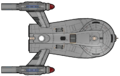 Dorsal
 -
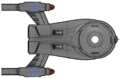 Ventral
 -
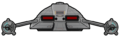 Stern
Stern
.png)
.png)
.png)
.png)
Notes
- The rough graphic provide in Timo's Guide was not detailed enough, nor were any related images found associated with (the cited) Star Fleet Battles. Instead, handofmanos' Granger re-creation was heavily modified to produce the provided imagery.
- Per its service with the FCS, the USS Lancer must be a Battleaxe sub-class vessel.
- Timo subtly indicates Mandalay entered service in 2244.