Guide:Bonaventure (survey cruiser): Difference between revisions
No edit summary |
No edit summary |
||
| (32 intermediate revisions by the same user not shown) | |||
| Line 1: | Line 1: | ||
{{Sidebar Guide ship | {{Sidebar Guide ship | ||
|image=[[ | |image=[[File:Bonaventure survey cruiser (stbd).png|250px|''Bonaventure'' class survey cruiser]] | ||
|classname= ''Bonaventure'' | |classname= ''Bonaventure'' | ||
|category= | |category= survey cruiser | ||
|years= [[2064]] - [[2077]] | |years= [[2064]] - [[2077]] | ||
|constructed= 1 | |constructed= 1 | ||
| Line 32: | Line 32: | ||
* 2 shuttlepods | * 2 shuttlepods | ||
|historicalships= | |historicalships= | ||
|design= | |design= ''Spaceflight Chronology'' | ||
|name= | |name= ''Spaceflight Chronology'' | ||
|history= | |history= ''Spaceflight Chronology'' | ||
|report= [[Bonaventure class]] | |||
|delta= [http://starshiptracker.com/deltadynamics/images/b/b8/SRM_Bonaventure_%28survey%29.pdf ''SRM #295''] | |||
|excel= | |||
}} | }} | ||
The development of the [[Guide: Defiant and Valiant|''Defiant'' and the ''Valiant'']] had created a significant pool of expertise and skill | ==Background== | ||
among the international construction teams. [[Earth]] still lacked the resources to mass-produce warp | ===''Hobbyist's Guide''=== | ||
explorers, but the teams wished to push on with development of more practical warp drives and | The development of the [[Guide: Defiant and Valiant|''Defiant'' and the ''Valiant'']] had created a significant pool of expertise and skill among the international construction teams. [[Earth]] still lacked the resources to mass-produce warp explorers, but the teams wished to push on with development of more practical warp drives and more useful exploration vessels. The national pride that had driven earlier space programs was | ||
more useful exploration vessels. The national pride that had driven earlier space programs was | replaced by a combination of professional pride and competitive spirit, with the frighteningly advanced [[Vulcans]] as the opposing players. | ||
replaced by a combination of professional pride and competitive spirit, with the frighteningly | |||
advanced Vulcans as the opposing players. | |||
In [[2052]], during the final stages of the econo-technological race against the [[ | In [[2052]], during the final stages of the econo-technological race against the [[ECON]], the [[United States|US government]] had begun to construct a large defensive space cruiser, tentatively christened the ''[[Guide:Seneca|Seneca]]'', for challenging ECON orbital supremacy in the 800-4000 km region. The vessel was in many ways just an enlarged copy of the ''[[Guide:Keldysh|Keldysh]]'' design, and something of a departure from the classic [[USAF]] spacecraft lineage. Indeed, the more traditional, less ambitious ''[[Guide:Guardian (USAF)|Guardian]]'' series of large manned combat spacecraft remained the budgetary favorite, and work on the ''Seneca'' was aborted before the outbreak of the war. In [[2064]], the ship was floating dead on a decaying orbit within the shrapnel cloud that had been [[Freedom Assembly Berth 02]] prior to the war. The warp development teams promptly attached a tug onto the hulk and towed it to the ''Valiant'' construction berth. | ||
had begun to construct a large defensive space cruiser, tentatively christened the ''Seneca'', for | |||
challenging | |||
an enlarged copy of the ''Keldysh'' design, and something of a departure from the classic USAF | |||
spacecraft lineage. Indeed, the more traditional, less ambitious ''Guardian'' series of large manned | |||
combat spacecraft remained the budgetary favorite, and work on the ''Seneca'' was aborted before the | |||
outbreak of the war. In [[2064]], the ship was floating dead on a decaying orbit within the shrapnel | |||
cloud that had been [[Freedom Assembly Berth 02]] prior to the war. The warp development teams | |||
promptly attached a tug onto the hulk and towed it to the ''Valiant'' construction berth. | |||
Within a year, the ship sported two 30,000 ton warp coil assemblies in hexagonal protective | Within a year, the ship sported two 30,000 ton warp coil assemblies in hexagonal protective nacelles fashioned out of the lateral fuel tanks, and a three-chamber fusion powerplant with huge radiator surfaces bolted astern of the centerline tank. Her old national insignia were retained, but the registry and name were painted over to give room for the national symbols of the rest of the teams. Instead of the rather martial names chosen for the first warp explorers, the ship proudly carried the words “Bonaventure – the dream is alive” on her hull. Still, the ship was far from being a purely pacifist science project, as the financial backers of the project did not wish to see their interstellar envoy appear defenseless to the unknown dangers of space. Two laser emitters were installed on the arrowhead-shaped forward hull, and a full range of missile warning systems and glass bead emitters covered the propulsion modules and nacelle assemblies. | ||
nacelles fashioned out of the lateral fuel tanks, and a three-chamber fusion powerplant with huge | |||
radiator surfaces bolted astern of the centerline tank. Her old national insignia were retained, but the | |||
registry and name were painted over to give room for the national symbols of the rest of the teams. | |||
Instead of the rather martial names chosen for the first warp explorers, the ship proudly carried the | |||
words “Bonaventure – the dream is alive” on her hull. Still, the ship was far from being a purely pacifist science project, as the financial backers of the project did not wish to see their interstellar envoy appear defenseless to the unknown dangers of space. Two laser emitters were installed on the | |||
arrowhead-shaped forward hull, and a full range of missile warning systems and glass bead emitters | |||
covered the propulsion modules and nacelle assemblies. | |||
Since the ship was primarily intended to explore strange new planets, she required landing craft and | Since the ship was primarily intended to explore strange new planets, she required landing craft and remote mapping gear, neither of which was provided for in the original cruiser design. Two former USAF sentry platform maintenance shuttles were hauled from Earth and bolted onto the ventral surface of the fuel tank, and a selection of telescopes crowded the forward hull. A completely closed-circuit life support system was also installed for a maximum endurance of six years, representing a quantum leap over the primitive systems aboard the ''Valiant/Defiant'' ships. | ||
remote mapping gear, neither of which was provided for in the original cruiser design. Two former | |||
USAF sentry platform maintenance shuttles were hauled from Earth and bolted onto the ventral | |||
surface of the fuel tank, and a selection of telescopes crowded the forward hull. A completely | |||
closed-circuit life support system was also installed for a maximum endurance of six years, | |||
representing a quantum leap over the primitive systems aboard the ''Valiant/Defiant'' ships. | |||
The gigantic vessel fared better than the two initial survey cruisers: her second operational warp | The gigantic vessel fared better than the two initial survey cruisers: her second operational warp sortie under the command of Captain [[Hadrian Huckleby]] took her to [[Tau Ceti]] and, more significantly, back. Mankind’s first two-way interstellar journey had been completed in just eight years. During the following decade, the successful ''[[Guide:Columbus series|Columbus]]'' sublight explorers would also return to Earth, but too late to claim the honor. It mattered little that the ''Bonaventure'' went missing on her third mission, to [[Sirius]] – Earth had been firmly established as capable of interstellar exploration now, and would continue to expand its efforts in the upcoming years. | ||
sortie under the command of Captain Hadrian Huckleby took her to [[Tau Ceti]] and, more significantly, back. | |||
Mankind’s first two-way interstellar journey had been completed in just eight years. During the | |||
following decade, the successful ''[[Guide: Columbus|Columbus]]'' sublight explorers would also return to Earth, but too | |||
late to claim the honor. It mattered little that the ''Bonaventure'' went missing on her third mission, to | |||
[[Sirius]] – Earth had been firmly established as capable of interstellar exploration now, and would | |||
continue to expand its efforts in the upcoming years. | |||
While the capability of Earth to construct something the size of the ''Bonaventure'' was severely | While the capability of Earth to construct something the size of the ''Bonaventure'' was severely limited in the postwar environment, scavenging of existing space structures would help Earth equip for its warp exploration spree. The basic structure demonstrated by the ''Defiant'', the ''Valiant'' and the ''Bonaventure'' would remain popular in early purpose-built warp vessels as well. A central fuel tank and reactor compartment flanked by two nacelles and mounting reaction engines and fusion powerplant aft, and an angular habitation compartment forward: all this would see service well into the mid-[[2100s]], although the amount of onboard fuel required would gradually decrease and thus free internal space for other applications. | ||
limited in the postwar environment, scavenging of existing space structures would help Earth equip | |||
for its warp exploration spree. The basic structure demonstrated by the ''Defiant'', the ''Valiant'' and the | |||
''Bonaventure'' would remain popular in early purpose-built warp vessels as well. A central fuel tank | |||
and reactor compartment flanked by two nacelles and mounting reaction engines and fusion | |||
powerplant aft, and an angular habitation compartment forward: all this would see service well into | |||
the mid-[[2100s]], although the amount of onboard fuel required would gradually decrease and thus | |||
free internal space for other applications. | |||
[[Image:Bonaventure orbit.jpg|center|900px]] | [[Image:Bonaventure orbit.jpg|center|900px]] | ||
The most direct successors of the ''Bonaventure'' would be the ''[[Guide: Messier|Messier]]'' class heavy cruisers, Earth’s | The most direct successors of the ''Bonaventure'' would be the ''[[Guide: Messier|Messier]]'' class heavy cruisers, Earth’s first true interstellar warships that in the [[22nd century]] would be drafted to serve in the desperate struggle against the Romulans. However, the course of Earth warp technology was far from charted in [[2064]], and at least two major competing basic configurations would soon emerge. It is a matter of | ||
first true interstellar warships that in the [[22nd century]] would be drafted to serve in the desperate | some specieist pride to [[Human]]kind that the native ''Bonaventure'' configuration would persevere where the alien-influenced competitors would not. | ||
struggle against the Romulans. However, the course of Earth warp technology was far from charted | |||
in [[2064]], and at least two major competing basic configurations would soon emerge. It is a matter of | ===Delta Dynamics=== | ||
some specieist pride to | During the lead-up to the [[Third World War]] ([[2052]]-[[2053]]) on [[Earth]], the [[United States Air Force]] engaged in the development and construction of varying series of warcraft for the 800-4000 km orbital region. The vanguard of a large defensive space cruiser class was begun with the prototype ''Seneca'' at [[Space Station Freedom]]'s assembly berth 02. The ship was essentially an enlarged version of the Eurasian Confederation's ''[[Guide: Keldysh|Keldysh]]'' cruiser class. However, construction was halted late in the process in favor of the more traditional (and less ambitious) ''[[Guide:Guardian (USAF)|Guardian]]'' series of large manned combat spacecraft, due to budgetary constraints. By the post-First Contact period of [[2064]], the ''Seneca'' hull was in the dead-center of a shrapnel cloud in a decaying orbit. The international warp development teams tugged her into the now-vacant ''[[Guide: Valiant|Valiant]]'' construction berth, to become a more robust survey cruiser for the planet newly starstruck by a galactic manifest destiny. | ||
where the alien-influenced competitors would not. | |||
The ''Seneca'''s lateral fuel tanks provided the protective structure for two 30,000-ton warp coil assemblies, with intra-system propulsion dependent upon the tried-and-true three-chamber fusion powerplant bolted to the stern of the centerline main fuel tank. Cooling was provided via the relatively large radiator surfaces of the main propulsion channel. The phrase "Bonaventure – the dream is alive" proudly broadcast the change in name and ''raison d'être''; the existing American pennant was joined by the pennants of the other partner nations. Despite the scientific and exploration mission, two Sorac 1.2 Plus class lasers were installed, along with suites of missile warning systems and glass bead emitters (for defense versus lasers), to demonstrate Earth's capacity for self-defense. Two former USAF sentry platform maintenance shuttles were mounted on the respective attachments bolted to the central fuel tank; they could only be crewed following a spacewalk from the command section, but they provided a means to approach natural bodies, such as asteroid belts of alien systems, without directly endangering the safety of the ship. Various optical and electronic telescopes were crammed into the various spaces of the main hull. | |||
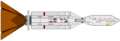
The ''Bonaventure'' first entered service with a three-month shakedown cruise outside the [[Sol]] system in [[2065]], before departing to [[Tau Ceti]] in [[2066]]. She was 206.1 meters in length, 63.4 meters wide, and 66.7 meters high (when the radiator was deployed in the open position). She massed about 79,400 metric tons. Her warp assemblies allowed for a speedy warp 2 for cruising, with a maximum speed of warp 2.5; her mission endurance was a very impressive six years. She was equipped with one general purpose laboratory, and one dedicated to planetary sciences. The ship's hull was mottled with hexagonal three-dimensional scanned telescopic arrays and one port-side electro-rigidized deployable radio antenna. Two (previously mentioned) shuttles were bolted to the ventral side of the central fuel tank and two shuttlepods for extravehicular maintenance were stored in the aft cargo bay of the command hull. The ship was crewed by 45 specialists with a gamut of areas of expertise and nations of origin. | |||
The ''Bonaventure'' was not Earth's first ship to attempt a two-way interstellar journey, but she was the first to complete it, beating the three surviving pre-warp ''[[Guide:Columbus series|Columbus]]'' ships (''Icarus'', ''Hector'', and ''Prometheus'') home by about a decade, with her return from Tau Ceti. She would go missing on the third trip out, to [[Sirius]] in [[2077]], but not missing from her place in history. | |||
==Missions== | ==Missions== | ||
| Line 101: | Line 74: | ||
==Gallery== | ==Gallery== | ||
===''Bonaventure'' survey cruiser=== | |||
<gallery> | |||
File:Bonaventure survey cruiser (stbd).png|''Bonaventure'' | |||
File:Bonaventure (bow).png | |||
File:Bonaventure (dorsal).png | |||
File:Bonaventure (stern).png | |||
File:Bonaventure (ventral).png | |||
</gallery> | |||
===Orthos=== | |||
<gallery> | |||
File:Bonaventure (named ortho).png | |||
</gallery> | |||
===Other Images=== | |||
<gallery> | <gallery> | ||
File:Bonaventure departing Tau Ceti.png|''Bonaventure'' departing [[Tau Ceti]] | File:Bonaventure departing Tau Ceti.png|''Bonaventure'' departing [[Tau Ceti]] | ||
File:Bonaventure.png|Alpha-canon ''Bonaventure'' | |||
</gallery> | </gallery> | ||
==Supporting Documents== | |||
* [http://starshiptracker.com/deltadynamics/index.php/Cruiser_Blueprints#Bonaventure_.28survey_cruiser.29_.282064.29 Blueprints] | |||
* [http://starshiptracker.com/deltadynamics/images/b/b8/SRM_Bonaventure_%28survey%29.pdf ''Starship Recognition Manual #295 - Report: Bonaventure Survey Cruiser''] | |||
==Notes== | |||
* The canon image of the ''Bonaventure'' (included in the gallery) is—unfortunately—not being used here, as it does appear to fall outside the design scope of both the article description and the lineage of early warp ships from [[Earth]]. I'd love to find a way to make it game-canon, maybe even as the described ''Seneca'', but because of the warp nacelles, it clearly is a post-2063 ship. | |||
---- | ---- | ||
*[[Timo's Guide to | * [[Guide: Timo's Guide to Star Fleet|Back to the Table of Contents]] | ||
*[[2063 | * [[Guide: Before 2063 - The Playground|Back to "The Playground"]] | ||
*[[Of Ship Statistics | * [[Guide: Of Ship Statistics|Appendix A: Of Ship Statistics]] | ||
*[[Glossary | * [[Guide: Glossary|Appendix B: Glossary]] | ||
*[[ | * [[Guide: Star Fleet Organization - General Outline|Appendix C: Star Fleet Organization - General Outline]] | ||
*[[Abbreviations From Outside | * [[Guide: Abbreviations From Outside|Appendix D: Abbreviations From Outside]] | ||
[[Category:Guide|{{PAGENAME}}]] | [[Category:Guide|{{PAGENAME}}]] | ||
Latest revision as of 07:42, 13 October 2026
.png)
| |
| Bonaventure | |
|---|---|
| Class Overview | |
| Category | survey cruiser |
| Operational | 2064 - 2077 |
| Constructed | 1 |
| Dimensions | |
| Length | 206.1 m |
| Beam | 63.4 m (radiator wings deployed) |
| Height | 66.7 m (radiator wings deployed) |
| Mass | 79,400 mt |
| Performance | |
| Cruise Speed | w 2.0 |
| Max Speed | w 2.5 |
| Endurance | 6 years |
| Complement | |
| Officers | 5 |
| Enlisted | 40
|
| Tactical Systems | |
| Beam Weapons | 2x Sorac 1.2 Plus Class lasers, fwd hull
|
| Shields |
|
| Laboratories |
|
| Auxiliary Craft |
|
| Canonicity | |
| Design | Spaceflight Chronology |
| Name | Spaceflight Chronology |
| History | Spaceflight Chronology |
| Class Report | Bonaventure class |
| Delta Dynamics | SRM #295 |
Background
Hobbyist's Guide
The development of the Defiant and the Valiant had created a significant pool of expertise and skill among the international construction teams. Earth still lacked the resources to mass-produce warp explorers, but the teams wished to push on with development of more practical warp drives and more useful exploration vessels. The national pride that had driven earlier space programs was replaced by a combination of professional pride and competitive spirit, with the frighteningly advanced Vulcans as the opposing players.
In 2052, during the final stages of the econo-technological race against the ECON, the US government had begun to construct a large defensive space cruiser, tentatively christened the Seneca, for challenging ECON orbital supremacy in the 800-4000 km region. The vessel was in many ways just an enlarged copy of the Keldysh design, and something of a departure from the classic USAF spacecraft lineage. Indeed, the more traditional, less ambitious Guardian series of large manned combat spacecraft remained the budgetary favorite, and work on the Seneca was aborted before the outbreak of the war. In 2064, the ship was floating dead on a decaying orbit within the shrapnel cloud that had been Freedom Assembly Berth 02 prior to the war. The warp development teams promptly attached a tug onto the hulk and towed it to the Valiant construction berth.
Within a year, the ship sported two 30,000 ton warp coil assemblies in hexagonal protective nacelles fashioned out of the lateral fuel tanks, and a three-chamber fusion powerplant with huge radiator surfaces bolted astern of the centerline tank. Her old national insignia were retained, but the registry and name were painted over to give room for the national symbols of the rest of the teams. Instead of the rather martial names chosen for the first warp explorers, the ship proudly carried the words “Bonaventure – the dream is alive” on her hull. Still, the ship was far from being a purely pacifist science project, as the financial backers of the project did not wish to see their interstellar envoy appear defenseless to the unknown dangers of space. Two laser emitters were installed on the arrowhead-shaped forward hull, and a full range of missile warning systems and glass bead emitters covered the propulsion modules and nacelle assemblies.
Since the ship was primarily intended to explore strange new planets, she required landing craft and remote mapping gear, neither of which was provided for in the original cruiser design. Two former USAF sentry platform maintenance shuttles were hauled from Earth and bolted onto the ventral surface of the fuel tank, and a selection of telescopes crowded the forward hull. A completely closed-circuit life support system was also installed for a maximum endurance of six years, representing a quantum leap over the primitive systems aboard the Valiant/Defiant ships.
The gigantic vessel fared better than the two initial survey cruisers: her second operational warp sortie under the command of Captain Hadrian Huckleby took her to Tau Ceti and, more significantly, back. Mankind’s first two-way interstellar journey had been completed in just eight years. During the following decade, the successful Columbus sublight explorers would also return to Earth, but too late to claim the honor. It mattered little that the Bonaventure went missing on her third mission, to Sirius – Earth had been firmly established as capable of interstellar exploration now, and would continue to expand its efforts in the upcoming years.
While the capability of Earth to construct something the size of the Bonaventure was severely limited in the postwar environment, scavenging of existing space structures would help Earth equip for its warp exploration spree. The basic structure demonstrated by the Defiant, the Valiant and the Bonaventure would remain popular in early purpose-built warp vessels as well. A central fuel tank and reactor compartment flanked by two nacelles and mounting reaction engines and fusion powerplant aft, and an angular habitation compartment forward: all this would see service well into the mid-2100s, although the amount of onboard fuel required would gradually decrease and thus free internal space for other applications.

The most direct successors of the Bonaventure would be the Messier class heavy cruisers, Earth’s first true interstellar warships that in the 22nd century would be drafted to serve in the desperate struggle against the Romulans. However, the course of Earth warp technology was far from charted in 2064, and at least two major competing basic configurations would soon emerge. It is a matter of some specieist pride to Humankind that the native Bonaventure configuration would persevere where the alien-influenced competitors would not.
Delta Dynamics
During the lead-up to the Third World War (2052-2053) on Earth, the United States Air Force engaged in the development and construction of varying series of warcraft for the 800-4000 km orbital region. The vanguard of a large defensive space cruiser class was begun with the prototype Seneca at Space Station Freedom's assembly berth 02. The ship was essentially an enlarged version of the Eurasian Confederation's Keldysh cruiser class. However, construction was halted late in the process in favor of the more traditional (and less ambitious) Guardian series of large manned combat spacecraft, due to budgetary constraints. By the post-First Contact period of 2064, the Seneca hull was in the dead-center of a shrapnel cloud in a decaying orbit. The international warp development teams tugged her into the now-vacant Valiant construction berth, to become a more robust survey cruiser for the planet newly starstruck by a galactic manifest destiny.
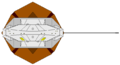
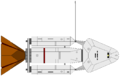
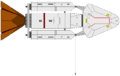
The Seneca's lateral fuel tanks provided the protective structure for two 30,000-ton warp coil assemblies, with intra-system propulsion dependent upon the tried-and-true three-chamber fusion powerplant bolted to the stern of the centerline main fuel tank. Cooling was provided via the relatively large radiator surfaces of the main propulsion channel. The phrase "Bonaventure – the dream is alive" proudly broadcast the change in name and raison d'être; the existing American pennant was joined by the pennants of the other partner nations. Despite the scientific and exploration mission, two Sorac 1.2 Plus class lasers were installed, along with suites of missile warning systems and glass bead emitters (for defense versus lasers), to demonstrate Earth's capacity for self-defense. Two former USAF sentry platform maintenance shuttles were mounted on the respective attachments bolted to the central fuel tank; they could only be crewed following a spacewalk from the command section, but they provided a means to approach natural bodies, such as asteroid belts of alien systems, without directly endangering the safety of the ship. Various optical and electronic telescopes were crammed into the various spaces of the main hull.
The Bonaventure first entered service with a three-month shakedown cruise outside the Sol system in 2065, before departing to Tau Ceti in 2066. She was 206.1 meters in length, 63.4 meters wide, and 66.7 meters high (when the radiator was deployed in the open position). She massed about 79,400 metric tons. Her warp assemblies allowed for a speedy warp 2 for cruising, with a maximum speed of warp 2.5; her mission endurance was a very impressive six years. She was equipped with one general purpose laboratory, and one dedicated to planetary sciences. The ship's hull was mottled with hexagonal three-dimensional scanned telescopic arrays and one port-side electro-rigidized deployable radio antenna. Two (previously mentioned) shuttles were bolted to the ventral side of the central fuel tank and two shuttlepods for extravehicular maintenance were stored in the aft cargo bay of the command hull. The ship was crewed by 45 specialists with a gamut of areas of expertise and nations of origin.
The Bonaventure was not Earth's first ship to attempt a two-way interstellar journey, but she was the first to complete it, beating the three surviving pre-warp Columbus ships (Icarus, Hector, and Prometheus) home by about a decade, with her return from Tau Ceti. She would go missing on the third trip out, to Sirius in 2077, but not missing from her place in history.
Missions
- Mission 2065: Three-month shakedown cruise outside the Sol system
- Mission 2066: Exploration of the Tau Ceti system
- Mission 2077: Exploration of the Sirius system (craft lost)
Gallery
-
 Bonaventure
 -
-
-

-
.png)
.png)
.png)
.png)
Orthos
.png)
Other Images
-
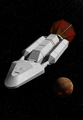 Bonaventure departing Tau Ceti
 -
 Alpha-canon Bonaventure


Supporting Documents
Notes
- The canon image of the Bonaventure (included in the gallery) is—unfortunately—not being used here, as it does appear to fall outside the design scope of both the article description and the lineage of early warp ships from Earth. I'd love to find a way to make it game-canon, maybe even as the described Seneca, but because of the warp nacelles, it clearly is a post-2063 ship.