Guide:Verne: Difference between revisions
No edit summary |
|||
| (14 intermediate revisions by the same user not shown) | |||
| Line 4: | Line 4: | ||
|category= survey cruiser/system defense destroyer | |category= survey cruiser/system defense destroyer | ||
|years= [[2064]] - [[2095]] | |years= [[2064]] - [[2095]] | ||
|constructed= 18 | |constructed= 18 (built [[2064]] - [[2074]]) | ||
|length= 235.9 m | |length= 235.9 m | ||
|beam= 80.4 m | |beam= 80.4 m | ||
| Line 10: | Line 10: | ||
|mass= 25,000 mt | |mass= 25,000 mt | ||
|cruisespeed= w 2.5 | |cruisespeed= w 2.5 | ||
|maxspeed= w 2.7 | |maxspeed= w 2.7 (10-30 mins) | ||
|endurance= 2.5 years | |endurance= 2.5 years | ||
|officers= 9 | |officers= 9 | ||
|enlisted= 103 | |enlisted= 103 | ||
|troops= | |troops= | ||
|passengers= | |passengers= 8 | ||
|patients= | |patients= | ||
|crew= | |crew= | ||
|cargo= | |cargo= <br> | ||
* fuel: 13,891 mt | |||
* holds: 782 mt | |||
|beamweapons= <br> | |beamweapons= <br> | ||
* 4x Sorac 1.5 Plus Class lasers (cruiser) | * 4x Sorac 1.5 Plus Class lasers (cruiser) | ||
* 8x Sorac 1.8 Plus Class lasers (destroyer, [[2087]]) | * 8x Sorac 1.8 Plus Class lasers (destroyer, [[2087]]) | ||
|missileweapons= <br> | |missileweapons= <br> | ||
* 2x missile tubes (w/ | * 2x missile tubes (w/ 40 nuclear missiles & 10 probes) | ||
|otherweapons= | |otherweapons= | ||
|shields= <br> | |shields= <br> | ||
* | * Type II hull plating | ||
* anti-laser glass-cloud dispensers (destroyers) | * anti-laser glass-cloud dispensers (destroyers) | ||
|labs= | |labs= <br> | ||
* 1x GP | |||
* 1x planetary sciences | |||
|transporters= | |transporters= | ||
|auxcraft= <br> | |auxcraft= <br> | ||
* | * 2x atmospheric shuttles (cruiser) | ||
* | * 2x spatial shuttlepods (all) | ||
|historicalships= <br> | |historicalships= <br> | ||
* ''USS Banshee'' | |||
* ''USS Hammer'' (CS/DD-24) | * ''USS Hammer'' (CS/DD-24) | ||
* ''USS Fletcher'' (CS-08) | * ''USS Fletcher'' (CS-08) | ||
* ''USS Mercury'' | |||
* ''USS Scythe'' (CS/DD-25) | * ''USS Scythe'' (CS/DD-25) | ||
|design= ''Federation Spaceflight Chronology'' | |design= ''Federation Spaceflight Chronology'' | ||
|name= ''Federation Spaceflight Chronology'' | |name= ''Federation Spaceflight Chronology'' | ||
|history= ''Federation Spaceflight Chronology'' | |history= ''Federation Spaceflight Chronology'' | ||
|report= [[Verne class|''Verne'' class]] | |||
|delta= | |delta= | ||
}} | }} | ||
The late [[2060s]] saw a swift rebirth of industrial networks across and above the surface of the [[Earth]]. In consequence, the proliferation of warp technology and its adaptiveness to existing ship configurations enabled almost any organization with access to space to equip a warp-powered explorer. Literally hundreds of different ships exploded out of the solar system in search of new life, civilizations, raw materials, explanations and answers of all kinds – or just for the fun of it. The surviving governments of the time were determined to get their piece of the action as well, and in [[2073]], the first series-produced interstellar spaceship class, the '''''Verne''''' survey cruiser, was fielded to serve under the [[United Earth]] flag. The story of the ship class had begun much earlier, however, in the form of the final major nationalistic spacecraft program under [[NUN]] colors. | The late [[2060s]] saw a swift rebirth of industrial networks across and above the surface of the [[Earth]]. In consequence, the proliferation of warp technology and its adaptiveness to existing ship configurations enabled almost any organization with access to space to equip a warp-powered explorer. Literally hundreds of different ships exploded out of the solar system in search of new life, civilizations, raw materials, explanations and answers of all kinds – or just for the fun of it. The surviving governments of the time were determined to get their piece of the action as well, and in [[2073]], the first series-produced interstellar spaceship class, the '''''Verne''''' survey cruiser, was fielded to serve under the [[United Earth]] flag. The story of the ship class had begun much earlier, however, in the form of the final major nationalistic spacecraft program under [[NUN]] colors. | ||
The original ''Verne'' ships were built jointly by the countries that had survived the devastation of WW III with the least damage – mainly the larger North American nations that were protected well enough, and South American and African nations not worthy of having been nuclear targets. They featured a hull taken from the promising ''Guardian'' series of USAF prewar near-Earth warships, a huge cone similar to the postwar ''[[Guide:Liberty|Liberty]]'' hulls yet technologically less ambitious and consequently more robust. Modifications to this design had been on the drawing boards for some time, and had held back prewar series production. Now these plans helped speed up the conversion of the ''Guardians'' into warp explorers that would give the West an edge over Terran competition. | The original ''Verne'' ships were built jointly by the countries that had survived the devastation of [[WW III]] with the least damage – mainly the larger North American nations that were protected well enough, and South American and African nations not worthy of having been nuclear targets. They featured a hull taken from the promising ''[[Guide:Guardian (USAF)|Guardian]]'' series of [[USAF]] prewar near-Earth warships, a huge cone similar to the postwar ''[[Guide:Liberty|Liberty]]'' hulls yet technologically less ambitious and consequently more robust. Modifications to this design had been on the drawing boards for some time, and had held back prewar series production. Now these plans helped speed up the conversion of the ''Guardians'' into warp explorers that would give the West an edge over Terran competition. | ||
In [[2064]], three ''Guardian'' hulls were available in orbit, but none were originally deemed salvageable. Instead, a completed | In [[2064]], three ''Guardian'' hulls were available in orbit, but none were originally deemed salvageable. Instead, a completed but previously unlaunched hull lifted off from the reinstated [[Edwards Space Force Base]], bearing the name ''Jules Verne'' alongside its NUN livery. Launches of three flat, monoelement Korngold-McHale warp nacelles soon followed. These were mated to the aft hull at 120 degree intervals, not in the style of the Cochrane experiment but in the configuration of the USAF plans from the early [[2050s]]. A warp power source of three Singh-derived fusion reactors replaced half the fuel tankage as well as all the particle cannon from the original blueprints. As long planned, the fission NTR reaction engines from the late [[2040s]] were replaced by fusion NTR propulsion that utilized a single gigantic nozzle. Alterations to hull form were minimal, and did not attempt the kind of endurance increases the truly international ''[[Guide:Defiant and Valiant|Defiant/Valiant]]'' and ''[[Guide:Bonaventure (survey cruiser)|Bonaventure]]'' programs had aimed for. Instead, much of the original martial nature of the design survived. For example, the bow cone retained the original two missile tubes while gaining some protrusions necessitated by extended life support systems. | ||
intervals, not in the style of the Cochrane experiment but in the configuration of the USAF plans from the early [[2050s]]. A warp power source of three Singh-derived fusion reactors replaced half the fuel tankage as well as all the particle cannon from the original blueprints. As long planned, the fission NTR reaction engines from the late [[2040s]] were replaced by fusion NTR propulsion that utilized a single gigantic nozzle. Alterations to hull form were minimal, and did not attempt the kind of endurance increases the truly international ''[[Guide:Defiant and Valiant|Defiant/Valiant]]'' and ''[[Guide:Bonaventure (survey cruiser)|Bonaventure]]'' programs had aimed for. Instead, much of the original martial nature of the design survived. For example, the bow cone retained the original two missile tubes while gaining some protrusions necessitated by extended life support systems. | |||
A successful sublight test flight in October [[2064]] paved way for the first warp run, initiated safely outside the orbit of [[Uranus]] | A successful sublight test flight in October [[2064]] paved way for the first warp run, initiated safely outside the orbit of [[Uranus]] on December 14th, [[2065]]. The ''Jules Verne'' reached warp 1.02 under the close supervision of a [[Vulcans|Vulcan]] chase ship. Never mind that the test run proved incorrect most of the USAF calculations, resulted in terminal damage to the nacelles, and was greeted by the Vulcans as "a most irresponsible and ill-advised act of experimentation", an apparent cussword in Vulcan science circles. Nor did the [[Sparon-DeSoto Treaty|Sparon-DeSoto]] clamp-on that squashed the original political goals of the program deter the participating nations. They still granted funding for the re-engining of the ''Verne'', completion of three more vessels out of unlaunched components, and conversion of the orbital derelicts to operational warp explorers. | ||
By [[2075]], eighteen ''Vernes'' had been constructed, seventeen of them had attained warp capability, and sixteen had been launched on missions of exploration, to [[Epsilon Eridani]], [[Altair]], [[Arcturus]] and [[Sirius]]. In [[2073]], the nations operating the ''Verne'' ships promised to make all their findings public through the [[UESPA|UE Space Probe Agency]] (a promise only partially kept), and in [[2089]] relinquished control of their ships to the [[United Earth Stellar Navy|UE Stellar Navy]] (a more honest show of idealism). Little of this mattered to the ships and crews themselves, typically underway on decades-long journeys. Unlike the long-shot ''Defiant'' and ''Valiant'' missions, the ''Verne'' ships systematically surveyed the homeworlds of the newly encountered races and estimated their resources and military strength, charting nearby space for possible expansion. A top speed of warp 2.7 allowed the ships to outrun many private warp vessels | By [[2075]], eighteen ''Vernes'' had been constructed, seventeen of them had attained warp capability, and sixteen had been launched on missions of exploration, to [[Epsilon Eridani]], [[Altair]], [[Arcturus]] and [[Sirius]]. In [[2073]], the nations operating the ''Verne'' ships promised to make all their findings public through the [[UESPA|UE Space Probe Agency]] (a promise only partially kept), and in [[2089]] relinquished control of their ships to the [[United Earth Stellar Navy|UE Stellar Navy]] (a more honest show of idealism). Little of this mattered to the ships and crews themselves, typically underway on decades-long journeys. Unlike the long-shot ''Defiant'' and ''Valiant'' missions, the ''Verne'' ships systematically surveyed the homeworlds of the newly encountered races and estimated their resources and military strength, charting nearby space for possible expansion. A top speed of warp 2.7 allowed the ships to outrun many private warp vessels | ||
and thus to attain certain leverage over such entrepreneurs. The limited range of the ''Vernes'' often forced them to seek replenishment from the worlds they explored, leading to rudimentary trade | and thus to attain certain leverage over such entrepreneurs. The limited range of the ''Vernes'' often forced them to seek replenishment from the worlds they explored, leading to rudimentary trade agreements and improvised diplomatic overtures. | ||
agreements and improvised diplomatic overtures. | |||
[[Image:Amity approaches Vulcan.png|left|300px|thumb|On the first [[Human]] diplomatic-scientific expedition to ''[[Vulcan|Vulcania]]'', ''USS Amity'' approaches 40 Eridani A, with the innermost planet of the system visible off port bow. The two orbit-to-surface craft, modified from Patriot transorbital interceptors, have already undocked; the photograph is taken from one of them, just prior to the craft engaging its rather formidable reaction drive for an independent rendezvous with planet Vulcan. The show-off maneuver was in fact necessitated by an embarrassing drive malfunction aboard the ''Amity'', leaving the mothership stranded on a circumstellar orbit. Vulcans were led to believe that the approach maneuver had ceremonial roots, while the crew of the ''Amity'' performed frantic and ultimately successful repairs.]] | [[Image:Amity approaches Vulcan.png|left|300px|thumb|On the first [[Human]] diplomatic-scientific expedition to ''[[Vulcan|Vulcania]]'', ''USS Amity'' approaches 40 Eridani A, with the innermost planet of the system visible off port bow. The two orbit-to-surface craft, modified from Patriot transorbital interceptors, have already undocked; the photograph is taken from one of them, just prior to the craft engaging its rather formidable reaction drive for an independent rendezvous with planet Vulcan. The show-off maneuver was in fact necessitated by an embarrassing drive malfunction aboard the ''Amity'', leaving the mothership stranded on a circumstellar orbit. Vulcans were led to believe that the approach maneuver had ceremonial roots, while the crew of the ''Amity'' performed frantic and ultimately successful repairs.]] | ||
Back on Earth, the ''Verne'' project initially faced stiff criticism from many nations struggling with the post-war horrors. Terrorist attacks frequently threatened the launches of components, and funding was hard to come by. But the rapid recovery of infrastructures in the [[2060s]] and [[2070s|70s]] made it possible to start fighting the rampant poverty and hunger and the environmental devastation. The recovery owed as much to the continuing space program as it owed to the Vulcan beneficiaries. Asteroid mining and weather and communications satellite networks were widely advertised as essential to Earth’s recuperation, and in the late 70s the public opinion had turned in favor of space exploration and exploitation. In the [[2080s|80s]], less than 20% of Earth’s population suffered from hunger and poverty—a feat never before attained. The remaining distress would disappear thanks to space resources and interstellar trade, promised the new world government. | Back on Earth, the ''Verne'' project initially faced stiff criticism from many nations struggling with the post-war horrors. Terrorist attacks frequently threatened the launches of components, and funding was hard to come by. But the rapid recovery of infrastructures in the [[2060s]] and [[2070s|70s]] made it possible to start fighting the rampant poverty and hunger and the environmental devastation. The recovery owed as much to the continuing space program as it owed to the Vulcan beneficiaries. Asteroid mining and weather and communications satellite networks were widely advertised as essential to Earth’s recuperation, and in the [[2070s|late 70s]] the public opinion had turned in favor of space exploration and exploitation. In the [[2080s|80s]], less than 20% of Earth’s population suffered from hunger and poverty—a feat never before attained. The remaining distress would disappear thanks to space resources and interstellar trade, promised the new world government. | ||
The ''Verne'' ships frequently made the news with intriguing scientific discoveries and daring recovery operations of old sublight colonization ships. Dozens of colonies sprung up around distant stars and Earth’s solar system bustled with activity once again. But there were many setbacks in the space program as well. Most notably, it was found out that contacts with hostile alien cultures were quite possible, and that Earth would have to be ready for violent encounters. ''USS Mercury'' and ''USS Banshee'' were the first vessels of the class to be lost in deep space in [[2077]]. No official explanation was ever found for the losses, and the Vulcan High Command strongly discouraged such solo missions, at least until better communications networks would be in place. Existing Vulcan military networks were strictly off limits, however, presenting | The ''Verne'' ships frequently made the news with intriguing scientific discoveries and daring recovery operations of old sublight colonization ships. Dozens of colonies sprung up around distant stars and Earth’s solar system bustled with activity once again. But there were many setbacks in the space program as well. Most notably, it was found out that contacts with hostile alien cultures were quite possible, and that Earth would have to be ready for violent encounters. ''USS Mercury'' and ''USS Banshee'' were the first vessels of the class to be lost in deep space in [[2077]]. No official explanation was ever found for the losses, and the [[Vulcan High Command]] strongly discouraged such solo missions, at least until better communications networks would be in place. Existing Vulcan military networks were strictly off limits, however, presenting UESPA with a chicken-and-egg problem: contact with deep space explorers could only be maintained after extensive exploration of deep space. | ||
On the other hand, nobody was left in the dark when ''USS Fletcher'' exploded and scattered debris to the upper atmosphere after a warp drive failure in Earth’s gravity well in [[2086]]. The early warp drives were notoriously unreliable anywhere near gravity gradients, and the three-lobed fields of the ''Vernes'' far more so than the Cochrane-style ones. Indeed, the ''Fletcher'' explosion factually spelled the end of the Korngold-McHale style of warp propulsion, leaving the Cochrane and Tellarite multicoil drives and the Vulcan ring-engine drive as the only serious competitors on the field. ''Verne'' vessels back in the [[Sol]] system at the time of the accident were assigned sublight duty and a destroyer designation, assisting the ''Liberty'' class in guarding Earth’s front yard against the next alien intrusion. | On the other hand, nobody was left in the dark when ''USS Fletcher'' exploded and scattered debris to the upper atmosphere after a warp drive failure in Earth’s gravity well in [[2086]]. The early warp drives were notoriously unreliable anywhere near gravity gradients, and the three-lobed fields of the ''Vernes'' far more so than the Cochrane-style ones. Indeed, the ''Fletcher'' explosion factually spelled the end of the Korngold-McHale style of warp propulsion, leaving the Cochrane and Tellarite multicoil drives and the Vulcan ring-engine drive as the only serious competitors on the field. ''Verne'' vessels back in the [[Sol]] system at the time of the accident were assigned sublight duty and a destroyer designation, assisting the ''Liberty'' class in guarding Earth’s front yard against the next alien intrusion. | ||
In [[2089]], ''USS Scythe'' briefly brought back to public view the ''Verne'' class for the last time as she accidentally fired her lasers at sister destroyer ''USS Hammer'' and the more modern ''USS Emnity'' in training maneuvers, resulting in significant casualties. The class was withdrawn from both combat | In [[2089]], ''USS Scythe'' briefly brought back to public view the ''Verne'' class for the last time as she accidentally fired her lasers at sister destroyer ''USS Hammer'' and the more modern ''USS Emnity'' in training maneuvers, resulting in significant casualties. The class was withdrawn from both combat and training use soon thereafter. No vessels of this type survive today, as the decommissioned destroyers were efficiently used for target practice. | ||
==Gallery== | ==Gallery== | ||
<gallery> | <gallery> | ||
File:Verne (stbd).png|starboard | |||
File:Verne.png|bow | |||
File:Verne (ventral).png|ventral | |||
Image:Verne 70.jpg | Image:Verne 70.jpg | ||
| Line 72: | Line 81: | ||
</gallery> | </gallery> | ||
==External Sources== | |||
* [https://vintagestarships.wordpress.com/2017/01/13/2080-verne/ Vintage Starships: "2080 – Verne"]: includes 3D viwer | |||
==Notes== | ==Notes== | ||
* The original references to the UE Starfleet and [[Earth Fleet]] have been changed to [[United Earth Stellar Navy]], as the UESF was not founded until [[2133]]. | * The original references to the UE Starfleet and [[Earth Fleet]] have been changed to [[United Earth Stellar Navy]], as the UESF was not founded until [[2133]]. Similarly, UESPA is made the target of the "chicken-and-egg problem", as [[2077]] was too early for the UESN's acquisition of the class. | ||
* The infobox must still be updated with Timo's named ships (only). (Remove this when complete.) | * The infobox must still be updated with Timo's named ships (only). (Remove this when complete.) | ||
* Aaaah: the [[2089]] transfer of the class to the UESN was due to the loss of the ''Fletcher'' in [[2086]], marking a mission change from exploration to defense. | |||
---- | ---- | ||
* [[Guide: Timo's Guide to Star Fleet|Back to the Table of Contents]] | * [[Guide: Timo's Guide to Star Fleet|Back to the Table of Contents]] | ||
Latest revision as of 05:03, 13 October 2026
.png)
| |
| Verne | |
|---|---|
| Class Overview | |
| Category | survey cruiser/system defense destroyer |
| Operational | 2064 - 2095 |
| Constructed | 18 (built 2064 - 2074) |
| Dimensions | |
| Length | 235.9 m |
| Beam | 80.4 m |
| Height | 50.0 m |
| Mass | 25,000 mt |
| Performance | |
| Cruise Speed | w 2.5 |
| Max Speed | w 2.7 (10-30 mins) |
| Endurance | 2.5 years |
| Complement | |
| Officers | 9 |
| Enlisted | 103
|
| Passengers | 8 |
| Cargo |
|
| Tactical Systems | |
| Beam Weapons |
|
| Missile Weapons |
|
| Shields |
|
| Laboratories |
|
| Auxiliary Craft |
|
| Historical | |
| Ships of Note |
|
| Canonicity | |
| Design | Federation Spaceflight Chronology |
| Name | Federation Spaceflight Chronology |
| History | Federation Spaceflight Chronology |
| Class Report | Verne class
|
The late 2060s saw a swift rebirth of industrial networks across and above the surface of the Earth. In consequence, the proliferation of warp technology and its adaptiveness to existing ship configurations enabled almost any organization with access to space to equip a warp-powered explorer. Literally hundreds of different ships exploded out of the solar system in search of new life, civilizations, raw materials, explanations and answers of all kinds – or just for the fun of it. The surviving governments of the time were determined to get their piece of the action as well, and in 2073, the first series-produced interstellar spaceship class, the Verne survey cruiser, was fielded to serve under the United Earth flag. The story of the ship class had begun much earlier, however, in the form of the final major nationalistic spacecraft program under NUN colors.
The original Verne ships were built jointly by the countries that had survived the devastation of WW III with the least damage – mainly the larger North American nations that were protected well enough, and South American and African nations not worthy of having been nuclear targets. They featured a hull taken from the promising Guardian series of USAF prewar near-Earth warships, a huge cone similar to the postwar Liberty hulls yet technologically less ambitious and consequently more robust. Modifications to this design had been on the drawing boards for some time, and had held back prewar series production. Now these plans helped speed up the conversion of the Guardians into warp explorers that would give the West an edge over Terran competition.
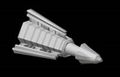
In 2064, three Guardian hulls were available in orbit, but none were originally deemed salvageable. Instead, a completed but previously unlaunched hull lifted off from the reinstated Edwards Space Force Base, bearing the name Jules Verne alongside its NUN livery. Launches of three flat, monoelement Korngold-McHale warp nacelles soon followed. These were mated to the aft hull at 120 degree intervals, not in the style of the Cochrane experiment but in the configuration of the USAF plans from the early 2050s. A warp power source of three Singh-derived fusion reactors replaced half the fuel tankage as well as all the particle cannon from the original blueprints. As long planned, the fission NTR reaction engines from the late 2040s were replaced by fusion NTR propulsion that utilized a single gigantic nozzle. Alterations to hull form were minimal, and did not attempt the kind of endurance increases the truly international Defiant/Valiant and Bonaventure programs had aimed for. Instead, much of the original martial nature of the design survived. For example, the bow cone retained the original two missile tubes while gaining some protrusions necessitated by extended life support systems.
A successful sublight test flight in October 2064 paved way for the first warp run, initiated safely outside the orbit of Uranus on December 14th, 2065. The Jules Verne reached warp 1.02 under the close supervision of a Vulcan chase ship. Never mind that the test run proved incorrect most of the USAF calculations, resulted in terminal damage to the nacelles, and was greeted by the Vulcans as "a most irresponsible and ill-advised act of experimentation", an apparent cussword in Vulcan science circles. Nor did the Sparon-DeSoto clamp-on that squashed the original political goals of the program deter the participating nations. They still granted funding for the re-engining of the Verne, completion of three more vessels out of unlaunched components, and conversion of the orbital derelicts to operational warp explorers.
By 2075, eighteen Vernes had been constructed, seventeen of them had attained warp capability, and sixteen had been launched on missions of exploration, to Epsilon Eridani, Altair, Arcturus and Sirius. In 2073, the nations operating the Verne ships promised to make all their findings public through the UE Space Probe Agency (a promise only partially kept), and in 2089 relinquished control of their ships to the UE Stellar Navy (a more honest show of idealism). Little of this mattered to the ships and crews themselves, typically underway on decades-long journeys. Unlike the long-shot Defiant and Valiant missions, the Verne ships systematically surveyed the homeworlds of the newly encountered races and estimated their resources and military strength, charting nearby space for possible expansion. A top speed of warp 2.7 allowed the ships to outrun many private warp vessels and thus to attain certain leverage over such entrepreneurs. The limited range of the Vernes often forced them to seek replenishment from the worlds they explored, leading to rudimentary trade agreements and improvised diplomatic overtures.

Back on Earth, the Verne project initially faced stiff criticism from many nations struggling with the post-war horrors. Terrorist attacks frequently threatened the launches of components, and funding was hard to come by. But the rapid recovery of infrastructures in the 2060s and 70s made it possible to start fighting the rampant poverty and hunger and the environmental devastation. The recovery owed as much to the continuing space program as it owed to the Vulcan beneficiaries. Asteroid mining and weather and communications satellite networks were widely advertised as essential to Earth’s recuperation, and in the late 70s the public opinion had turned in favor of space exploration and exploitation. In the 80s, less than 20% of Earth’s population suffered from hunger and poverty—a feat never before attained. The remaining distress would disappear thanks to space resources and interstellar trade, promised the new world government.
The Verne ships frequently made the news with intriguing scientific discoveries and daring recovery operations of old sublight colonization ships. Dozens of colonies sprung up around distant stars and Earth’s solar system bustled with activity once again. But there were many setbacks in the space program as well. Most notably, it was found out that contacts with hostile alien cultures were quite possible, and that Earth would have to be ready for violent encounters. USS Mercury and USS Banshee were the first vessels of the class to be lost in deep space in 2077. No official explanation was ever found for the losses, and the Vulcan High Command strongly discouraged such solo missions, at least until better communications networks would be in place. Existing Vulcan military networks were strictly off limits, however, presenting UESPA with a chicken-and-egg problem: contact with deep space explorers could only be maintained after extensive exploration of deep space.
On the other hand, nobody was left in the dark when USS Fletcher exploded and scattered debris to the upper atmosphere after a warp drive failure in Earth’s gravity well in 2086. The early warp drives were notoriously unreliable anywhere near gravity gradients, and the three-lobed fields of the Vernes far more so than the Cochrane-style ones. Indeed, the Fletcher explosion factually spelled the end of the Korngold-McHale style of warp propulsion, leaving the Cochrane and Tellarite multicoil drives and the Vulcan ring-engine drive as the only serious competitors on the field. Verne vessels back in the Sol system at the time of the accident were assigned sublight duty and a destroyer designation, assisting the Liberty class in guarding Earth’s front yard against the next alien intrusion.
In 2089, USS Scythe briefly brought back to public view the Verne class for the last time as she accidentally fired her lasers at sister destroyer USS Hammer and the more modern USS Emnity in training maneuvers, resulting in significant casualties. The class was withdrawn from both combat and training use soon thereafter. No vessels of this type survive today, as the decommissioned destroyers were efficiently used for target practice.
Gallery
-
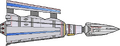 starboard
 -
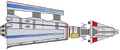 bow
bow -
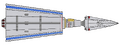 ventral
 -
-

.png)
.png)


External Sources
- Vintage Starships: "2080 – Verne": includes 3D viwer
Notes
- The original references to the UE Starfleet and Earth Fleet have been changed to United Earth Stellar Navy, as the UESF was not founded until 2133. Similarly, UESPA is made the target of the "chicken-and-egg problem", as 2077 was too early for the UESN's acquisition of the class.
- The infobox must still be updated with Timo's named ships (only). (Remove this when complete.)
- Aaaah: the 2089 transfer of the class to the UESN was due to the loss of the Fletcher in 2086, marking a mission change from exploration to defense.