Guide:Mo'Kal: Difference between revisions
No edit summary |
No edit summary |
||
| (18 intermediate revisions by the same user not shown) | |||
| Line 4: | Line 4: | ||
|category= light fleet tug | |category= light fleet tug | ||
|years= [[2260]]-[[2307]] | |years= [[2260]]-[[2307]] | ||
* Mark I ([[ | * Mark I ([[2260]]-[[xxxx]]) | ||
* Mark II ([[ | * Mark II ([[2270]]-[[2307]]) | ||
|constructed= 136 total: | |constructed= 136 total: | ||
* Mk I: 90 (built [[ | * Mk I: 90 (built [[2259]]-[[2268]]) | ||
* Mk II: 78 (46 built [[ | * Mk II: 78 (46 built [[2269]]-[[xxxx]]; 32 refitted [[xxxx]]-[[xxxx]]) | ||
|length= <br> | |length= <br> | ||
* Mk I: 140.0 m (155.0 m, grapple extended) | * Mk I: 140.0 m (155.0 m, grapple extended) | ||
| Line 21: | Line 21: | ||
* Mk I: 235,200 mt | * Mk I: 235,200 mt | ||
* Mk II: 206,900 mt | * Mk II: 206,900 mt | ||
|cruisespeed= | |cruisespeed= <br> | ||
* Mk I: w 6 | * Mk I: w 6 | ||
* Mk II: w 8 | * Mk II: w 8 | ||
|towspeed= w 5 | |towspeed= w 5 | ||
|maxspeed= | |maxspeed= <br> | ||
* Mk I: w 8 | * Mk I: w 8 | ||
* Mk II: w 9 | * Mk II: w 9 | ||
| Line 39: | Line 39: | ||
|cargo= <br> | |cargo= <br> | ||
<u>Mk I</u> | <u>Mk I</u> | ||
* 2x 121,600 mt (standard cargo pod arrangement) | * 2x 121,600 mt (standard cargo pod arrangement), or | ||
* 255,000 mt (maximum non-pod load) | * 255,000 mt (maximum non-pod load) | ||
<u>Mk | <u>Mk II</u> | ||
* 4x 121,600 mt (standard cargo pod arrangement) | * 4x 121,600 mt (standard cargo pod arrangement), or | ||
* 550,000 mt (maximum non-pod load) | * 550,000 mt (maximum non-pod load), or | ||
* 7x empty standard cargo pods | |||
|beamweapons= | |beamweapons= | ||
|missileweapons= | |missileweapons= | ||
| Line 65: | Line 66: | ||
|history= FASA, own | |history= FASA, own | ||
}} | }} | ||
[[File:Mo'Kal | [[File:Mo'Kal (Mk I) grapple.png|left|200px|thumb|Mk I pushing a load.]] | ||
[[File:Mo'Kal | [[File:Mo'Kal 4 pods.png|left|200px|thumb|A somewhat frivolous example of the versatility of the ''Mo’Kal'' Mk II. The optimal configuration for the warp field erected by the two LN-61 units remained a classic monospindle projected dead ahead of the vessel, but this broader symmetric arrangement for fully laden containers was also practicable, and demonstrates both the strength of the manipulator arm and the effectiveness of the modern warp field in reducing inertial stresses on the load. The image also provides a twofold answer to why [[Star Fleet]] never opted to arm the tugs: an engine this capable would certainly make evasion the best combat tactic available, while a cargo configuration like this would severely limit the fields of fire for defensive weaponry.]] | ||
The early successes of the Ohio light tug program only whetted the appetite of Logistics Command. A | [[File:Mo'Kal grapple.png|left|200px|thumb|Mk II pushing a load.]] | ||
The early successes of the ''[[Guide:Ohio|Ohio]]'' light tug program only whetted the appetite of [[Logistics Command]]. A | |||
few years of data gathering and number-crunching resulted in the case being made for a parallel | few years of data gathering and number-crunching resulted in the case being made for a parallel | ||
program of two-engined tugs. Doubling of engine power would enable either doubling of load or a | program of two-engined tugs. Doubling of engine power would enable either doubling of load or a | ||
significant increase in acceleration while hauling a single container, even if the tow speed could not be | significant increase in acceleration while hauling a single container, even if the tow speed could not be | ||
improved beyond the warp five of the Ohio class. More significantly, a propulsion system featuring | improved beyond the warp five of the ''Ohio'' class. More significantly, a propulsion system featuring | ||
two PB-35E engines would allow the unloaded tugs to be deployed to their assignments much faster – | two PB-35E engines would allow the unloaded tugs to be deployed to their assignments much faster – | ||
a major advantage for a vessel type intended to compensate for the inflexibilities of heavier container | a major advantage for a vessel type intended to compensate for the inflexibilities of heavier container | ||
| Line 87: | Line 90: | ||
While warp engineers began searching for the optimal way to install and tune the engine pair, work | While warp engineers began searching for the optimal way to install and tune the engine pair, work | ||
proceeded on the overall design. More onboard space was naturally needed than in the Ohio, not just | proceeded on the overall design. More onboard space was naturally needed than in the ''Ohio'', not just | ||
for accommodating the larger power systems, but also for hosting a quartet of cargo handling drones | for accommodating the larger power systems, but also for hosting a quartet of cargo handling drones | ||
now deemed vital for flexible operations. The saucer thus quickly grew to 85 | now deemed vital for flexible operations. The saucer thus quickly grew to 85 meter diameter and sprouted | ||
two trailing segments, each with a hangar for two drones, a fuel tank, an impulse engine assembly, | two trailing segments, each with a hangar for two drones, a fuel tank, an impulse engine assembly, | ||
plus mountings for a dorsal warp engine pylon. Between the segments lay a grappling system similar | plus mountings for a dorsal warp engine pylon. Between the segments lay a grappling system similar | ||
to the Ohio one for holding a standard container securely underneath the vessel. A second grappling | to the ''Ohio'' one for holding a standard container securely underneath the vessel. A second grappling | ||
cradle was mounted at the bow, and a heavy duty manipulator moved on rails along the bow cradle to | cradle was mounted at the bow, and a heavy duty manipulator moved on rails along the bow cradle to | ||
grab and position one or two containers beneath the ship. The manipulator itself was strong enough to | grab and position one or two containers beneath the ship. The manipulator itself was strong enough to | ||
support a single container in flight as well, but it was uncommon to push loads ahead of the tug in this | support a single container in flight as well, but it was uncommon to push loads ahead of the tug in this | ||
manner. | manner. | ||
Those Sol and Morena yards not tied up with Remora and Hellespont construction could now start | |||
Those [[Sol]] and [[Morena]] yards not tied up with ''[[Guide:Remora|Remora]]'' and ''[[Guide:Hellespont|Hellespont]]'' construction could now start | |||
bolting PB-35E nacelles to the tug spaceframes. The warp envelope was gradually expanded during | bolting PB-35E nacelles to the tug spaceframes. The warp envelope was gradually expanded during | ||
early operations, until warp six cruising, unloaded, could be offered to potential commercial buyers. | early operations, until warp six cruising, unloaded, could be offered to potential commercial buyers. | ||
For a rare once, notable civilian interest emerged, and between 2260 and 2270, hundreds of | For a rare once, notable civilian interest emerged, and between [[2260]] and [[2270]], hundreds of | ||
commercial tugs were completed with either the military | commercial tugs were completed with either the military super-engines or a variety of off-the-shelf | ||
alternatives; unit costs for [[Star Fleet]] dropped as the result. More significantly, PB-35 technology finally | alternatives; unit costs for [[Star Fleet]] dropped as the result. More significantly, PB-35 technology finally | ||
reached an affordability plateau of sorts: benefits of mass production began to balance costs of product | reached an affordability plateau of sorts: benefits of mass production began to balance costs of product | ||
improvement, maintenance and creeping obsolescence. Support types once produced piecemeal could | improvement, maintenance and creeping obsolescence. Support types once produced piecemeal could | ||
now have been greatly multiplied in number, but Star Fleet | now have been greatly multiplied in number, but Star Fleet concentrated its funds on the most modern | ||
types – and the new Mo’Kal light tug was a prime candidate. A highly satisfactory fleet of 234 Mo’Kal | types – and the new '''''Mo’Kal''''' light tug was a prime candidate. A highly satisfactory fleet of 234 ''Mo’Kal'' | ||
type vessels was in operation by 2268, ninety of these in Star Fleet registry. | type vessels was in operation by [[2268]], ninety of these in Star Fleet registry. | ||
The versatile little pusher was now Star Fleet Merchant | The versatile little pusher was now [[Star Fleet Merchant Marine]]’s principal container asset. While | ||
Logistics Command only ran twenty-eight of the vessels, their double capacity and swift reaction time | Logistics Command only ran twenty-eight of the vessels, their double capacity and swift reaction time | ||
made them by far the Command’s | made them by far the Command’s fore-running cargo tug. Their self-loading prowess also contributed | ||
to Star Fleet shunning any further procurement of the smaller and more limited if also quite a bit more | to Star Fleet shunning any further procurement of the smaller and more limited, if also quite a bit more | ||
affordable Ohio type. | affordable, ''Ohio'' type. | ||
The seventies brought on a change that upset the balance of logistics strategy. Linear excitation warp | The [[2270s|seventies]] brought on a change that upset the balance of logistics strategy. Linear excitation warp | ||
engine technology was famed for the extra speed and cruise economy it gave to large combat starships, | engine technology was famed for the extra speed and cruise economy it gave to large combat starships, | ||
but it also greatly increased the flexibility of warp field generation overall, including the generation of | but it also greatly increased the flexibility of warp field generation overall, including the generation of | ||
cargo-encompassing fields so important to tugships. When LN-61 became available, Logistics | cargo-encompassing fields so important to tugships. When LN-61 became available, Logistics | ||
Command immediately saw the immense potential for Mo’Kal upgrade. Not only could the tug be | Command immediately saw the immense potential for ''Mo’Kal'' upgrade. Not only could the tug be | ||
made faster in cruise, dash and towing alike, but her warp field could now encompass trains of | made faster in cruise, dash and towing alike, but her warp field could now encompass trains of | ||
containers, rather than just firmly grappled pairs. The procurement of a second batch of tugs, originally | containers, rather than just firmly grappled pairs. The procurement of a second batch of tugs, originally | ||
| Line 128: | Line 132: | ||
encompass up to six cargo containers docked into a train – or, say, a hexagonal bundle of seven, not to | encompass up to six cargo containers docked into a train – or, say, a hexagonal bundle of seven, not to | ||
mention assorted more exotic loads. The field could only compensate for the mass of up to four fully | mention assorted more exotic loads. The field could only compensate for the mass of up to four fully | ||
laden containers, though, and this became a standard outbound load for Star Fleet’s own Mo’Kal Mk II | laden containers, though, and this became a standard outbound load for Star Fleet’s own ''Mo’Kal'' Mk II | ||
tugs. Inward legs usually involved pushing completely empty containers left over from previous | tugs. Inward legs usually involved pushing completely empty containers left over from previous | ||
Mo’Kal runs or from priority shipments carried by the faster Ptolemy family vessels, demonstrating the | ''Mo’Kal'' runs or from priority shipments carried by the faster ''[[Guide:Ptolemy|Ptolemy]]'' family vessels, demonstrating the | ||
principal weakness of the container logistics system. | principal weakness of the container logistics system. | ||
The Mk II, too, gained civilian users, and production eventually reached 126 hulls. Logistics | The Mk II, too, gained civilian users, and production eventually reached 126 hulls. Logistics | ||
Command took charge of 78 units, of which | Command took charge of 78 units, of which 46 were newbuilds. Yet in parallel with this project, an | ||
all-new single-nacelle light tug was introduced: the Kethkin, a puller rather than pusher design, could | all-new single-nacelle light tug was introduced: the ''[[Guide:Kethkin|Kethkin]]'', a puller rather than pusher design, could | ||
match Mo’Kal Mk II almost blow by blow with half the warp engine acquisition costs or operating | match ''Mo’Kal'' Mk II almost blow by blow with half the warp engine acquisition costs or operating | ||
expenses. The newcomer was falling short only on total mass carried (325 rather than 550 kilotons) – | expenses. The newcomer was falling short only on total mass carried (325 rather than 550 kilotons) – | ||
and on cruise speed, which the two-nacelle configuration could ramp up to an impressive warp eight | and on cruise speed, which the two-nacelle configuration could ramp up to an impressive warp eight | ||
(versus the humdrum warp five of the Kethkin), guaranteeing Mo’Kal a central role in container | (versus the humdrum warp five of the ''Kethkin''), guaranteeing ''Mo’Kal'' a central role in container | ||
logistics until the early 24th century. Nevertheless, by the 2290s, several of the twin-engine tugs had | logistics until the early [[24th century]]. Nevertheless, by the [[2290s]], several of the twin-engine tugs had | ||
been scrapped for fatigue or damage accrued, six had been destroyed in action, and one relegated to | been scrapped for fatigue or damage accrued, six had been destroyed in action, and one relegated to | ||
training duty. | training duty. | ||
After Khitomer, Star Fleet began liquidating its assets to a wanting civilian market. At that point, the | After Khitomer, Star Fleet began liquidating its assets to a wanting civilian market. At that point, the | ||
Mo’Kal fleet was already reduced to operating in the inner regions of the UFP, a realm where the | ''Mo’Kal'' fleet was already reduced to operating in the inner regions of the [[UFP]], a realm where the | ||
Kethkin was a fierce rival and ultimate winner in Logistics Command’s game of favorites. In | ''Kethkin'' was a fierce rival and ultimate winner in Logistics Command’s game of favorites. In | ||
commercial sales, however, the swift twin-engined tug triumphed. Examples of both originally civilian | commercial sales, however, the swift twin-engined tug triumphed. Examples of both originally civilian | ||
and ex-Star Fleet Mk II tugs survive today in active commercial operations, some with modern engines | and ex-Star Fleet Mk II tugs survive today in active commercial operations, some with modern engines | ||
| Line 165: | Line 169: | ||
</gallery> | </gallery> | ||
==Notes== | |||
* To clarify: the Mk I ship generally cradles one or two containers under the hull. The manipulator could also push one container—even at warp—if so desired, though that prevented any containers from being slung under. However, the warp field coverage on the Mk II allowed the manipulator to grasp one container above the ship, with another one attached astern, for a total load of 4 containers. Or, 6 partially-loaded containers could be pushed (as a train) ahead of the ship, and up to 7 in a hexagonal pattern, if they were all empty. Both variants have two cradles installed on the ventral hull. | |||
== | * Sixty-two (62) of the Mk I ships went directly to the [[Star Fleet Merchant Marine]], with 28 to Star Fleet's [[Logistics Command]]. | ||
* | |||
* Logistics Command received a total of 78 Mk IIs, 46 as new-builds. | |||
* [[2270]] was chosen as the introduction of the Mk II, as it was "in parallel" with the ''[[Guide: Kethkin|Kethkin]]'' class. | |||
==Alt Sources== | |||
* [https://www.ststcsolda.space/federation/mokal/mokal.html STSTCSOLDA] | |||
<br> | <br><br> | ||
---- | ---- | ||
*[[Guide: Timo's Guide to Star Fleet|Back to the Table of Contents]] | * [[Guide: Timo's Guide to Star Fleet|Back to the Table of Contents]] | ||
*[[Guide: 2240-2270 - The Final Frontier|Back to "The Final Frontier"]] | * [[Guide: 2240-2270 - The Final Frontier|Back to "The Final Frontier"]] | ||
*[[Guide: Of Ship Statistics|Appendix A: Of Ship Statistics]] | * [[Guide: Of Ship Statistics|Appendix A: Of Ship Statistics]] | ||
*[[Guide: Glossary|Appendix B: Glossary]] | * [[Guide: Glossary|Appendix B: Glossary]] | ||
*[[Guide: Star Fleet Organization - General Outline|Appendix C: Star Fleet Organization - General Outline]] | * [[Guide: Star Fleet Organization - General Outline|Appendix C: Star Fleet Organization - General Outline]] | ||
*[[Guide: Abbreviations From Outside|Appendix D: Abbreviations From Outside]] | * [[Guide: Abbreviations From Outside|Appendix D: Abbreviations From Outside]] | ||
[[Category:Guide|{{PAGENAME}}]] | [[Category:Guide|{{PAGENAME}}]] | ||
Latest revision as of 15:26, 10 August 2024
.png)
| |
| Mo'kal | |
|---|---|
| Class Overview | |
| Category | light fleet tug |
| Operational | 2260-2307 |
| Constructed | 136 total: |
| Dimensions | |
| Length |
|
| Beam |
|
| Height |
|
| Mass |
|
| Performance | |
| Cruise Speed |
|
| Tow Speed | w 5 |
| Max Speed |
|
| Endurance | 2 years |
| Complement | |
| Officers | 4 |
| Enlisted |
|
| Cargo | Mk I
Mk II
|
| Tactical Systems | |
| Shields |
|
| Transporters | Mk I
Mk II
|
| Auxiliary Craft |
|
| Historical | |
| Ships of Note |
|
| Canonicity | |
| Design | FASA (dimensions corrected for Mk II) |
| Name | FASA |
| History | FASA, own
|
_grapple.png)


The early successes of the Ohio light tug program only whetted the appetite of Logistics Command. A few years of data gathering and number-crunching resulted in the case being made for a parallel program of two-engined tugs. Doubling of engine power would enable either doubling of load or a significant increase in acceleration while hauling a single container, even if the tow speed could not be improved beyond the warp five of the Ohio class. More significantly, a propulsion system featuring two PB-35E engines would allow the unloaded tugs to be deployed to their assignments much faster – a major advantage for a vessel type intended to compensate for the inflexibilities of heavier container tug operations by repositioning empty or lightly laden containers as needed.
Improving of cruise speed by a full warp factor was a real possibility, even if PB-35 had so far failed to exceed warp five in combat starship applications. The powerplant of a warp tug propulsion system, intended to cope with massively varying loads, inherently had excess output capacity of a sort that could never be affordably built into the reactor of a fighting vessel. By the same token, dash speed could also be greatly increased with application of brute power; the usual issues of bottleneck weaknesses in the power chain, wear and tear of systems, or concerns of warp signature were irrelevant to the scenario of brief maximum speed evasion from an attack.
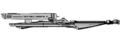
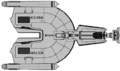
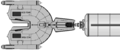
While warp engineers began searching for the optimal way to install and tune the engine pair, work proceeded on the overall design. More onboard space was naturally needed than in the Ohio, not just for accommodating the larger power systems, but also for hosting a quartet of cargo handling drones now deemed vital for flexible operations. The saucer thus quickly grew to 85 meter diameter and sprouted two trailing segments, each with a hangar for two drones, a fuel tank, an impulse engine assembly, plus mountings for a dorsal warp engine pylon. Between the segments lay a grappling system similar to the Ohio one for holding a standard container securely underneath the vessel. A second grappling cradle was mounted at the bow, and a heavy duty manipulator moved on rails along the bow cradle to grab and position one or two containers beneath the ship. The manipulator itself was strong enough to support a single container in flight as well, but it was uncommon to push loads ahead of the tug in this manner.
Those Sol and Morena yards not tied up with Remora and Hellespont construction could now start bolting PB-35E nacelles to the tug spaceframes. The warp envelope was gradually expanded during early operations, until warp six cruising, unloaded, could be offered to potential commercial buyers. For a rare once, notable civilian interest emerged, and between 2260 and 2270, hundreds of commercial tugs were completed with either the military super-engines or a variety of off-the-shelf alternatives; unit costs for Star Fleet dropped as the result. More significantly, PB-35 technology finally reached an affordability plateau of sorts: benefits of mass production began to balance costs of product improvement, maintenance and creeping obsolescence. Support types once produced piecemeal could now have been greatly multiplied in number, but Star Fleet concentrated its funds on the most modern types – and the new Mo’Kal light tug was a prime candidate. A highly satisfactory fleet of 234 Mo’Kal type vessels was in operation by 2268, ninety of these in Star Fleet registry.
The versatile little pusher was now Star Fleet Merchant Marine’s principal container asset. While Logistics Command only ran twenty-eight of the vessels, their double capacity and swift reaction time made them by far the Command’s fore-running cargo tug. Their self-loading prowess also contributed to Star Fleet shunning any further procurement of the smaller and more limited, if also quite a bit more affordable, Ohio type.
The seventies brought on a change that upset the balance of logistics strategy. Linear excitation warp engine technology was famed for the extra speed and cruise economy it gave to large combat starships, but it also greatly increased the flexibility of warp field generation overall, including the generation of cargo-encompassing fields so important to tugships. When LN-61 became available, Logistics Command immediately saw the immense potential for Mo’Kal upgrade. Not only could the tug be made faster in cruise, dash and towing alike, but her warp field could now encompass trains of containers, rather than just firmly grappled pairs. The procurement of a second batch of tugs, originally only intended to feature a stronger and lighter hull and some navigational gear refinements, now was rethought and came to feature a pair of linear warp nacelles, somewhat more widely separated than the original circumferential excitation pair. The two cargo cradles were retained, but rarely put to use. Instead, the powerful warp field created by the new engines could be extended far forward to encompass up to six cargo containers docked into a train – or, say, a hexagonal bundle of seven, not to mention assorted more exotic loads. The field could only compensate for the mass of up to four fully laden containers, though, and this became a standard outbound load for Star Fleet’s own Mo’Kal Mk II tugs. Inward legs usually involved pushing completely empty containers left over from previous Mo’Kal runs or from priority shipments carried by the faster Ptolemy family vessels, demonstrating the principal weakness of the container logistics system.
The Mk II, too, gained civilian users, and production eventually reached 126 hulls. Logistics Command took charge of 78 units, of which 46 were newbuilds. Yet in parallel with this project, an all-new single-nacelle light tug was introduced: the Kethkin, a puller rather than pusher design, could match Mo’Kal Mk II almost blow by blow with half the warp engine acquisition costs or operating expenses. The newcomer was falling short only on total mass carried (325 rather than 550 kilotons) – and on cruise speed, which the two-nacelle configuration could ramp up to an impressive warp eight (versus the humdrum warp five of the Kethkin), guaranteeing Mo’Kal a central role in container logistics until the early 24th century. Nevertheless, by the 2290s, several of the twin-engine tugs had been scrapped for fatigue or damage accrued, six had been destroyed in action, and one relegated to training duty.
After Khitomer, Star Fleet began liquidating its assets to a wanting civilian market. At that point, the Mo’Kal fleet was already reduced to operating in the inner regions of the UFP, a realm where the Kethkin was a fierce rival and ultimate winner in Logistics Command’s game of favorites. In commercial sales, however, the swift twin-engined tug triumphed. Examples of both originally civilian and ex-Star Fleet Mk II tugs survive today in active commercial operations, some with modern engines but many with the original LN-61 pairs.
Gallery
-
 Mo'Kal class
 -

-
-
-
 Mo'Kal refit
 -

-

-
.png)
.png)
.png)
_(stbd).png)
_(bow).png)
_(dorsal).png)
.png)
Notes
- To clarify: the Mk I ship generally cradles one or two containers under the hull. The manipulator could also push one container—even at warp—if so desired, though that prevented any containers from being slung under. However, the warp field coverage on the Mk II allowed the manipulator to grasp one container above the ship, with another one attached astern, for a total load of 4 containers. Or, 6 partially-loaded containers could be pushed (as a train) ahead of the ship, and up to 7 in a hexagonal pattern, if they were all empty. Both variants have two cradles installed on the ventral hull.
- Sixty-two (62) of the Mk I ships went directly to the Star Fleet Merchant Marine, with 28 to Star Fleet's Logistics Command.
- Logistics Command received a total of 78 Mk IIs, 46 as new-builds.
Alt Sources