Guide:Columbia: Difference between revisions
No edit summary |
|||
| (19 intermediate revisions by the same user not shown) | |||
| Line 10: | Line 10: | ||
|beam= 132.6 m | |beam= 132.6 m | ||
|height= 53.4 m | |height= 53.4 m | ||
|mass= 297,000 | |mass= 297,000 mt | ||
|cruisespeed= w 3 | |cruisespeed= w 3 | ||
|maxspeed= <br> | |maxspeed= <br> | ||
| Line 36: | Line 36: | ||
|shields= <br> | |shields= <br> | ||
* 1-layer subspace/graviton forcefield bubble | * 1-layer subspace/graviton forcefield bubble | ||
* | * navigational deflector at secondary hull bow | ||
* | * auxiliary navigational deflector at primary hull bow | ||
|labs= <br> | |labs= <br> | ||
* 4x GP | * 4x GP | ||
| Line 53: | Line 53: | ||
* 4x spatial pods | * 4x spatial pods | ||
|historicalships=<br> | |historicalships=<br> | ||
* ''USS Endeavour'' (NCC-06) | * ''USS Apollo'' | ||
* ''USS Valiant'' | * ''USS Ares'' | ||
* ''USS Buran'' | |||
* ''USS Charybdis'' | |||
* ''UESS/USS Endeavour'' (NCC-06) | |||
* ''USS Phoenix'' | |||
* ''USS Shenlong'' | |||
* ''USS Soyuz'' | |||
* ''USS Valiant'' | |||
|design= Doug Drexler | |design= Doug Drexler | ||
|name= Christopher Bennett, ''ST:ENT Romulan War'' | |name= Christopher Bennett, ''ST:ENT Romulan War'' & ''Rise of the Federation'' series | ||
|history= Christopher Bennett, Michael. A. Martin, ''ST:ENT Romulan War'' | |history= Christopher Bennett, Michael. A. Martin, ''ST:ENT Romulan War'' & ''Rise of the Federation'' series | ||
}} | }} | ||
At the conclusion of the Romulan War, the [[UESF]] was in possession of three principal types of deep | ==Background: ''Hobbyist's Guide''== | ||
space combat vessel: slightly diminished formations of modern fast cruisers like ''[[Guide: Christopher|Christophers]]'' and | At the conclusion of the [[Romulan War]], the [[UESF]] (''a.k.a.'', [[Earth Fleet]]) was in possession of three principal types of deep space combat vessel: slightly diminished formations of modern fast cruisers like ''[[Guide: Christopher|Christophers]]'' and ''[[Guide: Achilles|Achilles]]'', in relatively good service condition but severely lacking in endurance and the ability to mount upgrades or additional gear; lumbering giants like ''[[Guide: Messier|Messier]]'' or ''[[Guide: Triton|Triton]]'', good only for fighting an enemy that agreed to stopping by; and hordes of nimble destroyers and corvettes that would be swatted out of existence in a matter of minutes if attempting a solo frontier sortie. None were prime choices for promoting the [[Earth]] agenda beyond local space. Yet out of the ranks of the newborn [[Federation]], it fell on Earth forces specifically to carry the joint flag to new worlds and civilizations: [[Vulcan]] and [[Andor]] wanted nothing to do with expansion or exploration for now. | ||
''[[Guide: Achilles|Achilles]]'', in relatively good service condition but severely lacking in endurance and the ability to | |||
mount upgrades or additional gear; lumbering giants like ''[[Guide: Messier|Messier]]'' or ''[[Guide: Triton|Triton]]'', good only for fighting | |||
an enemy that agreed to stopping by; and hordes of nimble destroyers and corvettes that would be | |||
swatted out of existence in a matter of minutes if attempting a solo frontier sortie. None were prime | |||
choices for promoting the [[Earth]] agenda beyond local space. Yet out of the ranks of the newborn | |||
[[Federation]], it fell on Earth forces specifically to carry the joint flag to new worlds and civilizations: | |||
[[Vulcan]] and [[Andor]] wanted nothing to do with expansion or exploration for now. | |||
As [[ | As [[Star Fleet]] deployed its light cruisers on foolhardy errands across unwise distances, Earth’s one remaining space expansion arm, [[UESPA]], set out to recreate the uniquely [[Human]] push to the unknown. A lot more was at stake than mere specieist pride. Neither Vulcan nor Andor had such far-flung colonial assets as mankind, whose private and corporate vessels had exploded out of [[Sol]] at the release of the secrets of FTL propulsion. On the other hand, the older and more established civilizations were not as starved of key resources as Humanity, still largely confined to a single star system as far as manufacturing and indigenous mining industries were concerned. While [[Tellar]] had extensive trade networks in place, it was not as vitally dependent on them. And while [[Vulcania]], [[Centauria]] and [[Andoria]] may have been the founder empires with the misfortune to border on the [[Romulans]], it was Terra that had extended its diplomatic and commercial reach past them towards [[Vega]] and [[Beta Rigel]], treading on ancient toes. | ||
remaining space expansion arm, [[UESPA]], set out to recreate the uniquely | |||
unknown. A lot more was at stake than mere specieist pride. Neither Vulcan nor Andor had such | |||
far-flung colonial assets as mankind, whose private and corporate vessels had exploded out of [[Sol]] at | |||
the release of the secrets of FTL propulsion. On the other hand, the older and more established | |||
civilizations were not as starved of key resources as | |||
system as far as manufacturing and indigenous mining industries were concerned. While [[Tellar]] had | |||
extensive trade networks in place, it was not as vitally dependent on them. And while Vulcania, | |||
[[Centauria]] and Andoria may have been the founder empires with the misfortune to border on the | |||
Romulans, it was Terra that had extended its diplomatic and commercial reach past them towards | |||
[[Vega]] and [[Rigel]], treading on ancient toes. | |||
What Earth needed the UFP to have the most was knowledge. What lay beyond could only be | What Earth needed the [[UFP]] to have the most was knowledge. What lay beyond could only be revealed by fielding exploration vessels and a two-pronged campaign was launched to create those. A way was devised to turn the masses of ''[[Guide: Daedalus|Daedalus]]'' corvettes back into survey vessels capable of meaningful research. Since little could be done to improve the survivability of the tiny "tin cans", ships of heavy cruiser caliber were in turn given a boost in endurance. The final batch of ''Tritons'' trundled out at warp three to find out who really ruled Beta Rigel and whether there still would be secrets in the Orion or Vegan ruins for Humans to uncover. Meanwhile, the ''Endeavour'' refit, once deemed a prestige project without practical applications, was turned into a ''bona fide'' effort to improve reliability, range, and exploration prowess. | ||
revealed by fielding exploration vessels | |||
A way was devised to turn the masses of ''[[Guide: Daedalus|Daedalus]]'' corvettes back into survey vessels capable of | |||
meaningful research. Since little could be done to improve the survivability of the tiny | |||
ships of heavy cruiser caliber were in turn given a boost in endurance. The final batch of ''Tritons'' | |||
trundled out at warp three to find out who really ruled Rigel and whether there still would be secrets | |||
in the Orion or Vegan ruins for | |||
prestige project without practical applications, was turned into a ''bona fide'' effort to improve | |||
reliability, range and exploration prowess. | |||
Unlike with the tentative ''[[Guide: Enterprise|Enterprise]]'' modification, the original power plant of NX-06 was removed | Unlike with the tentative ''[[Guide: Enterprise|Enterprise]]'' modification, the original power plant of NX-06 was removed altogether. Instead of the F4.0 substitute reactor, the ship was now powered by the much larger and clumsier but also less risky, SSWR-I system, where annihilation was controlled with the help of the newly-perfected forcefield technology, rather than by dilithium crystals alone. The new powerplant was again housed in a large ventral pod mounted directly beneath the former reactor bay and connected to it via a thick vertical shaft. Antimatter tanks were now carried in the bulging lower part of the pod for an extra three years of endurance; top speed was also hiked up by almost a full warp factor. | ||
altogether. Instead of the F4.0 substitute reactor, the ship was now powered by the much larger and | |||
clumsier but also less risky SSWR-I system, where annihilation was controlled with the help of the | |||
newly perfected forcefield technology rather than by dilithium crystals alone. The new powerplant | |||
was again housed in a large ventral pod mounted directly beneath the former reactor bay and | |||
connected to it via a thick vertical shaft. Antimatter tanks were now carried in the bulging lower | |||
part of the pod for an extra three years of endurance; top speed was also hiked up by almost a full | |||
warp factor. | |||
Use was made of the pod in other ways as well. An improved navigational deflector of Rigelian | Use was made of the pod in other ways, as well. An improved navigational deflector of Rigelian make was purchased, joining a modern Vulcan FTL sensor array at the bow and small holds for supplies, research gear, and cargo were added on the lower stern, where they could be easily accessed. A new external access route was needed in any case, as the pod had been mounted in place of the original shuttlebays. No actual shuttle capacity was installed, however; the secondary hull merely sported four docking ports in addition to the small holds and the primary hull holds now had to accommodate any auxiliary craft carried. The IMRF stabilizing crystal was relocated in the pod as well and structural supports and power leads were extended from the pod to the boom aft ends in continuation of the engine pylons. | ||
make was purchased, joining a modern Vulcan FTL sensor array at the bow | |||
supplies, research gear and cargo were added on the lower stern where they could be easily | |||
accessed. A new external access route was needed in any case, as the pod had been mounted in | |||
place of the original shuttlebays. No actual shuttle capacity was installed, however; the secondary | |||
hull merely sported four docking ports in addition to the small holds | |||
now had to accommodate any auxiliary craft carried. The IMRF stabilizing crystal was relocated in | |||
the pod as well | |||
ends in continuation of the engine pylons. | |||
[[File:Nx-refit-drex-files.jpg|left|300px|thumb|The ''Endeavour'' undergoing the final stages of refitting, portraying her new secondary hull to advantage. Its forward part houses the new power generation functions, while the doors to the aft cargo spaces are clearly visible here, as are the three structures connecting the pod to the preexisting spaceframe.]] | [[File:Nx-refit-drex-files.jpg|left|300px|thumb|The ''Endeavour'' undergoing the final stages of refitting, portraying her new secondary hull to advantage. Its forward part houses the new power generation functions, while the doors to the aft cargo spaces are clearly visible here, as are the three structures connecting the pod to the preexisting spaceframe.]] | ||
The vessel initially formed a subclass of her very own in UFP | The vessel initially formed a subclass of her very own in UFP Star Fleet service, but this was soon to change. Production of all-new hulls was launched, as no further ''Enterprises'' were in serviceable condition; a class of ten new-builds strong was projected and somewhat esoterically renamed in honor of the '''''Columbia''''', the first explorer to be lost. The pathfinder-veteran received the registry NCC-06, as the new interstellar system made no difference between combat cruisers and explorers in pennant lettering. The mission profile nevertheless very much remained one formerly deserving of an NX designation. | ||
change. Production of all-new hulls was launched, as no further ''Enterprises'' were in serviceable | |||
condition; a class ten new-builds strong was projected | |||
of the '''''Columbia''''', the first explorer to be lost. The pathfinder-veteran received the registry NCC-06, | |||
as the new interstellar system made no difference between combat cruisers and explorers in pennant | |||
lettering. The mission profile nevertheless very much remained one formerly deserving of an NX | |||
designation. | |||
The | [[File:Endeavour nebula.jpg|left|300px|thumb|The ''Endeavour'' lights up nebular gases in a demonstration of the poor integration of her warp fields with the [[Andorian]] shield bubble. A string of wormhole mishaps in the [[2160s|sixties]] would result from the failure to understand the finesses of duonetic modeling—while data from survivable incidents would improve that understanding, allowing [[Star Fleet]] to confront the next hurdle in the path to proper warp theory. The ''Endeavour'' never challenged the Ishakawa-Dell barrier, let alone the Tyme one; if the later ''Columbias'' did, nothing was learned from it at this stage yet.]] | ||
The test flight program ran in parallel with the fitting out of the vessel. Armament was virtually unaltered, with low-fatigue phase guns installed from stock; modern heavy lasers were an option deemed too much trouble for the worth. The sublight missile tubes now served probe deployment needs, and the late war standard warp torpedo launcher configuration was only modified by the relocation of the aft tube into the secondary hull stern. Despite the loss of the original shuttlebay, a flight of K42 or [[SP-50]] transatmospheric pods could still be carried, in the supply holds opening aft on both sides of the former main reactor chamber. Said chamber now became senior officer accommodation and further laboratory spaces were installed in the berthing areas of the primary hull. The original bow deflector was reduced in size but not discarded altogether and took on additional sensing functions. Rigelian technology was applied on the impulse drive and a Vulcan tractor beam replaced the physical grapples. Yet it was only when Andorian shield generators were finally installed aboard that compatibility issues began to arise. With the shields raised, all targeting and sensing was unexpectedly hobbled—but so was warp drive, with desperate re-tuning efforts restoring equilibrium only at a dismal warp three. | |||
were | |||
Still at least more potent than the ''Tritons'', the ''Endeavour'' was in November [[2162]] commissioned for a sweeping mission of frontier diplomacy in the [[Tandar]]-Beta Rigel flank of the nascent Federation. | |||
Meanwhile, work progressed on shield/warp field integration, at first on the ''Triton'' fleet, then on the new Human flagship. Top speed of the ''Endeavour'' could gradually be hiked back up to warp 5.8—and the first new-builds, emerging in early [[2165]], did even better, hitting warp 6.1 on trials even if not risking it in operational use | |||
The late standard ''Tritons'' remained in service with minimal modifications. Many of their postwar missions were as amazing in scope as those of the ''Columbias'', but they also took a toll on their over-strained propulsion systems. The dilithium foci of the ''Prospect'' finally shattered in [[2168]], killing Commodore [[Arkadi Lunov]], the last surviving cruiser commander of the legendary "escape velocity" era. Similar accidents had claimed the ''Resolute'' and gravely damaged the ''Concord''; although these had been wartime losses, they had not been forgotten, and in [[2169]] Star Fleet ordered all dilithium-regulated reactors shut down for an indefinite period of reassessment. | |||
Results of the investigation were not favorable. When the long-idled ''Endeavour'' was paid off in [[2174]], Star Fleet had already decided on peristaltic forcefields as the focusing system for all its future | |||
cruisers. The resulting slight drop in efficiency was accepted as the price of vastly increased reliability and safety and the ''Valiant'' trail-blazed the conversion of the ''Columbia'' class to this type of power generation for the final two decades of operation. The ''[[Guide: Horizon|Horizon]]'' and ''[[Guide: Advance|Advance]]'' cruisers that inherited the position of the ''Columbia'' class were content with maintaining rather than challenging its speed records. Star Fleet would not return to the dilithium technology until half a century later and then in greatly altered form. Still, experience would soon show the preferability of dilithium regulation and one is left to wonder whether Star Fleet and the UFP exploration program were unduly held back by the caution of the [[2170s]]. | |||
==Gallery== | ==Gallery== | ||
<gallery> | <gallery> | ||
File:Columbia (bow).png|''Columbia'' class (bow view) | File:Columbia (bow).png|''Columbia'' class (bow view) | ||
File:Columbia (dorsal).png|Dorsal | File:Columbia (dorsal).png|Dorsal | ||
| Line 185: | Line 107: | ||
File:Abaft the starboard beam.png|Abaft the starboard beam | File:Abaft the starboard beam.png|Abaft the starboard beam | ||
File:It s been a long road by trekmodeler-d65hlsr.jpg|''Columbia'' class departing [[Earth]] orbit | File:It s been a long road by trekmodeler-d65hlsr.jpg|''Columbia'' class departing [[Earth]] orbit | ||
</gallery> | </gallery> | ||
< | ==Star Fleet Registry== | ||
<div style="-moz-column-count:3; column-count:3;"> | |||
* ''USS Endeavour'' (NCC-06) | |||
</div> | |||
==See Also== | |||
* [[Guide: Enterprise]] | |||
==Notes== | |||
* The initial ''[[Guide: Enterprise|Enterprise]]'' article was updated by Timo and the ''Columbia'' subclass was broken out as its own. Serious attempts were made to update all related information elsewhere in this Delta Dynamics canon, but any discrepancies may originate with this attempt to update the material. | |||
* There was never a ''USS Columbia'': Timo holds firm to beta-canon that she was lost in the war, as an ''[[Guide: Enterprise|Enterprise]]'' class explorer, and he also explains that the new class was named not after ''USS Endeavour'' (technically the second class to receive the refit, after ''UESS Enterprise''), but in honor of her lost sister. | |||
* The penultimate paragraph suggests the ''Tritons'' suffered catastrophic losses due to engine failures, however lists ship names associated with the ''Enterprise'' class. These ships have been re-named for Delta Dynamics canon. | |||
* The ''Star Trek: Enterprise'' novel ''Rise of the Federation: Live by the Code'' indicates, following the conversion of ''USS Endeavour'', ''Buran'' and ''Shenlong'' were the first two new-builds. Three more runs of two each were ordered: ''Apollo'' and ''Soyuz'', ''Ares'' and ''Charybdis'', and ''Phoenix'' and ''Valiant''. | |||
* Because of serious overlaps with other older classes and double-digit NCCs, the ''Columbia'' new-builds will be given registries more aligned with their post-Founding construction. For that reason, I am removing Timo's NCC for ''Valiant''. ''Endeavour'' will keep her hull number of NCC-06, as she was transferred from [[UESF]] to the [[UFP Star Fleet]], with the low number attributed to being in drydock at the time the transferal took place. | |||
<br> | <br><br> | ||
---- | ---- | ||
*[[Guide: Timo's Guide to | * [[Guide: Timo's Guide to Star Fleet|Back to the Table of Contents]] | ||
*[[Guide: 2130-2161 - Into The Romulan War|Back to "Into The Romulan War"]] | * [[Guide: 2130-2161 - Into The Romulan War|Back to "Into The Romulan War"]] | ||
*[[Guide: Of Ship Statistics|Appendix A: Of Ship Statistics]] | * [[Guide: Of Ship Statistics|Appendix A: Of Ship Statistics]] | ||
*[[Guide: Glossary|Appendix B: Glossary]] | * [[Guide: Glossary|Appendix B: Glossary]] | ||
*[[Guide: | * [[Guide: Star Fleet Organization - General Outline|Appendix C: Star Fleet Organization - General Outline]] | ||
*[[Guide: Abbreviations From Outside|Appendix D: Abbreviations From Outside]] | * [[Guide: Abbreviations From Outside|Appendix D: Abbreviations From Outside]] | ||
[[Category:Guide|{{PAGENAME}}]] | [[Category:Guide|{{PAGENAME}}]] | ||
Latest revision as of 11:31, 26 July 2023
.png)
| |
| Columbia | |
|---|---|
| Class Overview | |
| Category | explorer |
| Operational | 2162-2192 |
| Constructed | Total: 9
|
| Dimensions | |
| Length | 225.1 m |
| Beam | 132.6 m |
| Height | 53.4 m |
| Mass | 297,000 mt |
| Performance | |
| Cruise Speed | w 3 |
| Max Speed |
|
| Endurance | 7 years |
| Complement | |
| Officers | 23 |
| Enlisted | 189
|
| Tactical Systems | |
| Beam Weapons |
|
| Missile Weapons |
|
| Shields |
|
| Laboratories |
|
| Transporters | Endeavour
Columbia (standard)
|
| Auxiliary Craft |
|
| Historical | |
| Ships of Note |
|
| Canonicity | |
| Design | Doug Drexler |
| Name | Christopher Bennett, ST:ENT Romulan War & Rise of the Federation series |
| History | Christopher Bennett, Michael. A. Martin, ST:ENT Romulan War & Rise of the Federation series
|
Background: Hobbyist's Guide
At the conclusion of the Romulan War, the UESF (a.k.a., Earth Fleet) was in possession of three principal types of deep space combat vessel: slightly diminished formations of modern fast cruisers like Christophers and Achilles, in relatively good service condition but severely lacking in endurance and the ability to mount upgrades or additional gear; lumbering giants like Messier or Triton, good only for fighting an enemy that agreed to stopping by; and hordes of nimble destroyers and corvettes that would be swatted out of existence in a matter of minutes if attempting a solo frontier sortie. None were prime choices for promoting the Earth agenda beyond local space. Yet out of the ranks of the newborn Federation, it fell on Earth forces specifically to carry the joint flag to new worlds and civilizations: Vulcan and Andor wanted nothing to do with expansion or exploration for now.
As Star Fleet deployed its light cruisers on foolhardy errands across unwise distances, Earth’s one remaining space expansion arm, UESPA, set out to recreate the uniquely Human push to the unknown. A lot more was at stake than mere specieist pride. Neither Vulcan nor Andor had such far-flung colonial assets as mankind, whose private and corporate vessels had exploded out of Sol at the release of the secrets of FTL propulsion. On the other hand, the older and more established civilizations were not as starved of key resources as Humanity, still largely confined to a single star system as far as manufacturing and indigenous mining industries were concerned. While Tellar had extensive trade networks in place, it was not as vitally dependent on them. And while Vulcania, Centauria and Andoria may have been the founder empires with the misfortune to border on the Romulans, it was Terra that had extended its diplomatic and commercial reach past them towards Vega and Beta Rigel, treading on ancient toes.
What Earth needed the UFP to have the most was knowledge. What lay beyond could only be revealed by fielding exploration vessels and a two-pronged campaign was launched to create those. A way was devised to turn the masses of Daedalus corvettes back into survey vessels capable of meaningful research. Since little could be done to improve the survivability of the tiny "tin cans", ships of heavy cruiser caliber were in turn given a boost in endurance. The final batch of Tritons trundled out at warp three to find out who really ruled Beta Rigel and whether there still would be secrets in the Orion or Vegan ruins for Humans to uncover. Meanwhile, the Endeavour refit, once deemed a prestige project without practical applications, was turned into a bona fide effort to improve reliability, range, and exploration prowess.
Unlike with the tentative Enterprise modification, the original power plant of NX-06 was removed altogether. Instead of the F4.0 substitute reactor, the ship was now powered by the much larger and clumsier but also less risky, SSWR-I system, where annihilation was controlled with the help of the newly-perfected forcefield technology, rather than by dilithium crystals alone. The new powerplant was again housed in a large ventral pod mounted directly beneath the former reactor bay and connected to it via a thick vertical shaft. Antimatter tanks were now carried in the bulging lower part of the pod for an extra three years of endurance; top speed was also hiked up by almost a full warp factor.
Use was made of the pod in other ways, as well. An improved navigational deflector of Rigelian make was purchased, joining a modern Vulcan FTL sensor array at the bow and small holds for supplies, research gear, and cargo were added on the lower stern, where they could be easily accessed. A new external access route was needed in any case, as the pod had been mounted in place of the original shuttlebays. No actual shuttle capacity was installed, however; the secondary hull merely sported four docking ports in addition to the small holds and the primary hull holds now had to accommodate any auxiliary craft carried. The IMRF stabilizing crystal was relocated in the pod as well and structural supports and power leads were extended from the pod to the boom aft ends in continuation of the engine pylons.

The vessel initially formed a subclass of her very own in UFP Star Fleet service, but this was soon to change. Production of all-new hulls was launched, as no further Enterprises were in serviceable condition; a class of ten new-builds strong was projected and somewhat esoterically renamed in honor of the Columbia, the first explorer to be lost. The pathfinder-veteran received the registry NCC-06, as the new interstellar system made no difference between combat cruisers and explorers in pennant lettering. The mission profile nevertheless very much remained one formerly deserving of an NX designation.

The test flight program ran in parallel with the fitting out of the vessel. Armament was virtually unaltered, with low-fatigue phase guns installed from stock; modern heavy lasers were an option deemed too much trouble for the worth. The sublight missile tubes now served probe deployment needs, and the late war standard warp torpedo launcher configuration was only modified by the relocation of the aft tube into the secondary hull stern. Despite the loss of the original shuttlebay, a flight of K42 or SP-50 transatmospheric pods could still be carried, in the supply holds opening aft on both sides of the former main reactor chamber. Said chamber now became senior officer accommodation and further laboratory spaces were installed in the berthing areas of the primary hull. The original bow deflector was reduced in size but not discarded altogether and took on additional sensing functions. Rigelian technology was applied on the impulse drive and a Vulcan tractor beam replaced the physical grapples. Yet it was only when Andorian shield generators were finally installed aboard that compatibility issues began to arise. With the shields raised, all targeting and sensing was unexpectedly hobbled—but so was warp drive, with desperate re-tuning efforts restoring equilibrium only at a dismal warp three.
Still at least more potent than the Tritons, the Endeavour was in November 2162 commissioned for a sweeping mission of frontier diplomacy in the Tandar-Beta Rigel flank of the nascent Federation. Meanwhile, work progressed on shield/warp field integration, at first on the Triton fleet, then on the new Human flagship. Top speed of the Endeavour could gradually be hiked back up to warp 5.8—and the first new-builds, emerging in early 2165, did even better, hitting warp 6.1 on trials even if not risking it in operational use
The late standard Tritons remained in service with minimal modifications. Many of their postwar missions were as amazing in scope as those of the Columbias, but they also took a toll on their over-strained propulsion systems. The dilithium foci of the Prospect finally shattered in 2168, killing Commodore Arkadi Lunov, the last surviving cruiser commander of the legendary "escape velocity" era. Similar accidents had claimed the Resolute and gravely damaged the Concord; although these had been wartime losses, they had not been forgotten, and in 2169 Star Fleet ordered all dilithium-regulated reactors shut down for an indefinite period of reassessment.
Results of the investigation were not favorable. When the long-idled Endeavour was paid off in 2174, Star Fleet had already decided on peristaltic forcefields as the focusing system for all its future cruisers. The resulting slight drop in efficiency was accepted as the price of vastly increased reliability and safety and the Valiant trail-blazed the conversion of the Columbia class to this type of power generation for the final two decades of operation. The Horizon and Advance cruisers that inherited the position of the Columbia class were content with maintaining rather than challenging its speed records. Star Fleet would not return to the dilithium technology until half a century later and then in greatly altered form. Still, experience would soon show the preferability of dilithium regulation and one is left to wonder whether Star Fleet and the UFP exploration program were unduly held back by the caution of the 2170s.
Gallery
-
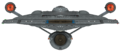 Columbia class (bow view)
 -
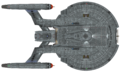 Dorsal
 -
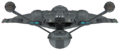 Stern
Stern -
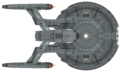 Ventral
 -
 Columbia class (forward dorsal view)
 -
 Columbia class (forward ventral view)
 -
 Columbia class (stern dorsal view)
 -
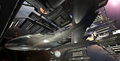 Construction in progress
 -
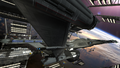 Nearing completion
 -
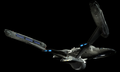 Abaft the starboard beam
 -
 Columbia class departing Earth orbit
.png)
.png)
.png)
.png)
.png)
.png)
.png)
.png)


Star Fleet Registry
- USS Endeavour (NCC-06)
See Also
Notes
- The initial Enterprise article was updated by Timo and the Columbia subclass was broken out as its own. Serious attempts were made to update all related information elsewhere in this Delta Dynamics canon, but any discrepancies may originate with this attempt to update the material.
- There was never a USS Columbia: Timo holds firm to beta-canon that she was lost in the war, as an Enterprise class explorer, and he also explains that the new class was named not after USS Endeavour (technically the second class to receive the refit, after UESS Enterprise), but in honor of her lost sister.
- The penultimate paragraph suggests the Tritons suffered catastrophic losses due to engine failures, however lists ship names associated with the Enterprise class. These ships have been re-named for Delta Dynamics canon.
- The Star Trek: Enterprise novel Rise of the Federation: Live by the Code indicates, following the conversion of USS Endeavour, Buran and Shenlong were the first two new-builds. Three more runs of two each were ordered: Apollo and Soyuz, Ares and Charybdis, and Phoenix and Valiant.
- Because of serious overlaps with other older classes and double-digit NCCs, the Columbia new-builds will be given registries more aligned with their post-Founding construction. For that reason, I am removing Timo's NCC for Valiant. Endeavour will keep her hull number of NCC-06, as she was transferred from UESF to the UFP Star Fleet, with the low number attributed to being in drydock at the time the transferal took place.