Guide:Tavares: Difference between revisions
No edit summary |
|||
| (One intermediate revision by the same user not shown) | |||
| Line 47: | Line 47: | ||
[[Image:No Photo Available.jpg|left|200px|thumb|A stern view reveals two of the three primary means of cargo entry to this ''Tavares'' on starport tarmac: the vast doors of the lower hold, and the shuttlebay directly above. The starboard cargo transporter platform can also be glimpsed in the far corner of the hold, which is lit brightly and provided with integrated antigravs for ease of loading on austere ports like this.]] | [[Image:No Photo Available.jpg|left|200px|thumb|A stern view reveals two of the three primary means of cargo entry to this ''Tavares'' on starport tarmac: the vast doors of the lower hold, and the shuttlebay directly above. The starboard cargo transporter platform can also be glimpsed in the far corner of the hold, which is lit brightly and provided with integrated antigravs for ease of loading on austere ports like this.]] | ||
Rounding out the logistics escalation program of the mid-[[23rd century]] was a light transport | Rounding out the logistics escalation program of the mid-[[23rd century]] was a light transport combining a solid-state warp drive system and an atmospheric hull capable of planetfall and takeoff. Emboldened by a decade of operating ''[[Guide:Chameleon|Chameleon]]'' and ''[[Guide:Mission |Mission]]'' light craft of these characteristics, [[Star Fleet]] wanted to push the envelope and field a larger, more potent theater transport—in part to cover the shortfall of frontline orbit-to-surface logistics due to Project Tradewinds that had dispersed the modern light craft to civilian assignments. Naturally, there were still technological hurdles to be overcome, or then acknowledged and acquiesced to for the time being. By [[2254]], a workable configuration had nevertheless emerged, and the influence of its success can be compared to that of the fast ''[[Guide:Aakenn|Aakenn]]'' heavyweights. For the [[2270s]], the '''''Tavares''''' class would be virtually the | ||
combining a solid-state warp drive system and an atmospheric hull capable of planetfall and takeoff. | |||
Emboldened by a decade of operating ''[[Guide:Chameleon|Chameleon]]'' and ''[[Guide:Mission |Mission]]'' light craft of these characteristics, | |||
[[Star Fleet]] wanted to push the envelope and field a larger, more potent theater | |||
cover the shortfall of frontline orbit-to-surface logistics due to Project Tradewinds that had | |||
dispersed the modern light craft to civilian assignments. Naturally, there were still technological | |||
hurdles to be overcome, or then acknowledged and acquiesced to for the time being. By [[2254]], a | |||
workable configuration had nevertheless emerged, and the influence of its success can be compared | |||
to that of the fast ''[[Guide:Aakenn|Aakenn]]'' heavyweights. For the [[2270s]], the '''''Tavares''''' class would be virtually the | |||
standard light transport of [[Federation]] deep space commerce agencies. | standard light transport of [[Federation]] deep space commerce agencies. | ||
The ''Tavares'' was propelled by two solid-state warp engines – PB-40 in the Star Fleet model and DB-2250 | The ''Tavares'' was propelled by two solid-state warp engines – PB-40 in the Star Fleet model and DB-2250 in concurrently produced civilian versions, even if the difference was basically in name only. The engine type provided the same warp 5 cruise and 6 maximum speed performance here as in the other prominent application, the ''[[Guide: Masterson|Masterson]]'' police corvette refit. The coils were nacelle-mounted yet semi-embedded on the flanks of the six-deck hull, straddling a cargo hold that formed the lowermost two decks and enjoyed direct access to surface from a pair of doors astern, plus indirect access via a pair of cargo transporters forward. Hydrogen fuel was held in the engine cowlings, and intermix systems and antimatter tanks were kept out of the way of the cargo at the upper bow. This arrangement maximized stability and surface accessibility; penalties in radiation shielding and warp field gradient management were tolerable, leaving the ''Tavares'' class only slightly behind the heavier and more powerful ''[[Guide:Independence|Independence]]'' in performance. | ||
in concurrently produced civilian versions, even if the difference was basically in name only. | |||
The engine type provided the same warp 5 cruise and 6 maximum speed performance here as in the | |||
other prominent application, the ''[[Guide: Masterson|Masterson]]'' police corvette refit. The coils were nacelle-mounted yet | |||
semi-embedded on the flanks of the six-deck hull, straddling a cargo hold that formed the | |||
lowermost two decks and enjoyed direct access to surface from a pair of doors astern, plus indirect | |||
access via a pair of cargo transporters forward. Hydrogen fuel was held in the engine cowlings, and | |||
intermix systems and antimatter tanks were kept out of the way of the cargo at the upper bow. This | |||
arrangement maximized stability and surface accessibility; penalties in radiation shielding and warp | |||
field gradient management were tolerable, leaving the ''Tavares'' class only slightly behind the heavier | |||
and more powerful ''[[Guide:Independence|Independence]]'' in performance. | |||
Above the ventral cargo hold, a second major volume accommodated two shuttlecraft for maximum | Above the ventral cargo hold, a second major volume accommodated two shuttlecraft for maximum flexibility in stevedoring the cargo. Star Fleet insisted on full maintenance facilities, while most civilian operators of the vessels saw it better to dedicate some of the shuttle spaces to additional cargo. Civilian transports also typically made do with much smaller crews, donating some of the officer accommodation on Deck 2 or crew quarters on Deck 1 to passenger use, or converting the | ||
flexibility in stevedoring the cargo. Star Fleet insisted on full maintenance facilities, while most | Deck 1 vaults for high value cargo to passenger cabins. | ||
civilian operators of the vessels saw it better to dedicate some of the shuttle spaces to additional | |||
cargo. Civilian transports also typically made do with much smaller crews, donating some of the | |||
officer accommodation on Deck 2 or crew quarters on Deck 1 to passenger use, or converting the | |||
Deck 1 vaults for high value cargo to passenger cabins. | |||
The civilian market was still wary of Klingon aggression, and slow to absorb the 200 units | The civilian market was still wary of Klingon aggression, and slow to absorb the 200 units produced. Fifty hulls were earmarked for Star Fleet theater logistics from the beginning, and four added when their civilian sales fell through. Their major distinction from their mercantile counterparts, a pair of Type VI phasers plus their fire control computer, still came to see frequent use in the lawless outer trade routes in the [[2250s]]. A [[2270s|decade and a half later]], Star Fleet’s anti-piracy crusade finally brought back the confidence of the commercial operators, and saw the explosion of ''Tavares'' operations across the inner sectors and the colonization zone alike. | ||
produced. Fifty hulls were earmarked for Star Fleet theater logistics from the beginning, and four | |||
added when their civilian sales fell through. Their major distinction from their mercantile | |||
counterparts, a pair of Type VI phasers plus their fire control computer, still came to see frequent | |||
use in the lawless outer trade routes in the [[2250s]]. A [[2270s|decade and a half later]], Star Fleet’s anti-piracy | |||
crusade finally brought back the confidence of the commercial operators, and saw the explosion of | |||
''Tavares'' operations across the inner sectors and the colonization zone alike. | |||
Being a pathfinder, the ''Tavares'' was quickly overrun by more refined competition when commercial | Being a pathfinder, the ''Tavares'' was quickly overrun by more refined competition when commercial interest peaked. Star Fleet was slower to let go of its transports, operating a handful of corvette tenders till the [[2280s|early 2280s]] and only developing the replacement [[Guide:Deneva|Deneva]] class after the Khitomer peace. Yet even Fleet analysts saw the attractiveness of the warp-nimble, aerodynamically agile transport, and modeled the successful ''[[Guide:Sydney|Sydney]]'' medium-weight class on the same basic pattern, even extending some of the design influences to the much heavier ''[[Guide:Laweya|Laweyas]]'' and ''[[Guide:Overfield|Overfields]]''. The modern runabout also owes much to the ''Tavares'' layout, which has basically surpassed all earlier Star Fleet configurations for orbit-to-surface transport vessels. | ||
interest peaked. Star Fleet was slower to let go of its transports, operating a handful of corvette | |||
tenders till the [[2280s|early 2280s]] and only developing the replacement [[Guide:Deneva|Deneva]] class after the Khitomer | |||
peace. Yet even Fleet analysts saw the attractiveness of the warp-nimble, aerodynamically agile | |||
transport, and modeled the successful ''[[Guide:Sydney|Sydney]]'' medium-weight class on the same basic pattern, even | |||
extending some of the design influences to the much heavier ''[[Guide:Laweya|Laweyas]]'' and ''[[Guide:Overfield|Overfields]]''. The modern | |||
runabout also owes much to the ''Tavares'' layout, which has basically surpassed all earlier Star Fleet | |||
configurations for orbit-to-surface transport vessels. | |||
==Gallery== | ==Gallery== | ||
| Line 102: | Line 67: | ||
==Notes== | ==Notes== | ||
* | * Timo provides two differing hull registries for the class: standard & letter prefix. Because the class was split between two roles (light transports & corvette tenders), the F1200 series will go to the transports, while the tenders get the standard in the 5000 series. | ||
<br> | <br> | ||
---- | ---- | ||
*[[Guide: Timo's Guide to Star Fleet|Back to the Table of Contents]] | * [[Guide: Timo's Guide to Star Fleet|Back to the Table of Contents]] | ||
*[[Guide: 2240-2270 - The Final Frontier|Back to "The Final Frontier"]] | * [[Guide: 2240-2270 - The Final Frontier|Back to "The Final Frontier"]] | ||
*[[Guide: Of Ship Statistics|Appendix A: Of Ship Statistics]] | * [[Guide: Of Ship Statistics|Appendix A: Of Ship Statistics]] | ||
*[[Guide: Glossary|Appendix B: Glossary]] | * [[Guide: Glossary|Appendix B: Glossary]] | ||
*[[Guide: Star Fleet Organization - General Outline|Appendix C: Star Fleet Organization - General Outline]] | * [[Guide: Star Fleet Organization - General Outline|Appendix C: Star Fleet Organization - General Outline]] | ||
*[[Guide: Abbreviations From Outside|Appendix D: Abbreviations From Outside]] | * [[Guide: Abbreviations From Outside|Appendix D: Abbreviations From Outside]] | ||
[[Category:Guide|{{PAGENAME}}]] | [[Category:Guide|{{PAGENAME}}]] | ||
Latest revision as of 15:21, 18 December 2022
.png)
| |
| Tavares | |
|---|---|
| Class Overview | |
| Category | light transport |
| Operational | 2254-2283 |
| Constructed | 54
|
| Dimensions | |
| Length | 65.5 m |
| Beam | 36.1 m |
| Height |
|
| Mass | 45,000 mt |
| Performance | |
| Cruise Speed | w 5 |
| Max Speed | w 6 |
| Endurance | 1.5 years |
| Complement | |
| Officers | 4 |
| Enlisted | 12
|
| Cargo | 12,000 mt |
| Tactical Systems | |
| Beam Weapons | 2x phaser VI (dorsal bow)
|
| Shields |
|
| Transporters |
|
| Auxiliary Craft |
|
| Historical | |
| Ships of Note |
|
| Canonicity | |
| Design | FASA |
| Name | FASA |
| History | FASA, own
|

Rounding out the logistics escalation program of the mid-23rd century was a light transport combining a solid-state warp drive system and an atmospheric hull capable of planetfall and takeoff. Emboldened by a decade of operating Chameleon and Mission light craft of these characteristics, Star Fleet wanted to push the envelope and field a larger, more potent theater transport—in part to cover the shortfall of frontline orbit-to-surface logistics due to Project Tradewinds that had dispersed the modern light craft to civilian assignments. Naturally, there were still technological hurdles to be overcome, or then acknowledged and acquiesced to for the time being. By 2254, a workable configuration had nevertheless emerged, and the influence of its success can be compared to that of the fast Aakenn heavyweights. For the 2270s, the Tavares class would be virtually the standard light transport of Federation deep space commerce agencies.
The Tavares was propelled by two solid-state warp engines – PB-40 in the Star Fleet model and DB-2250 in concurrently produced civilian versions, even if the difference was basically in name only. The engine type provided the same warp 5 cruise and 6 maximum speed performance here as in the other prominent application, the Masterson police corvette refit. The coils were nacelle-mounted yet semi-embedded on the flanks of the six-deck hull, straddling a cargo hold that formed the lowermost two decks and enjoyed direct access to surface from a pair of doors astern, plus indirect access via a pair of cargo transporters forward. Hydrogen fuel was held in the engine cowlings, and intermix systems and antimatter tanks were kept out of the way of the cargo at the upper bow. This arrangement maximized stability and surface accessibility; penalties in radiation shielding and warp field gradient management were tolerable, leaving the Tavares class only slightly behind the heavier and more powerful Independence in performance.
Above the ventral cargo hold, a second major volume accommodated two shuttlecraft for maximum flexibility in stevedoring the cargo. Star Fleet insisted on full maintenance facilities, while most civilian operators of the vessels saw it better to dedicate some of the shuttle spaces to additional cargo. Civilian transports also typically made do with much smaller crews, donating some of the officer accommodation on Deck 2 or crew quarters on Deck 1 to passenger use, or converting the Deck 1 vaults for high value cargo to passenger cabins.
The civilian market was still wary of Klingon aggression, and slow to absorb the 200 units produced. Fifty hulls were earmarked for Star Fleet theater logistics from the beginning, and four added when their civilian sales fell through. Their major distinction from their mercantile counterparts, a pair of Type VI phasers plus their fire control computer, still came to see frequent use in the lawless outer trade routes in the 2250s. A decade and a half later, Star Fleet’s anti-piracy crusade finally brought back the confidence of the commercial operators, and saw the explosion of Tavares operations across the inner sectors and the colonization zone alike.
Being a pathfinder, the Tavares was quickly overrun by more refined competition when commercial interest peaked. Star Fleet was slower to let go of its transports, operating a handful of corvette tenders till the early 2280s and only developing the replacement Deneva class after the Khitomer peace. Yet even Fleet analysts saw the attractiveness of the warp-nimble, aerodynamically agile transport, and modeled the successful Sydney medium-weight class on the same basic pattern, even extending some of the design influences to the much heavier Laweyas and Overfields. The modern runabout also owes much to the Tavares layout, which has basically surpassed all earlier Star Fleet configurations for orbit-to-surface transport vessels.
Gallery
-
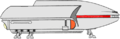 Tavares class
Notes
- Timo provides two differing hull registries for the class: standard & letter prefix. Because the class was split between two roles (light transports & corvette tenders), the F1200 series will go to the transports, while the tenders get the standard in the 5000 series.