Guide:Unity: Difference between revisions
No edit summary |
No edit summary |
||
| (9 intermediate revisions by the same user not shown) | |||
| Line 1: | Line 1: | ||
{{Sidebar Guide ship | {{Sidebar Guide ship | ||
|image=[[File:Unity (stbd).png|''Unity'' command ship]] | |image=[[File:Unity (stbd).png|250px|''Unity'' command ship]] | ||
|classname= ''Unity'' | |classname= ''Unity'' | ||
|category= command ship | |category= command ship | ||
|years= [[2257]]-[[2276]] | |years= [[2257]]-[[2276]] | ||
|constructed= 7 | |constructed= 7 ([[2255]]-[[2262]]) | ||
|length= 287.3 m | |length= 287.3 m | ||
|beam= 127.1 m | |beam= 127.1 m | ||
| Line 45: | Line 45: | ||
* 2-layer forcefields | * 2-layer forcefields | ||
* Primary navigational deflector (fwd secondary hull) | * Primary navigational deflector (fwd secondary hull) | ||
* Auxiliary navigational | * Navigational deflector (aft secondary hull) | ||
* Auxiliary navigational deflector array (fwd primary hull) | |||
|labs= 1 signals processing | |labs= 1 signals processing | ||
|transporters=<br> | |transporters=<br> | ||
| Line 61: | Line 62: | ||
* 4x work pods | * 4x work pods | ||
|historicalships=<br> | |historicalships=<br> | ||
* ''USS Unity'' (NCC- | * ''USS Harmony'' (NCC-2119) | ||
* ''USS Stability'' (NCC-2109) | |||
* ''USS Unity'' (NCC-2104) | |||
|design= aridas sofia, own | |design= aridas sofia, own | ||
|name= own | |name= own | ||
|history= SotSF, own | |history= SotSF, own | ||
}} | }} | ||
[[File:No Photo Available.jpg|left|200px|thumb|A typical Unity deployment in 2265 sees USS Stability (NCC-2109) blending in with Constitution and Rochester cruisers and a gaggle of destroyers. Entire fleets were seldom deployed; save for certain large scale exercises such as the annual Factor Two event depicted here, it was rare for even a third of the elements of a fleet to come together for concerted action.]] | [[File:No Photo Available.jpg|left|200px|thumb|A typical ''Unity'' deployment in [[2265]] sees ''USS Stability'' (NCC-2109) blending in with ''[[Guide:Constitution|Constitution]]'' and ''[[Guide:Rochester|Rochester]]'' cruisers and a gaggle of destroyers. Entire fleets were seldom deployed; save for certain large scale exercises such as the annual Factor Two event depicted here, it was rare for even a third of the elements of a fleet to come together for concerted action.]] | ||
The introduction of the dreadnought-type starship opened up new strategic possibilities for | The introduction of the dreadnought-type starship opened up new strategic possibilities for [[Star Fleet]]. | ||
Barring unforeseen expansion of the operational theater, the three-nacelled behemoths could | Barring unforeseen expansion of the operational theater, the three-nacelled behemoths could | ||
respond to crises on any of the fronts while operating from centrally located bases, thus alleviating | respond to crises on any of the fronts while operating from centrally located bases, thus alleviating | ||
the need for local garrisons. | the need for local garrisons. Star Fleet could now complete its withdrawal from planetary surfaces, a | ||
process begun as a result of the Axanari defection. However, being able to deploy the big guns to | process begun as a result of the [[Axanar|Axanari]] defection. However, being able to deploy the big guns to | ||
the border from afar was just part of the equation. Crucial issues of reconnaissance, | the border from afar was just part of the equation. Crucial issues of reconnaissance, | ||
communications, fuel and munitions logistics and maintenance also had to be solved without | communications, fuel and munitions logistics and maintenance also had to be solved without | ||
involving fixed planetside or orbital assets. The massive building programs for the required support | involving fixed planetside or orbital assets. The massive building programs for the required support | ||
vessels only began to meet the demand in the late 2250s. It was at this point that | vessels only began to meet the demand in the late [[2250s]]. It was at this point that Star Fleet could | ||
move on to programs of smaller production volume but equally crucial importance. | move on to programs of smaller production volume but equally crucial importance. | ||
A certain type of patrol combatant had been neglected for half a century, due to the availability of | A certain type of patrol combatant had been neglected for half a century, due to the availability of | ||
fixed facilities for the task. When moving to a distant war zone, the expeditionary fleets of the | fixed facilities for the task. When moving to a distant war zone, the expeditionary fleets of the | ||
2250s would once again have to take their headquarters with them – and | [[2250s]] would once again have to take their headquarters with them – and Star Fleet by now | ||
understood that burdening the HQ role on a primary combatant was a dubious solution at best. | understood that burdening the HQ role on a primary combatant was a dubious solution at best. | ||
Indeed, the Federations had deliberately been built without command facilities for operations | Indeed, the ''[[Guide:Federation|Federations]]'' had deliberately been built without command facilities for operations | ||
beyond Task Force level, and this was also the largest formation the facilities of a heavy cruiser | beyond Task Force level, and this was also the largest formation the facilities of a heavy cruiser | ||
could hold together. While the Hermes coordination ships could handle basic fleet-level operations, | could hold together. While the ''[[Guide:Hermes |Hermes]]'' coordination ships could handle basic fleet-level operations, | ||
they weren’t intended as | they weren’t intended as theater-wide HQ ships, and lacked the required size for adoption or | ||
adaptation as such. Thus, the dedicated command ship had to be reborn. | adaptation as such. Thus, the dedicated command ship had to be reborn. | ||
The torturous struggle for securing funding for individual dreadnoughts had the positive side effect | The torturous struggle for securing funding for individual dreadnoughts had the positive side effect | ||
that every heavy combatant turned down by the Council meant a hefty sum released for other uses. | that every heavy combatant turned down by the Council meant a hefty sum released for other uses. | ||
Star Fleet quickly learned the trick of immediately channeling the funds onto another bid on a less | |||
openly offensive, cheaper and thus more appealing vessel. The first of these inherited the registry, | openly offensive, cheaper and thus more appealing vessel. The first of these inherited the registry, | ||
powerplant and funding of the cancelled dreadnought Corporation. Borrowing was found to be an | powerplant and funding of the cancelled dreadnought ''Corporation''. Borrowing was found to be an | ||
affordable and efficient construction method overall: USS Unity (NCC-2104) sported a Class 1B | affordable and efficient construction method overall: ''USS Unity'' (NCC-2104) sported a Class 1B | ||
primary hull of Achernar design, its three phaser berths filled with twin Type V banks of Loknar | primary hull of ''[[Guide:Achernar|Achernar]]'' design, its three phaser berths filled with twin Type V banks of ''[[Guide:Loknar|Loknar]]'' | ||
surplus. Decks 2 and 3 were slightly expanded and equipped for communications functions rather | surplus. Decks 2 and 3 were slightly expanded and equipped for communications functions rather | ||
than torpedo handling, and the impulse assembly was bifurcated to allow for a rather curious central | than torpedo handling, and the impulse assembly was bifurcated to allow for a rather curious central | ||
primary plasma uptake. Laboratory spaces were replaced by command facilities, and crew and | primary plasma uptake. Laboratory spaces were replaced by command facilities, and crew and | ||
officer berthing adjusted to accommodate 405 of the former and 69 of the latter. Apart from these | officer berthing adjusted to accommodate 405 of the former and 69 of the latter. Apart from these | ||
modifications, basic Achernar infrastructure was retained. | modifications, basic ''Achernar'' infrastructure was retained. | ||
The secondary hull was a mission-specific, dreadnought-style design, longer and broader than the | The secondary hull was a mission-specific, dreadnought-style design, longer and broader than the | ||
cruiser hulls and sporting e.g. a specialized ‘Alphorn’ communications system with numerous | cruiser hulls and sporting e.g. a specialized ‘Alphorn’ communications system with numerous | ||
external antennas. The bow shuttlebay had an adjoining triage room; modular hospital facilities | external antennas. The bow shuttlebay had an adjoining triage room; modular hospital facilities | ||
could be brought aboard for forward deployments. The two nacelles on horizontal, | could be brought aboard for forward deployments. The two nacelles on horizontal, ‘shoulder-mounted’ | ||
pylons were of PB-47 type, and rated for warp 6 cruising and warp 8 dash speed. | pylons were of PB-47 type, and rated for warp 6 cruising and warp 8 dash speed. | ||
Similarly | Similarly cruiser-like performance was offered by the shield generators at the hull bottom. However, | ||
a careful observer would have noted four empty generator cradles, and perhaps also paid attention to | a careful observer would have noted four empty generator cradles, and perhaps also paid attention to | ||
how both primary and secondary plasma systems were rather grossly | how both primary and secondary plasma systems were rather grossly over-engineered – featuring for | ||
example a seemingly useless dorsal primary power coupling. | example a seemingly useless dorsal primary power coupling. | ||
Star Fleet’s ulterior plans with the class would have been obvious to anybody aware of these facts. In | |||
case of a prolonged military conflict, it would be a matter of days to bolt a third PB-47 to the | case of a prolonged military conflict, it would be a matter of days to bolt a third PB-47 to the | ||
mountings atop the impulse deck, to add the missing field generators, and to plug Type VIII phasers | mountings atop the impulse deck, to add the missing field generators, and to plug Type VIII phasers | ||
| Line 118: | Line 121: | ||
albeit with reduced endurance. There was a degree of fantasy to the plans, as no spare PB-47s were | albeit with reduced endurance. There was a degree of fantasy to the plans, as no spare PB-47s were | ||
actually set aside, nor were there enough Type VIII systems to outfit more than two of the command | actually set aside, nor were there enough Type VIII systems to outfit more than two of the command | ||
ships without depriving the Federations of vital spares. Still, seven Unity vessels were to be | ships without depriving the ''Federations'' of vital spares. Still, seven '''''Unity''''' vessels were to be | ||
completed, all of these with the built-in upgrade potential. | completed, all of these with the built-in upgrade potential. | ||
| Line 124: | Line 127: | ||
and sensor nets by up to 8.6 million distinct communications channels, four separate levels of | and sensor nets by up to 8.6 million distinct communications channels, four separate levels of | ||
command and targeting data sharing networks and an improved array of personnel transporters and | command and targeting data sharing networks and an improved array of personnel transporters and | ||
liaison craft. TBL-5 troop barges were configured as detachable surface command outposts, and | liaison craft. [[TBL-5]] troop barges were configured as detachable surface command outposts, and | ||
included in the auxiliary mix of the vessels, typically three being carried along with the six liaison | included in the auxiliary mix of the vessels, typically three being carried along with the six liaison | ||
shuttles. Extensive medical facilities were also included; | shuttles. Extensive medical facilities were also included; Star Fleet felt it needed no dedicated large | ||
hospital ships for operations under the current doctrine, in which planetary combat would be kept to | hospital ships for operations under the current doctrine, in which planetary combat would be kept to | ||
a minimum, yet some centralized medical assets for space combat casualties were still useful, and | a minimum, yet some centralized medical assets for space combat casualties were still useful, and | ||
efficiently combined with the HQ role. | efficiently combined with the HQ role. | ||
Since the other Federations were cancelled before any actual system construction had taken place, | Since the other ''Federations'' were cancelled before any actual system construction had taken place, | ||
there was no way to match the affordability of USS Unity in later procurement. Later units had their | there was no way to match the affordability of ''USS Unity'' in later procurement. Later units had their | ||
powerplants built from scratch, and struggled for funding and dockyard slots in a manner | powerplants built from scratch, and struggled for funding and dockyard slots in a manner | ||
unbecoming of a priority project. Nevertheless, the command cruisers were completed at a rapid | unbecoming of a priority project. Nevertheless, the command cruisers were completed at a rapid | ||
pace, USS Harmony (NCC-2119) being the last off the slipways in January 2262. The registries and | pace, ''USS Harmony'' (NCC-2119) being the last off the slipways in January [[2262]]. The registries and | ||
construction dates of the seven Unities were interspliced with those of the Federations, just like the | construction dates of the seven ''Unities'' were interspliced with those of the ''Federations'', just like the | ||
vessels themselves were expected to tag along the dominant combatants – but only in times of open | vessels themselves were expected to tag along with the dominant combatants – but only in times of open | ||
war. Like the class from which they had leeched their financial support and technological basis, they | war. Like the class from which they had leeched their financial support and technological basis, they | ||
were as expensive to operate as to build, and were in effect immediately mothballed upon | were as expensive to operate as to build, and were in effect immediately mothballed upon | ||
construction. | construction. | ||
The command ships remained idled until late 2267, when they were scrambled to counter the | The command ships remained idled until late [[2267]], when they were scrambled to counter the | ||
rapidly escalating Klingon hostilities. Although no more than 25 % of the Fleet mobilized during | rapidly escalating Klingon hostilities. Although no more than 25% of the Fleet mobilized during | ||
the hectic two weeks of the crisis, all seven HQ vessels were promptly crewed, and five of them | the hectic two weeks of the crisis, all seven HQ vessels were promptly crewed, and five of them | ||
were deployed to the primary theaters (albeit without a chance to install the more powerful | were deployed to the primary theaters (albeit without a chance to install the more powerful | ||
weapons). In a cruel twist of events, the most important command communiques in the crisis were | weapons). In a cruel twist of events, the most important command communiques in the crisis were | ||
issued independently of any Fleet command or communications assets, and indeed against the will | issued independently of any Fleet command or communications assets, and indeed against the will | ||
of the admirals headquartered aboard the Unity vessels. Still, there was no opposing the omnipresent | of the admirals headquartered aboard the ''Unity'' vessels. Still, there was no opposing the omnipresent | ||
and plenipotent Organians, and forces on both sides had to be withdrawn. | and plenipotent Organians, and forces on both sides had to be withdrawn. | ||
With the Klingon threat thus seemingly negated, deployments of large formations decreased | With the Klingon threat thus seemingly negated, deployments of large formations decreased | ||
drastically. In theory, the Unity vessels would have been quite capable of independent operations as | drastically. In theory, the ''Unity'' vessels would have been quite capable of independent operations as | ||
frontier explorers and combatants, especially if at least partially | frontier explorers and combatants, especially if at least partially re-armed with the intended Type | ||
VIII emitters. But the treaty that had been wrung out of the military impasse reflected the fact that | VIII emitters. But the treaty that had been wrung out of the military impasse reflected the fact that | ||
there had been no clear winner: in order to hold on to the fragile peace, both sides had agreed to a | there had been no clear winner: in order to hold on to the fragile peace, both sides had agreed to a | ||
range of concessions. None were militarily crippling, but several were annoyances, and intended as | range of concessions. None were militarily crippling, but several were annoyances, and intended as | ||
such: keeping the Unity class in fighting strength would have meant reducing the numbers of other | such: keeping the ''Unity'' class in fighting strength would have meant reducing the numbers of other | ||
classes of | classes of cruiser-like combatants, most of which were more affordable to operate than the ''Unity'' | ||
almost-dreadnoughts. Since the option existed of listing the Unities as lightly armed support assets | almost-dreadnoughts. Since the option existed of listing the ''Unities'' as lightly armed support assets | ||
instead, it was embraced, and the class saw relatively little frontline use during the treaty years. | instead, it was embraced, and the class saw relatively little frontline use during the treaty years. | ||
The basic concept of a HQ ship / combatant hybrid still held appeal beyond the ability to perform | The basic concept of a HQ ship / combatant hybrid still held appeal beyond the ability to perform | ||
political lip service. When the Unities got long on the teeth, a successor design was created in the | political lip service. When the ''Unities'' got long on the teeth, a successor design was created in the | ||
image of the class: USS Balson utilized technological solutions a quarter of a century more | image of the class: ''USS Balson'' utilized technological solutions a quarter of a century more | ||
advanced, but closely resembled USS Unity in silhouette, specifications and upgrading potential. | advanced, but closely resembled ''USS Unity'' in silhouette, specifications and upgrading potential. | ||
This follow-on class is described later in a dedicated entry. Also described is an in-between | This follow-on class is described later in [[Guide:Balson|a dedicated entry]]. Also described is an in-between | ||
command ship of lesser combat potential, the Brenton class cruiser. | command ship of lesser combat potential, the ''[[Guide:Brenton|Brenton]]'' class cruiser. | ||
The story of the original design would end in 2276, when Brenton procurement and Balson | The story of the original design would end in [[2276]], when ''Brenton'' procurement and ''Balson'' | ||
introduction freed the last of the vessels for sale to trusted rimward allies, for use as defense | introduction freed the last of the vessels for sale to trusted rimward allies, for use as defense | ||
cruisers. The sale was far from a resounding success, since the buyers were fully aware of the | cruisers. The sale was far from a resounding success, since the buyers were fully aware of the | ||
inferiority of the stripped-down, torpedo-less Unity hulls. Only two units eventually changed hands; | inferiority of the stripped-down, torpedo-less ''Unity'' hulls. Only two units eventually changed hands; | ||
the Megarans agreed to the sale in 2282 when it was sweetened with four surplus destroyers. | the Megarans agreed to the sale in [[2282]] when it was sweetened with four surplus destroyers. | ||
==Gallery== | ==Gallery== | ||
| Line 187: | Line 190: | ||
==Notes== | ==Notes== | ||
* | * Sidebar's registry for ''USS Unity'' was changed to match the text (NCC-2106 to -2104). | ||
<br> | <br> | ||
Latest revision as of 12:11, 1 May 2020
.png)
| |
| Unity | |
|---|---|
| Class Overview | |
| Category | command ship |
| Operational | 2257-2276 |
| Constructed | 7 (2255-2262) |
| Dimensions | |
| Length | 287.3 m |
| Beam | 127.1 m |
| Height |
|
| Mass |
|
| Performance | |
| Cruise Speed |
|
| Max Speed | * w 8 (peacetime configuration)
|
| Endurance | 2 years |
| Complement | |
| Officers |
|
| Enlisted |
|
| Tactical Systems | |
| Beam Weapons | Peacetime configuration
Crisis configuration
|
| Shields |
|
| Laboratories | 1 signals processing |
| Transporters | Standard
Select ships (after 2271)
|
| Auxiliary Craft |
|
| Historical | |
| Ships of Note |
|
| Canonicity | |
| Design | aridas sofia, own |
| Name | own |
| History | SotSF, own
|

The introduction of the dreadnought-type starship opened up new strategic possibilities for Star Fleet. Barring unforeseen expansion of the operational theater, the three-nacelled behemoths could respond to crises on any of the fronts while operating from centrally located bases, thus alleviating the need for local garrisons. Star Fleet could now complete its withdrawal from planetary surfaces, a process begun as a result of the Axanari defection. However, being able to deploy the big guns to the border from afar was just part of the equation. Crucial issues of reconnaissance, communications, fuel and munitions logistics and maintenance also had to be solved without involving fixed planetside or orbital assets. The massive building programs for the required support vessels only began to meet the demand in the late 2250s. It was at this point that Star Fleet could move on to programs of smaller production volume but equally crucial importance.
A certain type of patrol combatant had been neglected for half a century, due to the availability of fixed facilities for the task. When moving to a distant war zone, the expeditionary fleets of the 2250s would once again have to take their headquarters with them – and Star Fleet by now understood that burdening the HQ role on a primary combatant was a dubious solution at best. Indeed, the Federations had deliberately been built without command facilities for operations beyond Task Force level, and this was also the largest formation the facilities of a heavy cruiser could hold together. While the Hermes coordination ships could handle basic fleet-level operations, they weren’t intended as theater-wide HQ ships, and lacked the required size for adoption or adaptation as such. Thus, the dedicated command ship had to be reborn.
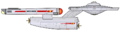
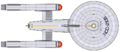
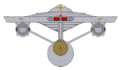
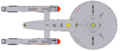
The torturous struggle for securing funding for individual dreadnoughts had the positive side effect that every heavy combatant turned down by the Council meant a hefty sum released for other uses. Star Fleet quickly learned the trick of immediately channeling the funds onto another bid on a less openly offensive, cheaper and thus more appealing vessel. The first of these inherited the registry, powerplant and funding of the cancelled dreadnought Corporation. Borrowing was found to be an affordable and efficient construction method overall: USS Unity (NCC-2104) sported a Class 1B primary hull of Achernar design, its three phaser berths filled with twin Type V banks of Loknar surplus. Decks 2 and 3 were slightly expanded and equipped for communications functions rather than torpedo handling, and the impulse assembly was bifurcated to allow for a rather curious central primary plasma uptake. Laboratory spaces were replaced by command facilities, and crew and officer berthing adjusted to accommodate 405 of the former and 69 of the latter. Apart from these modifications, basic Achernar infrastructure was retained.
The secondary hull was a mission-specific, dreadnought-style design, longer and broader than the cruiser hulls and sporting e.g. a specialized ‘Alphorn’ communications system with numerous external antennas. The bow shuttlebay had an adjoining triage room; modular hospital facilities could be brought aboard for forward deployments. The two nacelles on horizontal, ‘shoulder-mounted’ pylons were of PB-47 type, and rated for warp 6 cruising and warp 8 dash speed. Similarly cruiser-like performance was offered by the shield generators at the hull bottom. However, a careful observer would have noted four empty generator cradles, and perhaps also paid attention to how both primary and secondary plasma systems were rather grossly over-engineered – featuring for example a seemingly useless dorsal primary power coupling.
Star Fleet’s ulterior plans with the class would have been obvious to anybody aware of these facts. In case of a prolonged military conflict, it would be a matter of days to bolt a third PB-47 to the mountings atop the impulse deck, to add the missing field generators, and to plug Type VIII phasers in all weapons berths. A ‘pocket dreadnought’ would be ready for combat at speeds up to warp 10.0, albeit with reduced endurance. There was a degree of fantasy to the plans, as no spare PB-47s were actually set aside, nor were there enough Type VIII systems to outfit more than two of the command ships without depriving the Federations of vital spares. Still, seven Unity vessels were to be completed, all of these with the built-in upgrade potential.
In a crisis, each HQ ship would support a command staff of almost 200, linked to the combat forces and sensor nets by up to 8.6 million distinct communications channels, four separate levels of command and targeting data sharing networks and an improved array of personnel transporters and liaison craft. TBL-5 troop barges were configured as detachable surface command outposts, and included in the auxiliary mix of the vessels, typically three being carried along with the six liaison shuttles. Extensive medical facilities were also included; Star Fleet felt it needed no dedicated large hospital ships for operations under the current doctrine, in which planetary combat would be kept to a minimum, yet some centralized medical assets for space combat casualties were still useful, and efficiently combined with the HQ role.
Since the other Federations were cancelled before any actual system construction had taken place, there was no way to match the affordability of USS Unity in later procurement. Later units had their powerplants built from scratch, and struggled for funding and dockyard slots in a manner unbecoming of a priority project. Nevertheless, the command cruisers were completed at a rapid pace, USS Harmony (NCC-2119) being the last off the slipways in January 2262. The registries and construction dates of the seven Unities were interspliced with those of the Federations, just like the vessels themselves were expected to tag along with the dominant combatants – but only in times of open war. Like the class from which they had leeched their financial support and technological basis, they were as expensive to operate as to build, and were in effect immediately mothballed upon construction.
The command ships remained idled until late 2267, when they were scrambled to counter the rapidly escalating Klingon hostilities. Although no more than 25% of the Fleet mobilized during the hectic two weeks of the crisis, all seven HQ vessels were promptly crewed, and five of them were deployed to the primary theaters (albeit without a chance to install the more powerful weapons). In a cruel twist of events, the most important command communiques in the crisis were issued independently of any Fleet command or communications assets, and indeed against the will of the admirals headquartered aboard the Unity vessels. Still, there was no opposing the omnipresent and plenipotent Organians, and forces on both sides had to be withdrawn.
With the Klingon threat thus seemingly negated, deployments of large formations decreased drastically. In theory, the Unity vessels would have been quite capable of independent operations as frontier explorers and combatants, especially if at least partially re-armed with the intended Type VIII emitters. But the treaty that had been wrung out of the military impasse reflected the fact that there had been no clear winner: in order to hold on to the fragile peace, both sides had agreed to a range of concessions. None were militarily crippling, but several were annoyances, and intended as such: keeping the Unity class in fighting strength would have meant reducing the numbers of other classes of cruiser-like combatants, most of which were more affordable to operate than the Unity almost-dreadnoughts. Since the option existed of listing the Unities as lightly armed support assets instead, it was embraced, and the class saw relatively little frontline use during the treaty years.
The basic concept of a HQ ship / combatant hybrid still held appeal beyond the ability to perform political lip service. When the Unities got long on the teeth, a successor design was created in the image of the class: USS Balson utilized technological solutions a quarter of a century more advanced, but closely resembled USS Unity in silhouette, specifications and upgrading potential. This follow-on class is described later in a dedicated entry. Also described is an in-between command ship of lesser combat potential, the Brenton class cruiser.
The story of the original design would end in 2276, when Brenton procurement and Balson introduction freed the last of the vessels for sale to trusted rimward allies, for use as defense cruisers. The sale was far from a resounding success, since the buyers were fully aware of the inferiority of the stripped-down, torpedo-less Unity hulls. Only two units eventually changed hands; the Megarans agreed to the sale in 2282 when it was sweetened with four surplus destroyers.
Gallery
-
 Unity class
 -

-
-
-
.png)
.png)
.png)
.png)
Notes
- Sidebar's registry for USS Unity was changed to match the text (NCC-2106 to -2104).