Guide:Keith
(up).png)
| |
| Keith | |
|---|---|
| Class Overview | |
| Category | surveyor/scout |
| Operational | 2256-2296
|
| Constructed | 23 total: |
| Dimensions | |
| Length | 180.0 m |
| Beam | 80.0 m |
| Height |
|
| Mass |
|
| Performance | |
| Cruise Speed | w 6 |
| Max Speed | w 8 |
| Endurance | 5 years |
| Complement | |
| Officers | 18 |
| Enlisted |
|
| Crew | Research staff:
|
| Tactical Systems | |
| Beam Weapons |
|
| Missile Weapons | scout
|
| Shields |
|
| Laboratories | 4-8, with varying configurations |
| Transporters | surveyor
scout
|
| Auxiliary Craft |
|
| Historical | |
| Ships of Note |
|
| Canonicity | |
| Design | FASA |
| Name | FASA |
| History | FASA
|

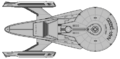
In parallel with the mainly Vulcan-driven T’Pari project, the ‘post-Klingon’ Star Fleet enthusiastically sponsored the development of a complementary scientific scouting vessel of Earth design, with greater cruising and top speeds, range and endurance. The Keith class surveyor was drafted as a multipurpose vessel, an obvious euphemism to hide certain abilities that were absent from the T’Pari. With twice the engine power, directed into twin PB-35E nacelles, and with a primary hull based on escorts rather than corvettes, the Keith was an altogether more capable deep space surveyor, yet also an armed reconnaissance and logistics asset.
Flexibility was increased by the use of a separable saucer for escort-standard accommodation, control systems and sensors, with an attached eight-reactor impulse engine. Providing the ship with virtually everything she needed for basic navigation, this primary hull featured very little in the way of mission-specific gear. Two twin Type VI phasers of FH-4 model were installed for defense, covering the upper firing angles only, and a Type D shield generator embedded in a keel structure sufficed for passive protection. In addition, a six-pad general purpose transporter and a small cargo unit were paired with an evacuation transporter, and an airlock with a retractable docking tube was provided just aft of the bridge.
Mission-specific gear would be carried in a secondary hull that in essence was but a pressure vessel and supporting framework for the widest possible range of mission gear, and a pathfinder to similar pods on later Oberth class vessels. Up to 20,000 tons of instrumentation or supplies would fill the spacious lower holds of the pod, covered by rolling or duonetically transparent surfaces, while the upper decks featured mission specialist accommodation and spaces wired for workshop or laboratory use. A hangar for two full-sized exploration or utility shuttlecraft was inset amidships, with a rolling door opening towards the fantail of the pod. Two cargo transporters and two general purpose units further facilitated the transfer of supplies or the deploying of survey parties.
The nature of the mission pod necessitated a separate engineering section to house the advanced but bulky antimatter powerplant. To properly englobe the mission pod in a warp field, the design placed the warp propulsion system underneath the pod, with the nacelles on upward-angled pylons so that they would straddle the pod. The RMR-200 reactor was cradled by curving structures not unlike the Oberth pylons, with similar quick-separation functionality. A powerful navigational deflector directly ahead of the reactor could swivel to both sides for various FTL scanning needs, utilizing side cutouts in the reactor pylons. In contrast, the sensors of the mission pod would be hard pressed to see past the warp engines – so these were mounted on hinged pylons, which could be dropped for sensing, and raised again for warp travel. There was no propulsive functionality to the variable geometry, unlike with some later designs.
Even with warp engines of (very) light cruiser standard, the smallish ship type did not meet Star Fleet’s criteria for an actual exploratory cruiser. Nor did it quite cover general Fleet logistics needs in the 2260s, and a decision to procure just seventeen out of the originally planned total of 25 vessels was made with the understanding that all ships would be equipped to survey configuration. More exactly, they would serve as ‘surveyor leaders’ for the emerging armada of Oberth vessels. In a threat environment where even destroyers often had to go leaderless, there was no real chance of using light cruisers as shepherds for the Oberth flocks, so the Keiths found a secure niche in frontier mapping and assaying campaigns.
The Organian effect on Keith operations was a complicated one. In theory, treaties limiting the numbers of warships should have left the class untouched, while survey operations ought to have benefited from the truce, giving all the more work for ‘deep space booster’ assets like the surveyor leaders. Yet the Keith fell into the Activation Class VI for military logistics ships, and had to be erased from Star Fleet records lest the ships themselves be scrapped. In 2268, various civilian research organizations thus received direct operational and financial responsibility for government-sponsored, state-of-the-art starships for the first time in Federation history. Being simpler and cheaper to operate than the simultaneously privatized Hopi cruisers, the Keiths immediately became popular and much utilized.
Star Fleet retained a keen interest in the design, though. Prior to the handover, the ships were given modern communications systems, for unspecified ‘future needs’, and the weapons berths were left unsealed even though the phasers themselves were removed. In addition, Star Fleet exercised its option for six more ships, this time equipped with KR05 reactors. Held uncompleted while Organian treaty figures were being shuffled and reshuffled, these Mk II vessels actually ended up entering service as the Mk III, a thoroughly modernized scout with LN-61 warp engines, a FIB-3 impulse deck shared with the modern transport fleet, and twin FH-7 phasers. Even a light escort-type torpedo launcher was included. The main incentive for introducing this new class was its commonality with Genser escorts; the two classes were fielded side by side, the Keiths providing early warning and logistical support for the Gensers in convoy escort duty.
There was to be no further procurement of the scout type, however. The curious relationship between warp propulsion and sensing did not really cater for the sort of constant vigilance needed in escort duty. The engine swiveling mechanisms were deemed so much dead weight, and eventually the sensor payloads were moved over to the Gensers themselves and the pylons fixed in place. The Mk III scouts were retained till the end of the Klingon crisis, and retired alongside the escorts. Exploration Command hopes of reassigning the vessels to survey duty were dashed by the extent of wear and tear on the engine systems; similarly disappointed was Logistics Command that had hoped to utilize the LN-61 surplus for the fielding of further light deep space tugs.
Gallery
-
 Keith class surveyor (pylons up)
 -

-
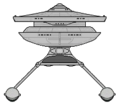 bow (down)
 -
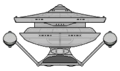
-
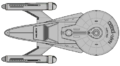
-
 Keith class scout
 -

-

-
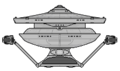
-
.png)
(down).png)
(up).png)
.png)
(up).png)
(down).png)
(down).png)
(up).png)
.png)
Notes
- Presently, the text refers to Mark I, II, and III variants. It's suggested these become subclasses, named after the lead ships.
- While active with Star Fleet, the class probably had a registry that began with NCC-L or NCC-Q (though probably the former). They received NAR registries once they were transferred to the civilian organizations.
Alt Sources