Guide:Phoenix
.png)
| |
| Phoenix | |
|---|---|
| Class Overview | |
| Category | warp drive testbed |
| Operational | 2063-2065 |
| Constructed | 1 |
| Dimensions | |
| Length |
|
| Beam |
|
| Height |
|
| Mass |
|
| Performance | |
| Max Speed |
|
| Complement | |
| Crew |
|
| Canonicity | |
| Design | ST:FC, DS9 |
| Name | ST:FC |
| History | ST:FC
|
World War III finally came in 2053. For some, it was a gracefully unfolding master plan, dutifully
following all the field manuals of 21st century strategists. For others, it was devoid of reason,
sparing the guilty and wiping out the innocent. Everybody was invited to participate; there was not
a country spared from the madness, some areas being hit by nuclear blasts, some by biological
weapons, and some succumbing to internal chaos. Just as the scientists had predicted, some 10% of
mankind died within the first two years – of radiation, diseases, hunger, despair.
Yet, the slate was not wiped clean, the civilization not erased. The centers of power survived, due to their super-technology protective systems, but they were deprived of everything that had made them powerful. Less developed areas were hit badly, but ultimately gained in power as they were able to provide the remaining cities with food, water and other sustenance. For a while, few organizations on Earth could operate a hovercar, much less an aircraft or spaceship. But in some remote enclaves, capacity for research, development and construction of space systems survived. One of the unlikeliest was the small township of Resurrection, Montana, the location of a former Titan V missile base, and the one-time home of one Zephram Cochrane (2032-?), PhD, SOB, drunkard and genius.
Before the war, Cochrane had been a young and moderately successful physicist in a local research conglomerate. As dark clouds began to gather over humanity, Cochrane decided to pursue a vision of a radical new technology that would revolutionize physics and turn the ideas of Einstein and Hawking upside down. Gathering a small research group, he formulated his theory of continuum distortion and sold the idea of possible future applications in propulsion and communications technology to various organizations. Weapons research corporations were especially interested, but the young scientist resisted their temptation.
But then the bombs began to fall. Cochrane lost everything, including his team, his backers, his hometown, and his belief in humanity. Within two months, he put his dream on sale for the highest bidder. To his surprise, several powerful organizations still expressed interest. Arranging simultaneous backing from all the competitors, Cochrane set base on an abandoned missile complex and began to build testbeds for the continuum distortion superimpellor, a device he alternately advertised as a powerful weapon, a revolutionary form of transport, and a fantastic new power source.
In 2061, Cochrane tested the first unit inside an underground Titan V/VI assembly hangar, and was able to accelerate a test payload to lightspeed by expending his energy budget for the next five years 500 times over. Work began on prototypes of a spaceborne propulsion platform. In 2063, such a platform stood proudly atop a Titan V lower stage, being readied for manned flight to the amusement of the township of Resurrection, and to the great interest of observers from once powerful corporations and crumbling militaries.
The ship incorporated a modified Titan VI upper stage reaction engine, four orbital maneuvering engines, and a toroid fusion reactor all clustered on the aft end of the main body. Fuel tanks were located atop this cluster, flanked on both sides by the equipment required to extend the twin hearts of the superimpellor drive – cylindrar nacelles containing the continuum distortion coils. These coils, made primarily out of doped copper alloys instead of the currently used vertenium cortenide, were excited by streams of plasma, energized by the fusion reactor and a small fusion-powered antimatter accumulator that ‘spiced’ the fusion through carefully controlled intermix of hydrogen and antihydrogen. The subspace field thus created would decouple the vehicle from normal space, countermanding several of the most cherished rules of classic Earth science.
Atop the machine was a small three-man control pod, constructed of titanium and partially covered with a ceramic heatshield. It was to carry the test pilot and two technicians throughout the experiment, and then to eject for a safe parachuted landing. The test rig was to be left in orbit, to be recovered by another spacecraft when (or if) any of Cochrane’s backers could afford to launch one. For financial security, Cochrane had also included a powerful self-destruct mechanism in the design of the rig.

On the eve of the test launch, however, a surprise strike was performed against the missile site, killing most of Cochrane’s new research team and damaging the test ship Phoenix. The attacker was never identified, but is believed to have been either a group of former Econ military leaders with access to orbital bombardment weapons, or then a mere automated misfire of the said weapons against a target that no longer was valid.
Befitting of her name, the ship rose from the ashes, however. Cochrane quickly drafted nearby villagers to help him repair the craft, and embarked on a historic test flight on April 5th. Some eyewitnesses claim there were two observers aboard, but history records Cochrane as having broken the light barrier solo. No recordings of the actual flight exist – the pitiful remains of the satellite surveillance network were directed elsewhere at the time, or deliberately jammed by the competing backers of the Cochrane team. What is known is that the tiny 1,028-millicochrane warp field of the Phoenix was observed by the passing Vulcan survey ship T’Plana-Hath, and a first contact with Earthpeople initiated by the Vulcans late on the 5th of April, 2063.
The crew pod of the ship was recovered by parachutes and airbags. The warp engine itself was left in orbit for some weeks, until no less than sixteen organizations claimed her on basis of being the sole financial backers of the Cochrane team. However, negotiations with Vulcans were filling the remaining communication networks at the time, and in a spectacular return to the idealism of his youth, Cochrane asked the Vulcan technicians to insert the complete specifications and blueprints of his warp drive to the Bellnet. Within 24 hours, there was not a country or alliance in the world that did not know how to build a warp engine. It soon became clear that there was not a country or alliance in the world that had the resources to do that, however, since the national industrial infrastructures were too badly damaged. The only way to build warp drives was to form an international network of relationships, just as Cochrane had done.
The original warp engine received a second, larger crew pod with a 5th of November, 2064 launch of a multicorporation recovery team. A wide meteoroid shield was also installed aft of the pod to combat micrometeoroid erosion at extreme subluminal and virtual-particle bombardment at superluminal speeds. In this configuration, the ship performed a series of seven test flights, the last of which took it as far out as Saturn. The flights also gave the first warnings about the instability of primitive warp fields in the vicinity of gravity wells, almost leading to the loss of the vessel near the Moon. As the Phoenix was retired in 2065 (and the warp section stored in a high orbit and eventually brought down in the early 22nd century to be preserved in the Smithsonian Institute), hundreds of other warp engines were already under construction. The infrastructure to build them was being erected at breakneck pace, revitalizing transportation and communication and totally relocating the industry in a way that made many former political boundaries meaningless. The political alliances of the time bore no relationship to the pre-war ones; simple east-west and north-south antagonism was transformed by the emergence of powerful agricultural nations in the south, end of factionalization in the east, and the worldwide sharing of the technological lead of the west. The political principles on which the briefly defunct but now resurrected New United Nations was founded were getting antiquated fast, and it would be only a matter of years until the NUN finally collapsed, giving way to a truly unified world government.
For a major part, this unification of the Earth and the ultimate emergence of a world government is attributed to Zephram Cochrane’s achievements as scientist and statesman. The inventor survived the post-war chaos and depression to see the brave new world take shape around him, then participated in the first interstellar colonization efforts, relocating to Alpha Centauri even before that colony became self-sustaining. In 2119, Cochrane left the spaceport of Cochrane City aboard a small warp yacht for parts unknown; his body was never found. Today, there is no major human colony out there without a Cochrane Building or a Cochrane Plaza, complete with a statue of the inventor (although most are a bit more subdued than the 120-meter colossus on Earth Colony Two), and several worlds bear the name of the benefactor of mankind. The famously open-minded Zephram Cochrane himself might find more delight in the fact that his name is revered in several nonhuman cultures as well.
Gallery
-
 Side diagram
 -
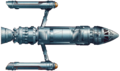 Dorsal view
 -
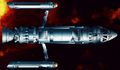 Dorsal view (2)
 -
 Launch facility
 -
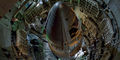 Cockpit (exterior)
 -
 Phoenix and launch rocket
 -
 Separation from launch rocket
 -
 Outbound
 -
 Engage warp engines
 -
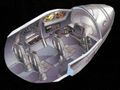 Cockpit (interior)
 -
 Starboard as pect
 -
 Bow aspect
 -
 Dorsal aspect
 -
 Forward dorsal aspect


.png)
.png)
.png)
.png)
Alt Sources