Guide:Cygnus / Cochise / Amerind
_(side).png)
| |
| Cygnus | |
|---|---|
| Class Overview | |
| Category | diplomatic courier / destroyer / scout |
| Operational | 2272 - 2330 |
| Constructed | 45 total: |
| Dimensions | |
| Length |
|
| Beam | 141.7 m |
| Height |
|
| Mass |
|
| Performance | |
| Cruise Speed |
|
| Max Speed |
|
| Endurance | 4 years |
| Complement | |
| Officers |
|
| Enlisted |
|
| Tactical Systems | |
| Beam Weapons | Cygnus
Cochise, Amerind
|
| Missile Weapons | Cochise
|
| Shields | Cygnus, Amerind
Cochise
|
| Laboratories | Cygnus
Amerind Flt I
Amerind Flt II
|
| Transporters | Cygnus
Cygnus (post-2282)
Cochise, Amerind
|
| Auxiliary Craft | 2x work pods |
| Historical | |
| Ships of Note |
|
| Canonicity | |
| Design | SotSF / aridas sofia |
| Name | SotSF / aridas sofia |
| History | SotSF, Timo
|
Background: Hobbyist's Guide
The temporary peace between Klingons and the UFP, imposed by the Organian noncorporeal entities, made a thorough mess of the strategic procurement plans of Starfleet. The latest post- Axanar plans had called for more mobility, an emphasis on border patrol and escort missions, and diminishing interest in attacking large enemy formations and capital ships. This meant the deployment of huge numbers of frigates and cruisers and the gradual downscaling of destroyer procurement, as well as introduction of a small number of dreadnoughts for best possible concentration of reserve firepower. Now the peace (or truce, as Starfleet would have liked to call it) meant that the frigate programs were becoming just as overbloated as the destroyer programs had been.
But despite their significant powers, the Organians were certainly neither omnipotent nor omniscient – and quite possibly not all that interested in protecting the Federation hides after all. Sooner or later, the Federation would have to take responsibility for defending itself again, and once more it wanted to do so from qualitative high ground. Its aging destroyers, many dating from before the Great Awakening, would be spending their last useful years in physical inactivity or bureaucratic limbo. Their replacements ought to represent the latest in technology and tactical thinking as well as in reliability and economy of operations, so that the transition from the old to the new would be a smooth one, giving the Klingons no opening for crying foul. After all, even if the Organian treaty were an empty letter, it was still a markedly useful one in obscuring qualitative changes behind a façade of unwavering quantity.
Thanks to the Organian Peace Treaty, bringing the destroyer fleet to the linear excitation era should have been an undertaking with every chance of controlled and scheduled success. Yet the inaugural Baker class was too carefully controlled, too meticulously scheduled as the optimal response to the inevitable return of the Klingon menace, to be able to adjust to changing circumstances. And change remained a constant in the 2270s, as severe animosities developed between the Federation and some of its lesser neighbors. The feline Xindi made their existence known once again in the early 2270s and led a suicidal attack against Federation core worlds. Starfleet fielded its modern strike cruisers and heavy cruisers in anger for the first time; the resulting bloodbath is one of the most shameful stains in the history of the Fleet, but poorly known among the public since the Xindi were essentially obliterated and unable to press their case afterwards. The disclosure of the 2273 Cammell IV investigation was to a select audience only. Only the 2317 publishing of “For the Living”, by Caitian poet D’irraj, introduced to the average Federation citizen the true horrors of this actively forgotten war.
The heightening tensions prompted the Council to agree to the production of a greater number of modern fast destroyers than originally projected. A response ahead of schedule necessitated an affordable design, in practice a single-engined vessel. After discouraging initial results from the refit of USS Jenghiz, the Saladins were deemed second-rate vessels, good only for a limited set of attrition operations. The newer and heavier Larsons promised more potential for a refit, but were not considered noticeably cheaper than the development of a wholly new destroyer class.
Thus, in 2274, after considerable discussion and disagreement, the Council gave a go-ahead for the construction of 26 ships of such a class, under the long-delayed Cochise subclass mandate. A condition was placed on the acquisition: the remaining unmodified Saladin derivatives would be retired as the new class entered service, and the Federation (II) upgrade program cut from the modernization of all 12 vessels to that of just nine units, including the already completed Alliance. Starfleet complied with this, and initiated development.
An advanced single-nacelle engine design had already been developed by Shuvinaaljis. Dubbed ACE, for Advanced Circumferential Engine, the system actually featured coils similar to those of the LN-64 series, but energized with circumferential plasma feed, and laid out in a very wide arrangement that produced an easily controllable field. A navigational deflector was integrated to the nacelle, sharing a protective hood with the Bussard collectors. Beginning in 2272, the system was installed on a series of six ships with standard Constitution-refit primary hulls. These ships were procured in place of the long- delayed third batch of Hermes scouts, under the subclass name Cygnus – despite the fact that USS Cygnus herself was one of the three units later cancelled from the proposed batch of nine.
The Cygnuses were intended as diplomatic couriers and mobile embassies, ferrying ambassadorial teams to locations where first contact was made, or was about to be made; thus, the scouts or cruisers that had located the potential new UFP member would not have to get tied down with lengthy negotiations. In the background lurked Starfleet’s concerns over the breadth of authority given to starship captains in the field of diplomacy. Perhaps some of that risky independence could now be revoked to stabilize political conditions?
The ships carried 12 phaser VI emitters for self-defense and featured VIP accommodation, negotiation rooms, advanced communications gear and an extensive information gathering and linguistics analysis suite. Their high maximum speed of warp 10, combined with their capacious yet low-cost spaceframe, made them extremely useful in large-scale or high-priority courier operations. Construction was relatively simple, and USS Tucana, USS Corvus and USS Columbia were all completed by 2272, USS Pavo, USS Grus and USS Phoenix following by 2273. It was soon found that these stellar birds were somewhat overweight to be used as the basis for a destroyer design, however, and the plans for the Cochise class were altered (and delayed) accordingly.
In 2283, the design was deemed sufficiently mature and the political climate tense enough for destroyer procurement. The Cochises were equipped with lighter versions of the Constitution saucer: a sector of the aft quarter was cut so that the Avidyne 4088 impulse deck was directly behind the bridge module. This also provided excellent possibilities for exhaust vectoring and violent sublight maneuvering. The connecting neck attached to the saucer closer to the bow as well, and the ACE nacelle was thus better placed for optimal warp field generation. The KR13-L reactor, favored since the earliest Jenghiz experiments, was still used as the main powerplant; it was poor field geometry rather than lack of raw power that had made the earlier vessels such miserable underperformers.
Offensive firepower consisted of a powerful Mk 7 twin medium torpedo launcher, mounted flush to the saucer underside. The assembly took the place of the sensor cluster familiar from the diplomatic ships and many other designs utilizing the standard saucer hull, leaving the destroyers ill equipped for exploration and mapping. But such duties had never really been part of the destroyer mission profile anyway. The heavy defensive armament of 12 phaser VII emitters was controlled by the highly effective Eyas targeting system, this in turn run by an Etrista main computer that was completely dedicated to the offensive/defensive mission. The advanced computing suite put the Cochises well apart from the earlier destroyer conversions, even if long range sensing capability still was severely lacking in accordance with the destroyer tradition. As before, the ships were intended to be operated in conjunction with cruisers or other picket ships that would take care of long range warning and prediction as well as fleet coordination; that the newest generation of such vessels was suffering from many delays and shortcomings was not considered a major problem yet.
Two docking ports were featured on the sides of the torpedo deck, and two on the saucer; in addition, the bridge assembly held one port. No shuttles were carried, although shuttlepods could be berthed inside the two saucer docking bays, and work pod interfaces were inset into the saucer cutout surfaces. Two six-pad transporters and one cargo platform were considered quite sufficient for landing and boarding party as well as replenishment purposes.
The type remained in service until the late 2310s, although eight of the vessels were retired in the 2290s because of Khitomer Accords arms limitations. The Cochises were well liked among destroyer crews, and performed admirably for single-engine ships. Still, no attempt was made in the 2300s to develop a follow-on design, and the medium destroyer fleet shrank to almost zero for the following decades of peace. Holding the line were two-nacelled Polaris units, ships of far greater versatility, survivability, mass and cost.
In 2288, the highly efficient Cochise configuration was adapted for scoutship use. Starfleet had learned its lessons from the Hermes variants; the new Amerind class ships made no attempt to conform to survey duty, which was better handled by the likes of Oberth class. Instead, they had plenty of everything the Oberths lacked: an exceptionally powerful, frigatelike defensive armament of 12 phaser VIIs for deep penetration of enemy space, excellent impulse maneuverability, high maximum warp speed, low emission profile, and a long-reaching sensor suite that took the place of the Cochise torpedo deck. Thus, the ships were superbly suited for military scouting duty. Sensory support and control of destroyer formations was still on the formal agenda as well, but in practice the retiring Wilkerson class passed the destroyer leader baton to the similarly twin-engined and more lavishly equipped Ticonderoga class in the late 2280s.
With the flotilla leader role gone, attempts were made to increase the scientific capabilities of the Amerinds. Four ships (NCC-626-629) had been completed by 2291; the remaining nine (NCC- 2046-2054) received upgrades to their sensors, mission computers and laboratories, and adopted a survey and charting role that changed from a thin smokescreen to a principal mode of employment with the Khitomer peace. Many argued that the major strengths of the design were being wasted in this role, but aggressive gathering of military intelligence was out of the question in the political climate of the late 2290s and early 2300s. Some sources do suggest that such operations were continued under cloak at least until 2299 against both Klingon and Romulan targets. These sources have later been largely discredited, however.
In theory, a slight drop in scouting capacity resulted after the retiring of the late Hermes models and associated designs – the thirteen Amerinds alone were not sufficient for covering the expanding exploration zones, and the first batch of eighteen ships of the Constant class did not see active service until just before the turn of the century. Yet decreasing offensive and defensive commitments resulted in the use of other starship types for scouting and exploration. Starfleet did not seriously consider the potentially costly conversion of Cochises into further scouts, preferring to maintain at least some sort of a destroyer reserve. Instead, a second Constant batch of twenty was augmented by the acquisition of numerous Surak units from Vulcan, and by the 2320s, the introduction of the balanced and successful Scylla class marked return to business as usual. All of the Amerinds had by then been driven well past their structural lives; none were saved from swift scrapping.
Registry
Gallery
-

-
 Cygnus (2265)
 -
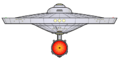
-

-
 Amerind
 -

-
 Cygnus
 -
 Cochise
 -
 Amerind

_(bow).png)
_(dorsal).png)
.png)
.png)
_(stbd).png)
_(stbd).png)
_(stbd).png)
Supporting Documents
Notes
References