Guide:Sevaijen
.png)
| |
| Sevaijen | |
|---|---|
| Class Overview | |
| Category | Light Cruiser |
| Operational | 2138 - 2196 |
| Constructed | 162 total |
| Dimensions | |
| Length | 140.2 m |
| Beam | 89.0 m |
| Height | 30.3 m |
| Mass | 180,000 mt |
| Performance | |
| Cruise Speed | w 3 |
| Max Speed | w 6.4 |
| Endurance | 1 year |
| Complement | |
| Officers | 6 |
| Enlisted | 49
|
| Tactical Systems | |
| Beam Weapons |
|
| Shields |
|
| Transporters | 2154 selected refit
|
| Auxiliary Craft |
|
| Historical | |
| Ships of Note |
|
| Canonicity | |
| Design | John Eaves STO concept art |
| Name | Bennett: A Choice of Futures |
| History | Bennett: A Choice of Futures
|
Background: The Hobbyist's Guide
At a time when Earth engineers struggled with making 150-meter warships move at warp two for brief dashes, the Andorian Imperial Guard was re-equipping its deep space units with light cruisers capable of sustaining warp three till fuel exhaustion and of pouncing on the enemy at warp six or better. Key to this superiority was the Andorian mastery of graviton/subspace forcefields, a versatile defense against kinetic or directed-energy attack but also a precision tool for containing antimatter annihilation reactions and regulating the flow of warp plasma.
The first-ever application of variable compression nozzle technology gave the Sevaijen class not only a performance edge over neighboring cultures, but also independence from dilithium. Competition for the scarce resource had been one of the many reasons straining the relationship between Andoria and Vulcania. That the Imperial Guard now pursued this resource with slightly lesser ferocity was no reason to de-escalate: the Sevaijen was provided with two wingtip phased particle beam pods capable of piercing the defenses of any Vulcan combat vessel and protected by forcefield deflectors. Navigational deflection beams fired from the forward ends of the two warp nacelles that were stacked at centerline and there was a potent combat shield generator amidships, just aft of the crew section. Typically for the species, a crew of just 55 operated the vessel as such a sizeable and potent combatant—a practice made easier by the equally typical low endurance of the Sevaijen.
Much like the earlier generations of antimatter-powered warships, the Sevaijen was rather heavily dependent on support from tenders in deep space maneuvers. Their burden was slightly alleviated by the lack of physical ordnance aboard the light cruisers: there was no torpedo launcher nor a bomb deployment system and the phase guns had forcefield-based rather than solid-walled resonance chambers and heavy duty power cells capable of tens of thousands of firing-recharging cycles before replacement. For movement of supplies, there were two ventral shuttlebays and hangar space for two light shuttles, with additional space for eight breaching pods.
After contact with Humans, the Imperial Guard began regretting its disinterest in deep space operations. The new species had surprising things to offer, among them a perfectly functional version of the Vulcan teleporting device, complete with the secret biocompatibility feature. Imperial Guard units started receiving their first transporters in the late 2140s, offering hints on the timing of the contact, still unrecorded by mainstream history. First installed aboard Kumari battle cruisers and then Thofsin cruisers, by 2154 they found their way aboard Guard Sevaijens, out-dating overnight their breaching pods and operating doctrines.
When Andor entered the Romulan fray in earnest, Sevajiens soon took on the role of skirmishers—not because they would have been particularly well suited for the role, but because keeping them deployed alongside Kumari or Thofsin formations formed a deadly threat to the bigger ships in case of Romulan telecapture attack. Independent Andorian action in the war quickly waned. Prewar clandestine trade agreements with Earth, made primarily to spite the Vulcans, also were largely let to expire. Transfer of key military technology continued nevertheless, in a quid pro quo of sorts for the teleportation secrets (which Earth never admitted to having sold). Acquisition of Andorian forcefield shielding technology played a crucial role in the later years of the UESF war effort, even though high power applications of the alien magic tended to wreak havoc with Terran warp fields.
At the conclusion of the conflict, Andor had learned how to better deal with Romulan information warfare and was confident in deploying the Sevajiens as part of the UFP Star Fleet, only retaining two dozen Guard units outside federal control. It had also gained a new appreciation of Terran warp technology and realized that the Sevajien drive type would not remain superior for long. The advantages of dilithium foci might not have been obvious to UESPA, which was struggling with reliability issues and trying to integrate forcefield constriction to its own engines. Andor offered help in the latter effort, but also quietly began preparations for retiring the Sevajien generation of ships en masse around 2170 and replacing them with types developed jointly with the close partners in the United Federation of Planets. All survivors of the production run of 162 were decommissioned by 2196.
Gallery
-
 Sevaijen (bow line)
 -
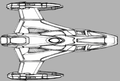 Sevaijen (dorsal line)
 -
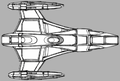 Sevaijen (ventral line)
 -
 Sevaijen (port bow aspect)
.png)
.png)
.png)
.png)
Star Fleet Registry
- USS (NCC-16)
- USS (NCC-21)
- USS (NCC-27)
- USS (NCC-50)
- USS (NCC-52)
- USS (NCC-57)
- USS (NCC-58)
- USS (NCC-61)
- USS (NCC-62)
- USS (NCC-66)
- USS (NCC-68)
- USS (NCC-70)
- USS (NCC-72)
- USS (NCC-73)
- USS (NCC-76)
- USS (NCC-80)
- USS (NCC-84)
- USS (NCC-93)
- USS (NCC-96)
- USS (NCC-98)
- USS (NCC-100)
- USS (NCC-101)
- USS (NCC-105)
- USS (NCC-107)
- USS (NCC-109)
- USS (NCC-112)
- USS (NCC-116)
- USS (NCC-117)
- USS (NCC-120)
- USS (NCC-123)
- USS (NCC-125)
- USS (NCC-127)
- USS (NCC-133)
- USS (NCC-135)
- USS (NCC-138)
- USS (NCC-139)
- USS (NCC-140)
- USS (NCC-145)
- USS (NCC-148)
- USS (NCC-150)
- USS (NCC-158)
- USS (NCC-159)
- USS (NCC-161)
- USS (NCC-164)
- USS (NCC-166)
- USS (NCC-172)
- USS (NCC-174)
- USS (NCC-178)
- USS (NCC-184)
- USS (NCC-187)
- USS (NCC-194)
- USS (NCC-195)
- USS (NCC-198)
- USS (NCC-230)
- USS (NCC-236)
- USS (NCC-240)
- USS (NCC-245)
- USS (NCC-250)
- USS (NCC-251)
- USS (NCC-254)
- USS (NCC-261)
- USS (NCC-263)
- USS (NCC-267)
- USS (NCC-269)
- USS (NCC-272)
- USS (NCC-274)
- USS (NCC-275)
- USS (NCC-279)
- USS (NCC-283)
- USS (NCC-289)
- USS (NCC-299)
- USS (NCC-306)
- USS (NCC-308)
- USS (NCC-309)
- USS (NCC-313)
- USS (NCC-314)
- USS (NCC-315)
- USS (NCC-319)
- USS (NCC-331)
- USS (NCC-338)
- USS (NCC-340)
- USS (NCC-342)
- USS (NCC-343)
- USS (NCC-345)
- USS (NCC-346)
- USS (NCC-351)
- USS (NCC-353)
- USS (NCC-358)
- USS (NCC-359)
- USS (NCC-362)
- USS (NCC-363)
Notes
- The concluding paragraph clearly indicates the majority of Sevaijen were transferred to the UFP Star Fleet, with 24 retained by the AIG. Since they were rather involved during the war—and no mention was made at their lack of loss—I'm presuming a loss rate of 17% of the original 162 and retirement of another 12%, so that 91 are transferred to Star Fleet. They are registered in the standard NCC range. (The lead ship was not transferred to Star Fleet.)