Guide:Samson
_(stbd).png)
| |
| Samson | |
|---|---|
| Class Overview | |
| Category | fleet tug/tender |
| Operational | 2261-2298 |
| Constructed | 6 |
| Dimensions | |
| Length |
|
| Beam |
|
| Height |
|
| Mass |
|
| Performance | |
| Cruise Speed | w 6 |
| Tow Speed | w 3 - 5 |
| Max Speed | w 8 |
| Endurance | 5 years |
| Complement | |
| Officers | 4 |
| Enlisted | 48
|
| Passengers |
|
| Tactical Systems | |
| Shields |
|
| Transporters | Flight I
Flight II
|
| Auxiliary Craft |
|
| Historical | |
| Ships of Note |
|
| Canonicity | |
| Design | FASA |
| Name | FASA |
| History | FASA
|

Although immediately following the mediumweight Master class tugs of the 2220s-30s in the registry scheme, the Samson tugs of the 2260s were among the heaviest in Fleet arsenal. These massive vessels were intended for the tasks too daunting for Ptolemy or Keppler units to handle: recovery of stranded dreadnoughts and possible future battleships, delivery of heavy orbital outposts and other installations, trajectory correction of asteroids for industrial or military purposes…
In light of the special and specific mission of the ship, it is perhaps surprising that the design was in fact a joint venture between Starfleet-sponsored Chiokis and the wholly commercial Rantura Shipping Lines. A civilian demand did exist for hauling equipment such as ore refineries to the newly opened frontier in as large and preintegrated units as possible. The more complete a factory could be delivered to the distant target, the more quickly the commercial operator could begin making profit. In the untamed depths of the Treaty Exploration Zone, size also translated to security: large factories would be more likely to come under Starfleet protection than small ones.
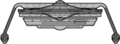
Between Rantura and Starfleet, a dozen hulls were procured. The forward half of each was a conventional saucer, while the aft extensions enclosed the impulse engine assemblies and main power systems. Beneath the hull at ship centerline was the massive cylindrar pod of the telescoping towing arm, flanked by cargo holds and shuttlecraft facilities to starboard and workshops plus a navigational deflector assembly to port. Empty mass reached a cruiserlike 160,000 tons without the twin PB-31 engines outrigged on arching pylons. Yet the bulk of the vessel could be made to move with just 48 crew and four officers; an additional 44 repair crew were usually carried on tender missions, although more than a hundred skilled specialists could be accommodated if need be.
The six units registered for Starfleet use were delivered between 2261 and 2264. All underwent an extensive overhaul and warp propulsion upgrade in the mid-2270s, eventually coming to mount LN- 64F engines on new, lightweight pylons, and KR16-A customized powerplants in a slightly reshaped aft hull. No armament was ever installed, however, nor were there sensors or computing systems beyond basic navigation gear. The civilian units were delivered in essentially the same original configuration as the Starfleet ones, even though their engine refits took different paths and resulted in a longer service life. Starfleet was satisfied to operate the Samsons till 2298, replacing them with Doppler class heavy tugs in a somewhat delayed but highly welcome move at the turn of the century.
Gallery
-
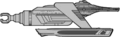 Timo's interpretation
 -
-
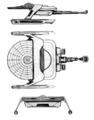 Original FASA
_(bow).png)
.png)
Notes
- Adrasil: I much prefer Timo's interpretation of this heavy "lifter", especially since it transports entire stations. However, I've added the FASA perspective, as it provides a possible depiction of the 2/3rds saucer-1/3 flat deck that Timo references in the text. Both represent the refitted Flight II version, rather than the TOS-era original.
References