Guide:Coventry/Benning
_(side).png)
| |
| Coventry | |
|---|---|
| Class Overview | |
| Category | strike frigate |
| Operational | 2247-2295:
|
| Constructed | 20 total: |
| Dimensions | |
| Length | 245.1 m |
| Beam | 127.1 m |
| Height |
|
| Mass |
|
| Performance | |
| Cruise Speed | w 6 |
| Max Speed | w 8.0 |
| Endurance | 4 years |
| Complement | |
| Officers |
|
| Enlisted |
|
| Troops | 15 pilots (Coventry)
|
| Tactical Systems | |
| Beam Weapons | Coventry, Benning (original)
Coventry, Benning (2255 refit)
Coventry, Benning (2265 refit)
NCC-1234, 1237, 1239, 1240 (2265 refit)
|
| Missile Weapons | Coventry (original)
Benning (original)
Coventry (2255 refit)
Benning (2255 refit)
Coventry, Benning (2265 refit)
|
| Shields |
|
| Laboratories | 1x general purpose |
| Transporters | Original
2271 upgrade
|
| Auxiliary Craft | Conventry strike configuration 1
Conventry strike configuration 2
Conventry strike configuration 3
Planetary survey configuration 1
|
| Historical | |
| Ships of Note |
|
| Canonicity | |
| Design | Coventry SotSF/Evan Mayerle, Benning Eric Kristiansen |
| Name | Coventry SotSF, Benning Eric Kristiansen, Theseus LUG |
| History | Coventry SotSF, Benning Eric Kristiansen, Theseus LUG
|

Even before the Klingon fleet was beaten back at Axanar, certain factions of both Star Fleet and the Federation Council expressed concern over the unbounded escalation. Most criticism was directed towards the destroyer and frigate programs which rallied for suspiciously high numbers of required ships. At a time when scores of cruisers were being churned out, the simultaneous procurement of advanced Saladin variants and the competing Larsons was a heavy burden, and ultimately the Larson program was significantly scaled down. Similarly, the Loknar, Miranda and Surya frigates all both filled the traditional frigate niche and expanded to overlap the destroyer and light cruiser roles. Star Fleet had never operated such large numbers of ships of such high capabilities, and the admirals had a hard time convincing the Council of the need for the vessels. In this situation, the program for introducing a still heavier frigate variant, and in considerable numbers, was bound to face stiff resistance.
The Coventry class braved the odds by the virtue of being the most cost-effective way of providing much-needed hangar decks for ground assault operations; these were presumed imminent if the Klingons continued their advance. The ships were simple and straightforward partial modernizations of the oversized and underpowered Anton light cruiser of 2239, and initially they were actually dubbed the Anton class Mk II variant. Star Fleet decided to play a previously successful card, however, and gave the design a new identity as Coventry class heavy frigates.
Even under this politically palatable designation, just ten newbuild ships out of the hoped-for eighteen were authorized. Their introduction in 2245 was a debated move when even many of the warhawks who had supported general escalation now felt that frigates should give way to increased destroyer numbers. Delays in financing (as well as the utilization of the well-known trick of procuring ships under already-approved but delayed NCCs, in this case those of unbuilt Antons) meant that the ships were deployed two years later than the basic-configuration Suryas, but with NCCs 800 units lower than the Surya ones. Constitutions, Mirandas, Loknars and Larsons also fell in between these numbers. Three more ships were added to the original production batch in late 2246, and a fourteenth vessel in early 2247, completed in late 2248. A pause then followed as Star Fleet decided on the best strategy for obtaining further frigates: should the Miranda, Surya, Coventry or Loknar lines be standardized upon?
In early 2249, USS Noshiro had been completed to test the blending of Miranda and Surya attributes. In 2251, USS Benning was created to hybridize Surya and Coventry, chiefly by matching the shorter hull of the former with the sturdy and simple vertical pylons of the latter. An aft-firing torpedo tube was also brought into the mix, but by installing it in the superstructure rather than by adopting a Miranda pod. Both vessels were eventually assigned an operational role and the Benning was given the official blessing for five successors. Yet in the end, no champion could be summoned from the confused ranks, and the scant funds and political capital were spent on a second run of Loknars, fully equipped with the matured technologies of the 2250s.
In technological comparison, the Coventries were simple machines. Many systems, including the PB-47 engines, were direct substitutions of old Anton hardware with counterparts projected for Constitutions and ultimately used in the Achernar subclass heavy cruisers. The armament of the Coventries in turn originally featured lasers and torpedoes identical to those aboard the Suryas. After 2257, they were refitted to the level of the late-standard Suryas, save for the installation of a twin phaser VII unit instead of the two phaser VIs, and (in a controversial, expensive and only semisuccessful move to increase interoperability with cruisers) the selection of more modern fire control systems. Between 2261 and 2262, eight vessels were also modified for improved anti-ship defenses with the addition of auxiliary deflector spires. Finally, in 2265, the number of phasers was doubled to general fighting frigate standards.
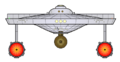
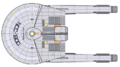
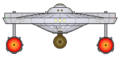
Three different standards were applied on Coventry hangar decks. The initial production run of ten featured two bays 45 by 25 by 9.5 meters in dimensions, while the next three ships had longer and higher facilities with somewhat more limiting doorways but with a greater variety of support systems. In the fourteenth ship, USS Indus, the two landing bays were joined with a transverse hangar just ahead of the main engineering area. The large hangars could well be utilized for exploration, colony support and rescue missions, de-emphasizing the military aspects of the ships without actually sacrificing any military capacity. In combat duty, the hangars could house as many as twenty small tactical craft or, more usually, four assault shuttles and six fightercraft. The Benning vessels embarked a much smaller complement on their shorter bays, and could not credibly receive the strike frigate designation that had helped the actual Coventries through the budgetary troubles. Their small craft support facilities were originally even more austere than those of the Suryas, yet improvements were introduced throughout the 2250s and 60s; some of these manifested as protrusions of new machinery atop each bay.
The ships equipped with modern duotronics easily kept going even when the main body of the original Suryas faced modernization or retirement, and Star Fleet decided to run the ships to the end of their structural lives instead of opting for further modernization. A shift in mission profile from convoy escort and local defense duties to a pure planetary assault support role eased the burden on the aging vessels. The most modern assault shuttles, assault barges and sub-impulse assault craft were utilized as the main offensive muscle of the Coventries; considered secondary to the mission, the old Awalt torpedo system could well be retained till the retirement of the last ships of this standard.
The Benning ships, lacking in excuses, did eventually require a midlife (or, rather, final-quarter-life) upgrade. The updating aimed at maximal commonality with the Avenger/Miranda (II) refit, and is mentioned in connection with that project. Option for a torpedo module was included in the 2275- 2295 refit, but ‘roll bars’ were seldom fitted on these frigates, so outwardly the four units ended up resembling the Miranda (II) class. A further blow to class identity came from the loss of the lead ship in 2271, just before she was scheduled to be decommissioned for the modifications; this resulted in the quartet nominally being considered the Theseus class.
The first loss had been suffered in 2254 already, when USS Achilles (NCC-1248) was destroyed in the Battle of Theta Kalyb with all but 53 of her crew. The second Coventry to be lost was USS Sverdlov (NCC-1238), failing to return from a test run of the new PB-51 series engines in 2258. Thankfully, Star Fleet was soon able to report that the tragedy had only claimed the lives of a minimal testing crew of 42, including sixteen specialists from Chiokis; on the other hand, it ended the PB-51 project, effectively terminating all further PB series linear warp engine research. The last true Coventry, USS Constant (NCC-1236), succumbed to budgetary cuts in 2295, cutting short her new career as shuttle pilot training vessel; she was followed to the junkyard by the last Achernar, USS Sol (NCC-1744), bringing another era to an end. The ships brought to Avenger-like standards were absorbed into the main body of what would soon be known as the Miranda class, and still remain in the inventory.
Gallery
-
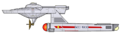 Benning (2265)
 -
-
-
 Coventry (2265) (side)
 -
-
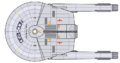
_(side).png)
_(bow).png)
_(dorsal).png)
_(bow).png)
_(dorsal).png)
Notes