Guide:Ishinomaki
.png)
| |
| Ishinomaki | |
|---|---|
| Class Overview | |
| Category | fuel transport |
| Operational | 2231-2266 |
| Constructed | 36 |
| Dimensions | |
| Length | 237.0 m |
| Beam | 111.1 m |
| Height | 70.0 m |
| Mass | 647,900 tons |
| Performance | |
| Cruise Speed |
|
| Max Speed | w 6 |
| Endurance | 1.5 years |
| Complement | |
| Officers | 9 |
| Enlisted | 72
|
| Cargo | 91,000 tons |
| Tactical Systems | |
| Beam Weapons |
|
| Shields |
|
| Transporters |
|
| Auxiliary Craft |
|
| Historical | |
| Ships of Note |
|
| Canonicity | |
| Design | STXI/John Eaves |
| Name | Richard Mandel |
| History | own
|

The ebb and flow of Klingon offensives in the 2220s and 2230s was vastly preferable to a relentlessly unified frontal attack. By giving Starfleet time to redeploy, replenish and replan, it promoted strategic thinking wherein fleets of ships could be constantly moved between hot spots, rather than being stationed around fortified bases or targets to be defended. In the long line of Starfleet excuses for its inferior numbers, the idea of a ‘lean and mean’ force of conventional but highly mobile assets was now taking the place of the ‘silver bullet’ stratagem.
Yet ‘lean and mean’ was as elusive a goal as ‘silver bullet’ had been, because every element of a mobile task force had to represent the latest in propulsive technology – in other words, every ship, from cruiser and destroyer to tug and tanker, had to be capable of supercruise. Even by the 2230s, this was not true of replenishment units, the majority of which still were adapted civilian transports of limited range and speed. Only a select few elite units could hope to be accompanied by a Ptolemy class supertender. The idea of providing forward staging areas with enough neutronic fuel to keep a task force going was still more or less science fiction. Thus, once a critical mass of Ptolemy units had been acquired, an immediate follow-up order was placed on a less ambitious supercruise design, to be built primarily as a fuel transport.
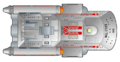
The PB-29 was deemed too expensive for the intended paired application, and the somewhat dated PB-21 of the Burke and Aldrin frigates was selected instead. Also adapted from these projects was the spaceframe itself, a standard Geering saucer complete with weapons berths. Additions to the basic frame included a bulge at the bow for the large deflector required at supercruise, four impressively bulky Scarbak BTE impulse engines at the trailing edge (two per side), and a centerline powerplant block between them. A hangar for work pods and replenishment shuttles adjoined the power block, and heavy duty tractor beam emitters were installed at the aft end of the structure. However, main cargo carriage was by the means of two ventral grapples. These usually held massive canoe fairings that featured fixed neutronic hydrogen tanks at the forward ends plus a series of deployable tanks held in rows of up to ten. In theory, the grapples could handle standard containers as well, but if these were fully loaded, the ship would be slowed to a crawling pace at warp and impulse alike.

Under the nominal fuel load of 90,000 tons, the PB-21 engines flanking the main hull could propel the ship to a top speed of warp six – but not to the required supercruise, not quite. A partial load would allow warp four to be sustained, though, and this was standard operating procedure for the class during runs through or near contested space. Klingon countermoves might be deterred by the six light laser emitters, even though targeting systems were modest in scope and reliability. It would have made no sense to invest in anything more potent, as the goal was to procure some eighty of these already rather expensive vessels (as well as release the design to commercial use, even if without a permission to install armaments of any sort).
Construction between 2231 and 2236 yielded 76 operational hulls of the Ishinomaki class for Logistics Command use, plus two training ships that lacked the cargo grapples and outermost impulse engines and were used for a variety of familiarization and basic training duties. While the training vessels stayed close to Earth for their entire careers, all the fuel transports were heavily engaged in frontline operations. In theory high-value assets, they were in practice forced to perform most of their supply runs unescorted, as the very idea behind the project had been to increase Starfleet’s flexibility and reach, not to tie down its already limited resources. Inevitably, there were losses, many related to the general dangers of deep space rather than to Klingon activity.
Curiously, the concept of a supercruising fuel transport never evolved into a supercruising fleet tanker. Freely roaming task forces remained a rarity in Starfleet doctrine, as there remained other factors to tie them down to fixed assets even if forward fuel replenishment was provided for. No effort was made to fit the Ishinomaki class with a direct fuel transfer receptacle similar to that of the Ptolemy class. Nor were engine upgrades performed even after various military and commercial alternatives to PB-21 became available in the 2250s. Instead, the ships were gradually replaced by commercially obtained stock, such as the Arcadia class that was externally quite similar to Ishinomaki yet cruised at warp three. True high speed tankers would have to wait, and the Ishinomaki class would not survive to see their emergence. The last of the older fuel transports were removed from Starfleet service in 2266, a decade before the introduction of the fast Huntington class.
Notes
Gallery
-
 bow with neutronic hydrogen tanks
 -
 dorsal
.png)
.png)