Guide:Vanguard

| |
| Vanguard | |
|---|---|
| Class Overview | |
| Category | Fast Transport |
| Operational | 2144 - 2180 |
| Constructed | 32 |
| Dimensions | |
| Length |
|
| Beam |
|
| Height |
|
| Mass |
|
| Performance | |
| Cruise Speed |
|
| Max Speed |
|
| Endurance |
|
| Complement | |
| Officers |
|
| Enlisted |
|
| Passengers |
|
| Cargo |
|
| Tactical Systems | |
| Beam Weapons |
|
| Shields |
|
| Auxiliary Craft |
|
| Historical | |
| Ships of Note |
|
| Canonicity | |
| Design | SFC |
| Name | SFC |
| History | SFC
|
To meet the heavy transportation needs created by the rampant expansion of Earth’s sphere of
influence, the UESF needed something more substantive than the modular freighters so far built. In
May 2142, the recently instated Fleet Logistics Division launched the acquisition of a large warp
transport capable of warp three when empty and warp two when the specified 300,000 cubic meter
cargo volume was loaded to capacity. To provide this cargo volume, the ship was to accommodate
multiple containers of a new military standard, comprising a 65 m x 40 m cylinder midsection and
hemispherical endcaps and featuring e.g. unpressurized, pressurized, fluid and general goods
configurations.
Several terrestrial shipbuilders offered growth models of their cargo tugs. Grapples for the new type of container could easily be introduced, and the tonnage requirements could be met or exceeded as well. The desired warp performance remained elusive, though. To keep the load moving at such speeds, the tug would basically have to be all engine, almost as gargantuan in size and mass as her fully laden cargo container. Highly tuned propulsion systems were proposed by CWD, Westinghouse and SEMP, but none could be guaranteed to withstand the rigors of a multi-month cruise to the frontier at the speeds involved. Finally, Starfleet turned to the Vulcans for obtaining the rights to a ring-element warp engine in the desired size and performance range.
The tug put together by Dalian GIS was not quite as elegant as a Vulcan engineer might have sculpted her, but got the job done. A conical midbody housed the mammoth reactor for generating power to the 25,000 ton warp ring, which in turn supported a quartet of impulse assemblies on its outer surface. The cargo containers were to be rigged immediately astern, the first held in a circular grappling ring mounted on an open trusswork. Instead of being provided with a grapple of its own, the optional second container could be docked directly onto the aft end of the first, thanks to the exceptionally sturdy construction of the vessels and their docking adapters. Internal stowage was also available, though, in the form of plate-covered (if unpressurized) hold space in the forward part of the main hull. This volume could be flexibly configured for various cargo types, or provided with pressurized compartments for the carrying of passengers (or, in practice, troops; up to a thousand could also be towed in specialized containers in wartime discomfort). Finally, fuel tanks similar to those of a Y class rig could be clustered in the bow, eight being a possible load but just three to four being more usual. With a full fuel load, the tug had an admirable operational range of 100 ly.
The ring drive technology combined reliability with high energy throughput, and allowed for operations under heavy load. The main drawback was lack of maneuverability, with asymmetric loads posing a secondary cause for concern for the fine-tuned, highly axis-symmetric warp field. The new military container was the perfect match for the design, as the cargo train concept imposed matching maneuverability limitations while ensuring symmetric loading. The sort of careful, inflexible scheduling that was required for successful shipping with these unprecedentedly large cylinder vessels was not the commercial sector’s cup of tea, though, and the ECS placed no orders for tugs of this type. Thus, UESF Logistics Division could fine-tune its properties to exactly meet its frontier needs, and placed a series of orders for an eventual 32 deep space tugs of Vanguard class.
For the first decade of Vanguard operations, Earth’s ambitions did not extend beyond 20 ly from the home system, and the UESF ran very few operations on the outer rim. In the Romulan War, the ships in turn often traveled lightly loaded in order to maintain maximum warp. Quick hops from outpost to outpost were at times performed with internal cargo only, or with light cargo rigged onto the bow grapples next to fuel tanks. Traveling from Earth to war zone starbases at full load would still have taken several months or years. Yet trips like this were rare, as the cargo traffic between the battlefront and the large Earth colonies or Vulcan or Andorian holdings near it was strategically the most important task for the class.
The rather large military crew of 94 could thus ride in relative comfort despite the limited accommodation volume. Main berthing was beneath the command sail that jutted out of the side of the cone hull. Various other pressurized compartments and corridors snaked through the spaceframe, providing access to engineering and cargo handling functions, bow and stern docking tubes and auxiliary craft berths. The propulsion ring also held two defensive plasma cannon stations, one on the top impulse assembly, another on the bottom one. An often carried additional feature was a large subspace communications dish, often bolstered by a variety of realspace EM antennas, depending on the theater of operations and the role of the transports there. Extensive UESPA survey packages were also frequently carried, and a number of specialists dedicated to their operation. At times, the vessels were summoned to act as command posts in addition to their usual role as convoy flagships and tenders; a special module for this purpose, containing an antenna farm and a spherical pressurized command center, could be accommodated in the aft container grapple.

Soon after the commissioning of the first Vanguards, the class also suffered its first losses, as USS Atlas (FV-304) fell prey to a covert Romulan attack, a possible test run of the remote capture techniques the enemy would later practice. Convoying the ships and adding cruiser protection allowed the continuation of operations beyond the outset of open war, but tied down interstellar-capable warships to escort duty. Still, the Vanguards were essential in providing supplies to the UESF elements operating a hundred lightyears away from home.
The class was withdrawn from duty two decades after the war, never receiving NCC registries, and several classes unrelated to the design were introduced to fulfill Starfleet heavy transportation requirements. The old tugs still had plenty of potential as cargo drones, however, thanks to their very stable and reliable engines and simple flight controls that could easily be slaved to onboard computers and external commands. Technologies and operating practices from the recently introduced dedicated Boyden drones were smoothly translated to the project, guaranteeing operational success and considerable service longevity. The drone conversions were considered a class of their own, were given Q series registries (later listed as G series), and generally referred to by the name of the first tug converted, USS Ganymede (formerly FV-310).
The Vanguard design lineage was continued in the civilian sector for a while, until the introduction of affordable medium load, high warp transports. These advances led to the transformation of transports in the Vanguard size range: the tug and container rig concept was abandoned for the time being, and heavy tugs changed from from primary cargo vessels to specialized long range carriers of oversize loads. There was no market for the obsolete Vanguard derivatives, and all vessels of this type were scrapped before the 2280s. Structurally similar Vulcan types remain commercial successes throughout the quadrant, however.
Gallery
-
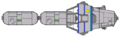 A Vanguard with containers
 -
 A Vanguard with the command post module
.png)
.png)