Guide:Clark
.png)
| |
| Clark | |
|---|---|
| Class Overview | |
| Category | space tank |
| Operational | 2150 - 2178 |
| Constructed | 20 |
| Dimensions | |
| Length | 61.0 m |
| Beam | 97.3 m |
| Height | 21.4 m |
| Mass | 13,050 mt |
| Performance | |
| Max Speed | w 1.0 |
| Endurance | 1 week |
| Complement | |
| Crew | 10
|
| Tactical Systems | |
| Beam Weapons |
|
| Missile Weapons |
|
| Shields | Polarizable armor |
| Canonicity | |
| Design | SFC |
| Name | SFC |
| History | SFC
|
Background: Hobbyist's Guide
The introduction of hull polarizing in the 2110s rather thoroughly transformed Earth space combat doctrines. It was no longer vital for a ship to get in the first shot nor fatal for her to receive a single plasma bolt or even a nuclear projectile. In practice, this meant increased survivability at shorter engagement ranges and decreased maneuverability requirements. Quite naturally, the UESF interest quickly turned to the use of slow, yet heavily armed and armored, space fortresses.
The primary mission of such fortresses would be system defense, in which sustainable speed played a minor role to begin with. Reaction speed still mattered, however, and even the earliest and most austere designs for armored system defense weapon platforms featured warp engines. Propulsive endurance was limited to short dashes, yet the machines were still too mobile to justly be called "fortresses". The name "space tank" soon caught on and production began in 2122 on the first tentative designs.
The early Guderian and Tal thousand-ton space tanks were not success stories, however. In absence of real threats, the best balance of weapons, protection, and mobility could not be plausibly established, and simple cost analysis favored the use of lightly protected and armed yet very mobile lifting body designs. Only a dozen Guderians and Tals were produced. The first half of the 22nd century clarified the nature of the interstellar threat and steered Earth farther away from the concept of space tanks. Yet the attack on the Delta VII mining outpost in 2146 demonstrated the need for system defenses in Human dwellings other than Sol. As constructing such defenses across interstellar distances was well beyond UESF capabilities at the time, mobile space fortresses were the only viable solution.

The space tanks to be sent to guard distant systems were significantly larger than the Guderian and Tal types. The first Manta class craft, completed in 2149, massed 1,890 tons before the installation of warp engines and measured almost seventy meters from wingtip cannon to wingtip cannon. The Clark class of 2150 was larger still, its total mass some 3,050 tons when fitted with six 200 MW and two 900 MW plasma cannon, two missile tubes, and carrying ten crew. When the UESF began shipping out the components of twenty Clarks to Vega, the first true diplomatic conflict between Earth and Vulcan began to brew.
Defense of the Human home system was acceptable and prudent, even according to the Vulcan principles of pacifism. However, deployment of permanent warship forces in "non-native" systems ran contrary to Vulcan policy. The alternative acceptable by Vulcan standards, reliance on starships deployed on demand, was not available for the ship-starved UESF. When the cruiser V’lith arrived to "escort" the transports carrying the Clark components, the UE Senate considered recalling the shipments. However, the mechanisms of star travel worked in Earth’s political favor for once: it would have been unsafe to turn the ships back after midpoint, especially after the Nebukadnessar sprang a leak and the reactor of the China Beach began acting up. The space tanks arrived at Vega as planned and were assembled by February 2152.
Meanwhile, production of further Clark units was halted while diplomats fought the Vulcan ban. This time, the advantage was on the Vulcan side, as the Xindi crisis diverted attention from traditional in-system defenses to preemptive deep space missions and rapid interdiction. For the better part of the decade, the UESF only brought up the space tank argument when it needed leverage for other acquisition programs or military moves and never seriously considered resuming Clark production.
When the tanks finally were tested in battle, results were mixed. On April 17th, 2159, they made a weak showing: Romulan light units blew up the orbital spaceport of Vega and retreated before the Clarks had a chance to concentrate their fire. The second engagement, on May 21st, was a splendid success, however. Two Romulan cruisers were immobilized and prompted to self-destruct, a third destroyed outright, and the invasion of Vega averted. All this was accomplished to the loss of four tanks and without the involvement of the destroyer Concord replenishing in the system. Belatedly, the UESF began deploying space tanks on other Human systems as well, even as the fleets were gearing up for an offensive.
The Clarks at Vega remained in service until 2178, fourteen units persevering through the cannibalization of the other two. System defenses of completely different type were being erected at the time and training of space tank crews was discontinued in 2173 already. No tank-type craft moved in to replace the Clarks; instead, Vega became home port for the light cruisers Sahara (NCC-921) and Los Angeles (NCC-930) and garrison for a regiment of Marines. The tanks were floated down to the planetary surface and dismantled for raw materials—save for a single specimen preserved for decorative purposes at the gate of the Glass Plains garrison.
Gallery
Notes
- The long-standing idea I had was to substitute Masao's fan-canon Archer design for the rough and vague Spaceflight Chronology vessel. However, my confidence in Adrasil to make an interesting and reasonable vessel out of the original is strong enough to want to go back to the source material.
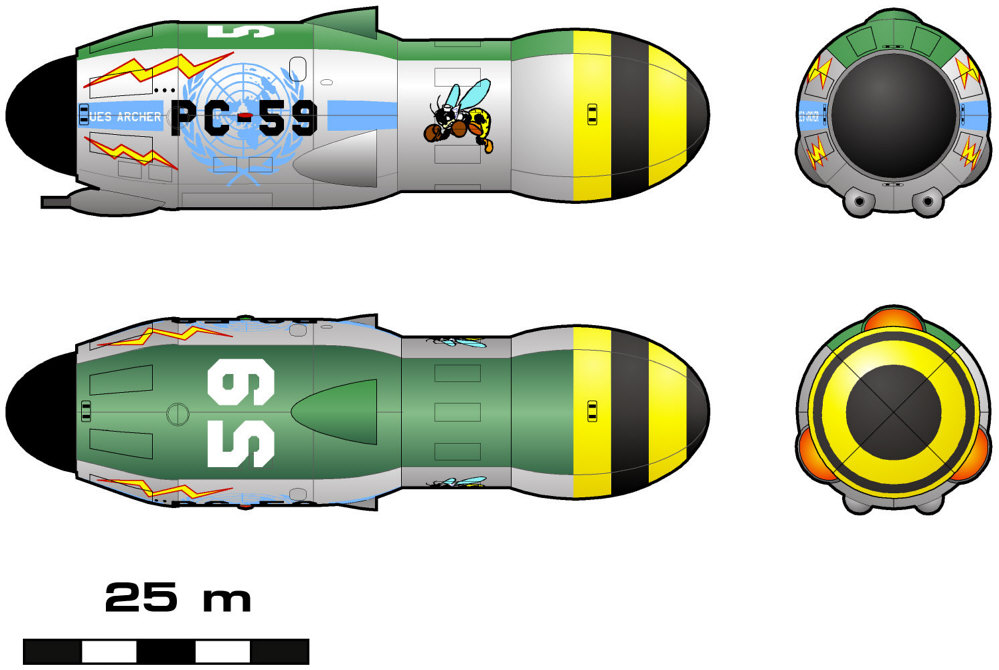
- Regarding the Guderians, Tals, and Mantas: I see one DD issue focused on space tanks, rather than one issue for each of the five models. Timo did not devote much information to the original three classes and since the latter two were not that historical either, that would seem to be the way to go. The Guderians and Tals were similar in specs and contemporaneous—maybe with slightly different missions—while the Mantas were 25 years more evolved. I'm envisioning the Clarks as the first to leave the Sol system, as their deployment (not the Mantas) is what sparked the diplomatic tension with the Vulcans. The Bradley class, of course, has its own war history.
- It seems reasonable the Clarks were retained post-war by the Earth Fleet or the government of Vega, never entering service with the UFP Star Fleet.